Lesson 23: Hypoxic Pulmonary Vasoconstriction
Lesson 23
Hypoxic Pulmonary Vasoconstriction (HPV)
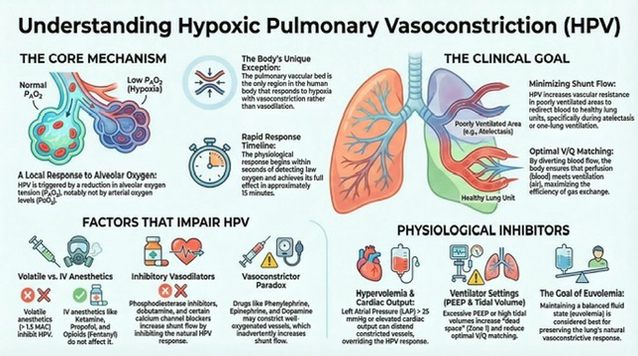
Definition: Local reaction to reduced alveolar oxygen tension (not arterial PO2).
Purpose:
Improve ventilation-perfusion matching.
Minimize shunt flow during atelectasis or one-lung ventilation.
Unique Feature: Only region in the body responding to hypoxia with vasoconstriction (pulmonary vascular bed).
Response Time: Begins in seconds, full effect in approximately 15 minutes.
Factors Affecting HPV
Drugs that Inhibit HPV:
Volatile anesthetics > 1.5 MAC
Phosphodiesterase inhibitors
Dobutamine
Vasodilators
Hypervolemia
Excessive PEEP or large tidal volumes
Drugs Not Affecting HPV:
IV anesthetics (ketamine, propofol, opioids) do not increase shunt flow.
Altered Physiology Conditions:
Hypervolemia (LAP > 25 mmHg) may increase shunt flow due to distention of constricted vessels.
Hypovolemia may cause constriction in well-ventilated units; euvolemia is optimal.
Excessive PEEP increases dead space and reduces V/Q matching optimal conditions.