Formation of the Earth
Composition of the Earth
In whole Earth:
Iron 35%
Oxygen 30%
Silicon 15%
In Earth’s crust:
Oxygen 46%
Silicon 28%
Aluminium 8%
as we get away from the core of the plane, we get lighter, less dense
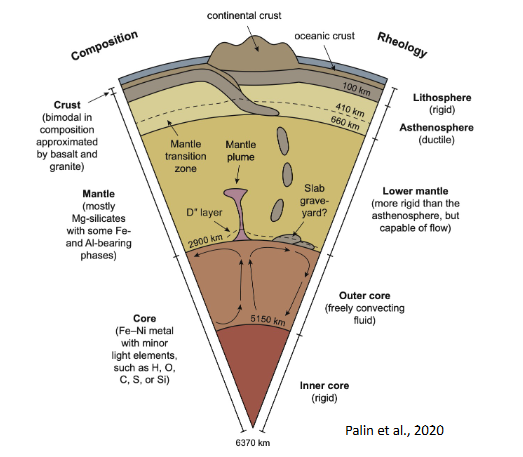
Partial Melting: Earth differentiated into 3 layers (chemically and physically different)
core (inner and outer) - metallic
mantle - rocky + intermediate density
crust - rocky + low density (oceanic and continental)
Before, Earth was mostly rocks - 2/3, just a smidge of fresh water, rocks are made of minerals are made of atoms
Silicate Minerals (Dominant rock)
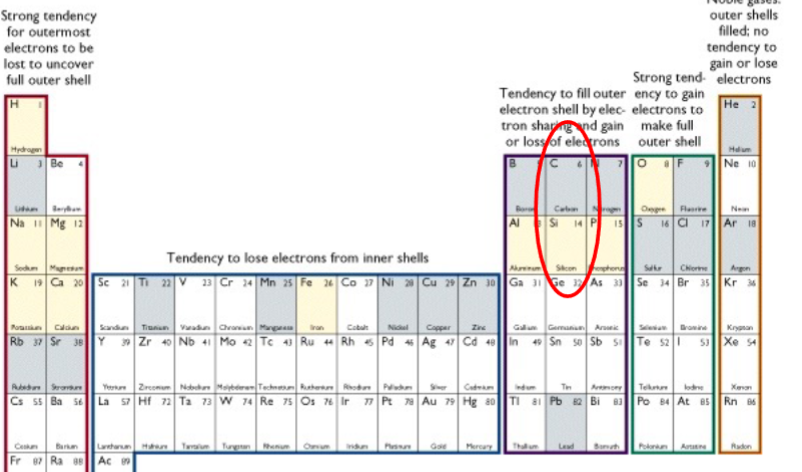
Formed primarily from silicon and oxygen
make up most rocks
very strong covalent bonds (material strength, difficult to weather)
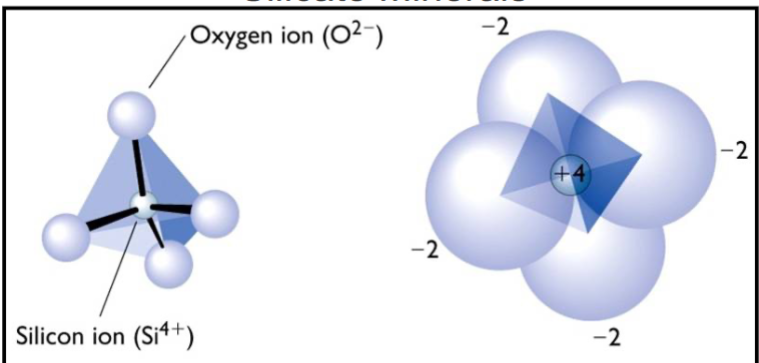
Chains of silicon (polymers linked together, share electrons)
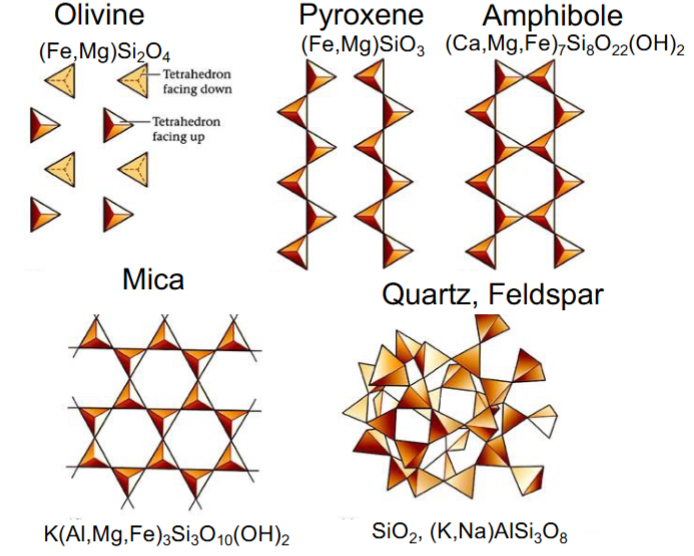
Silicates Structures Type: (most are minerals but not all silicates are)
Isolated silicate tetrahedra
simplest silicate structure
lots of metal cations (dense)
weaker bonds
Ex: Olivine
Chain Silicates: that make long rod-like minerals
single chain - proxegene
double chain - amphibole
Sheet Silicates
include micas and many clays
Ex: mica
Framework Silicates
3D lattice works of linked silica ions
include quartz and feldspars
Non-Silicate Minerals:
Carbonates: Composed primarily of carbonate ions, including minerals like calcite and dolomite.
1/5 of world’s sedimentary rocks
Oxides: Containing metal ions bonded to oxygen, such as hematite and magnetite.
Major ores (economically extracted)
Sulfates: Characterized by the presence of sulfate ions, such as gypsum and barite.
Major ores
unique mechanical and physical properties, important class of minerals
Why are minerals important?
Ex: mineral calcite, CaCO3 = stores most of Earth’s CO2
Chemical Weathering: Hydrolysis
Hydrolysis is a type of chemical weathering where minerals react with water, causing them to break down and form new minerals (often clays) and dissolved ions.
weak acids strip cations out of minerals
theses reactions reacquire water to be present as liquid or vapor
This process is essential in soil formation as it contributes to nutrient availability and influences the overall mineral composition of the soil.
Ex: dissolved calcium and bicarbonate combines to produce calcite - a solid mineral.
Calcite:
Both of Earth and Venus have similar concentration of carbon and oxygen, but their atmospheres and surfaces are very different, so the amount of CO2 in Earth’s can be partly explained by calcites, CaCO3, in the rock limestone. While Venus, has it still in its atmosphere and not stored in rocks like Earth.
Where is Earth’s Limestone? Insediment continents deposited in shallow seas
Cooling of Earth after Accretion and formation of a crust:
An initially hot planet (after accretion) cools by losing heat to space. Rock is a good insulator, so the interior stays hot longer. Additional heat is produced by radioactive decay. Convection transfers the heat toward the surface.
Mantle Plumes = narrow zones of anomalously hot, upwelling mantle. When they breach the lithosphere, they form flood basalts, followed by a volcanic chain.
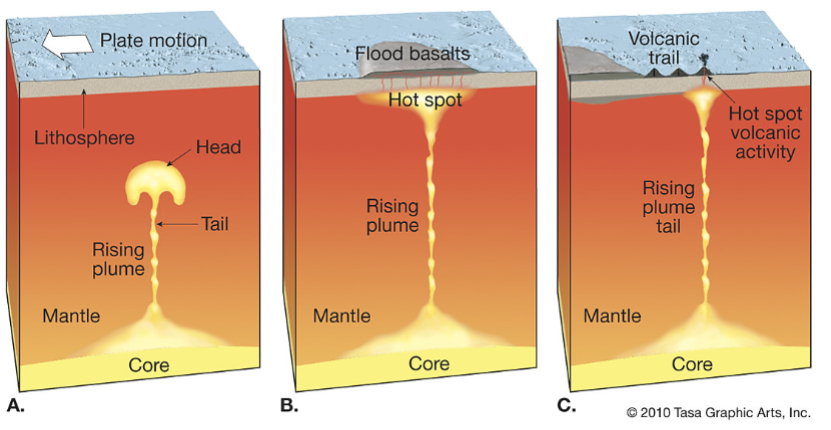
Hot Spots = locations where mantle plumes rise to the surface, leading to volcanic activity and creating islands such as Hawaii (classic hot spot).
as plates pass over hot spots, they create volcanic chains
Creates Seamounts: Underwater mountains
age away from orginated hot spot
age change marks direction of overriding plate motion
On Earth, we also lose heat, due to plates moving, we also have 2 different types of crust with different compositions because of that, continents and ocean basins
Ocean crust:
Plates that move and create space and melted, now creates new ocean crust, so we can assume that the youngest part of the Earth is the center
With a new ocean crust, we shove the old crust in the mantel, wich can’t go more than halfway because the core mantle limits it
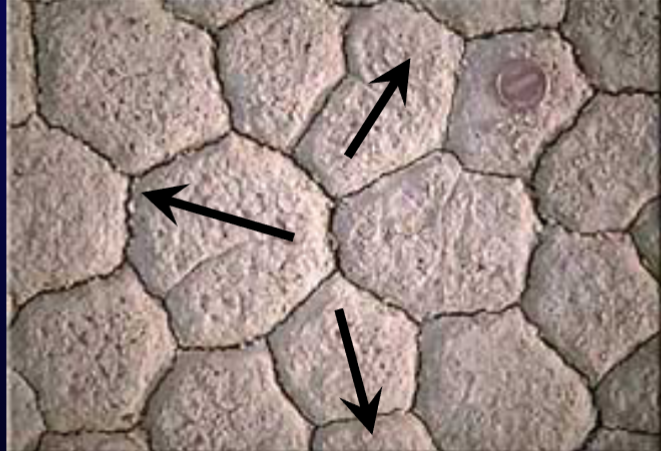
2CM A YEAR APPROXIMATE MOVEMENT OF PLATES
Plate Boundaries:
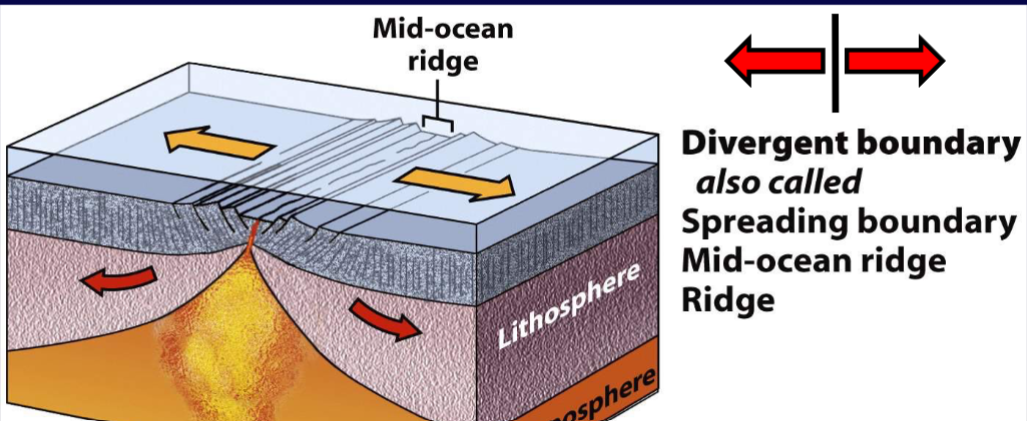
Divergent - tectonic plates move apart, allowing magma to rise and form a new crust as it cools and solidifies.
Divergent boundary also called Spreading boundary (mid-ocean ridge)
Sea-floor spreading progression
Triple junctions = places where 3 different plates come together to diverge.
Ex: Mudracks
Early stage:
rifting professed to mid-ocean ridge formation
before substantial widening of the ocean
forms along and thin ocean basing with young ocean crust
Ex: The red sea
Convergent - tectonic plates move together (litospheric plates)
Convergent boundary also called Convergent margin Subduction zone Consuming boundary trench
This is where one plate is forced down into the mantle beneath another plate.
One plate dives back into the mantle (subduction)
Subduction recycles oceanic litosphere
Subduction is balanced by the sea-floor spreading (replaced by that)
Earth maintains a constant circumference
many subduction zones are ocean trenches - deepest one is the Marianas Trench
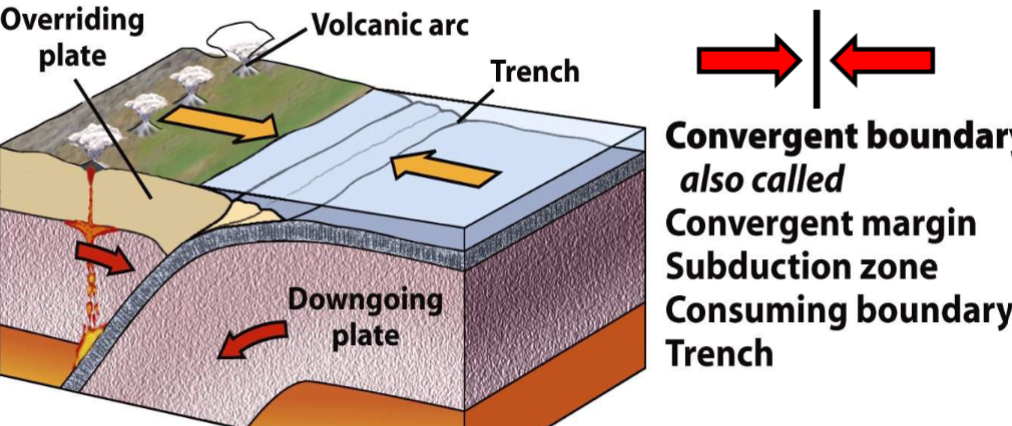
Subduction plate descent is revealed as earthquakes deepen away from the trench (quakes cease below 660km).
Subducted slap, releases water, causing the mantle above to partially melt (magma). The magma will rise to the surface and form volcanic chains or arcs, like the Andes
Igneous rocks: formed from cooling and solidification of molten rock (magma or lava) = basalt - from the mantle and granite - from the continental crust (remelting by subduction of basaltic rocks).
PLATE COLLISION
SUBDUCTION CONSUMES OCEAN BASINS
OCEAN CLOSURE ENDS IN CONTINENTAL COLLISION
Pangea - times of the dinosaurs - most recent supercontinent BUT NOW all subduction zones are gone (made atlantic ocean as we know it)
LIGHT CONTINENTAL CRUST WILL NOT SUBSTRUCT AND WILL EVENTUALLY MAKE MOUNTAINS (CRUST THICKENS) like the Himalayas
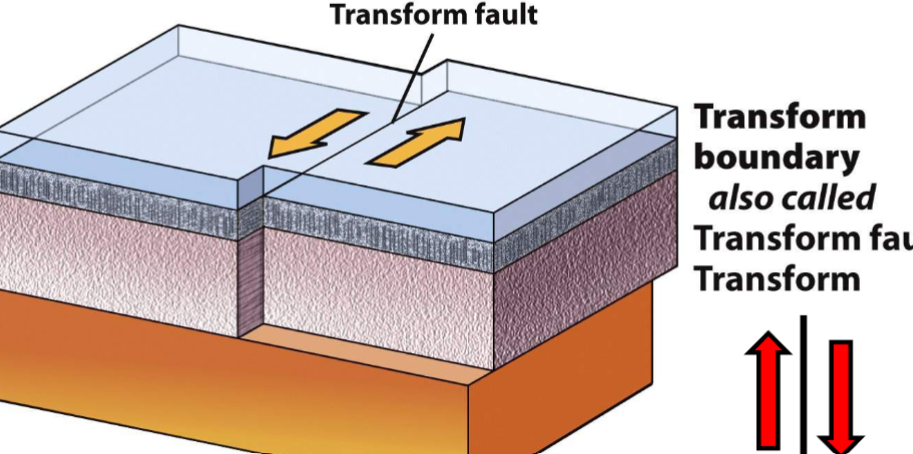
Transform - tectonic plates slide sideways
Transform boundary also called Transform fault
This is where two tectonic plates grind past each other horizontally, leading to seismic activity and faulting.
Mid-Ocean Ridges:
Linear mountain ranges in Earth’s ocean basins
Where Black Smokers are found
water entering fractured rock is heated by magma
hot water dissolves mineral and cycles back out of the rock
when water reaches the sea, minerals precipitate quickly
get their energy from exploiting oxidative chemicals around them
animal eat the organic chemicals they create and get their energy form the earth
Summary:
The water in hydrothermal vents comes from under the oceanic lithosphere, deep beneath the ocean floor, where it is heated by magma or hot mantle material.
This water, rich in dissolved minerals, rises through the cracks and fissures in the oceanic crust, eventually emerging at the ocean floor through the hydrothermal vents.
As the hot water interacts with the cold seawater, it rapidly cools, and the minerals precipitate out, creating the plumes or "smoke" seen around black smokers.
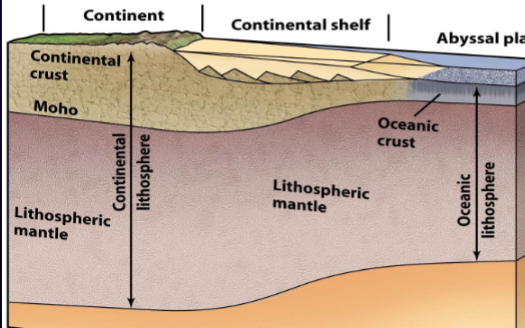
Continental Margins: Edges
Where land meets the ocean
Margin near plate boundaries are ‘active’
Margin far from plate boundaries are ‘passive’
Continental crust thins seaward
Transitions into ocean crust
Traps eroded sediment
Develops into the continental shelf
Final Summary:
The Earth is composed of a layered structure (core, mantle, and crust) that differentiates by density.
Minerals, especially silicates, make up most of Earth’s rocks and are the building blocks of the planet’s structure.
Processes like chemical weathering and hydrolysis help break down minerals and form soil, contributing to the carbon cycle.
Earth’s surface is constantly reshaped by plate tectonics, which form land features like mountains, ocean basins, and volcanoes.
The interaction between plates at divergent, convergent, and transform boundaries drives many geological processes and changes the surface over time.
These processes are essential for understanding Earth’s past and predicting its future dynamics.