Chapter 8: Democratic Transitions: Bottom-Up Mobilization and Top-Down Strategic Bargaining
Global Waves of Democratic Transitions (1946–2020)
Regime Trajectories over Time (1946–2020):
Across the post–World War II era, the total number of independent countries in the international system grew dramatically, driven heavily by post-war reconfigurations and global decolonization.
Between the late 1940s and the early 1970s, the growth in the total number of dictatorships outpaced that of democracies, peaking in the 1970s.
The year 1974 marked a major structural turning point, initiating the "Third Wave" of democracy. Following this juncture, the number of dictatorships experienced a steep secular decline, while the number of democracies increased substantially, eventually surpassing dictatorships in the early 1990s.
Regime classifications are coded utilizing the Democracy-Dictatorship (DD) index, where a regime is classified as a democracy if it satisfies specific procedural electoral criteria; otherwise, it is coded as a dictatorship.

Huntington’s Three Waves of Democracy:
First Wave (1828–1926): Rooted in the American and French Revolutions and continuing through World War I, marking the emergence of early mass democracies.
Second Wave (1943–1962): Emerged during and after World War II with the restoration and establishment of democratic institutions in countries including Italy, West Germany, Japan, and Austria.
Third Wave (1974–present): Commenced with the Carnation Revolution in Portugal (1974) and spread through Southern Europe (Greece, Spain), Latin America, parts of Africa, and Eastern Europe.
Taxonomy of Democratic Transitions:
Bottom-Up Transition: A transition in which the general populace rises up to overthrow an authoritarian regime through popular mobilization, collective action, and revolution.
Top-Down Transition: A transition in which the dictatorial ruling elite introduces liberalizing reforms that inadvertently or strategically lead to a full democratic opening.
Bottom-Up Transitions: Empirical Cases and the Revolutionary Puzzle
The Case of East Germany (1989):
In 1989, escalating mass protests forced the communist regime of the German Democratic Republic (GDR) to open the Berlin Wall and permit multi-party competitive elections, culminating in German reunification.
From a modern retrospective vantage point, the collapse of Eastern European communism is often viewed as inevitable; however, at the time, it came as a complete surprise to analysts, intelligence agencies, and citizens alike. The East German state had appeared exceptionally stable, deeply entrenched, and effectively policed.


Catalysts in the Soviet Sphere (1985–1989):
Mikhail Gorbachev (1985) introduced fundamental domestic reform doctrines aimed at revitalizing a deteriorating system:
Perestroika (economic restructuring): Targeted liberalization and modernization of the Soviet command economy.
Glasnost (openness): Targeted institutional transparency and expanded freedom of public expression.
Regional Spillovers in 1989:
Poland: The independent trade union Solidarity engaged in the historic Roundtable Talks with the ruling communist party, paving the way for semi-free elections.
Hungary: The communist government initiated political liberalization and dismantled its physical border fortifications with Austria, opening an escape corridor to the West for East Germans.
East Germany: Citizens mobilized through opposition groups such as Neues Forum (New Forum), shifting their public chants from "Wir bleiben hier" ("We are staying here") to "Wir sind das Volk" ("We are the people").
Global Examples of Bottom-Up Mobilization:
People Power Revolution in the Philippines ().
June Resistance in South Korea ().
Velvet Revolution in Czechoslovakia ().
Orange Revolution in Ukraine ().
Jasmine Revolution in Tunisia ().
Repression vs. Transition: Tiananmen Square, China (June 1989):
Bottom-up mobilizations do not universally culminate in democratic transition; authoritarian regimes may choose direct violent suppression.
In June 1989, massive pro-democracy demonstrations centered in Beijing's Tiananmen Square were violently crushed by the Chinese military.
Authoritarian information control can effectively erase public historical memory: in an experimental evaluation in , only out of surveyed students at Beijing University were able to recognize the iconic photograph of the "Tank Man" confronting military hardware.

Core Theoretical Questions:
Why are popular revolutions so historically rare and notoriously difficult to forecast?
Why do authoritarian regimes seem extraordinarily stable beforehand, yet appear utterly fragile and brittle in hindsight?
Collective Action Theory and the Free-Rider Problem
Fundamentals of Collective Action:
Collective Action: The pursuit of a shared goal or common objective by a group of individuals.
The objective of collective political mobilization is typically a public good, defined by two non-negotiable economic characteristics:
Nonexcludability: No individual can be effectively excluded from consuming or benefiting from the good once it is provided, regardless of whether they contributed to its provision.
Nonrivalry: One individual's consumption of the good does not reduce the quantity or quality available for consumption by others.
Examples of public goods include lighthouses, fire stations, national parks, and democratic institutions/civil liberties.
The Collective Action (Free-Rider) Problem:
Because public goods are nonexcludable, individual group members face severe disincentives to absorb private costs to supply the good, choosing instead to "free-ride" on the efforts of others.
This creates a core paradox: even when all individuals in a group desire an outcome, rational self-interest frequently results in the underprovision or non-provision of the public good.
Formal Model of Collective Protest Participation:
Consider a group containing potential individuals.
Provision of the public good requires that at least individuals actively contribute or participate ().
If at least individuals participate, the public good is provided, yielding a benefit to every single member of the group of size .
Each individual who chooses to participate pays a private cost .
Standard assumption: (the benefit of achieving democracy exceeds the cost of participating), which implies .
Successful collective action is more likely when C goes down.
Successful collective action is more likely when B goes up.

Strategic Scenarios for the Individual Decision-Maker:
Scenario 1 (Fewer than others participate):
If the individual participates: Total turnout remains below . The protest fails; the individual incurs cost and gains nothing, yielding payoff .
If the individual does not participate: Payoff is .
Best Response: Do not participate (). Individual participation is non-pivotal and futile.
Scenario 2 (Exactly others participate):
If the individual participates: Turnout reaches exactly . The protest succeeds, yielding payoff .
If the individual does not participate: Turnout stays at . The protest fails, yielding payoff .
Best Response: Participate (). The individual is strictly pivotal to the success of the collective action.
Scenario 3 ( or more others participate):
If the individual participates: The protest succeeds regardless, yielding payoff .
If the individual does not participate: The protest succeeds via the efforts of others, yielding payoff .
Best Response: Do not participate (). The individual successfully free-rides.
Determinants of Successful Collective Action:
Cost-Benefit Ratio ( and ): Collective action is more likely to succeed when participation costs decrease, or when perceived benefits increase.
Difference between and :
When , every single member of the group must participate for success to occur; under this condition, no free-riding is possible because every member is pivotal.
When , incentives to free-ride emerge. As the gap between and expands, individual pivotality drops, strengthening free-rider incentives.
Group Size ():
In larger groups, an individual is exceedingly unlikely to believe their participation is pivotal to reaching threshold .
Larger groups encounter severe monitoring and sanctioning deficits: identifying, tracking, and socially punishing free-riders is difficult.
Consequently, smaller groups are frequently more politically efficacious than larger groups, counteracting naive assumptions that majorities organize effortlessly.
Application to Dictatorships: Explains why communist regimes in Eastern Europe remained stable for decades despite widespread private dissatisfaction; shared anti-regime preferences do not automatically translate into coordinated public resistance.
Preference Falsification and Revolutionary Tipping Models
The Mechanics of Preference Falsification:
Under authoritarian rule, criticizing or resisting the regime carries severe personal costs (imprisonment, loss of employment, violence).
Preference Falsification: The deliberate public misrepresentation of one's private political preferences to avoid punishment.
Individuals hold two divergent stances: an unobservable private preference and an observable public preference.
Revolutionary Thresholds:
As the aggregate size of an anti-government protest grows, the capacity of the dictatorship to monitor, target, and punish individual participants declines (safety in numbers).
Revolutionary Threshold: The minimum proportion or absolute size of a protest that must materialize before a specific individual is willing to reveal their private opposition and publicly participate.
Thresholds vary across society due to divergent risk tolerances, moral commitments, and ideological beliefs:
Low-threshold individuals (e.g., ): Radicals, dissidents, or moral crusaders willing to protest alone regardless of turnout.
Moderate-threshold individuals: Citizens willing to join only once crowds provide sufficient collective protection.
High-threshold individuals (e.g., ): Regime beneficiaries, staunch loyalists, or extremely risk-averse citizens who will not protest under almost any conditions.
Threshold Distributions and Cascades in a 10-Person Society:
Case 1: Equilibrium Failure (Society A):
Distribution:
Process: The individual with threshold protests. At protest size , there is no individual with a threshold of ; the individuals with threshold refuse to join. The mobilization stalls at person.
Case 2: Revolutionary Cascade (Society A'):
Suppose one individual's threshold shifts from to due to shifting private sentiment:
Distribution:
Process: Individual protests (protest size ). This triggers individual (protest size ), which activates individual (protest size ), sequentially triggering individuals and .
Result: A nine-person revolt occurs. A single marginal change of one unit in a single actor's threshold generates a complete systemic cascade.
Case 3: Abortive Cascade (Societies B and B'):
Distribution:
If one individual's threshold shifts from to :
Process: Individual triggers individual (protest size ). Because there is no individual with threshold , the process terminates.
Result: A two-person protest that collapses, demonstrating that identical individual shifts yield vastly divergent political outcomes depending on the overall societal distribution.
The "Predictability of Unpredictability" (Timur Kuran):
Because preference falsification obscures individuals' true revolutionary thresholds, the underlying threshold distribution in a society is entirely unobservable to rulers, external analysts, and citizens alike.
A society can sit immediately adjacent to a revolutionary tipping point without any observer detecting the latent instability.
Broad structural factors (economic deterioration, regime illegitimacy) lower thresholds across the board, making cascades statistically more plausible, but cannot predict the exact timing or occurrence of a cascade.
Structural Catalysts and Diffusion in Eastern Europe (1989):
Threshold Reductions: Gorbachev's leadership, systemic economic insolvency, and explicit Soviet guarantees that the Red Army would not intervene militarily to preserve satellite regimes uniformly depressed thresholds across the Eastern bloc.
Demonstration Effects / Cross-National Diffusion: Successful transitions in pioneering countries demonstrated the feasibility of change, triggering revolutionary cascades across international borders rather than merely within domestic populations.
The Acceleration Timeline: "Poland – 10 years, Hungary – 10 months, East Germany – 10 weeks, Czechoslovakia – 10 days."
Two-Way Preference Falsification and the Illusion of Inevitability:
In hindsight, revolutions invariably appear overdetermined and historically inevitable because post-revolutionary testimonies reveal universal anti-regime sentiment.
However, preference falsification operates symmetrically: once a pro-democracy cascade becomes dominant, former regime supporters and fence-sitters publicly falsify their loyalties in reverse, asserting that they secretly opposed the dictatorship all along to shield themselves from post-transition marginalization.
Top-Down Transitions and the Complete Information Transition Game
Elite Fractures and Liberalization Policies:
Top-down transitions originate from strategic divisions within the authoritarian elite, typically spurred by macroeconomic crises or mounting public instability:
Hard-liners: Factions committed to maintaining the autocratic status quo and uncompromising repression.
Soft-liners: Factions seeking to broaden the social base of the dictatorship through limited, controlled liberalization.
Liberalization Policy: A managed political opening that may encompass legalizing political parties, conducting semi-competitive elections, instituting legislative bodies, or establishing an independent judiciary, aimed at stabilizing elite control rather than yielding power.
The Strategic Setup of the Transition Game:
Players: Soft-liners and Democratic Opposition.
Sequence of Moves:
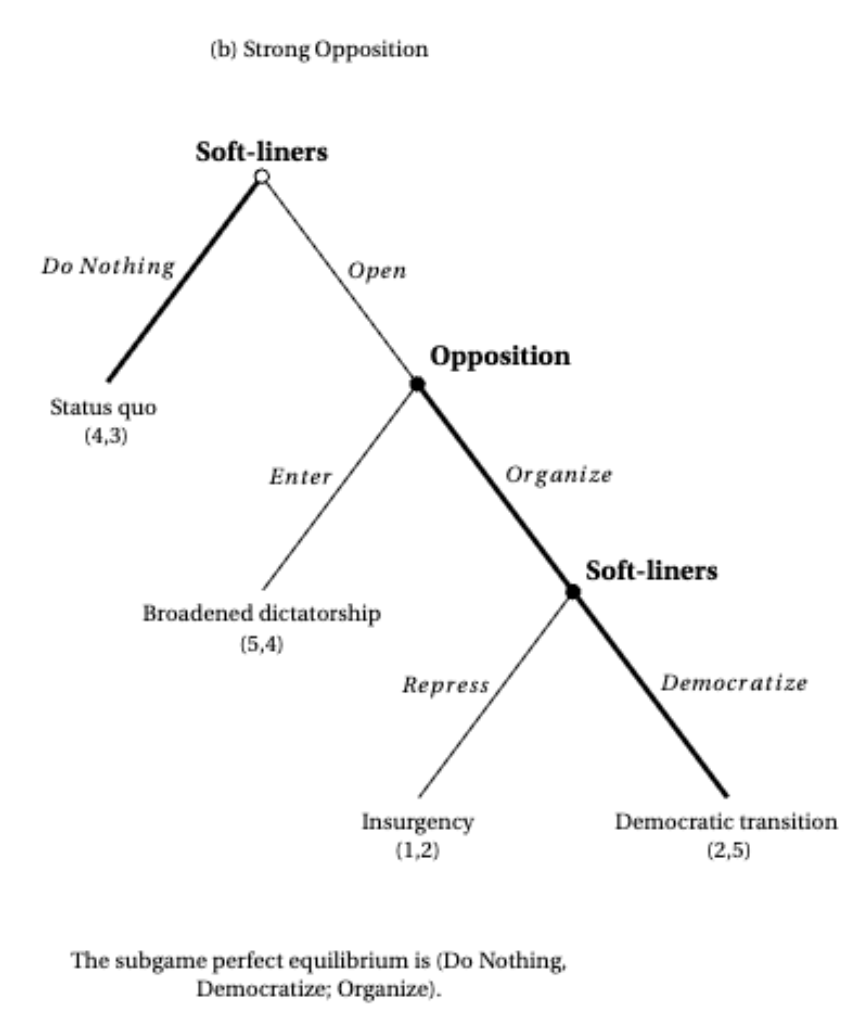
Soft-liners decide whether to Do Nothing or Open (liberalize).
If Soft-liners choose Open, Opposition decides whether to Enter the broadened authoritarian framework or Organize mass resistance.
If Opposition chooses Organize, Soft-liners must choose whether to Repress or Democratize.

Outcomes and Payoffs:
There are five distinct terminal outcomes, ranked ordinally from (most preferred) to (least preferred):
: Status Quo: Soft-liners do nothing. Payoffs: Soft-liners , Opposition .
: Broadened Dictatorship: Soft-liners open; Opposition co-opts and enters the institutional structure. Payoffs: Soft-liners , Opposition .
: Narrow Dictatorship: Soft-liners open, Opposition organizes, Soft-liners successfully repress a weak opposition. Payoffs: Soft-liners , Opposition .
: Insurgency: Soft-liners open, Opposition organizes, Soft-liners attempt to repress a strong opposition, resulting in violent civil conflict. Payoffs: Soft-liners , Opposition .
: Democratic Transition: Soft-liners open, Opposition organizes, Soft-liners capitulate and democratize. Payoffs: Soft-liners , Opposition .

Subgame Perfect Equilibrium (SPE) under Weak Opposition:
Terminal node (Soft-liners): Soft-liners compare Repress (payoff ) vs. Democratize (payoff ). Soft-liners choose Repress.
Intermediate node (Opposition): Opposition anticipates repression. Compares Enter (payoff ) vs. Organize (leading to Repress, yielding payoff ). Opposition chooses Enter.
Root node (Soft-liners): Compares Do Nothing (payoff ) vs. Open (leading to Enter, yielding payoff ). Soft-liners choose Open.
SPE:
(Open, Repress; Enter).Outcome: Broadened Dictatorship (payoffs: ).
if the opposition is weak, we have a broadened dictatorship

Subgame Perfect Equilibrium (SPE) under Strong Opposition:
Terminal node (Soft-liners): Soft-liners compare Repress (payoff , Insurgency) vs. Democratize (payoff , Transition). Soft-liners choose Democratize.
Intermediate node (Opposition): Opposition anticipates democratization. Compares Enter (payoff ) vs. Organize (leading to Democratize, yielding payoff ). Opposition chooses Organize.
Root node (Soft-liners): Compares Do Nothing (payoff ) vs. Open (leading to Democratize, yielding payoff ). Soft-liners choose Do Nothing.
SPE:
(Do Nothing, Democratize; Organize).Outcome: Status Quo (payoffs: ).
if the opposition is strong, we have the status quo.
Fundamental Theoretical Finding under Complete Information:
A complete information game is one where every actor possesses full knowledge regarding all players, strategies, and payoffs.
In a complete information environment, a transition to democracy is impossible:
If the opposition is weak, the regime successfully transitions to a broadened dictatorship.
If the opposition is strong, the regime anticipates democratization, refuses to open, and preserves the autocratic status quo.
Incomplete Information, Miscalculation, and Top-Down Democratization
Incomplete information will appear on midterm 3
The Necessity of Informational Asymmetry:
Because complete information precludes democratic transitions, top-down transitions to democracy can occur only when actors operate under incomplete information and commit strategic errors.
Specifically, democratization occurs when authoritarian soft-liners mistakenly believe the democratic opposition is weak, open the political system, and discover too late that the opposition is sufficiently strong to organize and compel a transition.
The Incomplete Information Transition Game:
An incomplete information game arises when a player lacks complete information concerning the payoffs or characteristics of other players.
An artificial player, Nature, initializes the game by choosing the type of opposition:
Opposition is Weak with probability .
Opposition is Strong with probability .
Soft-liners cannot observe Nature's choice; their initial choice node
s reside within an unobservable information set (represented by a dashed line connecting the nodes across the two sub-branches).

Expected Payoff Calculus for the Soft-Liners:
If Soft-liners choose Do Nothing:
They obtain a payoff of regardless of whether the opposition is weak or strong.
If Soft-liners choose Open:
If the opposition is weak (probability ), the weak opposition chooses Enter, yielding Soft-liners a payoff of .
If the opposition is strong (probability ), the strong opposition chooses Organize, prompting Soft-liners to Democratize, yielding Soft-liners a payoff of .
The Threshold for Authoritarian Liberalization:
Soft-liners choose to Open if and only if:
Substantive conclusion: Soft-liners will initiate liberalization reforms only when they are sufficiently confident (, or approximately greater than probability) that the opposition is weak.
Historical Validation: Poland (1989):
Facing economic decline, Polish communist leaders initiated liberalization and entered the 1989 Roundtable Talks with the outlawed union Solidarity.
The regime anticipated that Solidarity was weak and fractured, intending to co-opt the opposition into an electoral framework designed to grant the communists democratic legitimacy while retaining their monopoly on executive power.
The soft-liners miscalculated: Solidarity possessed enormous latent organizational strength, swept the competitive legislative seats, mobilized public support, and formed a government, appointing the first non-communist prime minister in the Eastern bloc in forty years.
Broader Substantive Implications:
Strategic Deception: Because opening depends directly on the belief that , a strong opposition has intense strategic incentives to mask its true capabilities, appearing weak and pliant until the autocracy commits to liberalization.
Institutionalization under Dictatorship: Authoritarian regimes institutionalize (create nominal legislatures, legal parties, and formal courts) strictly when soft-liners believe the opposition has moderate strength and can be safely managed.
Suboptimal Repression: Countless citizens under autocratic regimes live under far harsher repression than either the population or the ruling elites would ideally prefer, simply because elites fear that opening up would trigger an uncontrollable transition.