1.2 - Measurement of g by freefall
Definition of free fall:
free fall is any motion of a body where gravity is the only force acting upon it.
Theory:
An equation of motion can be used to calculate the acceleration due to gravity, g.
s = ut + ½at2
Where:
u = initial velocity = 0
s = height, h
and a = acceleration due to gravity, g
This gives h = ½gt2
If a graph of height, h, (y-axis) is plotted against time squared, t2 , (x-axis) the gradient will equal g/2, or g = 2 × gradient
Apparatus/Diagram:
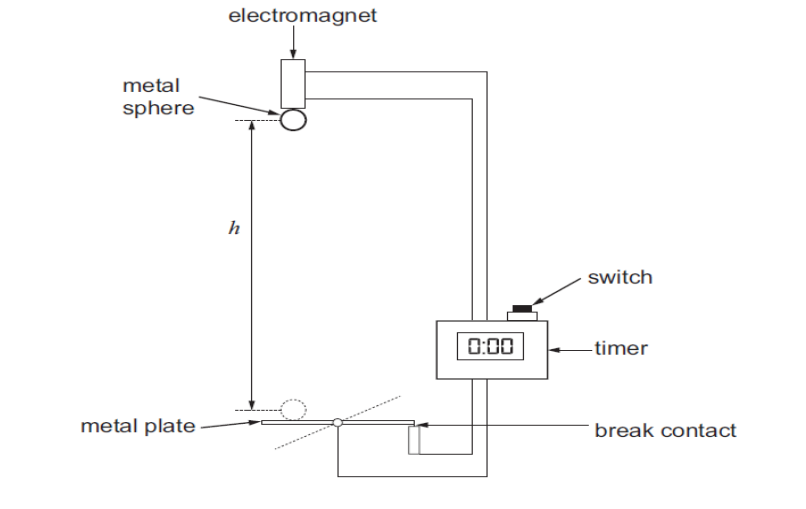
Experimental Method:
When the switch is pressed it disconnects the electromagnet releasing the metal sphere. At the same instant, the timer starts. When the sphere hits the magnetic switch it breaks the circuit stopping the timer, thus recording the time it takes for the sphere to fall through a height, h. The time taken for the ball bearing to fall through a range of different heights needs to be measured. Plot a graph of height, h, (y-axis) against time squared, t 2 , (x-axis) and calculate the value of g using: g = 2 × gradient.