Lecture 8: Earthquakes
Earthquakes
a vibration caused by the sudden breaking or frictional sliding of rock in the earth
causes of earthquakes
magma intrusions
tectonics
landslides
underground nuclear testing
seismic wave generation
Faults
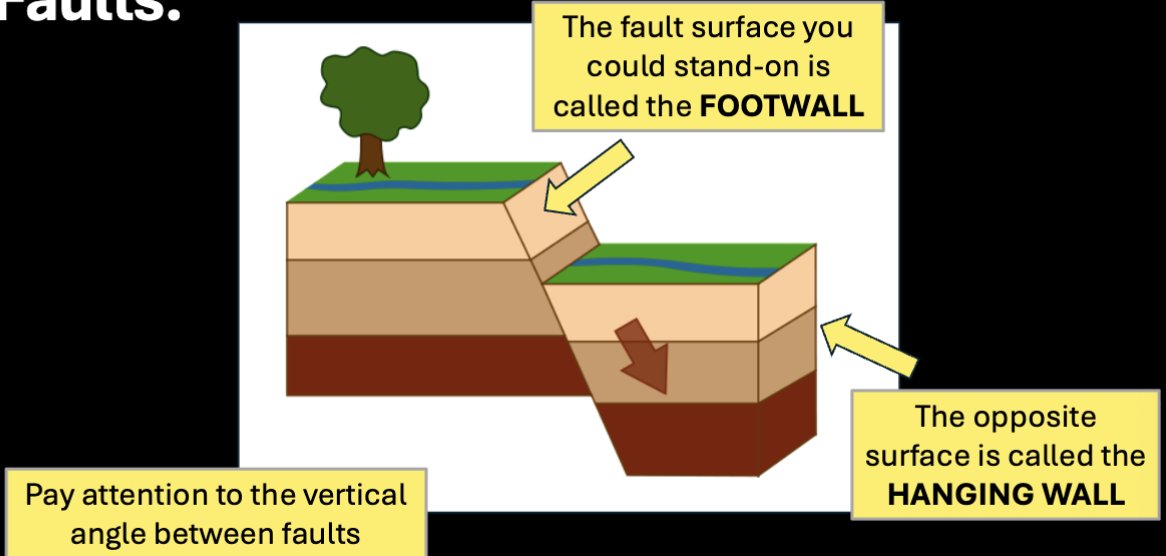
Faults - fractures on which one body of rock slides past another

3 types of faults
normal fault
extension in the crust causes the hanging wall to drop relative to the footwall

reverse fault
convergence in the crust causes the hanging wall moves up relative to the footwall

strike-slip fault
one block slides past another with no vertical displacement
the fault is vertical, the movement is not

Plate boundaries
convergent boundaries can create multiple types of earthquakes, ranging from shallow to deep
intraplate earthquakes
some earthquakes don’t occur on a tectonic plate boundary, but in the middle of a tectonic plate
a series of earthquakes in 1811-1812 near new madrid, missouri temporarily reversed the flow of the mississippi river

normal faults
blocks pulling apart
divergent boundaries
reverse faults
blocks pushing together
convergent boundaries
strike-slip faults
blocks sliding past each other
transform boundaries
Faults causing earthquakes
think of earth’s surface as composed of layers of rock that behave like a stick
as we apply force (stress) to the stick, it bends because it has some flexibility
as stress keeps applying, the stick suddenly breaks and releases a lot of energy
this causes an offset (fault) in the rocks and releases seismic waves

after the stick breaks, the two pieces straighten out and are at new angles
Locating earthquakes
focus - where fault slip begins belowground
epicenter - the point on earth’s surface directly above the focus

note the curved nature of the fault
the offset at the ground surface is far away from the focus/epicenter

with ONE seismic station, we can tell the distance to the earthquake, but not the direction
with a second one, we can narrow the epicenter down to TWO possible locations
with THREE seismic stations, we can find the exact location of an epicenter (triangulation)
Measuring earthquake size
there are two main ways to measure the size of earthquakes: their initial intensity and their magnitude
both of these measurements allow us to compare the relative size of earthquakes
Earthquake intensity -how much the ground is shaking based on people’s perceptions and the degree of damage caused by earthquakes
giuseppe Mercalli developed the scale for earthquake intensity
the modern Modified Mercalli Scale assigns a number to earthquakes based on subjective observations

mercalli scale numbers will vary based on distance from the epicenter
the mercalli scale allows us to asses earthquakes from historical records, before seismographs existed
Earthquake Magnitude - represents the amount of energy released by an earthquake
it uses the amplitude of seismic waves
if you know the amplitude and distance from and earthquake, you can calculate the magnitude using a simple chart
the richter scale
a logarithmic scale, an increase of 1 on the richter scale indicates a tenfold increase in magnitude

when will the next “big one” happen?
seismologists can study how frequently past earthquakes have occurred and their recurrence interval to assess long-term seismic hazards
short-term earthquake likelihood is much harder to predict
early warning systems (after an earthquake happens, but before the waves fully spread) may save lives and infrastructure