Urinary Catheter Insertion
Urinary catheters are used in many clinical situations for clients who are unable to void or need constant monitoring of fluid status. Urinary catheterization requires a provider's prescription. Most urinary catheterizations are temporary because of the increased risk of adverse events with prolonged catheterization.
Equipment
Urinary catheters come in several varieties, including straight catheters, indwelling catheters, urinary retention (multiple-lumen) catheters, coudé catheters, and condom catheters. Straight, indwelling, retention, coudé, and suprapubic catheters all involve a narrow tube that provides a passageway for urine from the bladder to a collection bag outside the body.
urinary retention
coudé catheter
Straight catheters are for one-time use and are removed immediately after the insertion and drainage of urine.
Indwelling catheters are used short term and provide a closed drainage system for urine.
Retention catheters are most commonly used postoperatively because they have multiple lumens to allow for the drainage of urine, irrigation of the bladder, and instillation of medications into the bladder.
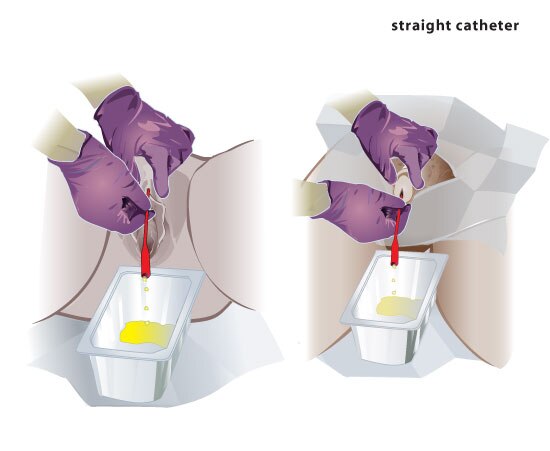
straight catheter
Coudé catheters are used for clients who have prostatic hyperplasia. This type of catheter has a curved tip to allow for easier insertion.
Suprapubic catheters are similar to indwelling catheters except they are placed through a surgical opening in the abdomen rather than through the urethra.
Condom catheters have a latex or silicone sheath to place over the penis.
Catheters come in many different sizes and materials (latex, silicone). A client's size, age, pathology, and potential allergies to materials are all considerations when selecting a catheter. Indwelling, retention, coudé, and suprapubic catheters have a small balloon at their tips to keep them in place. Balloon and catheter sizes also vary and are chosen based on the client's age and size and the clinical indications for catheterization. Always use sterile saline to inflate catheter balloons. Whether the balloon inflation should be pretested varies with the manufacturer's recommendations. Evidence suggests that testing the balloon may lead to integrity compromise and failure.
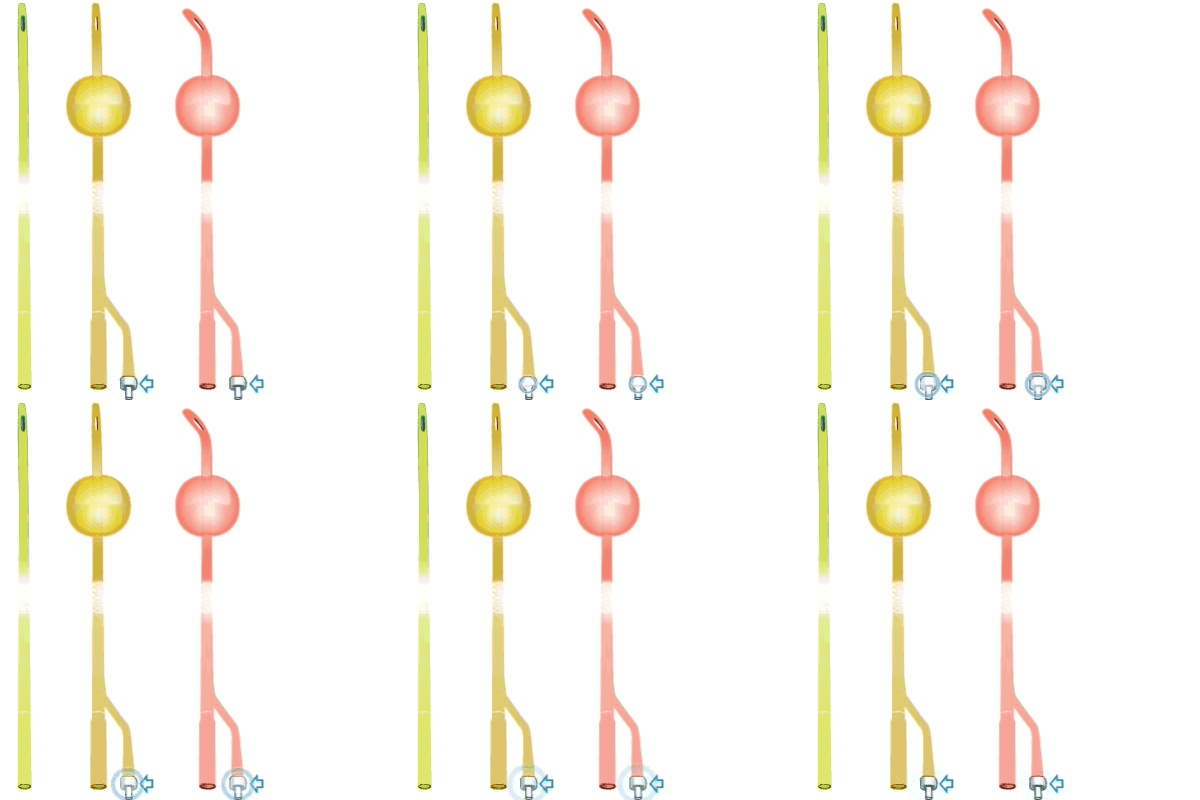
Drainage systems vary by manufacturer and clinical site, but most share the same fundamental characteristics. Most drainage systems come in either a standard or a leg-bag style. There are different rationales for and advantages and disadvantages of each type of system.
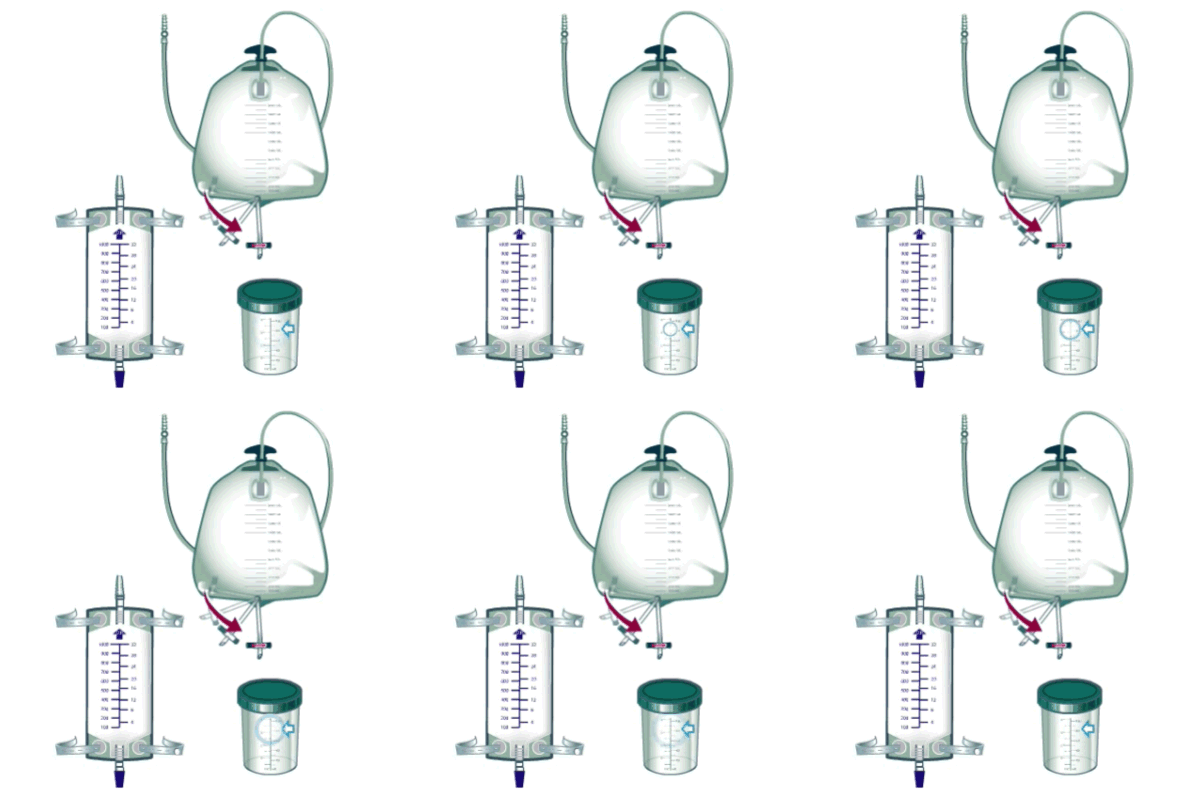
A standard collection bag is the most commonly used drainage system. The primary benefit of using a standard collection bag is its size. It has a large capacity (much greater than the human bladder) for holding urine. Despite its capacity, however, do not wait until it is completely full to empty a standard collection bag. Most facilities' policies require emptying bags a minimum of every 8 hours. Overfull bags and bags that drag on the floor are more prone to leaking and becoming contaminated.
Always fit collection bags to a nonmovable part of the client's bed or to the client's wheelchair. If attaching a standard bag to a client's wheelchair, it is important to consider the client's dignity and privacy. If possible, use a cloth covering so that the client's urine is not readily visible to others around them. With the drainage bag uncovered, clients might feel embarrassed or uncomfortable and thus avoid social or public situations.
Most standard collection bags have either free-flowing drainage or a one-way valve at the top of the bag that attaches to the end of the catheter away from the client's body. Collection bags with one-way valves may help prevent the reflux of urine from the collection bag back up into the bladder. Nevertheless, most collection bags allow free-flowing drainage from the catheter into the bag. It is always important to place collection bags at a level below the client's bladder to avoid reflux.
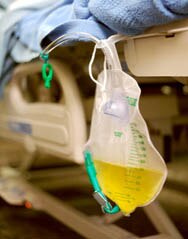
Urinary Collection Bag
On the opposite end of the collection bag near the bottom is a port for emptying the bag. Most bags have some type of drain valve in place to prevent leaks. To drain urine from the collection bag, open the drain valve and allow the urine to flow into a urinal, basin, or measuring container. Then, flush the urine down a toilet.
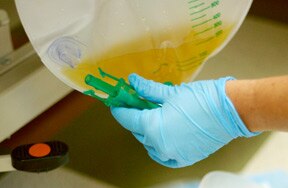
Emptying catheter bag
Leg-bag drainage systems are another option for collecting the urine of clients with urinary catheters. Leg bags have the benefit of being smaller in size and attaching directly to the client. The plastic collection bag is simply a smaller version of the standard bag and is attached using small elastic bands that wrap around the client's leg. Leg bags typically hold much smaller amounts of urine than standard bags hold, but they are easily concealed beneath clothing, which helps to promote the client's autonomy and dignity. They are an excellent choice for clients who are able to participate in their own care. Many clients are able to empty leg bags on their own with adequate training.
The valve systems in leg bags are very similar to those in standard bags. There is a one-way valve that allows urine to flow from the catheter into the bag and a drain valve at the bottom of the bag for draining the bag's contents. A disadvantage of leg bags is that they must be emptied more often. Leg bags can also be difficult to use with clients who are confused or are not ambulatory.
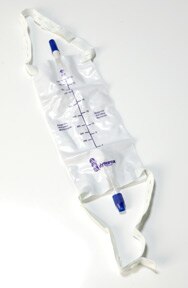
Leg Bag Drainage System
Collection bags vary in size and location on the body. Most clients prefer either a standard collection bag or a smaller leg bag. Most catheterizations require sterile insertion except for condom catheters (which require medical asepsis). Nurses can insert or place all but one type of catheter. A provider must insert a suprapubic catheter surgically.
medical asepsis
Insertion
Assessment of the client before and after catheterization is critical. Allergies, mental status, urine quality, voiding patterns, vital manifestations, skin assessment, and abdominal assessment are all essential. Urine assessment includes color, odor, presence of sediment or blood, and amount. Assess voiding patterns for both increased and decreased urination. Check vital signs to monitor for fever, alterations in blood pressure, and any other changes. Skin assessment includes hydration status and potential areas for skin breakdown. Abdominal assessment provides information about bladder distention in clients unable to sense the need to urinate. Always be sure to document all pertinent findings in the client's chart.
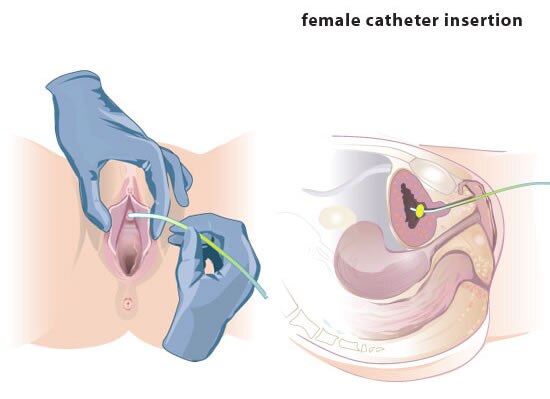
female catheter insertion
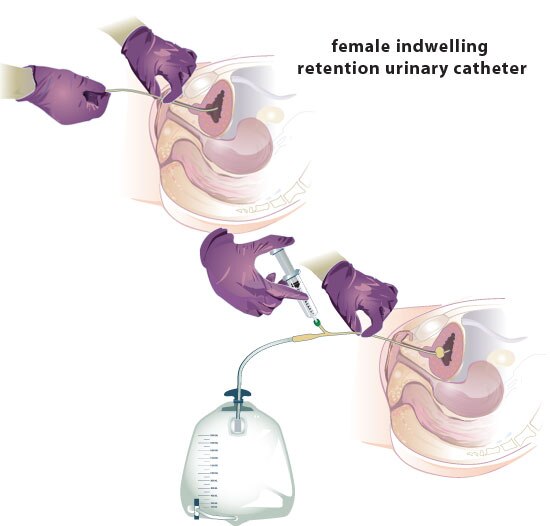
female indwelling retention urinary catheter
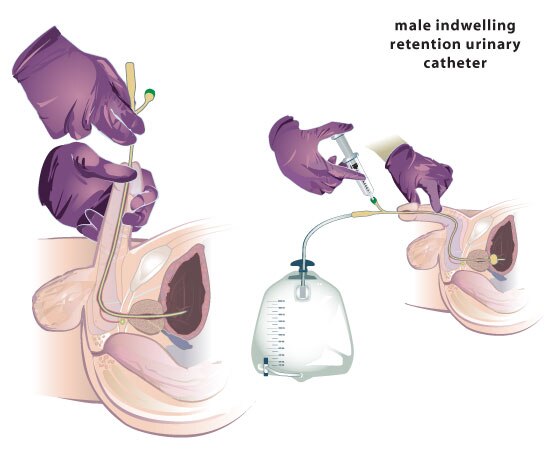
male indwelling retention urinary catheter