French tenses
pluperfect → imperfect → perfect → present → near future → simple future
+conditional, subjunctive, reflexive
pluperfect
the pluperfect is used to describe something that had happened - something further back in time than the imperfect.
functionally it’s very similar to the perfect (e.g. negatives, reflexives), except the auxillary verb is in the imperfect. e.g:
j’en avais eu assez - i had had enough
tu avais préparée tes affaires - you had prepared your things
the imperfect tense
is used to describe something you did consistently, what used to happen and no longer occurs, to describe something in the past, or to talk about an event that interrupted another.
to form it:
take the nous form of the verb in the present tense
remove the -ons
add the following endings:
je → ais
tu → ais
il/elle → ait
nous → ions
vous → iez
iles/elles → aient
the only exception is etre, which uses the stem ét-
the perfect tense:
is used to describe something you did once or a few times in the past - a completed action.
formed with the auxillary (either avoir or etre):
avoir | etre | |
je | ai | suis |
tu | as | es |
il/elle | a | est |
nous | avons | sommes |
vous | avez | êtes |
ils/elles | ont | sont |
and a past participle. for avoir verbs:
regular er, ir and re verbs:
er - change the er to an é
ir - drop the r off the end of ir
re - change re to a u
irregulars
boire → bu
voir → vu
lire → lu
pouvoir → pu
vouloir → voulu
devoir → dû
avoir → eu
dire → dit
écrire → écrit
mettre → mis
prendre → pris
etre → été
faire → fait
for etre verbs:
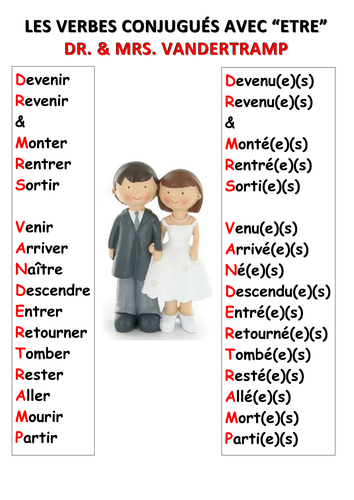
you add an e to their endings if feminine, and an s if plural. remember this is related to the subject not the object of the verb.
the present tense
is for describing things that are happening. in english, this exists in two forms - i eat and i am eating for example. but in french, it’s all one tense
unless a verb is irregular, it will fall into one of 3 patterns after the ending is removed:
ends in -er | ends in -re | ends in -ir | |
je | e | s | is |
tu | es | s | is |
il/elle | e | nothing | it |
nous | ons | ons | issons |
vous | ez | ez | issez |
ils/elles | ent | ent | issent |
the near future tense is formed using a conjugation of aller in the present and an infinitive verb.
negatives go around the conjugated form of aller. remember aller’s conjugation:
je vais
tu vas
il/elle va
nous allons
vous allez
iles/elles vont
the simple future
used to say will or shall - a bit further into the future than the near future. to form it:
find the stem of the verb - for regular er and ir verbs, it’s just the infinitive. for regular re verbs, get rid of the final e
add the following endings:
je → ai
tu → as
il/elle → a
nous → ons
vous → ez
ils/elles → ent
there are a bunch of irregular stems. in bold are the key ones.
aller → ir
avoir → aur
etre → ser
faire → fer
pouvoir → pourr
vouloir → voudr
devoir → devr
venir → viendr
voir → verr
savoir → saur
recevoir → recevr
mourir → mourr
envoyer → enverr
courir ( to run) → courr
the conditional tense
used to discuss how things would be if a certain condition was met (would)
to form, use simple future stems with the endings of the imperfect tense:
je → -ais
tu → -ais
il/elle → -ait
nous → -ions
vous → -iez
ils/elles → -aient
e.g. j’irais en France. → I would go to France.
if you want to say could or should (do something) you need to use pourr- and devr- followed by an infinitive. e.g:
nous pourrions aller au parc. → we could go to the park.
je devrais faire mes devoirs. → i should do my homework.
to form the conditional perfect, used to discuss things that could’ve, should’ve or would’ve happened but that didn’t, you use the auxillary verb (avoir/etre) in the conditional with the past participle as it is in the perfect. e.g:
elle aurait su la réponse à ta question. → she would’ve known the answer to your question.
to say could or should, you need to use aur- + du/pu + infinitive verb. e.g:
tu aurais dû manger ton dejeuner. → you should’ve eaten your lunch.
le matin, j’aurait pu aller a la plage, mais il pleuvait des cordes → in the morning, i could’ve gone to the beach, but it was raining cats and dogs
reflexive verbs
reflexive verbs have a reflexive pronoun in front of them which changes depending on who’s doing the action.
me
te
se
nous
vous
se
reflexive verbs to know fall mainly under Module 1.
when you’re negating a reflexive verb, just know the reflexive pronoun sticks to the verb ahead of it. so if that’s the first verb, you include the reflexive pronoun in the negative structure, and if that’s not the first verb, don’t include it.
reflexives in the pluperfect
see ‘reflexives in the perfect past’. only difference is that the auxillary etre is in the imperfect.
reflexives in the imperfect
use the reflexive pronoun and change the ending so it’s appropriate. e.g:
nous nous habillons seulement tous les matins. → we got dressed alone every morning.
reflexive verbs in the perfect past
etre is the auxillary, and it goes after the reflexive pronoun.
the past participle needs to agree with the gender of who’s doing the action.
negatives go around the reflexive pronoun and the first verb
elle ne s’est pas occupée d’elle. → she didn’t take care of her.
reflexive verbs in the near future
the conjugated form of aller precedes the reflexive pronoun. use an infinitive form of the verb. e.g:
je vais me reposer. → i am going to rest.
reflexive verbs in the simple future
the verb changes as needed but the pronoun stays in the same place. e.g:
je me sentirai heureuse si tu me donnes un cadeau.→ i will feel happy if you give me a gift.
reflexive verbs in the conditional
again, similar to the simple future. e.g:
je ne m’entendrais jamais bien avec lui. → i would never get on well with him.
nous pourrions nous lever. → we could get up.
the subjunctive
is a mood used to express uncertainty or unreality - wishes, preferences, necessity or feelings.
if your expression ends with ‘que’ or ‘qui’ (‘that' in english) it needs to be followed with the subjunctive. if it’s followed by ‘de’, use the infinitive. some common subjunctive triggering phrases are:
vouloir que - to want that (someone does something)
il faut que - it’s necessary that
il est important que - it’s important that
il est possible que - it’s possible that
penser que - to think that
bien que - although
pour que - so that
etre content/triste que - to be happy/sad that
but also, the subject and object need to be different, else you just use the infinitive. e.g:
je veux que tu fasses tes devoirs. → i want you to do your homework.
je veux faire mes devoirs. → i want to do my homework, as opposed to ‘je veux que je fasse mes devoirs.’ → i want me to do my homework. doesn’t make sense, right?
to form the subjunctive, take the ils form of the verb and get rid of the ent, then add the following endings:
je → e
tu → es
il/elle → e
nous → ions
vous → iez
ils/elles → ent
but all of the most used verbs are incredibly irregular :)
aller | avoir | etre | faire | prendre | vouloir | pouvoir | devoir | |
je | aille | aie | sois | fasse | prenne | veuille | puisse | doive |
tu | ailles | aies | sois | fasses | prennes | veuilles | puisses | doives |
il/elle | aille | ait | soit | fasse | prennes | veuille | puisse | doive |
nous | allions | ayons | soyons | fassions | prenions | voulions | puissions | devions |
vous | alliez | ayez | soyez | fassiez | preniez | vouliez | puissiez | deviez |
ils/elles | aillent | aient | soient | fassent | prennent | veuillent | puissent | doivent |
the imperative
giving instructions or a recommendation.
the tu form is used with someone you’re friendly with
the vous form is used with more than one person or someone you don’t know
the nous form means let’s…
for all regular + most irregular ir and re verbs, drop the pronoun from the appropriate form of the tense. e.g:
tuvends - sell
for -er verbs this is the same, but the final s is dropped in the tu form.
tumanges- eat
3 irregulars:
avoir | etre | savoir (to know) | |
tu | aie | sois | sache |
nous | ayons | soyons | sachons |
vous | ayez | soyez | sachez |
for reflexive verbs, conjugate the verb, drop the reflexive pronoun and then add on -toi, -nous or -vous. e,g:
asseyez-vous - sit down
modal verbs
pouvoir (can) | vouloir (want) | devoir (must) | |
je | peux | veux | dois |
tu | peux | veux | dois |
il/elle | peut | veut | doit |
nous | pouvons | voulons | devons |
vous | pouvez | voulez | devez |
ils/elles | peuvent | veulent | doivent |
+ infinitive