Atypical sex chromosome patterns
Key terms
Atypical sex chromosome patterns - any sex chromosome pattern that deviates from the usual XX/XY formation and which tends to be associated with a distinct pattern of physical and psychological symptoms.
Klinefelter’s syndrome - A syndrome affecting males in which an individual’s genotype has an extra X chromosome (in addition to normal XY), characterised by a tall thin physique, small infertile testes and enlarged breasts.
Turner’s syndrome - A chromosomal disorder in which affected women have only one X chromosome, causing developmental abnormalities and infertile.
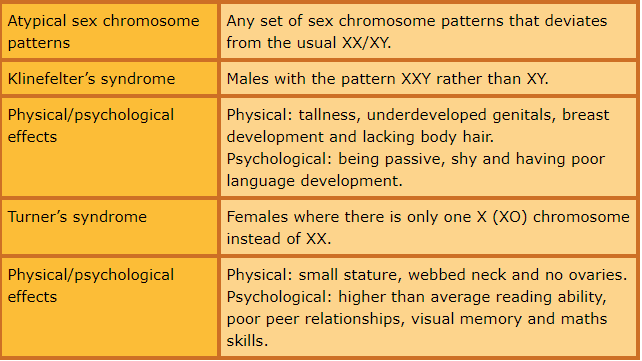
Atypical sex chromosome patterns
Klinefelter’s syndrome
This is an example of an atypical chromosome patterns. It affects between 1 in 500 and 1 in 1000 people. Individuals who have this condition are biological males - with the anatomical appearance of a male - and have an additional X chromosome. As such, their sex chromosome structure is XXY. Although 10% of cases are identified by prenatal diagnosis, it is thought that around 2/3rds of people who have Klinefelter’s syndrome are not aware of it. Diagnosis often comes about accidentally via a medical examination of some unrelated condition.
Physical characteristics - One of the effects of the additional X chromosome is reduced body hair when compared to a normal male. There may be some breast development at puberty (gynecomastia) and a softening or rounding of body contours. Individuals with the syndrome tend to have long gangly limbs, underdeveloped genitals and may have problems with coordination and general clumsiness. XXY men are also susceptible to health problems that are usually more commonly found in females such as breast cancer.
Psychological characteristics - Klinefelter’s syndrome is often linked to poorly developed language skills and reading ability. People with this condition tend to be passive, shy and lack interest in sexual activity. Many tend not to respond well to stressful situations and may often exhibit problems with executive functions such as memory and problem solving.
Turner’s syndrome
Approximately 1 in 5000 biological females have Turner’s syndrome, caused by an absence of one of the two allotted X chromosomes - this is referred to as X0. This means that affected individuals have 45 chromosomes rather than the usual 46.
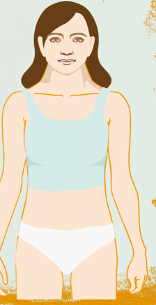
Physical characteristics - Individuals with Turner’s syndrome do not have a menstrual cycle (amenorrhoea), their ovaries fail to develop and thus they are sterile. They do not develop breasts at puberty and instead have a broad shield chest. Turner’s syndrome is also associated with a low set of ears and a webbed neck (area of folded skin that runs along the neck to the shoulders) There is a high waist-to-hip ratio in that the hips are not much bigger than the waist. Generally adults with this are physically immature and tend to retain the appearance of prepubescent girls.
Psychological characteristics - In contrast to Klinefelter’s syndrome, a feature of Turner’s is higher than average reading ability. However, performance on spatial, visual memory and mathematical tasks is lower than normal. As well as their immature appearance, people with Turner’s syndrome tend to be socially immature, have trouble relating to their peers and experience difficulty fitting in.
Treating Klinefelter’s and Turner’s syndromes
Testosterone replacement therapy can help people with Klinefelter’s syndrome increase their hormone levels towards a normal range. This can produce bigger muscles, deepen their voice and stimulate facial and body hair growth. Some XXY males can also benefit from fertility treatment to help them father children.
Growth hormone injections are beneficial for some individuals with Turner’s syndrome. Injections often begin in early childhood and may increase final adult height by a few inches. Oestrogen replacement therapy is usually started at the time of normal puberty to start breast development. Oestrogen and progesterone are given a little later to begin a monthly menstrual period, which is necessary to keep the womb healthy.
The psychological and behavioural characteristics associated with oestrogen are heightened emotions and irritability due to PMT, mood swings and these have even been associated with anti-social behaviour such as shoplifting.
The psychological and behavioural characteristics associated with testosterone are increased aggression. Studies show that increased testosterone levels have links with increased aggression.
Evaluation
Contribution to the nature-nurture debate
Studies of people with atypical sex chromosome patterns are useful as they contribute to our understanding of the nature-nurture debate in gender development. By comparing people who have these conditions with chromosome-typical individuals it becomes possible to see psychological and behavioural differences between the two groups (such as finding that people with Turner’s syndrome tend to have higher verbal ability and tend to talk more than typical girls) It might be logically inferred that these differences have a biological basis and are a direct result of the abnormal chromosomal structure, this would suggest that innate ‘nature’ influences have a powerful effect on psychology and behaviour.
Environment explanations
However, there may be issues in leaping to the above conclusion. The relationship between the chromosomal abnormalities associated with Klinefelter’s and Turner’s syndrome and the differences in behaviour seen in these individuals is not casual. It may actually be the environment and social influences are more responsible for the behavioural differences seen in these individuals. For instance, social immaturity and this may have an indirect impact upon their performance at school (hence specific learning and developmental problems identified) This shows that it is wrong to assume that observed psychological and behavioural differences are due to nature.
Practical application
Continued research into atypical sex chromosome patterns is likely to lead to earlier and more accurate diagnoses of Turner’s and Klinefelter’s syndromes as well as more positive outcomes in the future. An Australian study of 87 individuals with Klinefelter’s syndrome showed that those who had been identified and treated from a very young age had significant benefits compared to those who had been diagnosed in adulthood (Herlihy et al 2011) This suggests that increased awareness of these conditions may have practical application.
Extra
Unusual sample
Caution should always be exercised when drawing conclusion from such an unusual and unrepresentative sample of people. The main issue is the lack of generalisability from atypical individuals to a wider population. It is also the case that individuals who look different are unlikely to be treated in the same way as their peers. This may make it difficult when trying to assess the relative contribution of nature and nurture in the terms of behavioural and psychological differences.
As only around a third of people with Klinefelter’s are aware that they have the condition, and significantly fewer of those will have been the subject of psychological research. This limits the extent to which the generalisations can be made suggesting that their biology is responsible for their behaviour because we are drawing these conclusions from research on a very small sample.
The idea of typical vs atypical
The presumed contribution of Turner’s and Klinefelter’s syndrome to the nature-nurture debate is based on the idea that there are typical gender behaviours associated with males and females. For instance, the idea that Turner’s individuals are socially immature is based on the idea that there is a typical level of social maturity for the vast majority of females. However, this may be based on the stereotypical assumptions of what constitutes ‘average’ and ‘normal’ behaviour for males and females rather than fact.
The Maccoby and Jacklin study supports the idea that there may not be a typical standard for male and female behaviour because they found more differences in behaviour within the sexes than between them. As there were more differences within the sexes, this suggests there are no ‘typical’ behaviours for males, for example, as the behaviours of the males they looked at varied.