Environmental Sciences
Ecosystem
Definition: An ecosystem refers to a community of living organisms interacting with each other and their physical environment. It consists of biotic components comprising living organisms and abiotic components comprising physical factors like temperature, rainfall, wind, soil & minerals.
Components:
Abiotic: Non-living components like soil, water, sunlight, temperature.
Biotic: Living organisms including plants, animals, fungi, and microorganisms.
Examples:
Forest
Ponds
Lakes
Crop-fields
Garden
Aquarium
Types:
Terrestrial: Land-based ecosystems like forests, grasslands, deserts.
Aquatic: Water-based ecosystems like oceans, lakes, rivers, wetlands.
Natural: forests, grasslands, deserts, oceans, lakes, rivers, wetlands etc.
Human-made (Artificial): Crop-fields, Garden, Aquarium
Functions:
Energy flow: Transfer of energy through the ecosystem via food chains and food webs.
Nutrient cycling: Recycling of nutrients like carbon, nitrogen, and phosphorus.
Habitat: Providing a home for various species.
Importance:
Biodiversity: Ecosystems support a wide variety of species.
Economic value: Provide resources like food, medicine, and raw materials.
Environmental services: Regulation of climate, water purification, and pollination.
Threats:
Habitat destruction: Deforestation, urbanization.
Pollution: Air, water, and soil pollution.
Climate change: Alters ecosystems and disrupts species' habitats.
Conservation:
Protected areas: National parks, wildlife reserves.
Sustainable practices: Responsible resource management.
Education and awareness: Promoting understanding of ecosystems and their importance.
Types of Organisms
Autotrophs / Producers
Organisms that produce their own food.
Use sunlight or inorganic compounds for energy.
Examples: Plants, some bacteria.
Heterotrophs / Consumers
Organisms that rely on other organisms for food.
Consume organic compounds for energy.
Examples: Herbivores, Omnivores, Carnivores, Parasites
Decomposers / Reducers
Microorganisms which breakdown dead organic substances to simple organic substances.
Examples: Bacteria, Fungi
Food Chain
Definition: A food chain is a linear sequence of organisms where each organism serves as a source of food for the next level in the chain.
Types:
Grazing Food Chain: Begins with green plants, then herbivores, and finally carnivores.
Detritus Food Chain: Starts with dead organic matter, then detritivores, and finally predators.
Trophic Levels:
Producers: Autotrophic organisms like plants that produce their food.
Primary Consumers: Herbivores that feed on producers.
Secondary Consumers: Carnivores that feed on herbivores.
Tertiary Consumers: Apex predators that feed on other carnivores.
Energy Transfer: Energy flows through the food chain from one trophic level to another, with only about 10% of energy transferred to the next level.
Importance:
Balances ecosystems by regulating population sizes.
Shows the interdependence of organisms in an ecosystem.
Helps in understanding the flow of energy and nutrients in an ecosystem.
Human Impact:
Disruption of food chains can lead to imbalances in ecosystems.
Overexploitation of certain species can cause cascading effects on the entire food chain.
Pollution and habitat destruction can disrupt food chains and lead to biodiversity loss.
Food Web
Definition: A food web is a network of interconnected food chains showing the flow of energy and nutrients through an ecosystem.
Components:
Producers: Plants and algae that produce their own food through photosynthesis.
Consumers: Organisms that consume other organisms for energy.
Primary Consumers: Herbivores that feed on producers.
Secondary Consumers: Carnivores that feed on herbivores.
Tertiary Consumers: Apex predators that feed on other carnivores.
Decomposers: Organisms that break down dead organisms and organic matter, recycling nutrients back into the ecosystem.
Interconnectedness: Organisms in a food web are interconnected through their feeding relationships, showing the complex interactions within an ecosystem.
Energy Flow: Energy flows through a food web from producers to consumers and decomposers, with each trophic level receiving only about 10% of the energy from the level below.
Human Impact: Human activities such as habitat destruction, pollution, and overexploitation can disrupt food webs, leading to imbalances and ecosystem collapse.
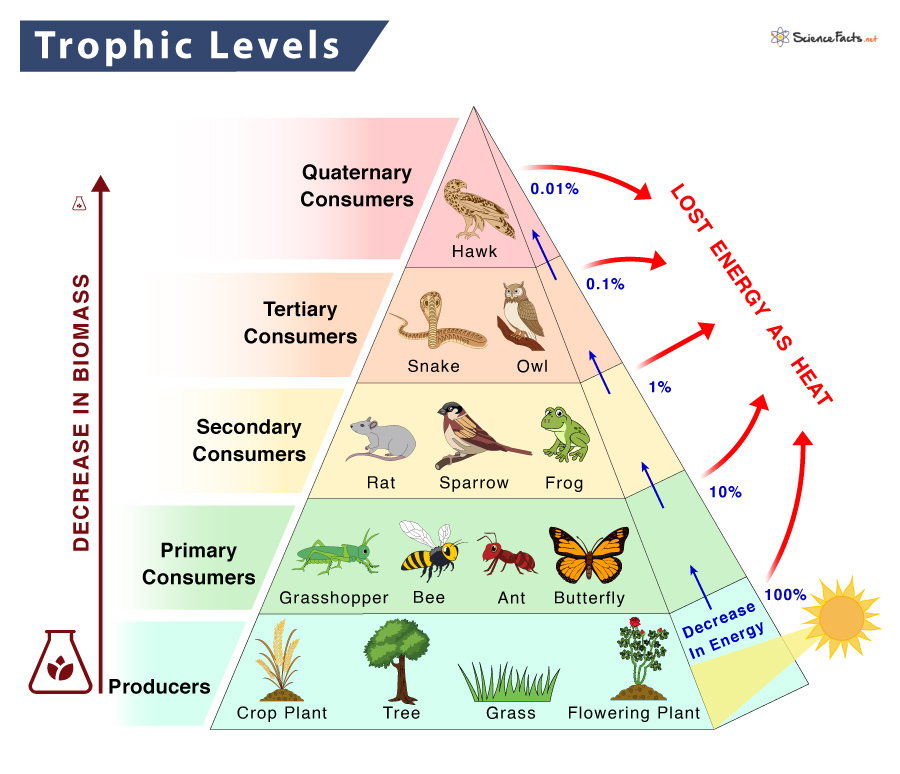
Trophic Levels
Trophic levels are the hierarchical levels in an ecosystem, indicating the position of an organism in the food chain.
Producers, such as plants, form the first trophic level as they convert sunlight into energy through photosynthesis.
Herbivores occupy the second trophic level, feeding on producers.
Carnivores and omnivores are on higher trophic levels, preying on herbivores and other carnivores.
Decomposers, like fungi and bacteria, break down organic matter, occupying the final trophic level.
Energy is transferred between trophic levels, with only about 10% being passed on to the next level, leading to pyramid-shaped energy distribution.
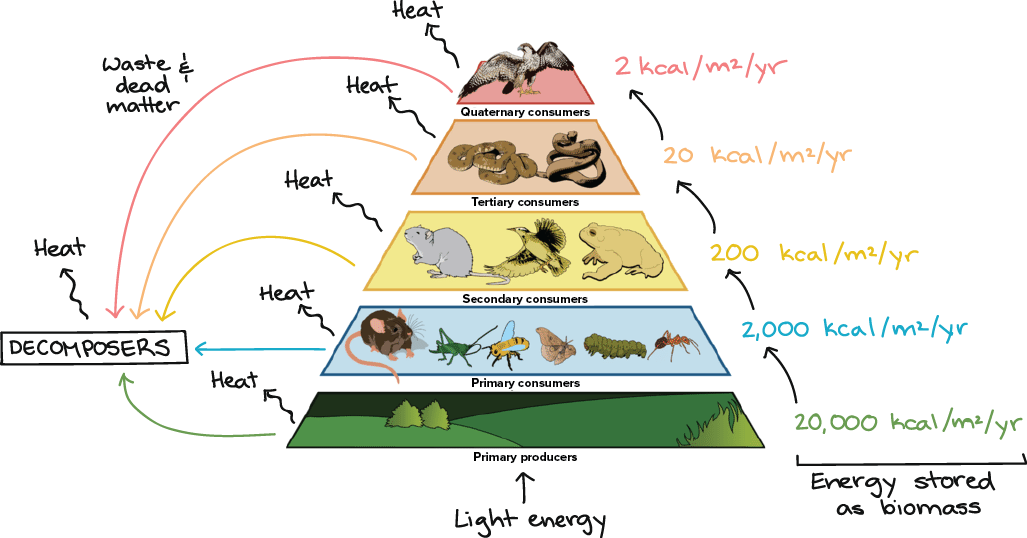
Food Chain
Definition: A food chain is a linear sequence of organisms where each organism serves as a source of food for the next organism in the chain.
Components:
Producers: Organisms like plants that produce their own food through photosynthesis.
Consumers: Organisms that consume other organisms for energy.
Primary Consumers: Herbivores that feed on producers.
Secondary Consumers: Carnivores that feed on herbivores.
Tertiary Consumers: Carnivores that feed on other carnivores.
Decomposers: Organisms like bacteria and fungi that break down dead organisms and organic matter.
Flow of Energy: Energy flows through the food chain from producers to consumers and decomposers. Only about 10% of energy is transferred from one trophic level to the next.
Types of Food Chains:
Aquatic Food Chains: Involving organisms in water bodies.
Terrestrial Food Chains: Involving organisms on land.
Importance:
Maintains Balance: Helps in regulating populations and maintaining ecosystem balance.
Energy Transfer: Facilitates the transfer of energy through different trophic levels.
Biodiversity: Supports biodiversity by creating interdependence among different species.
Examples:
Grass → Grasshopper → Frog → Snake → Hawk
Algae → Zooplankton → Small Fish → Large Fish → Shark
Human Impact: Human activities like deforestation, overfishing, and pollution can disrupt food chains, leading to imbalances in ecosystems.
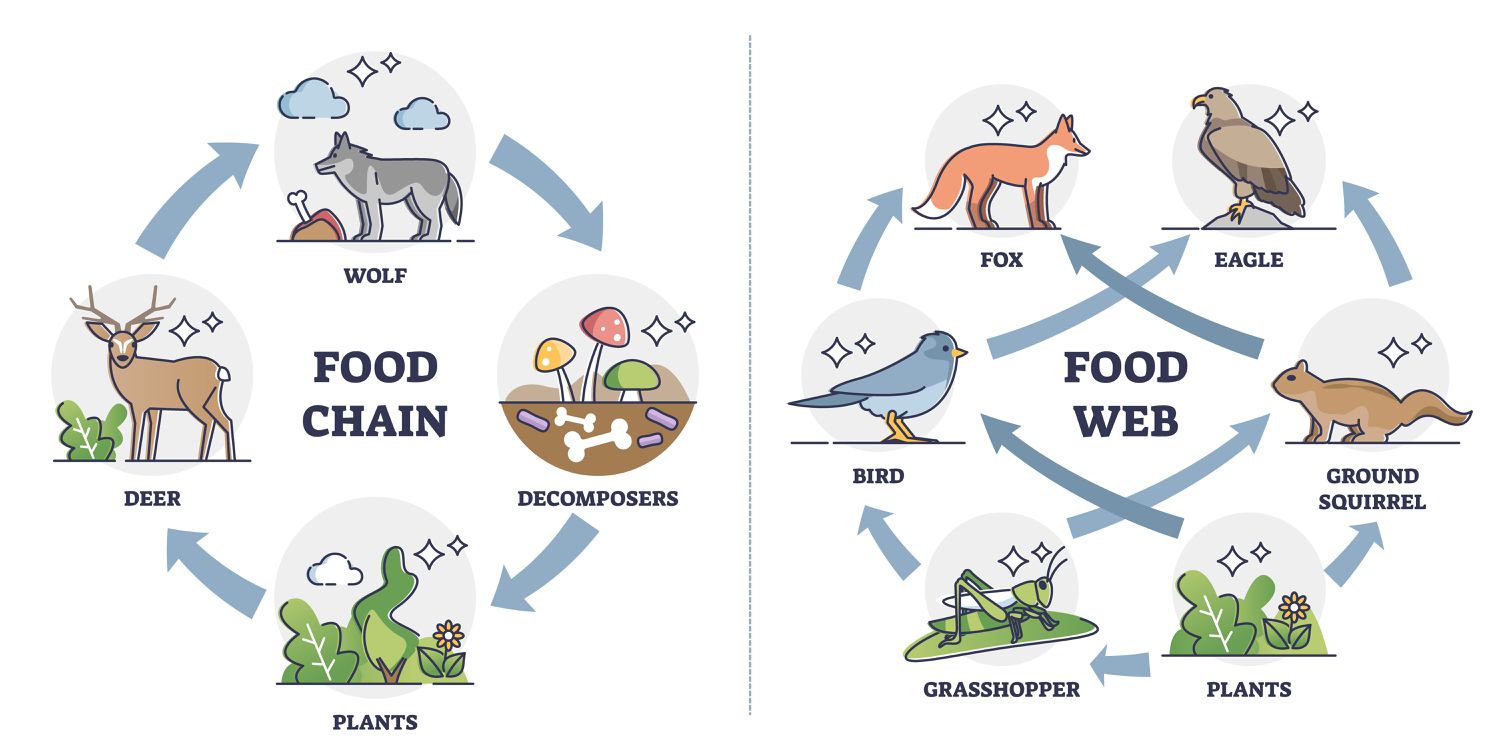
Food Web
Definition: A food web is a complex network of interconnected food chains showing the flow of energy and nutrients through an ecosystem.
Components:
Producers: Plants and other organisms that produce their own food through photosynthesis.
Consumers: Organisms that consume other organisms for energy.
Primary Consumers: Herbivores that eat producers.
Secondary Consumers: Carnivores that eat primary consumers.
Tertiary Consumers: Carnivores that eat secondary consumers.
Decomposers: Organisms that break down dead organisms and waste, returning nutrients to the soil.
Interconnectedness: Organisms in a food web are interconnected as they can have multiple food sources and predators.
Energy Flow: Energy flows through the food web from producers to consumers and decomposers, with each trophic level only receiving about 10% of the energy from the level below.
Stability: A diverse and interconnected food web leads to a more stable ecosystem as it can better withstand disruptions.
Human Impact: Human activities can disrupt food webs through habitat destruction, pollution, overfishing, and introduction of invasive species, leading to imbalances and ecosystem collapse.
Greenhouse Effect
Definition: Natural process that warms the Earth's surface. Gases in the atmosphere trap heat from the sun, preventing it from escaping back into space.
Without this process, life would not have been possible on the earth. But now it threatens life. Excess of Co, in the air is one of the gases responsible for this effect.
Greenhouse Gases: Carbon dioxide (CO2), methane (CH4), water vapor, nitrous oxide (N2O), and ozone are major greenhouse gases.
Enhanced Greenhouse Effect: Human activities, such as burning fossil fuels and deforestation, increase greenhouse gas levels, leading to more heat being trapped.
Consequences:
Global Warming: Average global temperatures are rising, causing climate change.
Melting Ice Caps: Resulting in rising sea levels.
Extreme Weather Events: More frequent and severe events like hurricanes, droughts, and heatwaves.
Mitigation:
Reducing Emissions: Transitioning to renewable energy sources.
Afforestation: Planting trees to absorb CO2.
Energy Efficiency: Using energy more efficiently to reduce emissions.
International Agreements:
Paris Agreement: Aims to limit global warming to well below 2 degrees Celsius above pre-industrial levels.
Kyoto Protocol: An earlier agreement to reduce greenhouse gas emissions.
Importance of Awareness: Educating people about the greenhouse effect and its consequences is crucial for taking collective action to mitigate climate change.
Pollution
Definition: Introduction of harmful substances or products into the environment, causing adverse effects.
Types:
Air Pollution: Contamination of the air by harmful gases and particles.
Water Pollution: Contamination of water bodies by chemicals, plastics, and other waste.
Soil Pollution: Contamination of soil by chemicals, pesticides, and waste.
Noise Pollution: Excessive noise that disrupts the environment.
Causes:
Industrial activities
Vehicle emissions
Deforestation
Improper waste disposal
Effects:
Health issues like respiratory problems, cancer, and skin ailments.
Harm to wildlife and ecosystems.
Climate change and global warming.
Prevention:
Use of clean energy sources.
Proper waste management and recycling.
Planting trees and promoting green spaces.
Air Pollution
Definition: Presence of harmful or excessive quantities of substances in the air.
Air Pollutants:
Definition: Substances in the air that can have harmful effects on human health and the environment.
Types:
Particulate Matter (PM): Tiny particles suspended in the air, can be solid or liquid.
Dust
Aerosols
Smoke
Fog
Smog
Mist
Fly ash
Fumes
Carbon Monoxide (CO): Colorless, odorless gas produced by incomplete combustion of carbon-containing fuels.
Carbon Dioxide (CO2)
Sulfur Oxides (SOx): Gas produced by burning fossil fuels containing sulfur.
Nitrogen Oxides (NOx): Gases produced by burning fossil fuels, contribute to smog and acid rain.
Volatile Organic Compounds (VOCs): Organic chemicals that evaporate at room temperature, contribute to smog formation.
Hydrocarbons
CFCs
Sources:
Natural:
Volcanic eruptions
Wildfires
Dust storms
Electric storms
Salt spray from oceans
Pollen
Microorganisms
Anthropogenic (Manmade/Artificial):
Industries
Vehicles (Automobile exhaust)
Burning of fossil fuels
Agriculture activities
Construction materials
Mining
Nuclear explosions
Air crafts
Wastewater treatment plants
Thermal and nuclear power plants
Health Impacts:
Respiratory issues (like asthma, bronchitis)
Cardiovascular diseases.
Premature death.
Cancer, lung cancer
Irritation to eye, throat & nose
Silicosis
Damage to nerve brain, kidney and vision problems
Environmental Impacts:
Acid rain.
Damage to plants & vegetation:
Destroy chlorophyll & affect photosynthesis
Damage to leaf structure
Block stomata and affect the rate of transpiration
Global warming.
Damage to materials & buildings (Taj mahal becoming yellow)
Increase in greenhouse gases
Damage to animals:
Paralysis and difficulty in breathing due to lead poisoning near animal grazing area.
Arsenic poisoning causes severe salivation, thirst, vomiting irregular pulse and respiration, abnormal body temperature and death.
Fluorine toxicity causes lack of appetite, periodic diarrhoea, muscular weakness, loss of weight and death.
Prevention and Control:
Use of cleaner fuels.
Promoting public transportation.
Planting trees.
Use of bicycle
Reducing use of pesticides, chemical fertilizers
Not burning plastic waste
Water Pollution
Definition: Contamination of water bodies by harmful substances, making it unsuitable for human use or aquatic life.
Sources of Water Pollution:
Industrial Discharges: Factories and industries release harmful chemicals and waste into water bodies. Examples are oil refineries, paper factories, textile and sugar mills and chemical factories.
Agricultural Runoff: Pesticides, fertilizers, and animal waste from farms can contaminate water sources.
Sewage and Wastewater: Untreated sewage and wastewater from households and urban areas are major sources of pollution.
Oil Spills: Accidental or deliberate discharge of oil into water bodies can have devastating effects.
Plastic Pollution: Improper disposal of plastic waste leads to pollution in oceans, rivers, and lakes.
Chemical Pollutants
Types of Water Pollution:
Chemical Pollution: Includes toxins, heavy metals, pesticides, and industrial chemicals that contaminate water.
Nutrient Pollution: Excessive amounts of nutrients like nitrogen and phosphorus lead to algal blooms and oxygen depletion.
Microbiological Pollution: Presence of harmful bacteria, viruses, and parasites from sewage and animal waste.
Sediment Pollution: Soil erosion and construction activities can lead to sedimentation in water bodies, affecting aquatic life.
Thermal Pollution: Discharge of heated water from industrial processes can disrupt aquatic ecosystems.
Effects:
On Environment:
Harmful algal blooms
Loss of biodiversity
Disruption of ecosystems
On Human Health:
Waterborne diseases
Contaminated drinking water
Impact on food chain
Pollution of surface water resources and river water
Pollution of ground water
Decrease in agricultural production
Prevention:
Regulations: Enforce laws on waste disposal and pollution control.
Treatment: Implement water treatment plants.
Awareness: Educate public on proper waste disposal and conservation.
Chlorination is a commonly used chemical method for purifying water. It is done by adding chlorine tablets or bleaching powder to the water.
Examples:
Ganga River Pollution: Industrial and human waste affecting a sacred river.
Climate and Climate Change
Climate: Refers to the long-term patterns of temperature, humidity, wind, and precipitation in an area. It is determined by factors like latitude, altitude, proximity to water bodies, and topography.
Climate Change: Refers to significant and lasting changes in the Earth's climate patterns over an extended period, often attributed to human activities such as burning fossil fuels, deforestation, and industrial processes.
Causes of Climate Change:
Greenhouse Gas Emissions: Carbon dioxide, methane, and other gases trap heat in the atmosphere, leading to a warming effect.
Deforestation: Trees absorb CO2, so cutting them down reduces the Earth's capacity to absorb greenhouse gases.
Industrial Activities: Burning fossil fuels releases CO2 and other pollutants into the atmosphere, contributing to the greenhouse effect.
Overutilization and exploitation of natural resources
Pollution caused by human activities
Changes in solar output which is associated with sunspot activities
The aerosols that reach the atmosphere after volcanic eruption
Impacts of Climate Change:
Rising Temperatures: Result in heatwaves, melting ice caps, and rising sea levels.
Extreme Weather Events: Increase in frequency and intensity of hurricanes, droughts, floods, and wildfires.
Ecosystem Disruption: Shifts in habitats, loss of biodiversity, and threats to food security.
Sea level rise
Warming oceans
Shrinking ice sheets
Declining Arctic sea ice
Glacial retreat
Ocean acidification
Decreased snow cover
Climate change poses a significant threat to the environment, human health, and economies worldwide, emphasizing the urgent need for collective action to address this global challenge.
Sources of Energy
Sources of energy: A source of energy is that which is capable of providing enough useful energy at a steady rate over a long period of time.
Renewable Sources
Definition: Resources that can be replenished naturally over time.
Examples: Solar, wind, hydroelectric, geothermal, biomass.
Advantages: Environmentally friendly, sustainable, reduces greenhouse gas emissions.
Disadvantages: Intermittent availability, high initial costs, land use conflicts.
Non-Renewable Sources
Definition: Resources that are finite and will deplete over time.
Examples: Fossil fuels (coal, oil, natural gas), nuclear.
Advantages: Reliable, high energy density, cost-effective.
Disadvantages: Contribution to climate change, air pollution, resource depletion.
Hydro Energy
Definition: Hydro energy, also known as hydropower, is a renewable energy source that harnesses the power of flowing or falling water to generate electricity.
Working:
The process involves the transference of potential energy of the water into kinetic energy' and then into electric energy.
It is the most conventional renewable energy source obtained from water falling from a great height.
Types:
Conventional Hydropower: Uses dams to store water in reservoirs and release it through turbines to generate electricity.
Pumped Storage Hydropower: Stores energy by pumping water uphill to a reservoir during low-demand periods and releases it to generate electricity during high-demand periods.
Advantages:
Renewable and sustainable.
Low greenhouse gas emissions.
Reliable and flexible for meeting peak electricity demand.
Can provide energy storage capabilities.
Disadvantages:
Environmental impact on ecosystems and wildlife due to dam construction.
Displacement of communities and loss of cultural heritage in dam construction areas.
High initial investment costs for building dams and infrastructure.
Solar Energy
Definition: Renewable energy derived from the sun's radiation.
Types:
Solar Photovoltaic (PV): Converts sunlight directly into electricity using solar cells.
Solar Thermal: Converts sunlight into heat, used for heating water or generating electricity.
Advantages:
Environmentally friendly.
Reduces electricity bills.
Low maintenance costs.
Sustainable and abundant source of energy.
Disadvantages:
Initial installation costs can be high.
Weather-dependent (less effective during winters and on cloudy days).
Energy storage challenges.
Requires more land
Applications:
Residential and commercial buildings for electricity generation.
Water heating systems.
Solar-powered vehicles.
Solar cookers
Solar furnaces
Solar space heating
Solar drying of agricultural and animal products
Solar distillation
Solar power plants
Traffic lights, street lights
Solar lanterns
Wind Energy
Definition: Wind energy is the conversion of wind into a useful form of energy, such as electricity, using wind turbines.
Working Principle: Wind turbines capture the kinetic energy of the wind and convert it into mechanical power, which is then used to generate electricity.
Average annual wind speed should be about 15 km/hr for wind mill.
Advantages:
Renewable and sustainable energy source.
Environmentally friendly, producing no greenhouse gas emissions.
Low operating costs once the turbines are installed.
Can be used in remote areas to provide electricity.
Disadvantages:
Intermittent source of energy, dependent on wind speed and availability.
High initial investment costs for setting up wind farms.
Impact on wildlife, especially birds and bats.
Visual and noise pollution in some areas.
Types of Wind Turbines:
Horizontal-axis wind turbines (HAWT):
Dutch type
Propeller type
Sail type
Magnus type
Fan type
Americal multi blade
Vertical-axis wind turbines (VAWT):
Savonious
Darious
Combined
Applications:
Electricity generation
Off-grid power in remote areas
water pumping in rural areas
Offshore wind farms
Microgrids
Battery charging
Heating systems
Run machines
Run flour mills
Biomass Energy
Definition: Biomass energy is derived from organic materials such as plants, agricultural residues, wood, and animal waste.
Examples:
Cow dung cakes, firewood, charcoal, coal etc.
Types:
Biofuels: Liquid fuels produced from biomass, such as ethanol and biodiesel.
Biogas: Produced from the anaerobic digestion of organic matter like food waste and manure.
Wood and Agricultural Residues: Direct burning of wood or crop residues for heat and electricity.
Advantages:
Renewable resource.
Reduces greenhouse gas emissions.
Helps in waste management by utilizing organic waste.
Challenges:
High initial investment costs.
Requires large land areas for biomass production.
Concerns about air pollution from burning biomass.
Applications:
Power generation.
Heating and cooling systems.
Transportation fuels.
Run farm machineries
Run engines, boilers, turbines etc.
As domestic fuels (in LPG gas)
Tidal Energy
Definition: Tidal energy is a form of hydropower that converts the energy obtained from the tides into electricity.
Mechanism: It harnesses the kinetic energy of the moving water caused by the gravitational pull of the moon and the sun (ભરતી અને ઓટ) i.e. Energy from tide’s rise and fall.
Types:
Tidal Stream Systems: Use underwater turbines to convert the kinetic energy of moving water into electricity.
Tidal Barrages: Dam-like structures built across estuaries to capture and release tidal water through turbines.
Advantages:
Renewable and predictable source of energy.
Environmentally friendly with no greenhouse gas emissions.
Low operating costs once infrastructure is in place.
Challenges:
High initial investment costs.
Impact on marine ecosystems and wildlife.
Limited locations suitable for tidal energy generation.
Variable intensity of sea waves
Applications of Tidal Energy:
Electricity Generation: Tidal turbines capture energy from tides to produce electricity.
Grid Integration: Tidal energy can stabilize the power grid, reducing reliance on fossil fuels.
Remote Power Supply: Provides sustainable energy for isolated areas.
Desalination: Tidal energy supports desalination for freshwater production.
Flood Control: Helps regulate water levels to prevent coastal flooding.
Environmental Benefits: Clean and renewable energy source without greenhouse gas emissions.
Research and Development: Encourages innovation in renewable energy technologies.
Geothermal Energy
Definition: Renewable energy derived from the heat stored beneath the Earth's surface.
Types:
Geothermal Power Plants: Generate electricity by harnessing steam or hot water from underground reservoirs.
Geothermal Heat Pumps: Use the stable temperature of the ground to heat and cool buildings.
Advantages:
Environmentally friendly with low emissions.
Reliable and consistent source of energy.
Reduces dependence on fossil fuels.
Disadvantages:
Location-specific, limited to areas with high geothermal activity.
Initial high costs for drilling and installation.
Potential for depletion of reservoirs if not managed sustainably.
Uses:
Electricity generation
Heating
Agricultural applications
Gold mining
Food dehydration
Milk pasteurization
Snow melting
Challenges:
High upfront costs and technical challenges in drilling.
Environmental concerns like induced seismicity and water usage.