Le Passé Compose
is a past tense
is used when referring to completed actions of the past
is made up of two parts
Auxiliary/Helping Verb + Past Participle
Auxiliary/Helping Verb
uses either avoir or être
Avoir: J’ai, Tu as, Il/Elle/On a, Nous avons, Vous avez, Ils/Elles ont
être: Je suis, Tu es, Il/Elle/On est, Nous sommes, Vous êtes, Ils/Elles sont
some verbs use être - memorize DrMrs. Vandertramp to remember the verbs
this acronym in in a different note
or use être for pronominal verbs (se promener, se brosser, etc)
Past Participle
generally for all verbs, we use avoir. However, there are a few exceptions to that rule - some verbs use être as the auxiliary verb
these verbs are in the acronym DrMrs.Vandertramp
when using être, the past participle (second verb) has to agree with the subject pronoun - subject pronouns are je, tu, il/elle/on, nous, vous, and ils/elles
if the subject or person you’re speaking about identifies as female, you have to add an extra ‘e’ (example: Elle est restée)
if the subject or person you’re talking about is plural (nous, vous, ils/elles) then you must add an extra ‘s’ (example: Ils sont devenis)
if it is both feminine and plural, add an ‘es’ (example: Elles sont restées)
to form the past participle for regular verbs, take off the infinitive of the verb (last 2 letters) and add ending
“ER” verb endings become é (ex: regarder - regardé)
IR” verb endings become i (ex: grandir - grandi)
“RE” verb endings become u (ex: vendre - vendu)
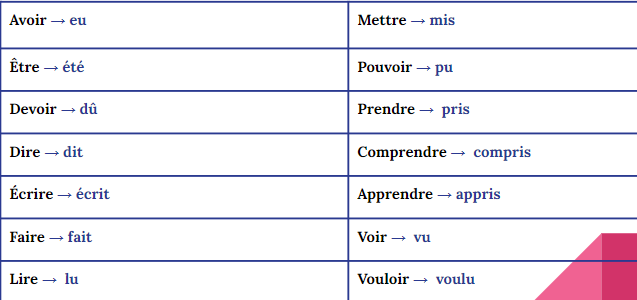
IRREGULAR VERBS
not all verbs are regular. Below is a list of some irregular verbs in the passé and their endings
THE NEGATIVE IN THE PASSE COMPOSE
to create the negative form of a sentence in the passé compose, follow this order:
Subject pronoun + n’ +avoir (conjugated) + pas +participe passé
example: Je n’ai pas mangé
when there are two verbs together (example: J’ai voulu danser), don’t change the order of the negative
example: Je n’ai pas voulu danser
REFLEXIVE VERBS
when using reflexive verbs, the reflexive pronoun (me, te, se, nous, vous) must be attached to the conjugated form of ‘ être’
subject pronoun + reflexive pronoun + être + participe passé + agreement (if needed)