QUIZ QUESTIONS
In the DRC model, words go down the lexical route, nonwords down the non-lexical route.
FALSE
Different routes provide information but both give same info
According to DRC, regular words are generally easier to read because.
Both routes produce the same response
REGULAR DOESNT MEAN FREQUNT
Grapheme-phoneme conversion is key to reading…
Unknown words
Irregular words use exceptions
If SEW was read by the non-lexical route of DRC, it should rhyme with…
FEW
SEW follows the knowledge in english
Sew to sound like sough would be a exception
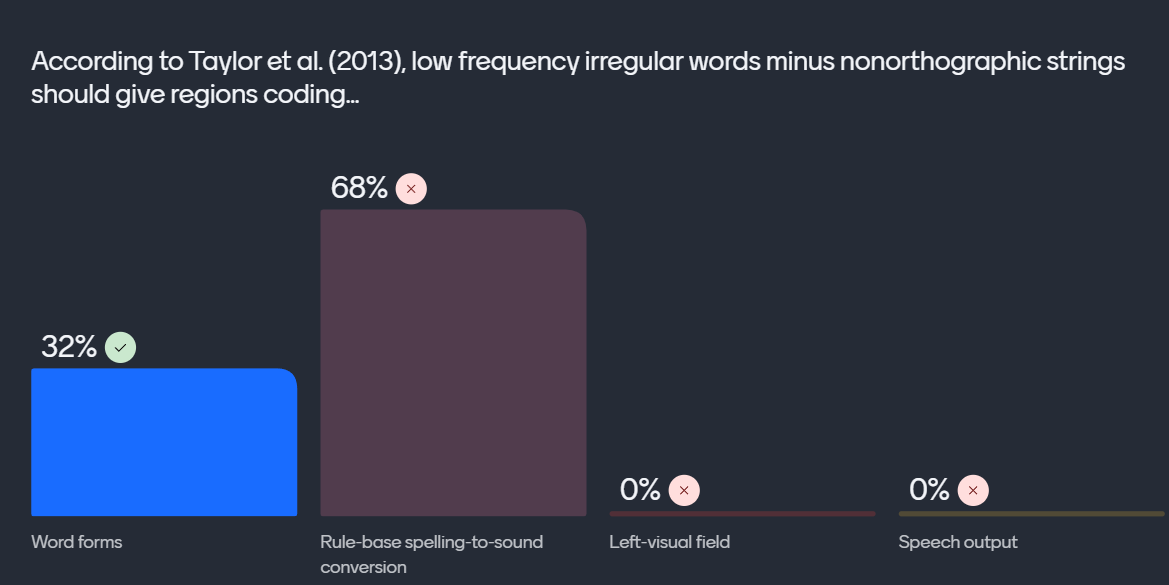
According to Taylor et al. (2013) peaks of activity in a specific brain region indicate
heightened cognitive effort
increase in fuel = reactive to stimulus
nonothorgraphic strings do not evoke the lexicon
You have reached the end of the presentation!
According to Taylor et al. (2013), pseudowords minus words gives regions coding
both rule base spelling to sound converions & speech output
peak for pesduo words
if it knows well = less effort but higher engagement
if it doesnt know well = more effort high engagement
21/03/2025 - dumay
The case of HM confirmed the link between anterograde amnesia and retrograde hypermnesia
false - hypermnesia mean that it was higher than it was before
doesnt show
You have reached the end of the presentation!
In Plihal & Born (1997), the split night protocol showed that…
In Plihal & Born (1997), the split night protocol showed that…
none of the above
declarative knowledge is promoted by SWS
procedural knowledge is promoted by REM
In Rasch et al. (2007), cued reactivation of spatial memories was obtained simply by diffusing a scent while participants were sleeping.
False → for a effect to be seen on memory needs to be during exposure & SWS
Recollecting memories that were previously inaccessible is called
reminiscence
The fact that new emotional words do not grab attention after 6 hrs of wake is in line with the notion of cellular consolidation.
False
cellular consolidation believes in the encoding phase