Myers 15: Adolescence.
Retrieving Practice.
RP-1 According to Kohlberg, morality focuses on self-interest, morality focuses on self-defined ethical principles, and morality focuses on upholding laws and social rules.
RP-1 preconventional; postconventional; conventional.
RP-2 How has Kohlberg’s theory of moral reasoning been criticized?
RP-2 Kohlberg’s work reflected an individualist worldview, so his theory is less culturally universal than he supposed.
RP-3 Match the psychosocial development stage below (i–viii) with the issue that Erikson believed we wrestle with at that stage (a–h).
Infancy
Toddlerhood
Preschool
Elementary school
Adolescence
Young adulthood
Middle adulthood
Late adulthood
Generativity vs. stagnation
Integrity vs. despair
Initiative vs. guilt
Intimacy vs. isolation
Identity vs. role confusion
Competence vs. inferiority
Trust vs. mistrust
Autonomy vs. shame and doubt
RP-3 i. g, ii. h, iii. c, iv. f, v. e, vi. d, vii. a, viii. b.
15.1: Explaining adolescence
Question 1: What is adolescence defined as?
Answer: Adolescence is defined as the transition period from childhood to adulthood, extending from puberty to independence.
Question 2: How do psychologists perceive development in modern times compared to past beliefs?
Answer: Modern developmental psychologists view development as lifelong, influenced by both maturation and experience.
In contrast to past beliefs that childhood sets our traits, the life-span perspective acknowledges that development continues beyond childhood into adolescence and adulthood.
Question 3: What factors contribute to the lengthening of adolescence in Western cultures?
In Western cultures, adolescence is lengthening due to earlier sexual maturation and delayed attainment of independent adult status.
This shift is influenced by cultural norms and socio-economic factors.
Question 4: Describe the psychological experience of adolescence according to G. Stanley Hall.
Answer: G. Stanley Hall described adolescence as a period of "storm and stress," characterized by tension between biological maturity and social dependence. This stage is marked by diminishing parental control and a craving for social acceptance, often accompanied by feelings of social disconnection.
Stanley Hall was one of the first psychologists to describe adolescence, emphasizing the tension between biological maturity and social dependence during this stage
Question 5: How do social relationships evolve during adolescence?
Answer: Social relationships during adolescence undergo significant changes, with many friendships formed during early adolescence dissolving by the end of middle school. Social disconnection during this period increases the risk of substance abuse and depressive symptoms.
Question 6: What are the contrasting perceptions of adolescence among individuals raised in Western cultures?
Answer: For many individuals raised in independence-fostering Western cultures, adolescence is remembered as a challenging time marked by the imperative need for peer approval, uncertainty about life direction, and feelings of alienation from parents. However, others view adolescence as a time of vitality, rewarding friendships, heightened idealism, and exciting possibilities.
Physical Development
Question 1: What marks the beginning of adolescence in terms of physical development?
Answer: Adolescence begins with puberty, which is the time when individuals mature sexually. Puberty is characterized by a surge of hormones that trigger various bodily changes.
Question 2: What determines the timing of puberty?
Answer: While the sequence of physical changes during puberty is relatively predictable, the timing varies significantly among individuals.
For example, some girls may start their growth spurt as early as age 9, while some boys may not experience it until age 16.
Question 3: What challenges are associated with early maturation during adolescence?
Answer: Early maturation during adolescence can present challenges, particularly in terms of mental health. Research indicates that early maturing adolescents, especially those with emotionally reactive temperaments, may be more susceptible to mental health problems due to puberty-related stress and difficulties.
Girls who mature early but are emotionally immature compared to their peers may face social challenges such as associating with older adolescents, experiencing teasing or sexual harassment, and developing anxiety or depression.
Question 6: How do early maturation and emotional maturity impact social interactions during adolescence?
Answer: Early maturation, coupled with emotional immaturity, may lead adolescents to associate with older peers, face social difficulties such as teasing or harassment, and experience anxiety or depression.
The Teenage Brain
Question 1: What characterizes the development of the adolescent brain?
Answer: The adolescent brain undergoes a process of selective pruning of unused neurons and connections, which occurs after a surge of hormones during puberty. Additionally, the frontal lobes continue to develop during adolescence, leading to improvements in judgment, impulse control, and long-term planning.
Question 2: How does myelination contribute to brain development during adolescence?
Answer: The continuing growth of myelin, a fatty tissue that surrounds axons and speeds up neurotransmission, occurs during adolescence. This process enhances communication between different brain regions and contributes to the maturation of the frontal lobes, resulting in improved cognitive functions.
Question 4: Why do teenagers often exhibit impulsivity and engage in risky behaviors?
Answer: Teenagers' occasional impulsiveness and engagement in risky behaviors can be attributed to the lagging development of the frontal lobes compared to the emotional limbic system. Puberty-related hormonal surges and limbic system development contribute to teenagers' susceptibility to emotional storms and impulsive actions.
Question 5: How does brain development explain teenagers' susceptibility to risky behaviors?
Answer: Teenagers' brains are biased toward immediate rewards, which can lead to a preference for risky behaviors despite understanding the associated risks. This tendency is due to the incomplete development of the frontal lobes, which are responsible for impulse control and long-term planning.
Question 6: How does the maturation of the adolescent brain progress until approximately age 25?
Answer: The frontal lobes continue to mature until about age 25, becoming better connected with the limbic system and enabling improved emotion regulation. However, heavy drinking during adolescence can impair brain development, leaving individuals prone to impulsivity and addiction. (Alcohol slows down brain development)
Question 7: How did the American Psychological Association (APA) contribute to legal decisions regarding juvenile offenders?
Answer: The APA, along with other medical and mental health associations, filed U.S. Supreme Court briefs arguing against the death penalty for 16- and 17-year-olds. These briefs highlighted the immaturity of the teen brain in decision-making areas, supported by brain scan evidence showing frontal lobe immaturity among juvenile offenders and drug users. This advocacy contributed to legal decisions declaring juvenile death penalties unconstitutional and opposing mandatory sentencing of juveniles to life without parole.
15.2: Cognitive Development
Question 1: How did Piaget describe adolescent cognitive development?
Answer: Piaget described adolescent cognitive development as reaching the stage of formal operations, characterized by the ability to think abstractly and apply abstract reasoning to various situations. Adolescents at this stage can contemplate hypothetical scenarios, deduce consequences, and analyze inconsistencies in reasoning, leading to a deeper understanding of complex concepts. (Age 11 and up)
Question 2: What is egocentrism, and how does it manifest in adolescence?
Answer: Egocentrism is the tendency to view the world from one's own perspective, often leading to difficulty understanding the perspectives of others. In adolescence, egocentrism persists, and reasoning is frequently self-focused.
Adolescents may also develop an imaginary audience, imagining that others are constantly observing and judging them, contributing to heightened self-awareness and concern about others' opinions.
Question 3: What is the concept of the "personal fable," and how does it relate to adolescent cognition?
Answer: The personal fable refers to adolescents' belief that they are unique and invulnerable, leading them to believe that they are immune to negative consequences that may befall others. Adolescents may engage in risky behaviors, such as substance use, while believing that negative outcomes will not apply to them personally.
Question 4: How does reasoning ability change during adolescence according to Piaget?
Answer: According to Piaget, adolescents' reasoning ability advances to formal operations, allowing them to think abstractly and critically analyze concepts such as human nature, morality, and justice. They move beyond concrete thinking and may search for deeper meaning in life, exploring spirituality and questioning societal norms.
Question 5: How do adolescents' ideas about fairness evolve during cognitive development?
Answer: Adolescents' understanding of fairness shifts from simple equality to equity, where fairness is perceived as proportionate to merit. They begin to consider factors such as effort and contribution when evaluating fairness, reflecting a more nuanced understanding of justice.
Summarize each stage of Cognitive Development by Piaget
Sensorimotor Stage (Birth to 2 years):
Characteristics: During this stage, infants learn about the world through their senses and actions. reflexive behaviors and later develop object permanence, the understanding that objects continue to exist even when they are out of sight.
Age: Birth to 2 years.
Preoperational Stage (2 to 7 years):
Characteristics: Children in this stage develop symbolic thinking and language skills. NOT logical reasoning. They are egocentric and tend to focus on a single aspect of an object (centration).
Age: 2 to 7 years.
Concrete Operational Stage (7 to 11 years):
Characteristics: Children in this stage become more capable of logical thought and conservation. can easily understand concrete concepts and truths
Age: 7 to 11 years.
Formal Operational Stage (11 years onwards):
Characteristics: In this stage, adolescents gain the ability to think abstractly and hypothetically. They can engage in deductive reasoning.They can think about possibilities and hypothetical situations beyond the concrete.
Age: 11 years onwards.
Developing Morality
Question 1: What are two essential tasks of childhood and adolescence related to morality?
Answer: Two crucial tasks related to morality during childhood and adolescence are discerning right from wrong and developing character, which involves strengthening the psychological abilities to control impulses and make ethical decisions.
Question 2: How does empathy development contribute to moral development in adolescence?
Answer: Adolescents continue to develop their ability to empathize with others, which plays a significant role in moral development. Empathy enables individuals to understand and share the feelings of others, fostering a sense of compassion and consideration for the well-being of others, thus guiding moral actions.
Question 3: According to Piaget and Kohlberg, how does moral reasoning influence moral actions?
Answer: Piaget and Kohlberg proposed that moral reasoning serves as a guide for moral actions. They suggested that individuals progress through stages of moral development, where their reasoning about right and wrong becomes more sophisticated and principled, influencing their moral decision-making and behavior.
Question 4: What is the newer perspective on moral functioning based on psychological research?
Answer: A newer perspective on moral functioning acknowledges that much of our moral behavior occurs unconsciously and automatically, rather than solely through deliberate, conscious thinking. This perspective aligns with psychology's recognition of both the "high road" of deliberate reasoning and the "low road" of automatic processes in human functioning.
Question 5: Provide an example illustrating the influence of moral reasoning on behavior, as seen in a real-life context.
Answer: The personal correspondence from an incarcerated individual in Michigan reflects the influence of moral reasoning on behavior. Despite being involved in a serious crime at the age of 17, the individual expresses remorse and regret over their actions, indicating a moral understanding and personal growth gained through their experience in prison. This example demonstrates the connection between moral reasoning and subsequent actions, even in complex and challenging circumstances.
Moral Reasoning
Question 1: What is Lawrence Kohlberg's contribution to the understanding of moral reasoning?
Answer: Lawrence Kohlberg sought to describe the development of moral reasoning by posing moral dilemmas to individuals across different ages and analyzing their responses. He proposed three basic levels of moral thinking: preconventional, conventional, and postconventional, forming a moral ladder that individuals progress through as they mature.
Question 2: Describe the characteristics and focus of each of Kohlberg's levels of moral thinking.
Answer:
Preconventional morality (before age 9): Focuses on self-interest and obedience to rules to avoid punishment or gain rewards. Example: "If you steal the medicine, you will go to jail."
Conventional morality (early adolescence): Upholds laws and rules to gain social approval or maintain social order. Example: "We are supposed to take care of our loved ones, so you should steal the drug."
Postconventional morality (adolescence and beyond): Actions reflect belief in basic rights and self-defined ethical principles. Example: "People have a right to live."
Question 3: What criticisms have been raised regarding Kohlberg's theory of moral development?
Answer: Critics of Kohlberg's theory argue that the postconventional stage is culturally limited, as it is more prevalent in individualistic societies that prioritize personal goals over collectivist societies that emphasize group goals. Additionally, the theory has been criticized for its male-focused perspective, as women tend to prioritize care for others over abstract notions of fairness.
Question 4: Provide an example of how moral reasoning varies in different cultural contexts.
Answer: In collectivist societies like India, morality is often perceived as a duty based on one's role within the community rather than a matter of personal choice. This contrasts with individualistic societies where personal ethical principles may take precedence.
Question 5: How do infants and preschoolers demonstrate early moral reasoning?
Answer: Infants demonstrate early moral reasoning by showing a preference for moral actions over immoral ones. Preschoolers, typically influenced by their cultural group, conform to and enforce moral norms, displaying behaviors such as helping others when norms reward kind actions.
Question 6: Provide a real-life example of a moral dilemma and explain how individuals' moral reasoning might influence their responses.
Answer: The moral dilemma faced by Bahamians after Hurricane Dorian in 2019, regarding whether to take in family and friends who had lost their homes, likely elicited varied responses reflecting different levels of moral thinking. Individuals may have based their decisions on considerations of self-interest, social approval, or broader ethical principles, as outlined in Kohlberg's levels of moral reasoning.
Moral Intuition
Question 1: According to Jonathan Haidt, what is the role of moral intuitions in shaping morality?
Answer: Jonathan Haidt proposes that much of our morality is rooted in moral intuitions, which he describes as "quick gut feelings." He suggests that the mind makes moral judgments in a manner similar to aesthetic judgments, quickly and automatically, with feelings of disgust or elation triggering moral reasoning.
Question 2: Provide an example illustrating the influence of moral intuitions on behavior, as described by Haidt.
Answer: Haidt presents an example of witnessing unexpected kindness triggering feelings of elevation, prompting an emotional response characterized by a desire to express gratitude and positivity towards others. This example illustrates how moral intuitions can influence behavior and emotional experiences.
Question 3: How does Haidt suggest that moral reasoning operates in relation to moral intuitions?
Answer: Haidt wonders whether moral reasoning merely serves as a rationalization of the intuitive moral judgments that arise from emotional reactions. He proposes that moral reasoning functions as the mind's "press secretary," aiming to convince individuals and others of the logic behind their intuitively felt moral judgments.
Question 4: Describe the findings of laboratory games regarding the desire to punish wrongdoing, as discussed by Haidt.
Answer: Laboratory games reveal that the desire to punish wrongdoing is primarily driven by emotional reactions, such as moral outrage and the pleasure of revenge, rather than rational considerations, such as the objective calculation of deterrence. Moral reasoning tends to follow emotional reactions, rationalizing the intuitive moral judgments made based on emotional responses.
Question 5: What is the trolley problem, and how does it demonstrate the influence of moral intuitions on moral judgments?
Answer: The trolley problem presents a moral dilemma where individuals must decide whether to divert a runaway trolley onto a track where it will kill one person instead of five. Most people agree to pull the switch in this scenario. However, when the scenario is modified to involve physically pushing a person onto the tracks to save others, most people refuse to do so. This demonstrates how moral intuitions, rooted in emotional responses, can override rational moral reasoning, leading to different moral judgments in similar situations.
Question 6: Explain the concept of dual processing in moral cognition, as described by Haidt.
Answer: Haidt describes moral cognition as having two tracks: intuitive moral emotions and moral reasoning. Intuitive moral emotions, rooted in specific brain areas, often override moral reasoning in influencing moral judgments. This concept aligns with dual processing theory, where both intuitive and rational processes contribute to decision-making.
Moral Action
Question 1: How does social influence impact moral action, according to the observations of Hannah Arendt?
Answer: According to Hannah Arendt, many Nazi concentration camp guards during World War II were ordinary people who became involved in morally reprehensible actions due to the powerful influence of the situation they were in. This observation highlights the significant impact of social context on moral behavior.
Question 2: Describe the focus and outcomes of character education programs, as discussed in the text.
Answer: Character education programs aim to cultivate moral development by focusing on the integration of moral thinking, feeling, and action. These programs often involve service-learning initiatives where teens engage in activities such as tutoring, neighborhood cleanup, and assisting older adults. The outcomes include increased sense of competence and desire to serve, decreased school absenteeism and dropout rates, and reduced violent behavior among participants.
Question 3: How do character education programs teach self-discipline, and what are the benefits associated with it?
Answer: Character education programs teach self-discipline by promoting the ability to delay gratification and restrain one's impulses. Individuals who have learned to delay gratification tend to exhibit greater social responsibility, academic success, and productivity. Additionally, they are less likely to engage in problem behaviors such as gambling, smoking, and delinquency.
Question 4: Describe Walter Mischel's marshmallow experiment and its implications for understanding self-discipline and success.
Answer: In Walter Mischel's marshmallow experiment, children were given the choice between receiving one marshmallow immediately or waiting to receive two marshmallows later. Those who were able to delay gratification and wait for the larger reward demonstrated higher rates of college completion, higher incomes, and fewer addiction problems later in life. This experiment highlights the importance of self-discipline and the ability to delay gratification in achieving long-term success.
Question 5: What is the significance of the replication of Walter Mischel's marshmallow experiment, as mentioned in the text?
Answer: While a replication of Walter Mischel's marshmallow experiment found a more modest effect compared to the original study, the fundamental idea remains unchanged: delaying gratification fosters maturity and life success. The ability to forgo immediate pleasures in favor of greater rewards in the future is associated with flourishing and positive outcomes in various aspects of life.
Question 6: Provide a quote from the text that encapsulates the importance of taking action aligned with moral principles.
Answer: "It is a delightful harmony when doing and saying go together." - Michel Eyquem de Montaigne (1533–1592) This quote emphasizes the significance of aligning one's actions with moral principles, highlighting the importance of integrity and consistency in moral behavior.
15.3: Social Development
Question 1: What did Erik Erikson propose regarding the psychosocial task of adolescence?
Answer: Erik Erikson proposed that adolescence is characterized by a psychosocial task known as identity versus role confusion. During this stage, teenagers work on refining their sense of self by exploring various roles and integrating them to form a coherent identity. Failure to achieve this integration can lead to confusion about one's identity.
Question 2: Explain the concept of identity versus role confusion as described by Erikson.
Answer: According to Erikson, identity versus role confusion is the psychosocial task of adolescence. Teenagers engage in a process of exploring different roles and aspects of themselves, testing various identities to form a cohesive sense of self. Failure to successfully navigate this stage may result in confusion and uncertainty about one's identity.
Question 3: How does Erikson's concept of identity versus role confusion relate to the broader framework of his stages of psychosocial development?
Answer: Erikson's concept of identity versus role confusion is part of his broader framework of psychosocial development, which consists of various stages characterized by specific tasks or crises. Identity versus role confusion represents the stage that adolescents face, where they grapple with questions of self-identity and integration of different roles.
Question 4: Provide examples of questions that adolescents may ask themselves during the process of identity formation, as described by Erikson.
Answer: Adolescents may ask themselves questions such as "Who am I as an individual?", "What do I want to do with my life?", "What values should I live by?", and "What do I believe in?" These questions reflect the introspective process of identity exploration and formation during adolescence.
Question 5: How did Erikson's personal experiences influence his theories, particularly regarding adolescence?
Answer: Erikson's personal experiences, including being the son of a Jewish mother and a Danish Gentile father, shaped his interest in the adolescent struggle for identity. He experienced feelings of being an outsider due to his mixed heritage, which fueled his interest in understanding identity development during adolescence.
Question 6: Describe one of Erikson's stages of psychosocial development other than adolescence, and explain the associated task or crisis.
Answer: One of Erikson's stages of psychosocial development is intimacy versus isolation, which occurs during young adulthood (20s to early 40s). The associated task is the struggle to form close relationships and develop the capacity for intimate love. Failure to achieve intimacy may result in feelings of social isolation and emotional disconnection.
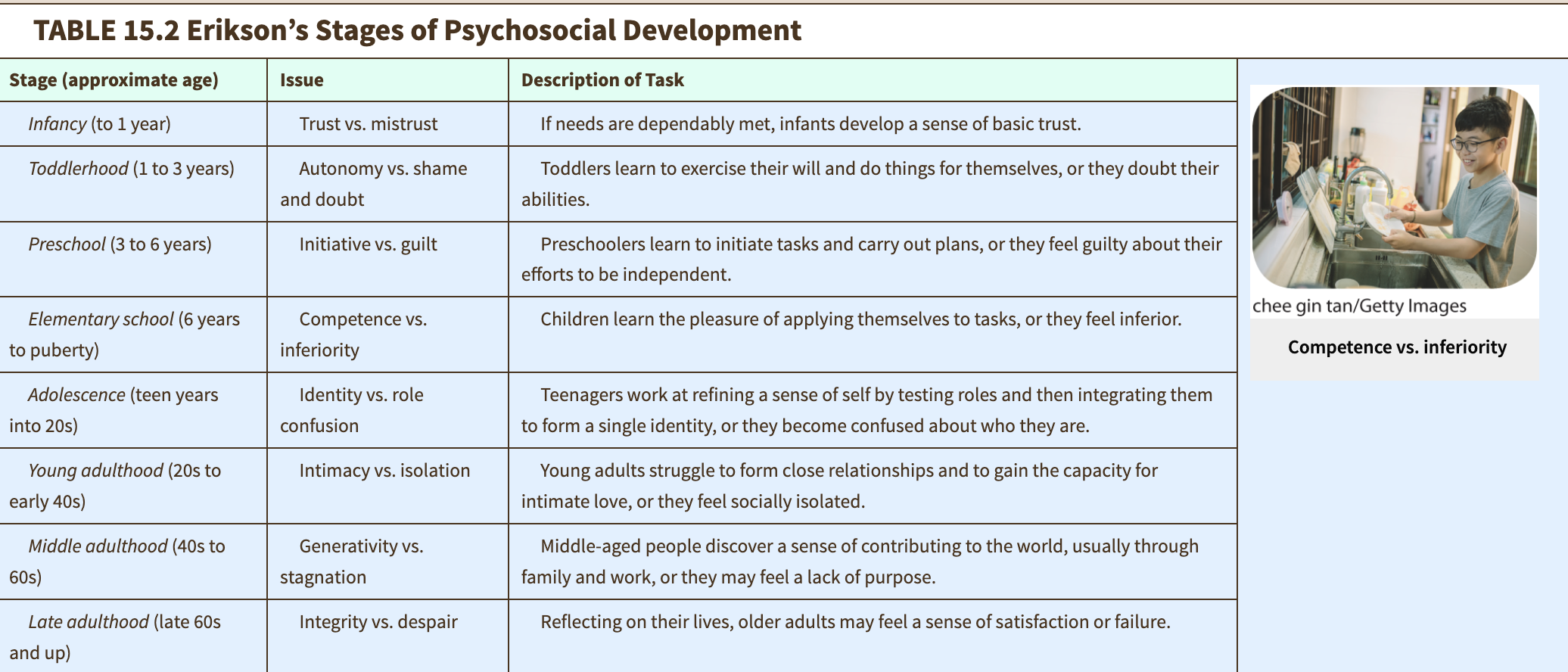
Explain each stage, its issue and give a description, for every Erikson stage of Psychosocial development (8 stages, draw it)
Here it is below !
Forming an Identity
Question 1: What is the psychosocial task proposed by Erik Erikson for adolescents, and how does it relate to the formation of identity?
Answer: Erik Erikson proposed that the psychosocial task for adolescents is the resolution of identity versus role confusion. This task involves refining one's sense of self by exploring different roles and integrating them into a cohesive identity. Adolescents grapple with questions of self-identity and strive to unify various aspects of themselves into a consistent and comfortable sense of identity.
Question 2: How do adolescents in individualist cultures typically explore and develop their identities, according to the text?
Answer: Adolescents in individualist cultures usually try out different "selves" in various situations to refine their sense of identity. They may adopt different personas at home, with friends, online, and at school. This exploration involves testing different aspects of themselves to determine which feels most authentic and comfortable.
Question 3: Describe the concept of group identities and how they are formed during adolescence.
Answer: Group identities during adolescence often form based on differences from those around us, such as gender, sexual orientation, age, wealth, abilities, and beliefs. Adolescents may become conscious of their identities based on their distinctiveness in various social contexts, such as being part of a minority ethnic or religious group, being gay or transgender, or having a disability.
Question 4: Explain the influence of cultural factors on adolescent identity formation, according to the text.
Answer: Cultural factors influence adolescent identity formation in various ways. In collectivist cultures, adolescents may adopt the identity prescribed by their families or cultural norms, whereas in individualist cultures, they are encouraged to explore and define their identities independently. Bicultural adolescents integrate multiple group memberships and navigate complex identities based on their cultural backgrounds.
Question 5: What role does purpose play in adolescent development, and how does it relate to achieving a sense of contentment with life?
Answer: Purpose plays a significant role in adolescent development, as achieving a sense of purpose involves pursuing personally meaningful goals that contribute to the world beyond oneself. Adolescents who have a clear sense of purpose are more likely to experience contentment with their lives. Purposeful pursuits provide a sense of direction and fulfillment, contributing to overall well-being.
Question 6: Discuss the impact of social media on adolescent self-esteem and mental health, as mentioned in the text.
Answer: Social media has been associated with both positive and negative effects on adolescent self-esteem and mental health. While social media platforms allow adolescents to connect with peers and explore self-expression, they also facilitate peer comparisons that can lead to feelings of inadequacy and depression. Increased exposure to idealized images and lifestyles on social media may contribute to declines in self-esteem and exacerbate mental health issues like depression and anxiety.
15.4: Parent and Peer Relationships
1. How do parents and peers influence adolescents?
Adolescence is marked by diminishing parental influence and increasing peer influence (Blakemore, 2018).
The transition from childhood to adolescence involves a gradual shift from close parental attachment to greater peer attachment.
Puberty plays a role in altering attachments and perceptions.
2. How does the parent-child relationship change during adolescence?
Parent-child relationships typically loosen during adolescence, as indicated by a national study of Canadian families (Pepler & Craig, 2012).
Arguments between parents and adolescents become more frequent, often revolving around mundane issues like household chores, bedtime, and homework (Tesser et al., 1989).
Conflict tends to be more pronounced with first-born children and with mothers compared to fathers (Burk et al., 2009; Shanahan et al., 2007).
3. What are common issues of disagreement between parents and adolescents?
Most disagreements between parents and adolescents are harmless bickering rather than major conflicts.
Sons often exhibit behavior-related issues, while daughters' concerns frequently involve relationships such as dating and friendships (Schlomer et al., 2011).
Despite disagreements, many adolescents still report liking their parents (Offer et al., 1988).
4. How do positive parent-teen relations affect adolescents?
Positive parent-teen relationships often coincide with positive peer relationships.
Adolescents who feel close to their parents tend to be healthier, happier, and perform better academically (Resnick et al., 1997).
High school girls with affectionate relationships with their mothers also tend to have intimate friendships with girlfriends (Gold & Yanof, 1985).
5. How do peers influence adolescent behavior and attitudes?
When with peers, teens focus more on immediate rewards and tend to discount the future (O’Brien et al., 2011).
Teens often emulate their peers in behavior, speech, and appearance.
Social media use illustrates the power of peer influence, with teens preferring photos with more likes and showing increased brain activity in reward processing and imitation when viewing popular photos (Sherman et al., 2016).
6. What are the consequences of exclusion and bullying by peers?
Exclusion and bullying by peers can cause acute emotional pain.
Some excluded students suffer silently, while others may act out violently against their classmates (Aronson, 2001).
Long-term consequences of bullying can include poorer physical health and greater psychological distress even decades later (Takizawa et al., 2014).
7. How do genetic factors interact with parental and peer influences during adolescence?
While heredity contributes significantly to individual temperament and personality differences, parents and peers also exert influence on teens' behavior and attitudes.
Adolescents often exhibit behaviors and attitudes that align with their peer group rather than their parents.
This interplay between genetic predispositions, parental influence, and peer influence shapes adolescent development.
15.5: Emerging Adulthood
1. What is emerging adulthood?
Emerging adulthood refers to a period of life between adolescence and full adulthood.
It is characterized by not yet assuming full adult responsibilities and independence, leading individuals to feel "in between" stages of life.
This phase typically occurs from the late teens to the mid-twenties, although it can vary depending on individual circumstances (Arnett, 2006, 2007; Reitzle, 2006).
2. How has the concept of adulthood changed over time?
In earlier times and in some parts of the world today, adolescence was shorter, and individuals assumed adult responsibilities shortly after sexual maturity, often marked by elaborate initiation rituals (Baumeister & Tice, 1986).
With compulsory schooling and changing social norms, adolescents now take more time to establish themselves as adults, leading to a prolonged transition period known as emerging adulthood.
3. What are some trends in emerging adulthood in Western societies?
Today's emerging adults are less likely to work for pay, drive, or engage in romantic relationships compared to previous generations (Twenge & Park, 2019).
The average age at first marriage has increased significantly since the 1960s, with fewer individuals meeting traditional markers of adulthood by age 30 (Henig, 2010).
A growing number of young adults are living with their parents, reflecting delayed financial independence and prolonged dependence on family support (Fry, 2017).
4. How has the transition to adulthood changed over time?
The transition to adulthood has been stretched from both ends, with a widening gap between biological maturity and social independence (Finer & Philbin, 2014; Guttmacher Institute, 1994).
Factors such as delayed marriage, prolonged education, and earlier onset of puberty contribute to the lengthening of this transition period.
This transition is particularly pronounced in well-off communities, where the gap between first menstruation and marriage has increased to about 14 years (Finer & Philbin, 2014).
5. What are some characteristics of emerging adulthood?
Emerging adults often experience a sense of exploration and identity development, as they navigate educational, career, and relationship choices.
They may experience greater autonomy in managing their time and priorities, but may still rely on parental support emotionally and financially (Fry, 2017).
The U.S. government recognizes this extended phase by allowing dependent children up to age 26 to remain on their parents' health insurance (Cohen, 2010).
6. How does emerging adulthood differ across cultures?
While emerging adulthood is most commonly observed in Western societies, variations exist across cultures based on factors such as socioeconomic status, cultural norms, and educational opportunities.
In some cultures, the transition to adulthood may be marked by different milestones and expectations, leading to variations in the duration and characteristics of emerging adulthood.