Stoichiometry
Solute: Gets dissolved
Solvent: Does the dissolving
Solution: Cmbined product
Salt(solute)+Water(solvent)=Saltwater(solution)
Matter
CHEMISTRY—the reason why we're here! Also, the study of matter, its composition, and how it changes.
Matter has these characteristics:
Is made up of particles-atoms, molecules, or ionsIts particles are in constant motion
Has mass
Occupies a volume in space
Early scientific observations of matter led to the idea that it has a fundamental unit, which we now know as the element.
Elements are the primary constituents of matter, as they cannot be chemically broken down into simpler substances.
Compounds vs. Mixtures
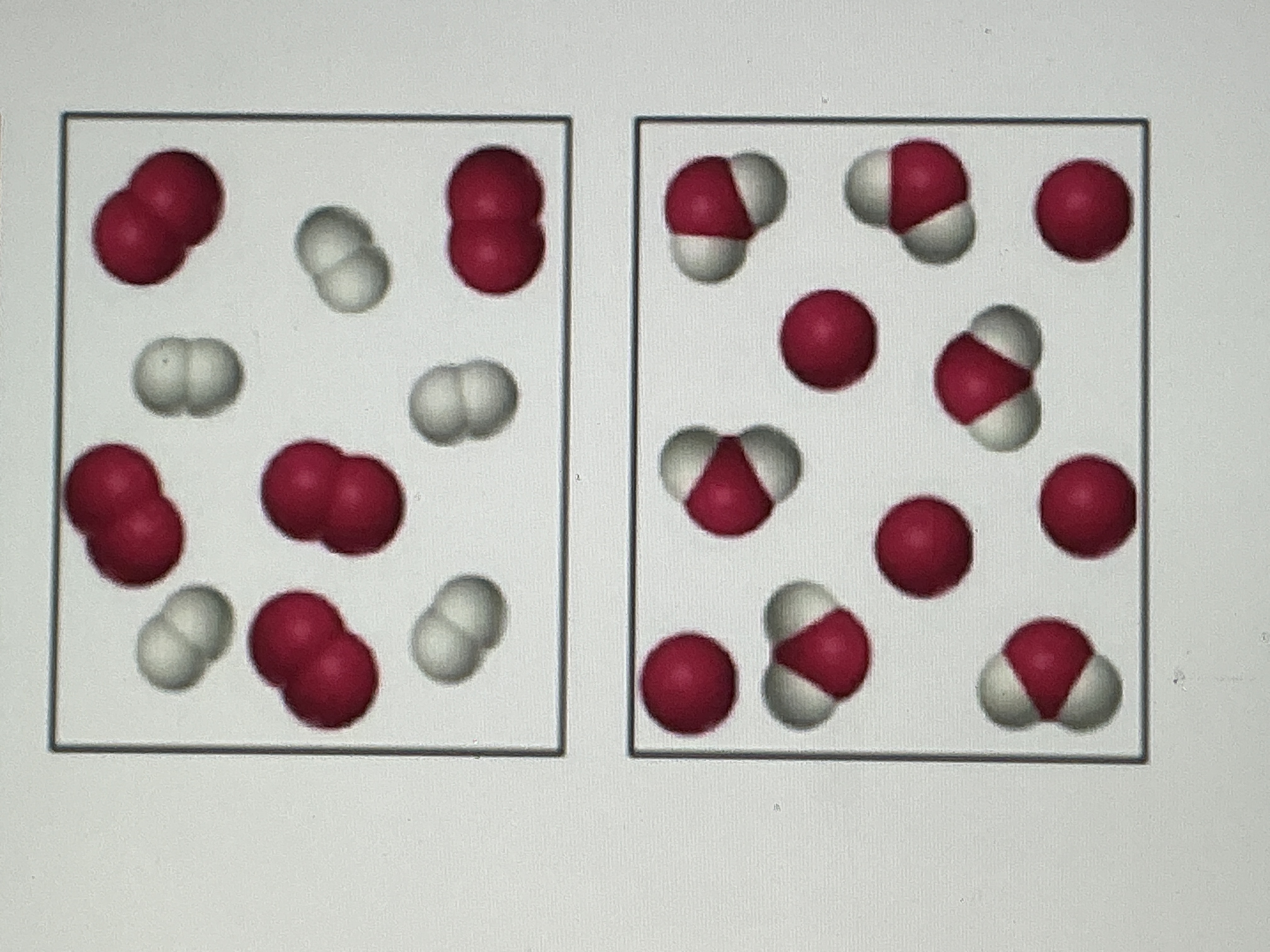
A compound consists of atoms of different elements, chemically bonded together in a fixed ratio.
Compounds contain 2 or more different elements (so something like O
2 is not a compound, but a molecule).Compounds have completely different properties than the elements that make them up.
Na is a highly reactive metal, Cl2 is a pousonous gas but we put NaCl in our food without a secoind thought.
The number and type of atoms given in a compound is determined by it’s chemical formula

A mixture contains more than one element or compound in no fixed ratio, which are not chemically bonded to each other and so can be separated by physical methods.

Compound or Mixture?

TYPES OF MIXTURES
Homogeneous Mixtures:
have a uniform composition and properties throughout
You can’t differentiate between the parts of the mixture
Example: seawater(a mixture of salt and water, but you can’t see the salt)
Heterogenous Mixtures:
have a non-uniform composition and sometimes multiple phases of matter
You can see the different components of the mixture
Example: Pizza because you can see the components of it
Categorize: Is it homogenous or heterogenous?
H2SO4
Whipped Cream
Black Tea
Household Bleach
Mixture of salt and sand
Orange juice with pulp

Separation Methods:
pure substances cannot be separated into individual components by physical means
A chemical reaction is required for this which alters the substance’s properties
Mixtures, however, can be separated into individual components by physical means retaining their respective physical property properties
This is because each component of the mixture has unique properties
There are six methods of separation we will learn for IB
Solvation
Filtration
Recrystallization
Evaporation
Paper chromatography
SOLVATION
This separates and purifies components in a mixture based on their differing solubilities in two or more different solvents.(typically water)
Ex: Separating salt from sand
FILTRATION
Separating an insoluble solid from a liquid by passing the mixture through a porous barrier. The solid stays behind as the residue, the liquid that passes through is the filtrate.
The solid is left on paper is the product whole the liquid below is filtrate
Great for quickly isolating crystals
Ex: Separating Sand From Water
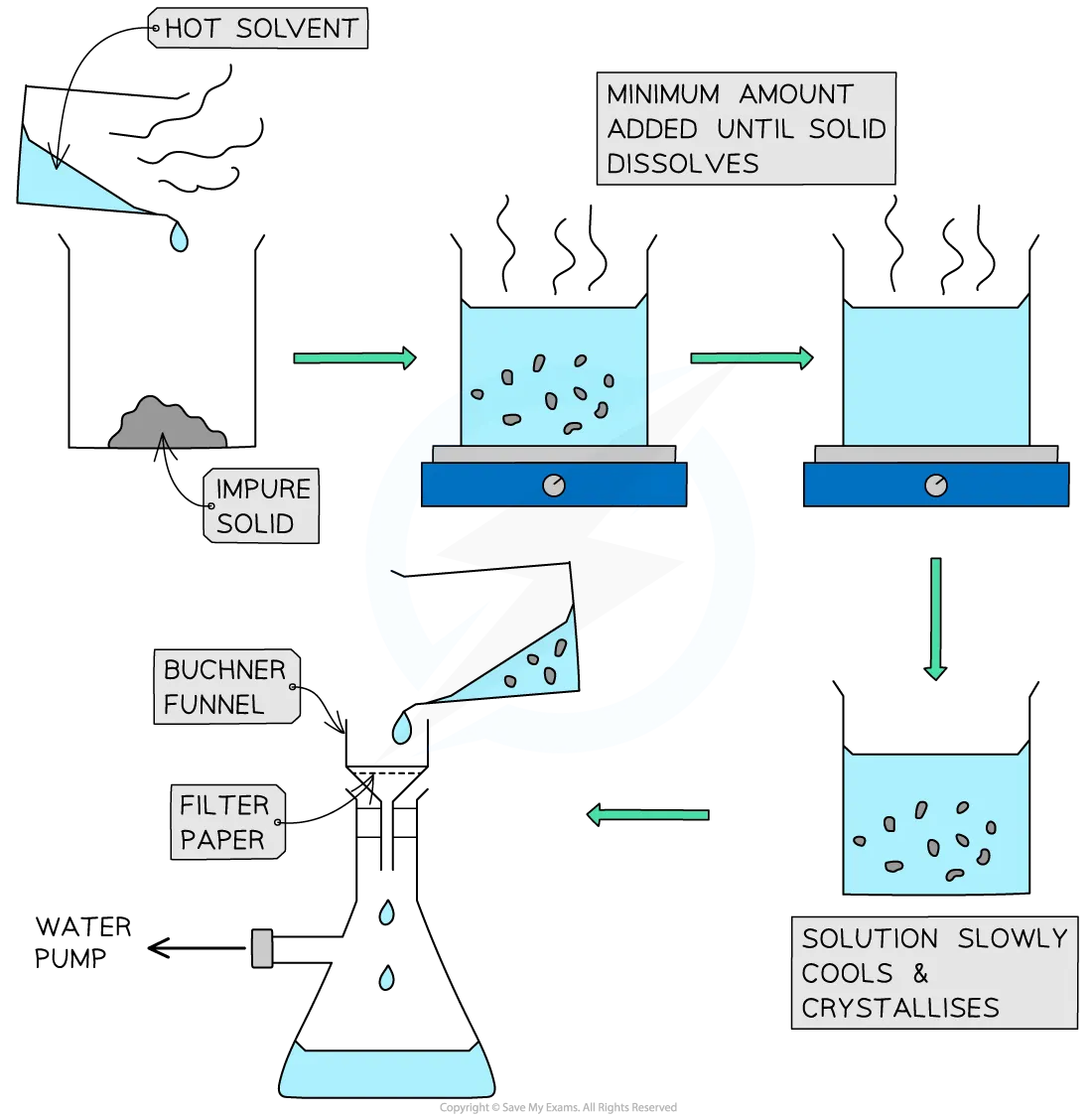
RECRYSTALLIZATION
Purifying a solid by dissolving it then letting it form purer crystals. Soluble impurities stay in solution.
EVAPORATION
Separating a soluble solid from a liquid by heating off the solvent. The solid stays as a residue
DISTILLATION
Separating liquids with different boiling points by vaporizing then condensing
Have to know the boiling point

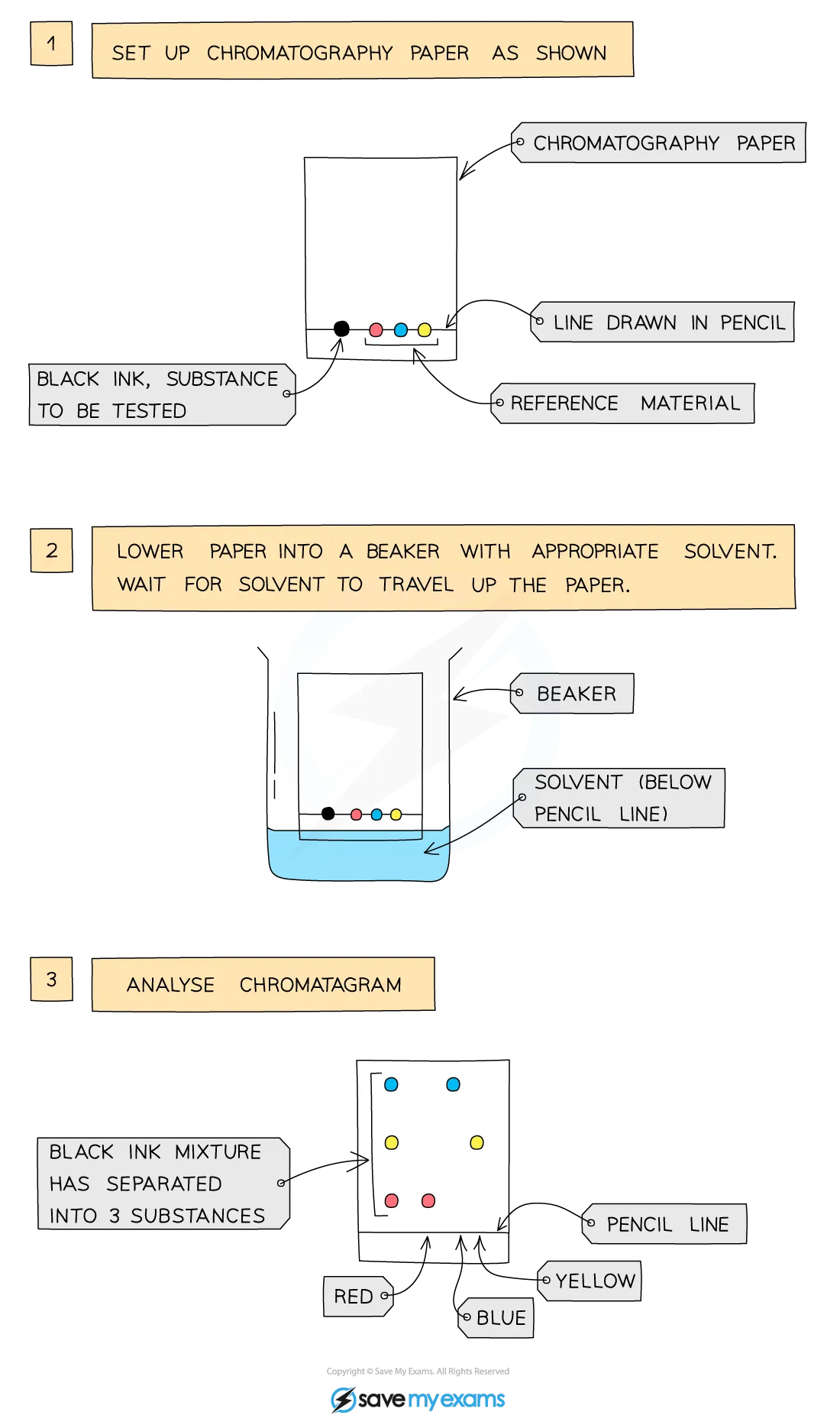
PAPER CHROMATOGRAPHY
Separating components of a mixture based on how far they travel up paper with a solvent. More soluble/less attracted to paper=travels faster
Gives glimpse of what colors are present
Desalination: Filtration in the UAE
One unique application of filtration is desalination - how most of our drinking water is produced in the UAE
One technology that enables desalination is called reverse osmosis where seawater is passed through a membrane at high pressure so salt and other substances can be removed.
PART 2:
Kinetic Molecular Theory
All particles have some quantity of kinetic energy regardless of state of matter, so matter and energy are closely linked
The kinetic molecular theory of matter uses this link to explain physical properties and behaviors of solids, liquids, and gases, as well as change of state.

Changes of State
Matter can change state, reversibly, depending on its kinetic energy.
substance state of matter is shown by letters in brackets after the formula.
solid(s)
liquid(l)
gas(g)
Diagram

From liquid to gas: evaporation includes vaporization and boiling at or above ph
Heating and Cooling Curves
Temperature: measure of the average kinetic energy of a sampe, in hotter substance particles are moving around more
Heating/Cooling Curve is a line graph that represents the changes in state of matter that occur as heat is added to or removed from a substance
These curves show states of matter as well as melting point and boiling point which are represented by the flat portions of the graph

HEATING CURVE - WHAT HAPPENS AT EACH STAGE
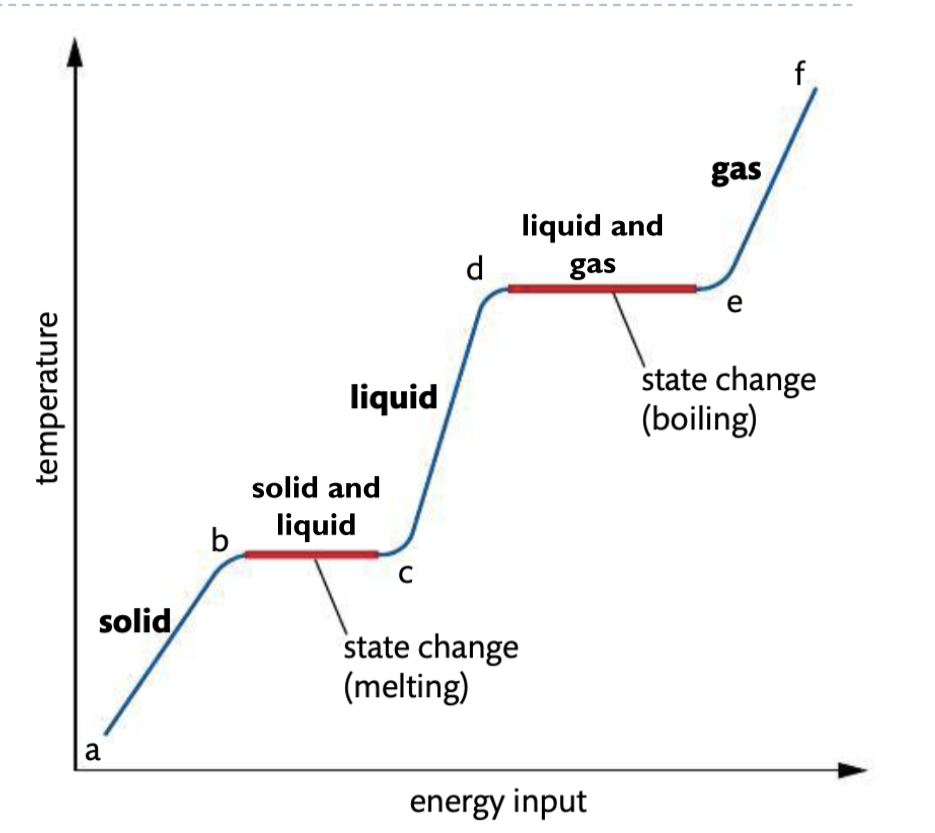
a→b: As the solid is heated, the kinetic energy of particles increases, increasing temperature.
b→c: Melting Point: All energy added is used to start to break the forces between particles so temperature stars constant. Particles are no longer locked in their positions as solids.
c→d: liquid is heated, and kinetic energy of the particles increases, increasing temperature.
d→e: Boiling Point: Now there is enough energy to completely break the forces between particles to form a gas. Temperature remains constant. Notice more energy is required, no longer a flat line, because all forces between particles are broken, rather than just some.
e→f: Gas is heated, and kinetic energy of particles increases, increasing temperature
SCALES OF TEMPERATURE
We know that temperature is dependent upon the average knetic energy of the particles in a substance
Many attempts were made to measure relative temperature, but the first widely accepted scale was that of physicist Daniel Fahrenheit.
This scale was based on the freezing point of brine and human bdy temperature
Now of course we use the Celsius scale in science which is based on the freezing and boiling points of water(0C and 100C).

CELSIUS & KELVIN
Celsius, while useful for temperatures encountered in everyday human experience, it is only a relative scale, its zero value has been arbitarily assigned.
The Kelvin scale however is an absolute scale where values of kelvin are directly proportional to the average kinetic energy of particles in the substance.
Absolute zero: implies zero kinetic energy at this temperature
One kelvin unit has the same incremental valus as one celcius degree so an increase of kelvin is the equivalent of an increase in 1Celsius.
Kelvin is the SI base unit of temperature
CONVERTING BETWEEN CELSIUS AND KELVIN
Since values on the celsius and kelvin scales are just shifted by 273.15 degrees, with the same size unit of temeprature, it is simple to convert between the two:
K=C+273.15