Carl Jung
Definition (#f7aeae)
Important (#edcae9)
Extra (#fffe9d)
Carl Jung disagreed with freud on:
Role of sexuality.
Forces that influence personality.
Unconscious.
Psychic Energy:
Basis of Jung’s system.
Libido: Broad and generalized form of psyche energy.
Psyche: Term for personality.
Principles of Psyche Energy:
Opposition principle: Conflict between processes required to generate psychic energy.
Equivalence principle: Continuous redistribution of energy, weakened energy is sent elsewhere.
Entropy principle: Tendency towards balance or equilibrium.
Aspects of Personality:
Ego:
Conscious part of the psyche.
Selective about what’s admitted into the awareness.
Attitudes:
Extraversion: Orientation towards external world and others.
Introversion: Orientation towards one’s own thoughts and feelings.
Psychological functions:
Ways of perceiving a person’s external and internal world.
Non-rational: Sensing, intuition.
Rational: Thinking, feeling.
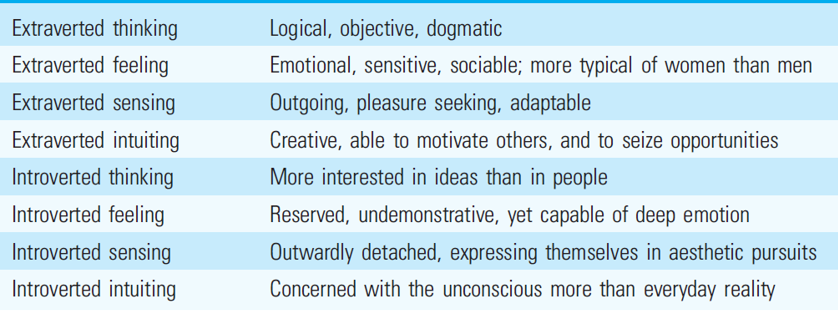
Psychological types:
Personal unconscious:
Reservoir for material that was once conscious.
Complexes:
Pattern of emotions, memories, perception and wishes in the personal unconscious.
Organised around a theme, may be conscious or unconscious.
The collective unconscious:
Deepest level of the psyche.
Contains the accumulation of inherited experiences of human and pre-human species.
Archetypes:
Images of universal experiences in the collective unconscious.
Persona: Public face or role presented to others.
Shadow: Contains primitive animal instincts.
Self: unity, integrity and harmony of the total personality.
Animus: Masculine aspect of the female psyche.
Anima: Feminine aspect of the male psyche.
Developmental Stages:
Childhood | Ego development begins when child distinguishes between self and others. |
Puberty - Young Adulthood | Adolescents must adapt to the growing demands of reality. The focus is external (education) and the conscious was determined. |
Middle Age | Period of transition when the focus of the personality shifts from external to internal to balance the unconscious with the conscious. |
Individuation: Integration of all conscious and unconscious facets of personality.
Transcend → Accept anima/animus → Accept the dark side → Dethrone the persona → Confront the unconscious.
Assessment Techniques:
Word-Association Test:
Person responds to a stimulus word with any word that comes to mind.
Projective technique.
Uncovers complexes.
Symptoms Analysis:
Similar to catharsis.
Verbal report of symptoms.
Interpretation of free association.
Dream Analysis:
Interpretation of dreams to uncover unconscious content.
Held that dreams are prospective and compensatory.
Used amplification to analyze dreams.
Myer-Briggs Types Indicator (MBTI):
Based on Jung’s psychological types and attitudes.
Popular self-report inventory.
Used for hiring.
Conclusions:
Research:
Used life-history reconstruction:
Examined past experience to identify developmental patterns.
Analysis of data was subjective and unreliable:
No verbatim and verification of accuracy.
Research on different psychological types (introvert/extrovert).
Research on female midlife crisis.
Contributions:
Word association became a standard projective technique.
Development of Rorschach inkblot test and lie-detection techniques.
Influenced future theorists.
Emphasize the role of future in determining behavior.
Midlife crisis is supported by considerable research.
Criticism:
Concepts are difficult to understand.
Writings are inconsistent and lack systemization.
Embraced the supernatural.