Skepticism and Modern Science
Reformation, war, uncertainty
The Protestant Reformation in the 16th century plunges Europe into war and division for over a century
16th and 17th centuries saw broad assault on traditional sources of authority
Increasing pessimism about:
Ability to understand scripture
Ability to arrive at religious consensus
Trustworthiness of religious leaders
Trustworthiness of one’s own conscience
Trustworthiness of the mind’s ability to grasp truth at all
there is only the seemingness of truth to the mind
Montaigne and Pyrrhonian Skepticism
Thinkers like Michel de Montaigne (1533-1592) began to revive an ancient school of philosophy called skepticism
Montaigne was skeptical, not about religous faith or authority, but about the possibility of genuine human knowledge.
he believes that philosophy and science is incapable of firmly grounding our knowledge about the world, ethics, or even oursleves
The role of philosophy, he says, is serving as a check on our pride: good philosophy will demonstrate how inadequate all our reasoning is to establish anything with certainty
to show how little we know
I’m a little dumb bitch and philosophy will humble me rq
The skeptical argument against sense information
This sensory information that we intake is subject to variable from species to species and person to person
Different animals, and different humans, perceive the world in different ways
At most one way of perceiving the world can be completely accurate
There is no way for us to tell whether or not what appears to us to be true is a more accurate way of perceiving the world than that appears to others to be true
Therefore, we cannot say thta our way of perceiving the world is the most accurate way
From this argument, skeptics conclude that we should not take our senses to be telling us anything about the fundamental natures of things in the external world
The skeptical argument against sense information
Different animals, and different humans, perceive the world in different ways
At most one way of perceiving the world can be completely accurate
There is no way for us to tell whether or not what appears to us to be true is a more accurate way of perceiving the world than what appears to others to be true
Therefore, we cannot cay that our way of perceiving the world is the most accurate way
From this argument, skeptics conclude that we should not take our senses to be telling us anything about the fundamental natures of things in the external world
the skeptical argument against a criterion of truth
A “criterion of truth” is a standard that provides us with some basis for thinking some things true and some things false
Suppose there is some criterion of truth
If there is a criterion of truth, then there must be a criterion to tell us whether ot not it is a truthworthy criterion
If there is a criterion for our criterion, then that must eb either (1) a new criterion or (2) the same criterion
If (1), then we get an infinite regress
If (2), then we get a circularity
So there is no satisfying answer for why the criterion for truth is a good criterion
Therefore, we should suspend judgement about the criterion
If there is no criterion for truth, the skeptics conclude, we should live based soley on appearances
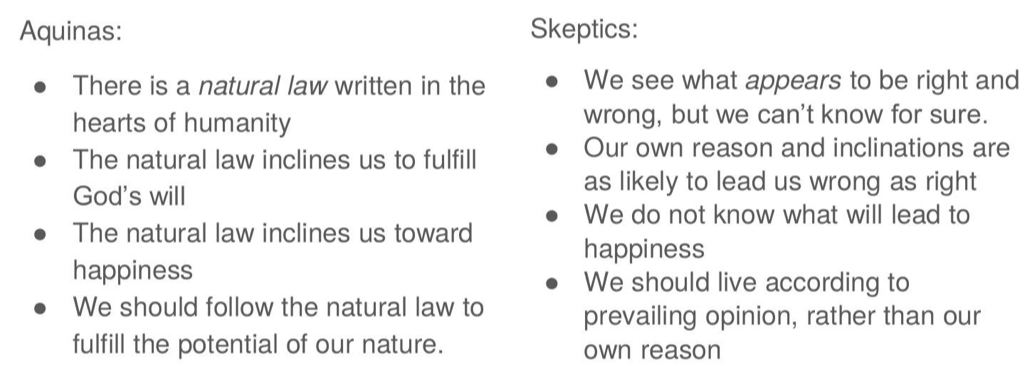
the scholastic vs. skeptical approach to ethics
Scientific rationalism: historical background
Against the background of dissatisfaction with prevailing modes of though, a new philosophy, with its own pretensions to knowledge, arises
This philosophy is associated with the Copernican Revolution
Copernicus, Kepler, and Galileo propose a new geometry with the sun at the center of the solar system
This theory is not (initially) any more accurate or useful than the prevailing geocentric view, but it quicky catches on because of its greater simplicity
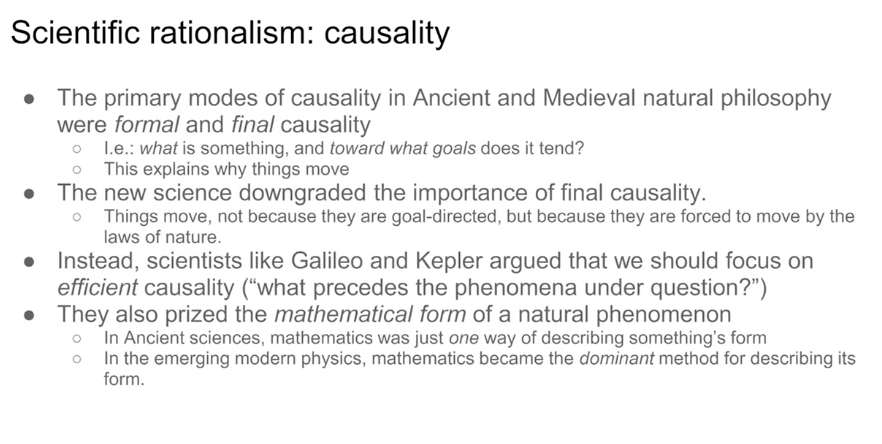
Central tenet of the new science: knowledge of the natural world is based on the ability to identify mathematically clear laws that govern mechanical interactions among material things
Scientific rationalism: the world as machine
When designing a machine, we are interested in precise, mathematical descriptions that predict how the machine will work
When looking at the physical world, the new scientists of the 16th and 17th centuries were similarly interested in mathematical description and prediction
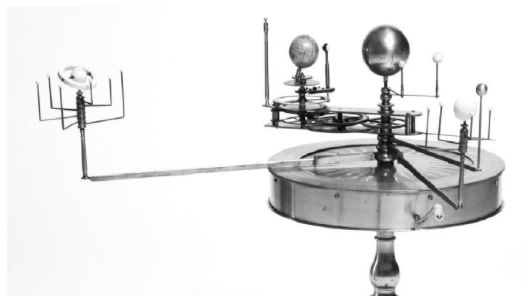
While before, the universe was interpreted under a biological model, now the universe becomes interpreted under a mechanical model