Chapter 21: Organic Chemistry
Functional Groups
Importance of Organic Compounds
All living things are primarily composed of carbon compounds, making them "carbon-based" life forms.
Organic compounds were historically viewed as unique substances from living matter not synthesizable artificially. This view was called vitalism.
Friedrich Wohler disproved vitalism by synthesizing urea (1832) from non-living materials.
Modern definitions classify organic compounds as carbon-containing and include both natural and synthetic compounds, excluding some like carbonates, cyanides, and oxides (CO, CO2).
Organic compounds are significant in daily life (plastics, pharmaceuticals, fuel, etc.).
20.1 Intro
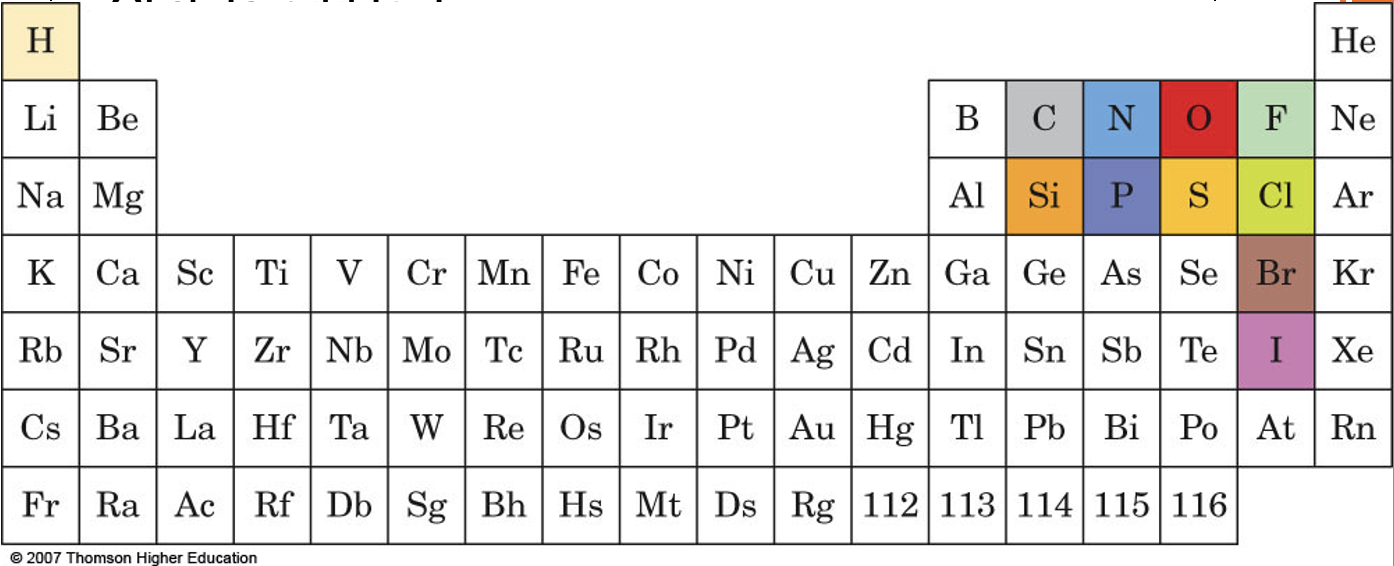
carbon + hydrogen is the basic framework for all organic molecules
Carbon
shares electrons to achieve an octet → stable bonds → 4 covalent bonds
tetravalent = likes to have 4 bonds
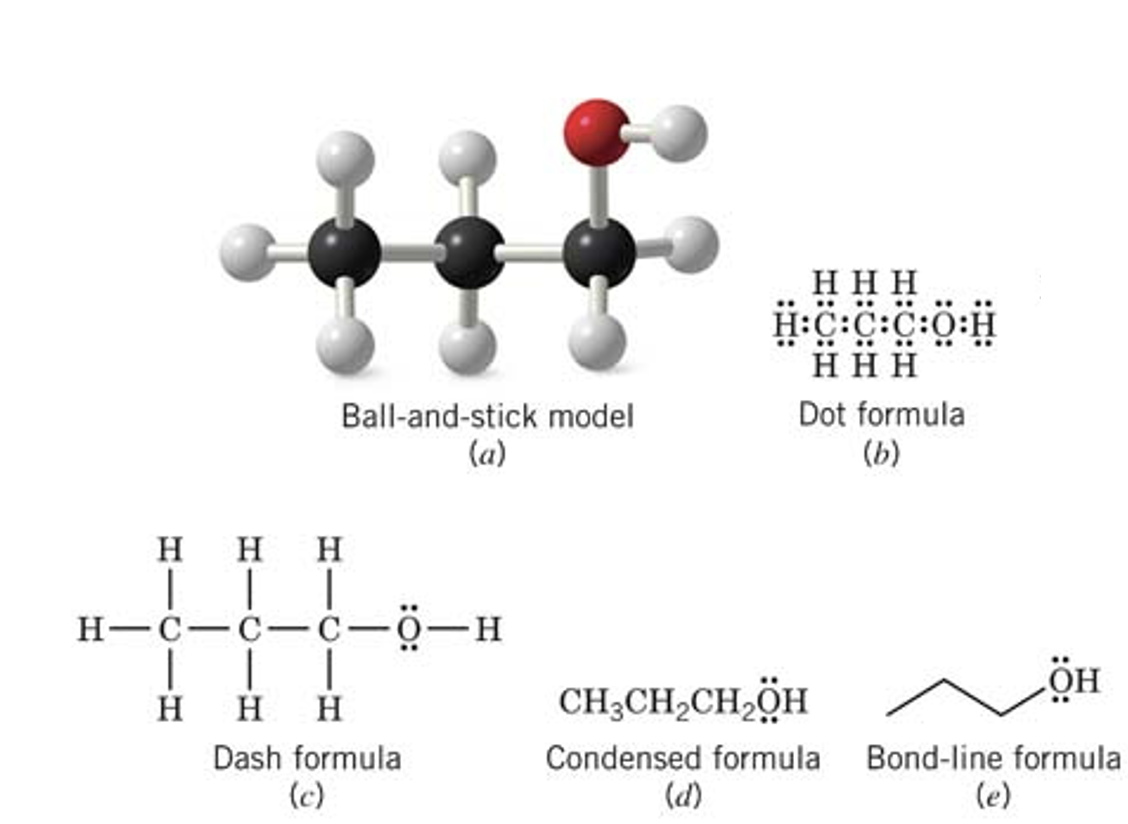
ball and stick: to show geometric structure
dot formula
dash formula: line represents bonds + shows lone pairs
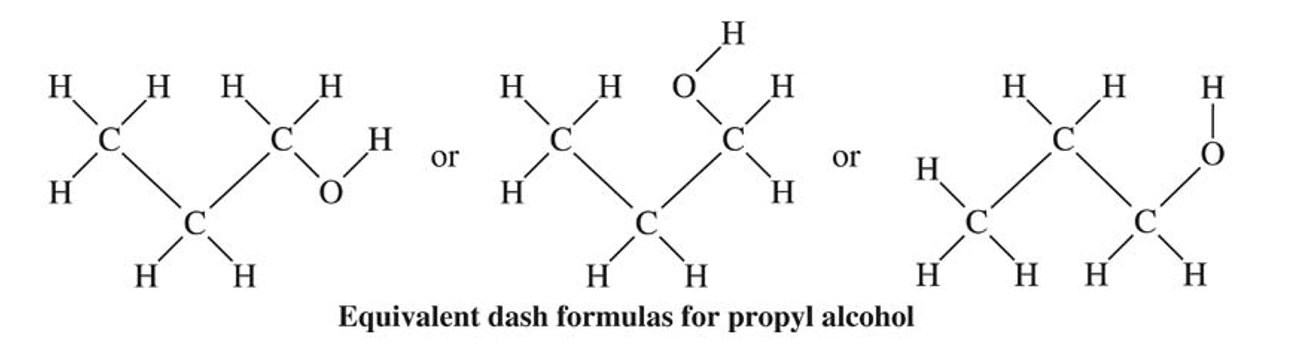
the atoms are joined by single bonds that can rotate freely
note lone pairs are dropped on the oxygen → they are still there
oxygen lines to have 2 bonds so it needs 2 lone pairs
condensed formula:
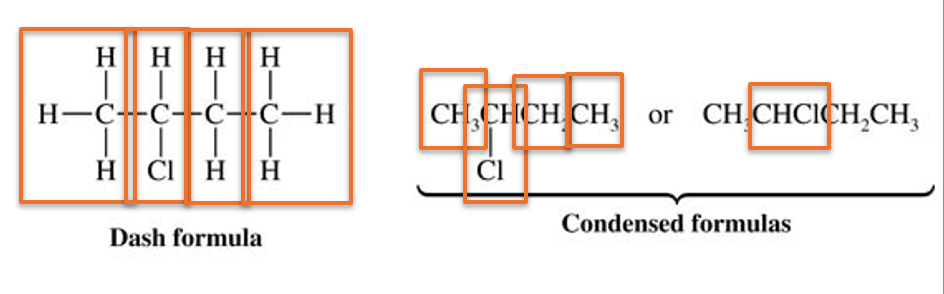
take the central 4 carbons and then write everything connected to each carbon after it
first one is C with 3 H connected to it → CH3
hydrogen follows carbon then any other molecules
bond-line formula: fastest way
removing hydrogens + carbon (still there just not drawn)
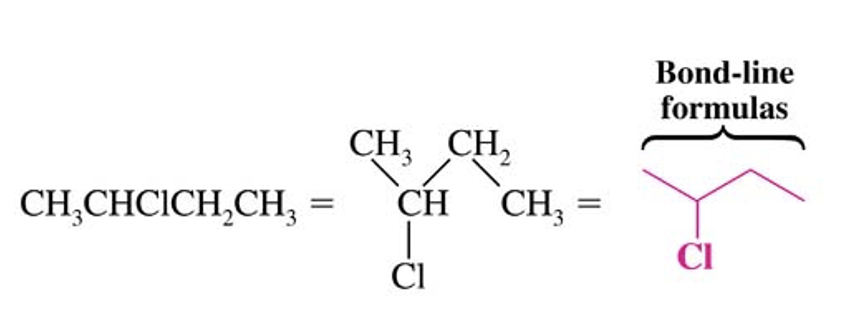
each point on a line is a carbon atom
carbons at the end of the chain are CH3
intersect points are CH2
all CH need to equal 3→ a combination of how many lines are attached to it + the subscript
3-D Formulas
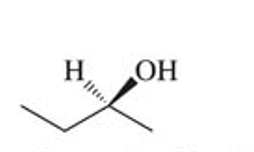
Things drawn as lines are in the plane of the paper
The wedge is the group is coming out of the page towards you
a dash is something coming behind the page
Isomerism
chiral objects: are not superposable
achiral objects: are superposable on mirror images
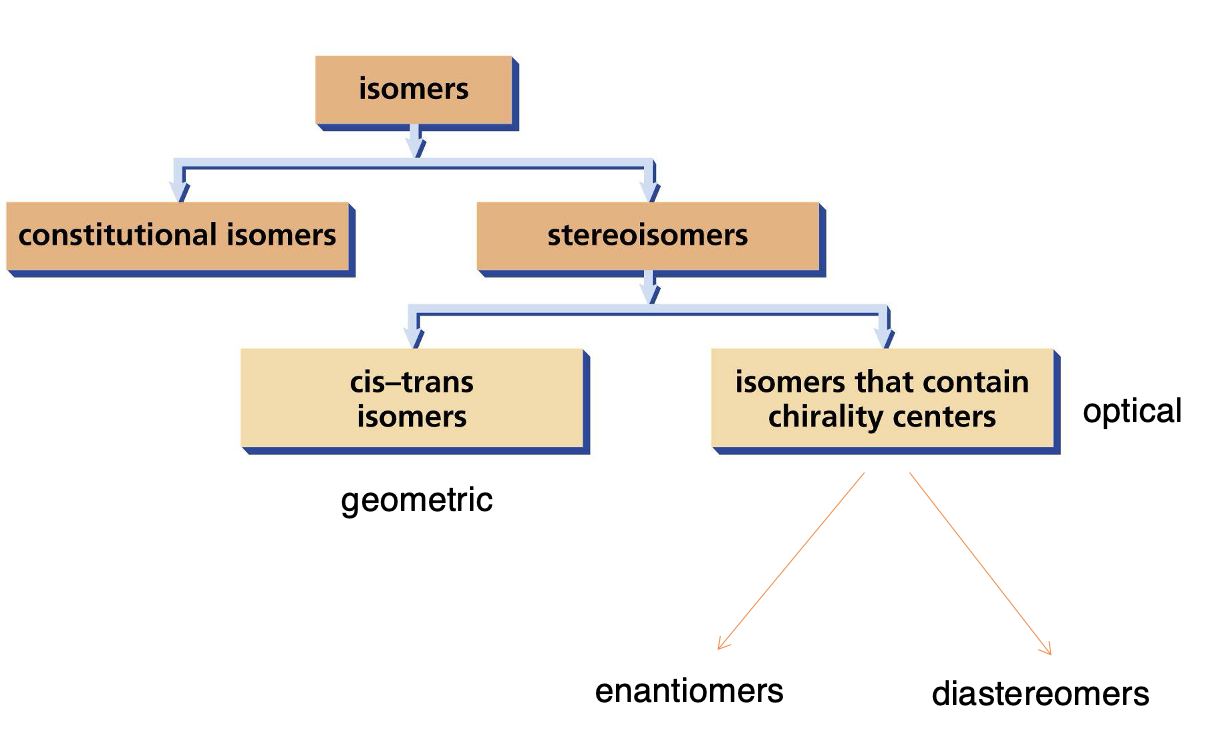
isomerism: the existence of multiple structures for the same molecular formula
Constitutional (structural) isomerism: compounds with the same molecular formula but differing in atom connectivity
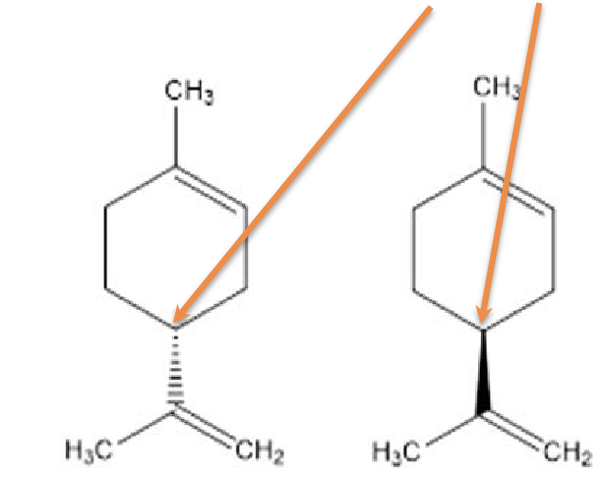
stereoisomers: more than 1 structure for a given compound with the same atom connectivity but differ in spatial arrangement around a central atom
Type of Stereoisomerism | |
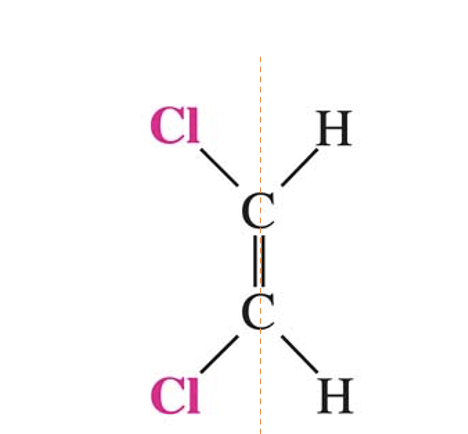
cis- isomer
|  |
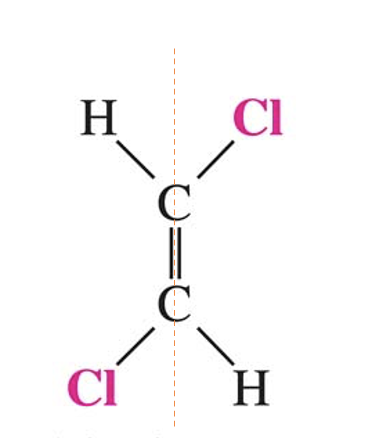
trans- isomer
|  |
superposable
| 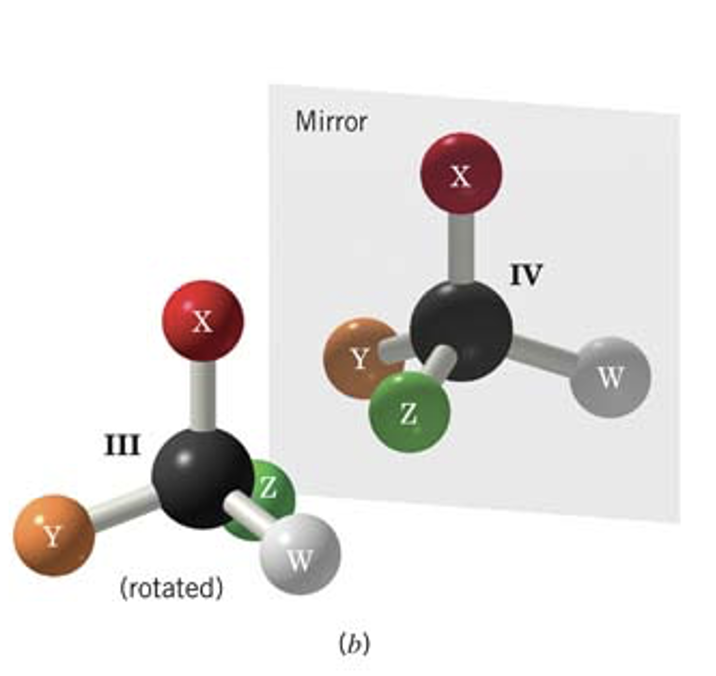 |
enantiomers
| 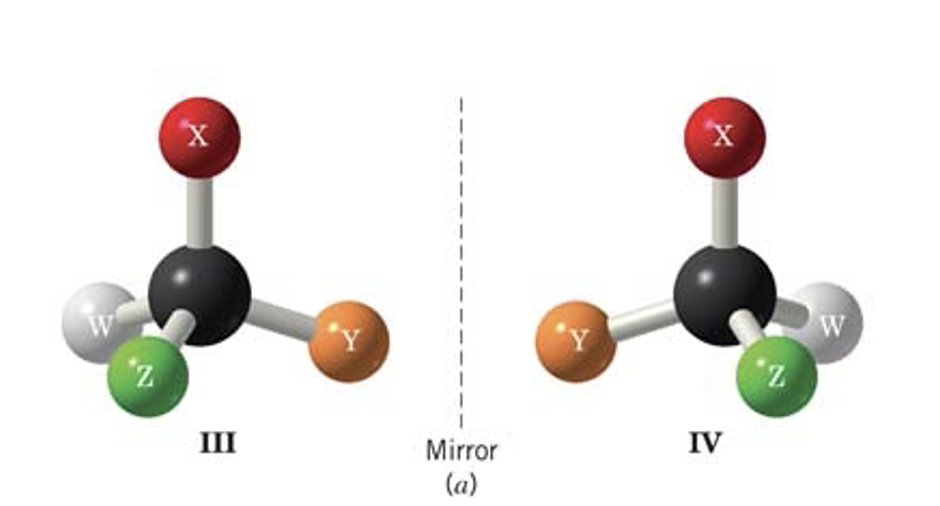 |
diastereomers
|
21.1 Hydrocarbons
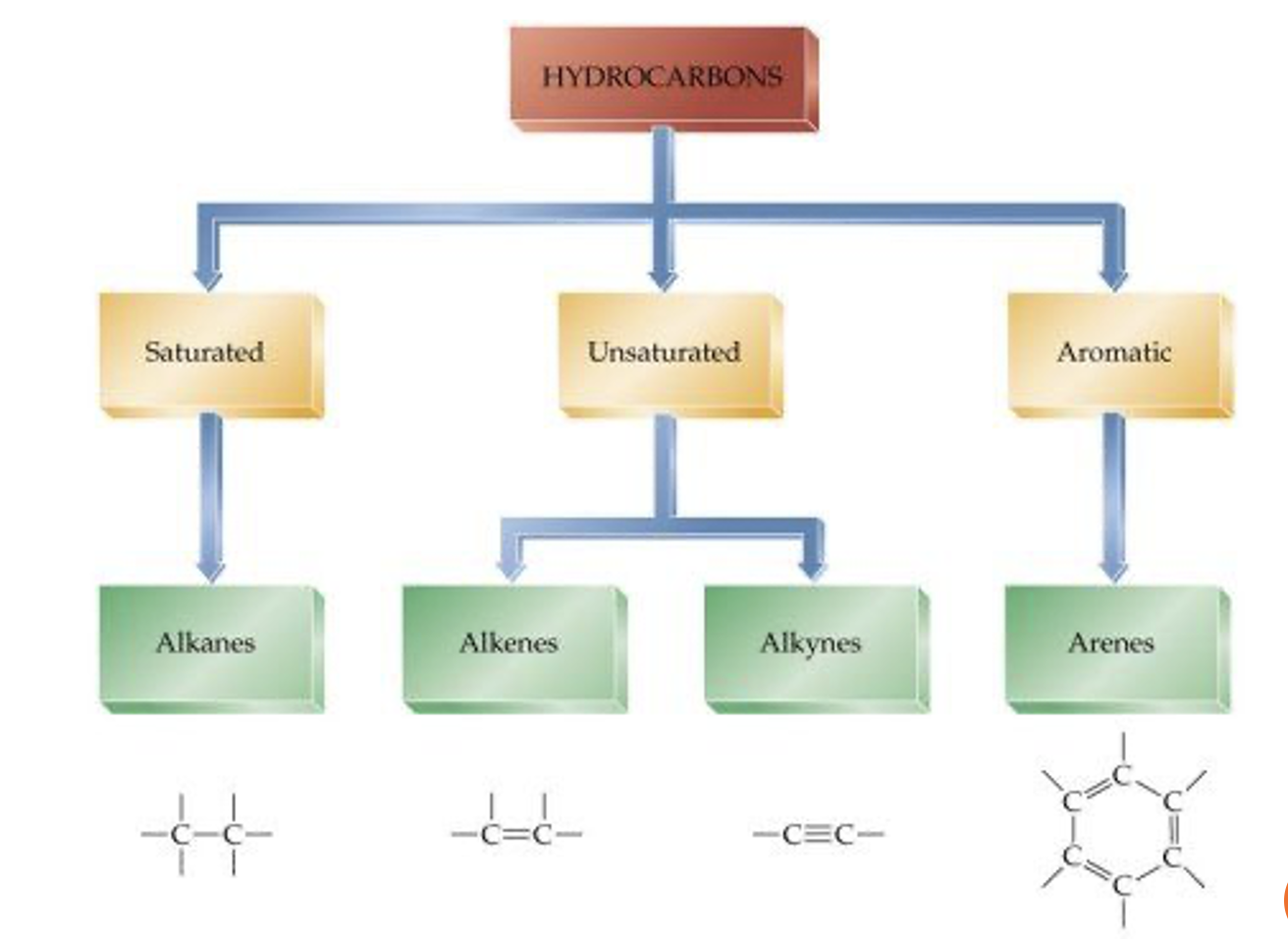
Types of Hydrocarbons
Alkanes: Saturated, single bonds (e.g., CH4, C2H6).
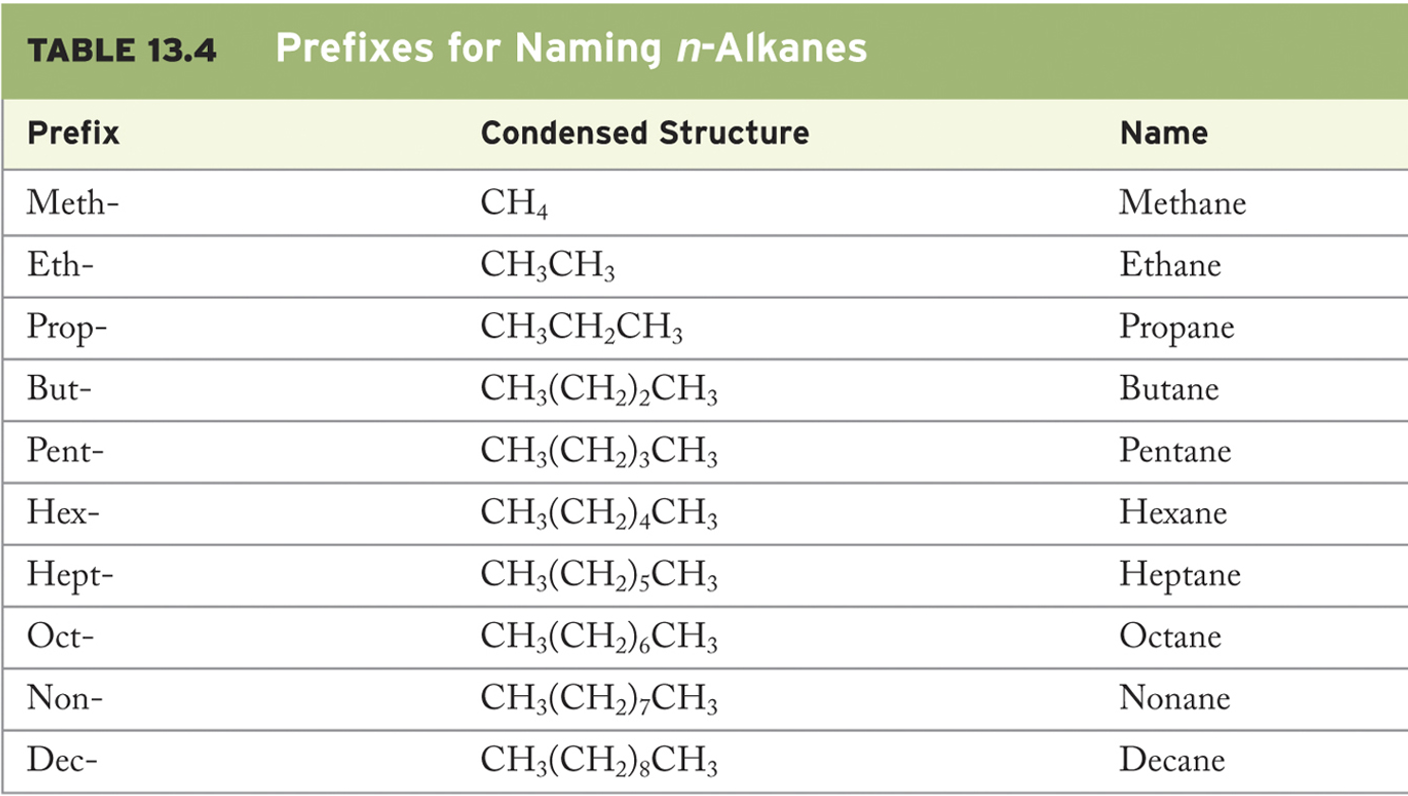

ane =
when the number of carbons increases → physical properties change (melting point goes up )
Alkenes: Unsaturated, at least one double bond (e.g., C2H4)

Alkynes: Unsaturated, at least one triple bond (e.g., C2H2).

Aromatic Hydrocarbons: Benzes
unsaturated cyclic hydrocarbons
for every pi bond added → 2 hydron bonds are removed
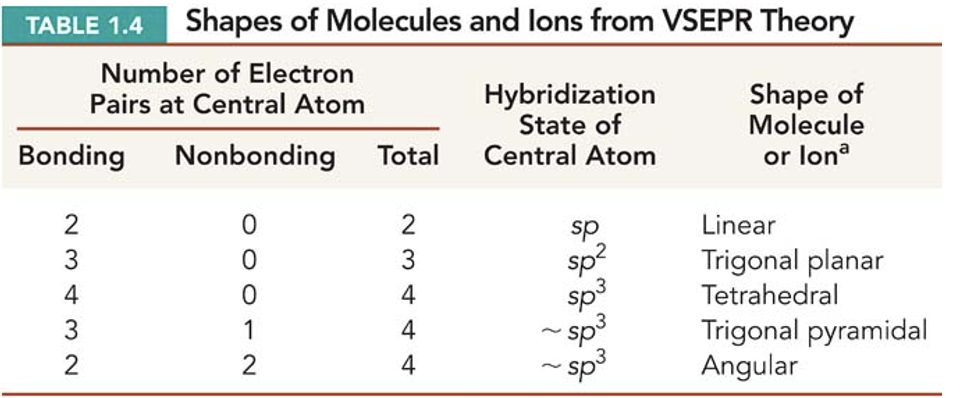
sp3= 4 single bonds to carbon
sp2= 2 single bonds and 1 double bond to carbon
sp= 1 single bond and 1 triple bond to carbon
sigma=sinlge
pie= 2 single bonds
triple= 1 sigma 1 pie
Naming Alkanes
find the longest continuous chain of carbon atoms → for base name
look at the branches
number so all the substituents occur at an equal distance
write the name
substituent number-substituent name parent name
4-ethyl-3, 6-methyloctane
if there are 2 or more identical groups use prefixes to designate the number
when writing go by ABC’s but pre fixes don’t count
Naming Alkenes and Alkynes
( double bonds) trigonal planar + sp2 hybrid orbitals + 120 degrees bond angles
(triple bonds) liner + sp hybrid orbitals + 180 degree bond angles
parent chain is the longest but has the double or triple bond
-ene for alkenes and -yna for alkynes
number to give the double or tripe bond the lowest possible number
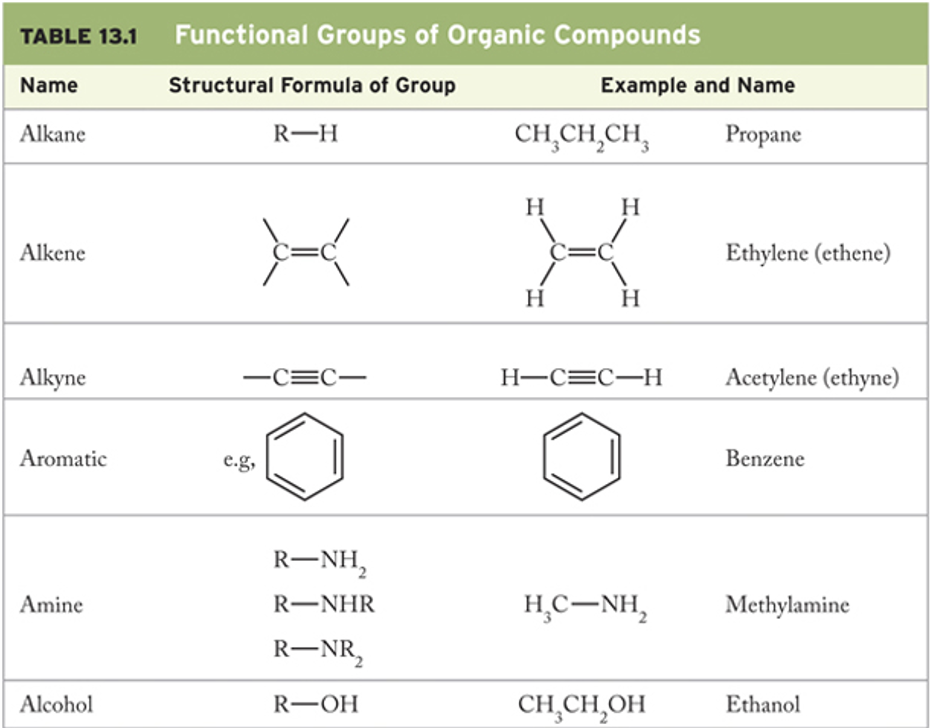
Functional Groups
an atom or group within a molecule that shows characteristic properties to the organic compounds of that group
Alchohols
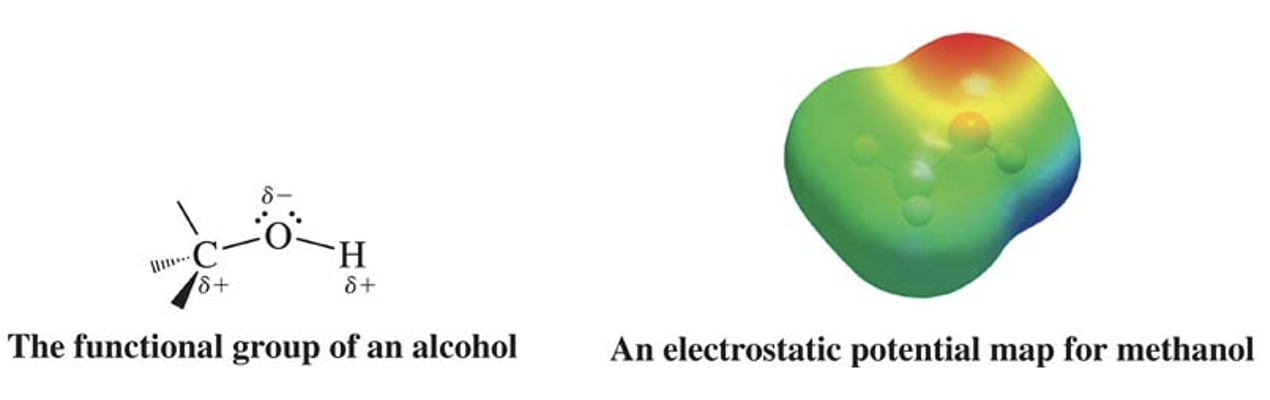
contain a hydroxyl group and a C-O single bond
general formula of R-O-H
bent geometry around oxygen
sp3 hybridization
hydrogen bond
reactions of alcohols
substitution reactions
dehydration reactions: eliminating water from the structure
oxidation reactions: increase in oxygen content/decrease in hydrogen content
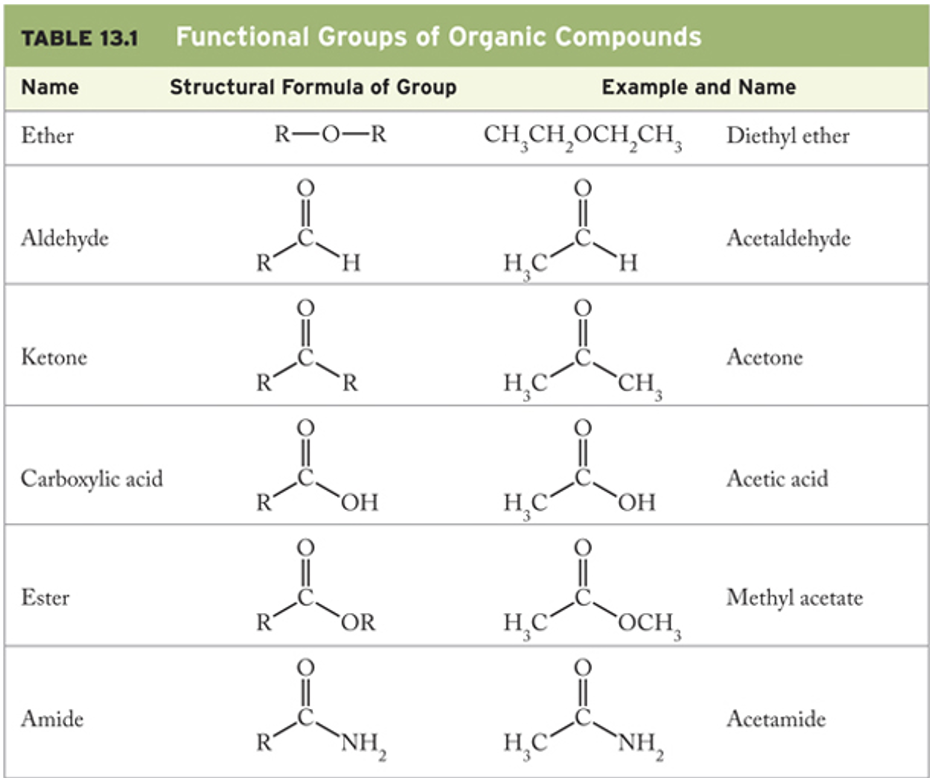
Ethers
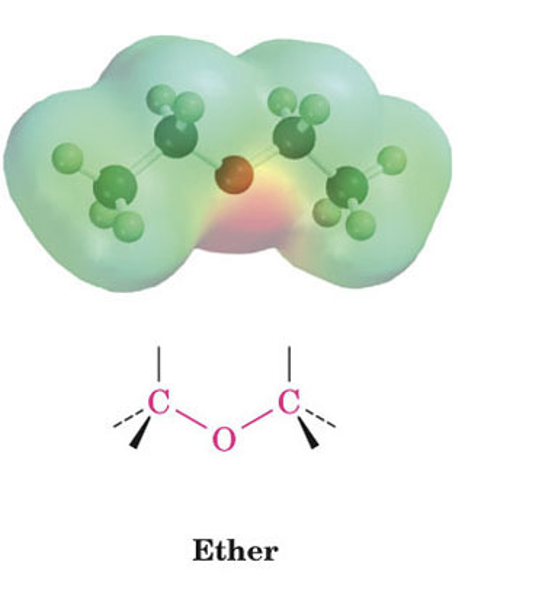
general formula of R-O-R
similar to alcohols with a second carbon attached to the middle oxygen
bent geometry around oxygen
polar
sp3 hybridization
hydrogen bond
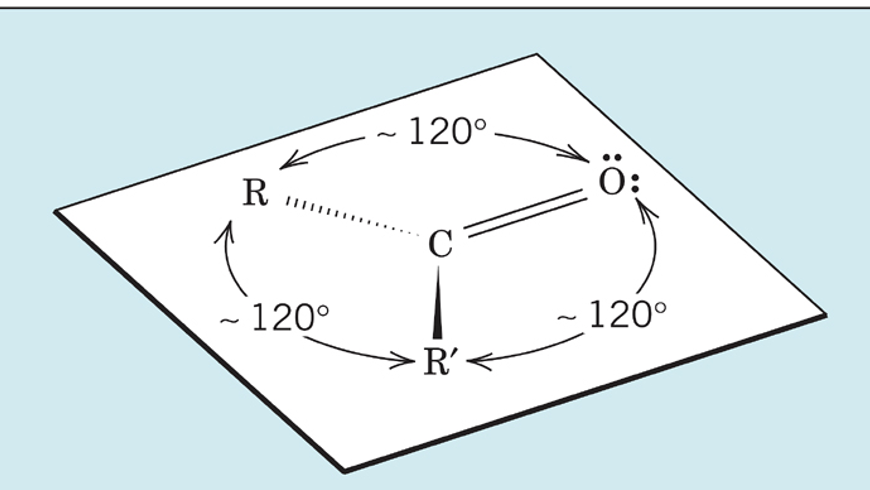
Carbonyl Compounds
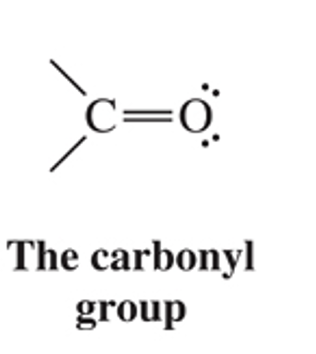
trigonal planer - 120 degree bond angles
polarization
groups
aldehyde
ketone
carboxylic acid
carboxylate ester
reduction: increase hydrogen content + decrease oxygen content
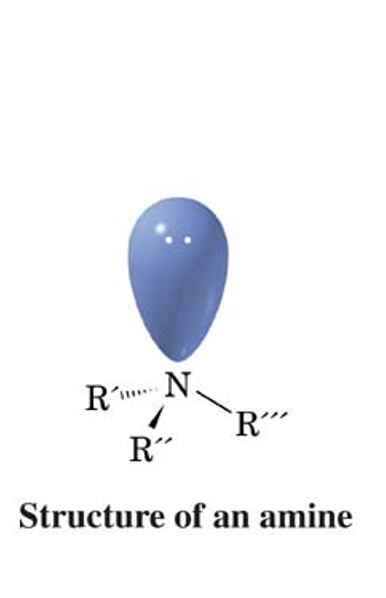
Amines
trigonal peramenal
sp3 hybridized
can be weak bases: proton acceptor
when amnio acids string themselves together they use amines to link
Polymers: macromolecules
subunits used to prepare polymers are called monomers
OTHER NOTES
Diversity of Organic Compounds
The ability of carbon to form four strong bonds leads to various structures: chains and rings.
Hydrocarbons (compounds of carbon and hydrogen) have numerous forms due to variations in chain lengths, branching, and bonding.
Cycloalkanes and Isomerism
Isomers are compounds with the same molecular formula but different structures.
Structural isomers have similar molecular formulas but different connectivity.
Example Isomers:
n-Butane (unbranched) vs 2-methylpropane (branched).
Reactions of Hydrocarbons
Combustion: Alkanes burn with oxygen producing CO2 and H2O, making them excellent fuels.
Substitution Reactions: Involves replacing hydrogen with another atom or group without breaking C-C bonds.
21.2 Alcohols and Ethers
Alcohols
Alcohols contain one or more hydroxyl groups (-OH) replacing hydrogen in hydrocarbons.
Ethanol (C2H5OH) is a common alcohol, produced by fermentation.
Naming: Drop the -e from the alkane name, add -ol, and indicate the carbon attached to -OH by a number.
Example:
2-Pentanol: 5 carbon chain with -OH on the 2nd carbon.
Ethers
Contain the functional group –O–.
Named as alkoxy substituents (e.g., ethoxyethane) or common names (e.g., diethyl ether).
Ethers are synthesized from alcohols via dehydration reactions.
21.3 Aldehydes, Ketones, Carboxylic Acids, and Esters
Aldehydes and Ketones
Contain a carbonyl group (>C=O).
Aldehydes: Carbonyl group is bonded to at least one hydrogen atom.
Ketones: Carbonyl group positioned between two carbon atoms.
Nomenclature: Aldehydes end in -al; ketones end in -one.
Reactions involving carbonyls typically involve Lewis bases attacking the carbonyl carbon.
Example:
Acetone (dimethyl ketone) and formaldehyde (HCHO).
Carboxylic Acids
Featured by a -COOH group, making them acidic. Example: acetic acid.
Esters
Formed from the reaction of a carboxylic acid with an alcohol, often responsible for fruity odors in compounds like ethyl acetate.
21.4 Amines and Amides
Amines
Contain a nitrogen atom bonded to carbon with at least one alkyl group.
Nomenclature: Typically end with -ine.
Amines can act as weak bases. Examples include many hormones and neurotransmitters.
Amides
Formed from the reaction of carboxylic acids with amines (amidation).
Integral in forming proteins from amino acids through peptide bonds.
Key Concepts
Organic chemistry studies primarily carbon-containing compounds.
Understanding functional groups (e.g., hydroxyl, carbonyl) is crucial for recognizing properties and reactions.
Hydrocarbons are foundational in organic chemistry, leading to diversity in structure and properties in larger organic molecules.
Conclusion
The study of organic chemistry encompasses an array of compounds and their transformations, with a profound impact on various scientific and practical fields.