Chapter 10: Personality Psych
Personality: long standing traits that propel individuals to consistently think, feel, behave in specific ways
Hippocrates: personality based on temperaments (inborn/genetic) associated with 4 bodily fluids “humors”
4 categories: melancholic, phlegmatic, sanguine, choleric,
Galen: imbalances in humors, there was 1 out of the 4 we’d have as our temperant
Wundt: two axes
Freud: First comprehensive theory of personality, focused on unconscious drives and childhood experiences
- Mind as iceberg:
- Conscious: 1/10th is conscious (top of iceberg)
- Unconscious: mental activity we are unaware of and are repressed (unacceptable sex/aggressive urges and desires)
- Freudian slip: urges/desires slipping out of unconscious
- Superego: Moral Compass (conscience)
- Strong superego: guilt (overcontrolled)
- Weak superego: psychopathy
- Ego: Self-personality seen by others (rational)
- Strong ego: finds middle ground
- Imbalances: neurosis - experience negative emotions (anxiety disorders)
- Id: Pleasure Principle (birth)
- Strong id: narcissistic, impulsive
- personality is a conflict between superego and id (conscious beliefs and unconscious urges)
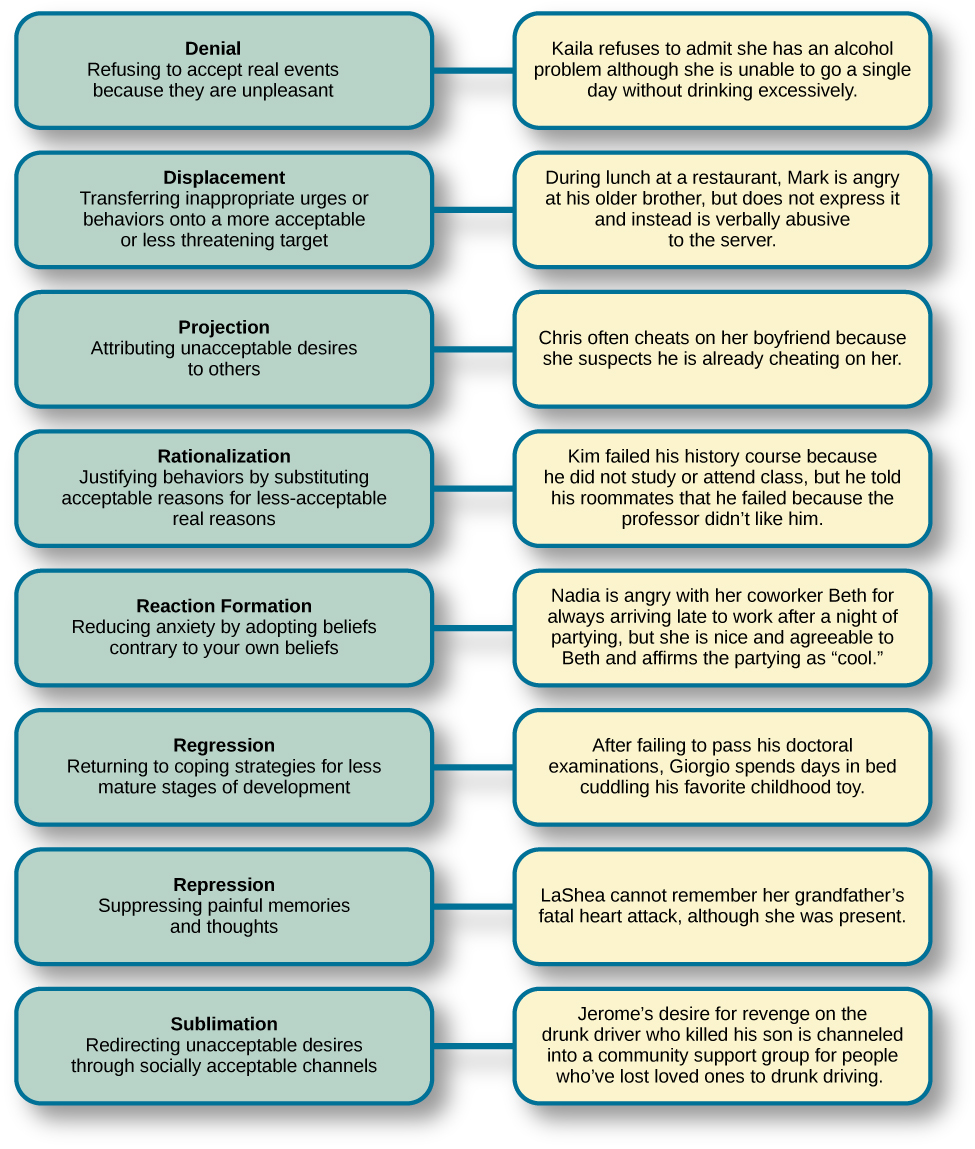
- ego restores balance and reduce anxiety via defense mechanisms
- projection
- sublimation
- repression
- regression
- reaction formation
- rationalization
- displacement
- denial
- Stages of Psychosexual Development:
- Personality develops during early childhood and is fixed in childhood
- Oral: Mouth, weaning
- Anal: Anus, toilet training
- Phallic: Genitals, oedipus (desire mom, replace dad - jealous), electra complex (desire dad, jealous of mom) - if successful, move on
- Latency Period: none - dormant (focus on other pursuits) - social behavior
- Genital: gentials, no conflict (have sex interests instead)
- not a lot of modern support
- mental life is influenced by experiences in childhood
Neo-Freudians: Agreed that childhood experiences matter, but reduced sex emphasis and focused more on social environment and culture
- Alder, Erikson, Jung
- Alfred Adler:
- Individual Psychology: Focuses on our drive to compensate for feelings of inferiority
- inferiority complex: a person’s feelings that they lack worth and don’t measure up to others’ or to society’s standard
- If we overcome it, we gain superiority and this is the driving force behind thoughts, feelings, and behaviors
- Erikson:
- Personality develops through the lifepsan (Freud said that it only develops early in life)
- Social relationships are important
- Successful completion of each conflict results in successful personality
- Carl Jung:
- 2 attitudes/approaches to life: extroversion and introversion
- Extroversion: Energized by being outgoing and socially oriented (derive energy from being around others)
- Introversion: May be quiet and reserved, but energy derived from inner activity
- Balance is best
Learning Approaches: Focuses on observable behavior only (scientifically tested because observable)
- Skinner (behaviorist)
- Personality is shaped by reinforcements and consequences
- Develops over our entire life through learning
- there can be some variability in development
- Bandura (social-cognitive)
- Personality is developed through learning, which may be observational
- Both learning and cognition are sources of individual differences in personality
- Personality development:
- Reciprocal determinism - 3 factors influence how a person acts and influence each other
- Person (Cognitive factors)
- Environment (Situational factors)
- Behavior itself
- Self-efficacy: Someone’s level of confidence in their own abilities, developed through social experiences
- High self-efficacy: Believe that their goals are within reach, have positive view of challenges, etc
- Rotter
- Locus of control: Our beliefs about the power we have over our lives
- The cognitive factor that affects learning and personality development
- Occurs on continuum from internal to external
- Internal: I am in control
- External: Outcomes are beyond my control
- Internal LOC: Perform better academically, achieve more in careers, etc
Humanistic Approaches: Recognize the innate capacity for self-directed change
- Maslow: Studied healthy models and found traits they all had
- Created Hierarchy of Needs
- Humans have certain needs in common and these needs must be met in a certain order
- Highest need is need for self-actualization
- Rogers:
- Self-concept: Our thoughts/feelings about self
- Self has two categories:
- Real self - who you are
- Ideal self - who you want to be
- Congruence when real and ideal are similar
- High congruence → greater sense of self worth and healthy lift
Biological
- Heritability: Proportion of difference among people that is attributed to genetics
Minnesota Study of Twins: Identical twins (reared together or apart) have very similar personality
- Regardless of the environment, identical twins have similar personality
Traits:
- Characteristics of ways of behaving
- Allport and Cattell
- All our personalities are made up of the same traits, we differ in the degree to which trait is expressed
- Allport and Cattell found 4500 words, 171 traits, 16 factors
- Cattell’s 16 personality factors are on a continuum
- Eysenck’s 3 factors
- Viewed people as having specific personality dimensions
- Extroversion/Introversion
- Neuroticism/Stability
- Anxious vs calm
- Psychoticism/superego control
- Cold impulsive vs high impulse control/cooperation
- Five Factor Model
- OCEAN, most popular and accurate
- Openness
- Conscientiousness
- Extroversion
- Agreeableness
- Neuroticism
- Relatively stable across the lifespan
Cronbach’s alpha: statistic for calculating internal consistency reliability