Law of Sines Notes

The Law of Sines

Oblique Triangles

  • An oblique triangle is defined as a triangle that does not contain a right angle.

  • Standard notations for triangle parts: angles A, B, C and sides a, b, c, with angles α, β, and γ respectively.

Derivation of the Law of Sines

  • Consider triangle ABC with angle α in standard position, and B on the positive x-axis.

  • Let h be the height from C to the x-axis, forming a right triangle.

  • From trigonometric definitions:
    sinα=hbsin α = \frac{h}{b}, so h=bsinαh = b sin α
    sinβ=hasin β = \frac{h}{a}, so h=asinβh = a sin β

  • Equating the two expressions for h:
    bsinα=asinβb sin α = a sin β

  • Which can be written as:
    sinαa=sinβb\frac{sin α}{a} = \frac{sin β}{b}

  • Similarly, by placing γ in standard position:
    sinαa=sinγc\frac{sin α}{a} = \frac{sin γ}{c}

Law of Sines Formula

  • The Law of Sines combines these ratios:
    sinαa=sinβb=sinγc\frac{sin α}{a} = \frac{sin β}{b} = \frac{sin γ}{c}

Formulas

  • The Law of Sines consists of three formulas:
    sinαa=sinβb\frac{sin α}{a} = \frac{sin β}{b}
    sinαa=sinγc\frac{sin α}{a} = \frac{sin γ}{c}
    sinβb=sinγc\frac{sin β}{b} = \frac{sin γ}{c}

Application Conditions

  • To apply the Law of Sines, know three of the four variables in any of the formulas.

  • The Law of Sines can be used to solve oblique triangles in the following cases:

    • Two sides and an angle opposite one of them (SSA)

    • Two angles and any side (AAS or ASA)

Cases Where Law of Sines Cannot be Directly Applied

  • Two sides and the angle between them (SAS)

  • Three sides (SSS)

  • Note: For these cases, the law of cosines is used.

Alternative Form of the Law of Sines

  • The law of sines can also be written in the form:
    asinα=bsinβ=csinγ\frac{a}{sin α} = \frac{b}{sin β} = \frac{c}{sin γ}

General Form

  • In any triangle, the ratio of the sine of an angle to the side opposite that angle is equal to the ratio of the sine of another angle to the side opposite that angle.

Rounding Rule

  • When finding parts of triangles, round off answers according to the accuracy of the known sides or angles.

    • If known sides are stated to the nearest 0.1, then unknown sides should be calculated to the nearest 0.1.

    • If known angles are stated to the nearest 10', then unknown angles should be calculated to the nearest 10'.

Example 1: Using the Law of Sines (ASA)

  • Problem: Solve triangle ABC, given α = 48°, γ = 57°, and b = 47.

  • Solution:

    1. Find angle β:

      • Since the sum of angles in a triangle is 180°:
        β=180°αγ=180°57°48°=75°β = 180° - α - γ = 180° - 57° - 48° = 75°

    2. Find side a:

      • Using the Law of Sines:
        asinα=bsinβ\frac{a}{sin α} = \frac{b}{sin β}

      • Solving for a:
        a=bsinαsinβ=47sin48°sin75°36a = \frac{b sin α}{sin β} = \frac{47 sin 48°}{sin 75°} ≈ 36

    3. Find side c:

      • Using the Law of Sines:
        csinγ=bsinβ\frac{c}{sin γ} = \frac{b}{sin β}

      • Solving for c:
        c=bsinγsinβ=47sin57°sin75°41c = \frac{b sin γ}{sin β} = \frac{47 sin 57°}{sin 75°} ≈ 41

The Ambiguous Case (SSA)

  • Given two sides and an angle opposite one of them, a unique triangle is not always determined.

  • Consider sides a and b and angle α opposite side a.

  • Place α in standard position with side b on the terminal side of α.

  • Find the third vertex B by striking off a circular arc of length a with center at C.

Possible Outcomes

  • (a) The arc does not intersect the x-axis: No triangle is formed.

  • (b) The arc is tangent to the x-axis: A right triangle is formed.

  • (c) The arc intersects the positive x-axis in two distinct points: Two triangles are formed.

  • (d) The arc intersects both the positive and the nonpositive parts of the x-axis: One triangle is formed.

Determining the case

  • Solve for sinβsin β

  • If sin β > 1, then no triangle exists (case a).

  • If sinβ=1sin β = 1, then β=90°β = 90° (case b).

  • If sin β < 1, there are two possible choices for angle B. Check both possibilities to determine whether case (c) or (d) occurs.

  • Obtuse Angle: If α > 90°, a triangle exists if and only if a > b.

Example 2: Using the Law of Sines (SSA) - No Triangle

  • Problem: Solve triangle ABC, given α = 67°, a = 100, and c = 125.

  • Solution:

    1. Find angle γ:

      • Using the Law of Sines:
        sinγc=sinαa\frac{sin γ}{c} = \frac{sin α}{a}

      • Solving for sinγsin γ:
        sinγ=csinαa=125sin67°1001.1506sin γ = \frac{c sin α}{a} = \frac{125 sin 67°}{100} ≈ 1.1506

    2. Since sinγsin γ cannot be greater than 1, no triangle can be constructed with the given parts.

Example 3: Using the Law of Sines (SSA) - Two Triangles

  • Problem: Solve triangle ABC, given a = 12.4, b = 8.7, and β = 36.7°.

  • Solution:

    1. Find angle α:

      • Using the Law of Sines:
        sinαa=sinβb\frac{sin α}{a} = \frac{sin β}{b}

      • Solving for sinαsin α:
        sinα=asinβb=12.4sin36.7°8.70.8518sin α = \frac{a sin β}{b} = \frac{12.4 sin 36.7°}{8.7} ≈ 0.8518

    2. Find possible angles α:

      • Reference angle: αR=sin1(0.8518)58.4°α_R = sin^{-1}(0.8518) ≈ 58.4°

      • Two possibilities for α:
        α1 = 58.4° and α2 = 180° — α1 = 180° = 121.6°

    3. Solve for Triangle 1 (α₁ = 58.4°):

      • Find angle γ₁:
        γ1 = 180° — α1 - β = 180° — 58.4° — 36.7° = 84.9°</p></li><li><p>Findsidec<em>1</p></li><li><p>Find side c<em>1: c</em>1<strong>/</strong>sinγ<em>1=a</em><strong><em>/</em></strong><em>sinα</em>1<br>{c</em>1}<strong>/</strong>{sin γ<em>1} = {a}</em><strong><em>/</em></strong><em>{sin α</em>1}<br>c1 = {a sin γ1}/{sin α_1} = {12.4 sin 84.9°}/{sin 58.4°} ≈ 14.5

      • Solution for Triangle 1: α<em>1=58.4°α<em>1 = 58.4°, γ</em>1=84.9°γ</em>1 = 84.9°, c1=14.5</p></li></ul></li><li><p>SolveforTriangle2(α2=121.6°):</p><ul><li><p>Findangleγ2:<br>γ<em>2=180°α</em>2β=180°121.6°36.7°=21.7°</p></li><li><p>Findsidec<em>2c_1 = 14.5</p></li></ul></li><li><p>Solve for Triangle 2 (α₂ = 121.6°):</p><ul><li><p>Find angle γ₂:<br>γ<em>2 = 180° — α</em>2 — β = 180° — 121.6° -- 36.7° = 21.7°</p></li><li><p>Find side c<em>2: c</em>2<strong>/</strong>sinγ<em>2=a</em><strong><em>/</em></strong><em>sinα</em>2<br>c<em>2=asinγ</em>2<strong>/</strong>sinα2=12.4sin21.7°<strong>/</strong>sin121.6°5.4</p></li><li><p>SolutionforTriangle2:α2=121.6°,γ2=21.7°,{c</em>2}<strong>/</strong>{sin γ<em>2} = {a}</em><strong><em>/</em></strong><em>{sin α</em>2}<br>c<em>2 = {a sin γ</em>2}<strong>/</strong>{sin α_2} = {12.4 sin 21.7°}<strong>/</strong>{sin 121.6°} ≈ 5.4</p></li><li><p>Solution for Triangle 2: α₂ = 121.6°, γ₂ = 21.7°,c_2=5.4</p></li></ul></li></ol></li></ul><h4id="2d0ef22952b74539bbd0416cd4876c58"datatocid="2d0ef22952b74539bbd0416cd4876c58"collapsed="false"seolevelmigrated="true">Example4:UsinganAngleofElevation</h4><ul><li><p><strong>Problem:</strong>Whentheangleofelevationofthesunis64°,atelephonepolethatistiltedatanangleof9°directlyawayfromthesuncastsashadow21feetlongonlevelground.Approximatethelengthofthepole.</p></li><li><p><strong>Solution:</strong></p><ol><li><p>Identifyangles:</p><ul><li><p>= 5.4</p></li></ul></li></ol></li></ul><h4 id="2d0ef229-52b7-4539-bbd0-416cd4876c58" data-toc-id="2d0ef229-52b7-4539-bbd0-416cd4876c58" collapsed="false" seolevelmigrated="true">Example 4: Using an Angle of Elevation</h4><ul><li><p><strong>Problem:</strong> When the angle of elevation of the sun is 64°, a telephone pole that is tilted at an angle of 9° directly away from the sun casts a shadow 21 feet long on level ground. Approximate the length of the pole.</p></li><li><p><strong>Solution:</strong></p><ol><li><p>Identify angles:</p><ul><li><p>β = 90° - 9° = 81°</p></li><li><p></p></li><li><p>γ = 180° - 64° - 81° = 35°</p></li></ul></li><li><p>UseLawofSinestofindsidea(lengthofthepole):<br></p></li></ul></li><li><p>Use Law of Sines to find side a (length of the pole):<br>\frac{a}{sin 64°} = \frac{21}{sin 35°}<br><br>a = \frac{21 sin 64°}{sin 35°} ≈ 33</p></li></ol></li><li><p>Thelengthofthetelephonepoleisapproximately33feet.</p></li></ul><h4id="739961d3191f45b28d29724f497aae2e"datatocid="739961d3191f45b28d29724f497aae2e"collapsed="false"seolevelmigrated="true">Example5:UsingBearings</h4><ul><li><p><strong>Problem:</strong>ApointPonlevelgroundis3.0kilometersduenorthofapointQ.ArunnerproceedsinthedirectionN25°EfromQtoapointR,andthenfromRtoPinthedirectionS70°W.Approximatethedistancerun.</p></li><li><p><strong>Solution:</strong></p><ol><li><p>Identifyangles:</p><ul><li><p>AnglePRQ=70°25°=45°</p></li><li><p>AngleQPR=180°25°45°=110°</p></li></ul></li><li><p>UseLawofSinestofindqandp:<br></p></li></ol></li><li><p>The length of the telephone pole is approximately 33 feet.</p></li></ul><h4 id="739961d3-191f-45b2-8d29-724f497aae2e" data-toc-id="739961d3-191f-45b2-8d29-724f497aae2e" collapsed="false" seolevelmigrated="true">Example 5: Using Bearings</h4><ul><li><p><strong>Problem:</strong> A point P on level ground is 3.0 kilometers due north of a point Q. A runner proceeds in the direction N25°E from Q to a point R, and then from R to P in the direction S70°W. Approximate the distance run.</p></li><li><p><strong>Solution:</strong></p><ol><li><p>Identify angles:</p><ul><li><p>Angle PRQ = 70° - 25° = 45°</p></li><li><p>Angle QPR = 180° - 25° - 45° = 110°</p></li></ul></li><li><p>Use Law of Sines to find q and p:<br>\frac{q}{sin 25°} = \frac{3.0}{sin 45°}<br><br>q = \frac{3.0 sin 25°}{sin 45°} ≈ 1.8<br><br>\frac{p}{sin 110°} = \frac{3.0}{sin 45°}<br><br>p = \frac{3.0 sin 110°}{sin 45°} ≈ 4.0</p></li><li><p>Distancerun:p+q4.0+1.8=5.8km</p></li></ol></li></ul><h4id="1fa6ed932e534e6291516a2b24b94ed7"datatocid="1fa6ed932e534e6291516a2b24b94ed7"collapsed="false"seolevelmigrated="true">Example6:LocatingaSchoolofFish</h4><ul><li><p><strong>Problem:</strong>Acommercialfishingboatusessonarequipmenttodetectaschooloffish2mileseastoftheboatandtravelinginthedirectionofN51°Watarateof8mi/hr.Iftheboattravelsat20mi/hr,approximatethedirectionitshouldheadtointercepttheschooloffishandthetimeitwilltaketoreachthefish.</p></li><li><p><strong>Solution:</strong></p><ol><li><p>Identifyangle:<br></p></li><li><p>Distance run: p + q ≈ 4.0 + 1.8 = 5.8 km</p></li></ol></li></ul><h4 id="1fa6ed93-2e53-4e62-9151-6a2b24b94ed7" data-toc-id="1fa6ed93-2e53-4e62-9151-6a2b24b94ed7" collapsed="false" seolevelmigrated="true">Example 6: Locating a School of Fish</h4><ul><li><p><strong>Problem:</strong> A commercial fishing boat uses sonar equipment to detect a school of fish 2 miles east of the boat and traveling in the direction of N51°W at a rate of 8 mi/hr. If the boat travels at 20 mi/hr, approximate the direction it should head to intercept the school of fish and the time it will take to reach the fish.</p></li><li><p><strong>Solution:</strong></p><ol><li><p>Identify angle:<br>α = 90° - 51° = 39°</p></li><li><p>UseLawofSinestofindβ:<br></p></li><li><p>Use Law of Sines to find β:<br>\frac{sin β}{b} = \frac{sin 39°}{a}<br><br>sin β = \frac{b sin 39°}{a}</p></li><li><p>Findb/a:<br></p></li><li><p>Find b/a:<br>a = 20t, b = 8t<br><br>\frac{b}{a} = \frac{8t}{20t} = \frac{2}{5}</p><p></p><p>sin β = (\frac{2}{5})sin 39°</p><p></p><p>β = sin^{-1}(\frac{2}{5} sin 39°) ≈ 14.6°</p></li></ol></li><li><p>TheboatshouldtravelinthedirectionN(90°14.6°)EN75.4°E.</p><olstart="4"><li><p>Findthetimet<br></p></li></ol></li><li><p>The boat should travel in the direction N(90° - 14.6°)E ≈ N75.4°E.</p><ol start="4"><li><p>Find the time t<br>γ = 180° - 39° - 14.6° = 126.4°</p></li></ol></li></ul><p></p></li></ol></li></ul><p>\frac{a}{sin α} = \frac{c}{sin γ}</p><p>Solvefora<br></p><p>Solve for a<br>a = \frac{c sin α}{sin γ} = \frac{2 * sin 39}{sin 126.4} ≈ 1.56</p><p></p><p>t= \frac{1.56}{20} = 0.08 hr = 5 min</p><ul><li><p>Itwilltakeapproximately5minutesfortheboattoreachthefish.</p></li></ul><h3id="0ae9668dfa6b4e92a521eadaebe6bd70"datatocid="0ae9668dfa6b4e92a521eadaebe6bd70"collapsed="false"seolevelmigrated="true">TheLawofCosines</h3><h4id="3046481cce5a4b22a0624f410b63a640"datatocid="3046481cce5a4b22a0624f410b63a640"collapsed="false"seolevelmigrated="true">Caseswherelawofcosinesisneeded</h4><ul><li><p>Twosidesandtheanglebetweenthem(SAS)</p></li><li><p>Threesides(SSS)</p></li></ul><h4id="3c8ae32ab37d4bf48b6c447b16416007"datatocid="3c8ae32ab37d4bf48b6c447b16416007"collapsed="false"seolevelmigrated="true">TheLawofCosinesFormulas</h4><ul><li><p>IfABCisatrianglelabeledintheusualmanner,then</p><ul><li><p></p><ul><li><p>It will take approximately 5 minutes for the boat to reach the fish.</p></li></ul><h3 id="0ae9668d-fa6b-4e92-a521-eadaebe6bd70" data-toc-id="0ae9668d-fa6b-4e92-a521-eadaebe6bd70" collapsed="false" seolevelmigrated="true">The Law of Cosines</h3><h4 id="3046481c-ce5a-4b22-a062-4f410b63a640" data-toc-id="3046481c-ce5a-4b22-a062-4f410b63a640" collapsed="false" seolevelmigrated="true">Cases where law of cosines is needed</h4><ul><li><p>Two sides and the angle between them (SAS)</p></li><li><p>Three sides (SSS)</p></li></ul><h4 id="3c8ae32a-b37d-4bf4-8b6c-447b16416007" data-toc-id="3c8ae32a-b37d-4bf4-8b6c-447b16416007" collapsed="false" seolevelmigrated="true">The Law of Cosines Formulas</h4><ul><li><p>If ABC is a triangle labeled in the usual manner, then</p><ul><li><p>a^2 = b^2 + c^2 − 2bc \cos α</p></li><li><p></p></li><li><p>b^2 = a^2 + c^2 − 2ac \cos β</p></li><li><p></p></li><li><p>c^2 = a^2 + b^2 − 2ab \cos γ</p></li></ul></li></ul><h4id="70c88cde2cdb491287b9348c217e747a"datatocid="70c88cde2cdb491287b9348c217e747a"collapsed="false"seolevelmigrated="true">ProofoftheLawofCosines</h4><ul><li><p>Placeangleαinstandardposition.PointChascoordinates</p></li></ul></li></ul><h4 id="70c88cde-2cdb-4912-87b9-348c217e747a" data-toc-id="70c88cde-2cdb-4912-87b9-348c217e747a" collapsed="false" seolevelmigrated="true">Proof of the Law of Cosines</h4><ul><li><p>Place angle α in standard position. Point C has coordinates(k, h).</p></li><li><p>Bytrigonometricdefinitions,.</p></li><li><p>By trigonometric definitions,k = b \cos αandandh = b \sin α.</p></li><li><p>ThecoordinatesofBare.</p></li><li><p>The coordinates of B are(c, 0).</p></li><li><p>Usingthedistanceformula:<br>.</p></li><li><p>Using the distance formula:<br>a^2 = [d(B, C)]^2 = (k − c)^2 + (h − 0)^2<br><br>a^2 = (b \cos α − c)^2 + (b \sin α)^2<br><br>a^2 = b^2 \cos^2 α - 2bc \cos α + c^2 + b^2 \sin^2 α<br><br>a^2 = b^2 (\cos^2 α + \sin^2 α) + c^2 - 2bc \cos α<br><br>a^2 = b^2 + c^2 - 2bc \cos α</p></li></ul><h4id="c8aaa75ee48a4c3bbe7c6c0849b646dc"datatocid="c8aaa75ee48a4c3bbe7c6c0849b646dc"collapsed="false"seolevelmigrated="true">PythagoreanTheoremasaSpecialCase</h4><ul><li><p>Ifα=90°,then</p></li></ul><h4 id="c8aaa75e-e48a-4c3b-be7c-6c0849b646dc" data-toc-id="c8aaa75e-e48a-4c3b-be7c-6c0849b646dc" collapsed="false" seolevelmigrated="true">Pythagorean Theorem as a Special Case</h4><ul><li><p>If α = 90°, thencos α = 0,andtheLawofCosinesreducesto, and the Law of Cosines reduces toa^2 = b^2 + c^2,whichisthePythagoreantheorem.</p></li><li><p>Thesquareofthelengthofanysideofatriangleequalsthesumofthesquaresofthelengthsoftheothertwosidesminustwicetheproductofthelengthsoftheothertwosidesandthecosineoftheanglebetweenthem.</p></li></ul><h4id="86f723a0407641ccb3f0f28c0bd97b52"datatocid="86f723a0407641ccb3f0f28c0bd97b52"collapsed="false"seolevelmigrated="true">Example1:UsingtheLawofCosines(SAS)</h4><ul><li><p><strong>Problem:</strong>SolvetriangleABC,givena=5.0,c=8.0,and, which is the Pythagorean theorem.</p></li><li><p>The square of the length of any side of a triangle equals the sum of the squares of the lengths of the other two sides minus twice the product of the lengths of the other two sides and the cosine of the angle between them.</p></li></ul><h4 id="86f723a0-4076-41cc-b3f0-f28c0bd97b52" data-toc-id="86f723a0-4076-41cc-b3f0-f28c0bd97b52" collapsed="false" seolevelmigrated="true">Example 1: Using the Law of Cosines (SAS)</h4><ul><li><p><strong>Problem:</strong> Solve triangle ABC, given a = 5.0, c = 8.0, andβ = 77°.</p></li><li><p><strong>Solution:</strong></p><ol><li><p>Findsideb:</p><ul><li><p>UsingtheLawofCosines:<br>.</p></li><li><p><strong>Solution:</strong></p><ol><li><p>Find side b:</p><ul><li><p>Using the Law of Cosines:<br>b^2 = a^2 + c^2 − 2ac \cos β<br><br>b^2 = (5.0)^2 + (8.0)^2 − 2(5.0)(8.0) \cos 77°<br><br>b^2 ≈ 71.0<br><br>b ≈ \sqrt{71.0} ≈ 8.4</p></li></ul></li><li><p>Findangleα(oppositetheshortestside):<br></p></li></ul></li><li><p>Find angle α (opposite the shortest side):<br>sin α = \frac{a sin β}{b} = \frac{5.0 sin 77°}{\sqrt{71.0}} ≈ 0.5782<br><br>α = sin^{-1} (0.5782) ≈ 35.3° ≈ 35°</p></li><li><p>Findangleγ:<br></p></li><li><p>Find angle γ:<br>γ = 180° − α − β = 180° − 35° − 77° = 68°</p></li></ol></li></ul><h4id="eca887453b1c48dfb3ea5efa1d5d539e"datatocid="eca887453b1c48dfb3ea5efa1d5d539e"collapsed="false"seolevelmigrated="true">Example2:UsingtheLawofCosines(SSS)</h4><ul><li><p><strong>Problem:</strong>IftriangleABChassidesa=90,b=70,andc=40,approximateanglesα,β,andγ.</p></li><li><p><strong>Solution:</strong></p><ol><li><p>Findthelargestangle(oppositethelongestside),whichisα:<br></p></li></ol></li></ul><h4 id="eca88745-3b1c-48df-b3ea-5efa1d5d539e" data-toc-id="eca88745-3b1c-48df-b3ea-5efa1d5d539e" collapsed="false" seolevelmigrated="true">Example 2: Using the Law of Cosines (SSS)</h4><ul><li><p><strong>Problem:</strong> If triangle ABC has sides a = 90, b = 70, and c = 40, approximate angles α, β, and γ.</p></li><li><p><strong>Solution:</strong></p><ol><li><p>Find the largest angle (opposite the longest side), which is α:<br>cos α = \frac{b^2 + c^2 − a^2}{2bc}<br><br>cos α = \frac{70^2 + 40^2 − 90^2}{2(70)(40)} = \frac{-400}{5600} = -\frac{1}{14}<br><br>α ≈ \cos^{-1}(-\frac{1}{14}) ≈ 106.6° ≈ 107°</p></li><li><p>Findangleβ:<br></p></li><li><p>Find angle β:<br>cos β = \frac{a^2 + c^2 − b^2}{2ac}<br><br>cos β = \frac{90^2 + 40^2 − 70^2}{2(90)(40)} = \frac{4800}{7200} = \frac{2}{3}<br><br>β ≈ \cos^{-1}(\frac{2}{3}) ≈ 48.2° ≈ 48°</p></li><li><p>Findangleγ:<br></p></li><li><p>Find angle γ:<br>cos γ = \frac{a^2 + b^2 − c^2}{2ab}<br><br>cos γ = \frac{90^2 + 70^2 − 40^2}{2(90)(70)} = \frac{11400}{12600} = \frac{19}{21}<br><br>γ ≈ \cos^{-1}(\frac{19}{21}) ≈ 25°</p></li></ol></li></ul><h4id="092d0e082b664717bde36a9dbe4ee77a"datatocid="092d0e082b664717bde36a9dbe4ee77a"collapsed="false"seolevelmigrated="true">Example3:ApproximatingtheDiagonalsofaParallelogram</h4><ul><li><p><strong>Problem:</strong>Aparallelogramhassidesoflengths30centimetersand70centimetersandoneangleofmeasure65°.Approximatethelengthofeachdiagonal.</p></li><li><p><strong>Solution:</strong></p><ol><li><p>ApproximatethelengthofdiagonalAC:<br></p></li></ol></li></ul><h4 id="092d0e08-2b66-4717-bde3-6a9dbe4ee77a" data-toc-id="092d0e08-2b66-4717-bde3-6a9dbe4ee77a" collapsed="false" seolevelmigrated="true">Example 3: Approximating the Diagonals of a Parallelogram</h4><ul><li><p><strong>Problem:</strong> A parallelogram has sides of lengths 30 centimeters and 70 centimeters and one angle of measure 65°. Approximate the length of each diagonal.</p></li><li><p><strong>Solution:</strong></p><ol><li><p>Approximate the length of diagonal AC:<br>(AC)^2 = 30^2 + 70^2 - 2(30)(70) \cos 65°</p><p></p><p>(AC)^2 = 900 + 4900 - 4200 \cos 65°</p><p></p><p>(AC)^2 = 4025</p><p></p><p>AC ≈ \sqrt{4025} ≈ 63 cm</p></li><li><p>ApproximatethelengthofdiagonalBD:<br></p></li><li><p>Approximate the length of diagonal BD:<br>(BD)^2 = 30^2 + 70^2 - 2(30)(70) \cos 115°</p><p></p><p>(BD)^2 = 900 + 4900 - 4200 \cos 115°</p><p></p><p>(BD)^2= 7575</p><p></p><p>BD ≈ \sqrt{7575} ≈ 87 cm</p></li></ol></li></ul><h4id="6615cbde47db4ecabcf07b0744e579eb"datatocid="6615cbde47db4ecabcf07b0744e579eb"collapsed="false"seolevelmigrated="true">Example4:FindingtheLengthofaCable</h4><ul><li><p><strong>Problem:</strong>Averticalpole40feettallstandsonahillsidethatmakesanangleof17°withthehorizontal.Approximatetheminimallengthofcablethatwillreachfromthetopofthepoletoapoint72feetdownhillfromthebaseofthepole.<br>Solution:</p></li></ul><ol><li><p>FindtheangleABC<br></p></li></ol></li></ul><h4 id="6615cbde-47db-4eca-bcf0-7b0744e579eb" data-toc-id="6615cbde-47db-4eca-bcf0-7b0744e579eb" collapsed="false" seolevelmigrated="true">Example 4: Finding the Length of a Cable</h4><ul><li><p><strong>Problem:</strong> A vertical pole 40 feet tall stands on a hillside that makes an angle of 17° with the horizontal. Approximate the minimal length of cable that will reach from the top of the pole to a point 72 feet downhill from the base of the pole.<br>Solution:</p></li></ul><ol><li><p>Find the angle ABC<br>LABD = 90° - 17° = 73°</p></li></ol><p></p></li></ol><p>LABC = 180° - 73° = 107°</p><p></p><p>(AC)^2 = 72^2 + 40^2 - 2(72)(40) \cos 107°</p><p></p><p>(AC)^2 ≈ 8468</p><p></p><p>AC ≈ \sqrt{8468} ≈ 92 ft</p><h4id="4ae9841e2aac49ae8b3d8765e4d8e31b"datatocid="4ae9841e2aac49ae8b3d8765e4d8e31b"collapsed="false"seolevelmigrated="true">AreaofaTriangle</h4><ul><li><p>GiventriangleABC,placeangleαinstandardposition.ThealtitudehfromvertexCis</p><h4 id="4ae9841e-2aac-49ae-8b3d-8765e4d8e31b" data-toc-id="4ae9841e-2aac-49ae-8b3d-8765e4d8e31b" collapsed="false" seolevelmigrated="true">Area of a Triangle</h4><ul><li><p>Given triangle ABC, place angle α in standard position. The altitude h from vertex C ish = b \sin α.</p></li><li><p>TheareaAofthetriangleis.</p></li><li><p>The area A of the triangle isA = \frac{1}{2}ch,so, soA = \frac{1}{2}bc \sin α.</p></li><li><p>Similarly,.</p></li><li><p>Similarly,A = \frac{1}{2}ac \sin βandandA = \frac{1}{2}ab \sin γ.</p></li><li><p>Theareaofatriangleequalsonehalftheproductofthelengthsofanytwosidesandthesineoftheanglebetweenthem.</p></li></ul><h4id="cc3adef0100044e4993b3a9e0a13cb3c"datatocid="cc3adef0100044e4993b3a9e0a13cb3c"collapsed="false"seolevelmigrated="true">Example5:ApproximatingtheAreaofaTriangle</h4><ul><li><p><strong>Problem:</strong>ApproximatetheareaoftriangleABCifa=2.20cm,b=1.30cm,and.</p></li><li><p>The area of a triangle equals one-half the product of the lengths of any two sides and the sine of the angle between them.</p></li></ul><h4 id="cc3adef0-1000-44e4-993b-3a9e0a13cb3c" data-toc-id="cc3adef0-1000-44e4-993b-3a9e0a13cb3c" collapsed="false" seolevelmigrated="true">Example 5: Approximating the Area of a Triangle</h4><ul><li><p><strong>Problem:</strong> Approximate the area of triangle ABC if a = 2.20 cm, b = 1.30 cm, andγ = 43.2°.</p></li><li><p><strong>Solution:</strong><br>.</p></li><li><p><strong>Solution:</strong><br>A = \frac{1}{2}ab \sin γ = \frac{1}{2}(2.20)(1.30) \sin 43.2° ≈ 0.98 cm^2.</p></li></ul><h4id="277f077554ee4d59b314ab27cdecbac7"datatocid="277f077554ee4d59b314ab27cdecbac7"collapsed="false"seolevelmigrated="true">Example6:ApproximatingtheAreaofaTriangle</h4><ul><li><p><strong>Problem:</strong>ApproximatetheareaoftriangleABCifa=5.0cm,b=3.0cm,and</p></li></ul><h4 id="277f0775-54ee-4d59-b314-ab27cdecbac7" data-toc-id="277f0775-54ee-4d59-b314-ab27cdecbac7" collapsed="false" seolevelmigrated="true">Example 6: Approximating the Area of a Triangle</h4><ul><li><p><strong>Problem:</strong> Approximate the area of triangle ABC if a = 5.0 cm, b = 3.0 cm, andα = 37°.</p></li><li><p><strong>Solution:</strong></p><ol><li><p>Findangleβ:<br>.</p></li><li><p><strong>Solution:</strong></p><ol><li><p>Find angle β:<br>\frac{sin β}{b} = \frac{sin α}{a}</p><p></p><p>sin β = \frac{b sin α}{a} = \frac{3.0 sin 37°}{5.0}</p></li></ol></li></ul><p>Referenceangle<br></p></li></ol></li></ul><p>Reference angle<br>β_R = sin^{-1}(\frac{3.0 sin 37°}{5.0})

            βR ≈ 21°
        
            β ≈ 21° or β ≈ 159°
        

        Reject β ≈ 159°, because then α + β = 196° > 180°.


        1. Find angle γ given β=21°

          γ = 180° − α − β ≈ 180° − 37° − 21° ≈ 122°
          
        2. Approximate the area of the triangle:
          A = \frac{1}{2}ab \sin γ = \frac{1}{2}(5.0)(3.0) \sin 122° ≈ 6.4 cm^2</p></li></ol><h4id="53cc0837adff431ca66a1ecc339c1f42"datatocid="53cc0837adff431ca66a1ecc339c1f42"collapsed="false"seolevelmigrated="true">HeronsFormula</h4><ul><li><p>TheareaAofatrianglewithsidesa,b,andcisgivenby<br></p></li></ol><h4 id="53cc0837-adff-431c-a66a-1ecc339c1f42" data-toc-id="53cc0837-adff-431c-a66a-1ecc339c1f42" collapsed="false" seolevelmigrated="true">Heron's Formula</h4><ul><li><p>The area A of a triangle with sides a, b, and c is given by<br>A = \sqrt{s(s − a)(s − b)(s − c)},wheresisonehalftheperimeter;thatis,, where s is one-half the perimeter; that is,s = \frac{1}{2}(a + b + c).</p></li></ul><h4id="2c2be9d5a4f140ff926b93fd90eb3798"datatocid="2c2be9d5a4f140ff926b93fd90eb3798"collapsed="false"seolevelmigrated="true">Definitions</h4><ul><li><p>.</p></li></ul><h4 id="2c2be9d5-a4f1-40ff-926b-93fd90eb3798" data-toc-id="2c2be9d5-a4f1-40ff-926b-93fd90eb3798" collapsed="false" seolevelmigrated="true">Definitions</h4><ul><li><p>A = \frac{1}{2}bc \sin α</p></li><li><p></p></li><li><p>A = \sqrt{\frac{1}{4}b^2c^2(1 − \cos^2 α)}</p></li></ul><p></p><p></p></li></ul><p></p><p>\frac12bc\left(1+cos\alpha\right)=\frac12bc[1+\left(\frac{b^2 + c^2 - a^2}{2bc}\right)]=\frac12bc\left(\frac{2bc+b^2+c^2-a^2}{2bc}\right)=\frac{2bc + b^2 + c^2 - a^2}{4}=\frac{(b + c)^2 - a^2}{4}=\frac{(b + c) + a}{2}\cdot\frac{\left(b+c\right)-a}{2}</p><p></p><p></p><p></p><p>\rightarrow\frac12bc(1-cos\alpha)=\frac{a-b+c}{2}\cdot\frac{a+b-c}{2}</p><p></p><p></p><p></p><p>A=\sqrt{\frac{b+c+a}{2}}\cdot\sqrt{\frac{b_{}+c-a}{2}}\cdot\sqrt{\frac{a-b+c}{2}}\cdot\sqrt{\frac{a+b-c}{2}}</p><p></p><p>Lettings=</p><p></p><p>Letting s =\frac12(a+b+c),weseethat</p><p>(a+b+c), we see that</p><p>s-a= \frac{b+c-a}{2}</p><p></p><p>s-b=\frac{a-b+c}{2}</p><p></p><p>s-c= \frac{a+b-c}{2}</p><h4id="30af67df55c04412acb4a347f70fc464"datatocid="30af67df55c04412acb4a347f70fc464"collapsed="false"seolevelmigrated="true">Example7:UsingHeronsFormula</h4><ul><li><p><strong>Problem:</strong>Atriangularfieldhassidesoflengths125yards,160yards,and225yards.Approximatethenumberofacresinthefield(1acre=4840squareyards).</p></li><li><p><strong>Solution:</strong></p><ol><li><p>Findonehalftheperimeter(s):</p></li></ol></li></ul><p></p><h4 id="30af67df-55c0-4412-acb4-a347f70fc464" data-toc-id="30af67df-55c0-4412-acb4-a347f70fc464" collapsed="false" seolevelmigrated="true">Example 7: Using Heron's Formula</h4><ul><li><p><strong>Problem:</strong> A triangular field has sides of lengths 125 yards, 160 yards, and 225 yards. Approximate the number of acres in the field (1 acre = 4840 square yards).</p></li><li><p><strong>Solution:</strong></p><ol><li><p>Find one-half the perimeter (s):</p></li></ol></li></ul><p>s = (125 + 160 + 225) = (510) = 255</p><olstart="2"><li><p>Calculatesa,sb,sc</p></li></ol><p></p><ol start="2"><li><p>Calculate s-a, s-b, s-c</p></li></ol><p>s − a = 255 − 125 = 130</p><p></p><p>s − b = 255 − 160 = 95</p><p></p><p>s − c = 255 − 225 = 30</p><p>SubstitutinginHeronsformulagivesus</p><p></p><p>Substituting in Heron's formula gives us</p><p>A = \sqrt{(255)(130)(95)(30)} ≈ 9720 yd^2</p><p>Sincethereare4840squareyardsinoneacre,dividethenumberofsquareyardsby4840toobtainapproximately2acres</p><h4id="0de2d94def9341a7b0a02ec5b7e89fd4"datatocid="0de2d94def9341a7b0a02ec5b7e89fd4"collapsed="false"seolevelmigrated="true">Vectors</h4><h5id="ea62ad3789df4704964d409f09fb0289"datatocid="ea62ad3789df4704964d409f09fb0289"collapsed="false"seolevelmigrated="true">Scalarvs.VectorQuantities</h5><ul><li><p><strong>ScalarQuantity:</strong>Hasmagnitudeonly(e.g.,area,volume,length,temperature,time)</p></li><li><p>Fullycharacterizedbyasinglerealnumberwithaunitofmeasurement</p></li><li><p><strong>VectorQuantity:</strong>Hasbothmagnitudeanddirection(e.g.,velocity,force)</p></li><li><p>Representedbyadirectedlinesegment(vector)</p></li></ul><h5id="82a4e0d1db8a4c4b9c9dfadae58d6c01"datatocid="82a4e0d1db8a4c4b9c9dfadae58d6c01"collapsed="false"seolevelmigrated="true">VectorNotationandMagnitude</h5><ul><li><p>VectorfrominitialpointPtoterminalpointQ:</p><p>Since there are 4840 square yards in one acre, divide the number of square yards by 4840 to obtain approximately 2 acres</p><h4 id="0de2d94d-ef93-41a7-b0a0-2ec5b7e89fd4" data-toc-id="0de2d94d-ef93-41a7-b0a0-2ec5b7e89fd4" collapsed="false" seolevelmigrated="true">Vectors</h4><h5 id="ea62ad37-89df-4704-964d-409f09fb0289" data-toc-id="ea62ad37-89df-4704-964d-409f09fb0289" collapsed="false" seolevelmigrated="true">Scalar vs. Vector Quantities</h5><ul><li><p><strong>Scalar Quantity:</strong> Has magnitude only (e.g., area, volume, length, temperature, time)</p></li><li><p>Fully characterized by a single real number with a unit of measurement</p></li><li><p><strong>Vector Quantity:</strong> Has both magnitude and direction (e.g., velocity, force)</p></li><li><p>Represented by a directed line segment (vector)</p></li></ul><h5 id="82a4e0d1-db8a-4c4b-9c9d-fadae58d6c01" data-toc-id="82a4e0d1-db8a-4c4b-9c9d-fadae58d6c01" collapsed="false" seolevelmigrated="true">Vector Notation and Magnitude</h5><ul><li><p>Vector from initial point P to terminal point Q:\overrightarrow{PQ}</p></li><li><p>DirectionindicatedbyarrowheadatQ</p></li><li><p>Vectorsdenotedbyboldfaceletters(e.g.,<strong>u</strong>,<strong>v</strong>)</p></li><li><p>Magnitudeof</p></li><li><p>Direction indicated by arrowhead at Q</p></li><li><p>Vectors denoted by boldface letters (e.g., <strong>u</strong>, <strong>v</strong>)</p></li><li><p>Magnitude of\overrightarrow{PQ}:: \|\|\overrightarrow{PQ}(lengthofsegmentPQ)</p></li></ul><h5id="e19f1284df0646798831a55498cd7ebc"datatocid="e19f1284df0646798831a55498cd7ebc"collapsed="false"seolevelmigrated="true">EquivalentVectors</h5><ul><li><p>Vectorswiththesamemagnitudeanddirectionareequivalent.</p></li><li><p>Vectorsdeterminedbymagnitudeanddirection,notlocation.</p></li><li><p>Equivalentvectorsareconsideredequal(e.g.,<strong>u</strong>=\|\| (length of segment PQ)</p></li></ul><h5 id="e19f1284-df06-4679-8831-a55498cd7ebc" data-toc-id="e19f1284-df06-4679-8831-a55498cd7ebc" collapsed="false" seolevelmigrated="true">Equivalent Vectors</h5><ul><li><p>Vectors with the same magnitude and direction are equivalent.</p></li><li><p>Vectors determined by magnitude and direction, not location.</p></li><li><p>Equivalent vectors are considered equal (e.g., <strong>u</strong> =\overrightarrow{PQ},<strong>v</strong>=, <strong>v</strong> =\overrightarrow{PQ},and<strong>u</strong>=<strong>v</strong>)</p></li></ul><h5id="5d25b6fdef0b4d91870c0a40996a7522"datatocid="5d25b6fdef0b4d91870c0a40996a7522"collapsed="false"seolevelmigrated="true">VectorRepresentationofPhysicalConcepts</h5><ul><li><p><strong>VelocityVector:</strong>Representsspeedanddirectionofanobject</p></li><li><p>Example:Airplanedescendingat100mi/hratanangleof20°withhorizontal</p></li><li><p><strong>ForceVector:</strong>Representsapullorpush</p></li><li><p>Example:Forceexertedholdinga5poundweight</p></li><li><p><strong>DisplacementVector:</strong>RepresentspathofapointmovingfromAtoB</p></li></ul><h5id="cad4686fb89a49098bae63b51907fd97"datatocid="cad4686fb89a49098bae63b51907fd97"collapsed="false"seolevelmigrated="true">VectorAddition</h5><ul><li><p><strong>TriangleLaw:</strong>Placeinitialpointofthesecondvectorontheterminalpointofthefirst.</p></li><li><p>Thesumisthevectorfromtheinitialpointofthefirsttotheterminalpointofthesecond.</p></li></ul><p>, and <strong>u</strong> = <strong>v</strong>)</p></li></ul><h5 id="5d25b6fd-ef0b-4d91-870c-0a40996a7522" data-toc-id="5d25b6fd-ef0b-4d91-870c-0a40996a7522" collapsed="false" seolevelmigrated="true">Vector Representation of Physical Concepts</h5><ul><li><p><strong>Velocity Vector:</strong> Represents speed and direction of an object</p></li><li><p>Example: Airplane descending at 100 mi/hr at an angle of 20° with horizontal</p></li><li><p><strong>Force Vector:</strong> Represents a pull or push</p></li><li><p>Example: Force exerted holding a 5-pound weight</p></li><li><p><strong>Displacement Vector:</strong> Represents path of a point moving from A to B</p></li></ul><h5 id="cad4686f-b89a-4909-8bae-63b51907fd97" data-toc-id="cad4686f-b89a-4909-8bae-63b51907fd97" collapsed="false" seolevelmigrated="true">Vector Addition</h5><ul><li><p><strong>Triangle Law:</strong> Place initial point of the second vector on the terminal point of the first.</p></li><li><p>The sum is the vector from the initial point of the first to the terminal point of the second.</p></li></ul><p> \overrightarrow{AC} = \overrightarrow{AB} + \overrightarrow{BC}</p><ul><li><p><strong>ParallelogramLaw:</strong>Choosevectors</p><ul><li><p><strong>Parallelogram Law:</strong> Choose vectors\overrightarrow{PQ}andand\overrightarrow{PR}equaltoequal to\overrightarrow{AB}andand\overrightarrow{BC},respectively,withsameinitialpointP.</p></li><li><p>ConstructparallelogramRPQS;, respectively, with same initial point P.</p></li><li><p>Construct parallelogram RPQS;\overrightarrow{PS} = \overrightarrow{PQ} + \overrightarrow{PR}</p></li><li><p>If</p></li><li><p>If\overrightarrow{PQ}andand\overrightarrow{PR}areforcesactingatP,are forces acting at P,\overrightarrow{PS} is the resultant force
      Scalar Multiplication
      • If m is a scalar and v is a vector, then mv is a vector whose magnitude is \|m\| times ||v||.

      • Direction of mv:

      • Same as v if m > 0

      • Opposite to v if m < 0

      • my is a scalar multiple of v.

      Vectors in the xy-Plane
      • Vector \overrightarrow{PQ}inxyplanehasauniqueequivalentvector<strong>a</strong>=in xy-plane has a unique equivalent vector <strong>a</strong> =\overrightarrow{OA}withinitialpointattheorigin.</p></li><li><p>Eachvectordeterminesauniqueorderedpairofrealnumbers,thecoordinates(a1,a2)oftheterminalpointA.</p></li><li><p>Everyorderedpair(a1,a2)determinesthevectorwith initial point at the origin.</p></li><li><p>Each vector determines a unique ordered pair of real numbers, the coordinates (a₁, a₂) of the terminal point A.</p></li><li><p>Every ordered pair (a₁, a₂) determines the vector\overrightarrow{OA},whereAhascoordinates(a1,a2).</p></li><li><p>Usesymbol(wedgenotation)foranorderedpairrepresentingavector;denotebyboldfaceletter(e.g.,<strong>a</strong>=)</p></li><li><p>a1anda2arethecomponentsofthevector</p></li><li><p>IfAisthepoint(a1,a2),then, where A has coordinates (a₁, a₂).</p></li><li><p>Use symbol (wedge notation) for an ordered pair representing a vector; denote by boldface letter (e.g., <strong>a</strong> = )</p></li><li><p>a₁ and a₂ are the components of the vector</p></li><li><p>If A is the point (a₁, a₂), then\overrightarrow{OA}isthepositionvectorfororforpointA.</p></li></ul><h5id="bed26d6918ef499ba06afa91a41ac607"datatocid="bed26d6918ef499ba06afa91a41ac607"collapsed="false"seolevelmigrated="true">MagnitudeofaVector</h5><ul><li><p>Themagnitudeofthevector<strong>a</strong>=isthelengthofitspositionvectoris the position vector for or for point A.</p></li></ul><h5 id="bed26d69-18ef-499b-a06a-fa91a41ac607" data-toc-id="bed26d69-18ef-499b-a06a-fa91a41ac607" collapsed="false" seolevelmigrated="true">Magnitude of a Vector</h5><ul><li><p>The magnitude of the vector <strong>a</strong> = is the length of its position vector\overrightarrow{OA}.

      Example 1: Finding the Magnitude of a Vector

      • Problem: Sketch vectors a = <-3, 2>, b = <0, -2>, c = <\frac45,,\frac35> and find the magnitude of each vector.

      • Solution:

      • ||a|| = \vert\vert<-3,2>\vert\vert=\sqrt{\left(-3\right)^2+2^2}=\sqrt{13}</p></li><li><p></p></li><li><p>\left\Vert b\right\Vert=\left\Vert<0,-2>\right\Vert=\sqrt{0^2+\left(-2\right)^2}^{}=\sqrt4=2</p></li><li><p><strong></p></li><li><p><strong>\left\Vert c\right\Vert=\left\Vert\frac45,\frac35\right\Vert=\sqrt{\left(\frac45\right)^2+\left(\frac35\right)^2}=\sqrt{\frac{16}{25}+\frac{9}{25}}=\sqrt{\frac{25}{25}}=1</strong></p></li></ul><h5id="ba2cb79c892e437186b86cfc1a6bcd5c"datatocid="ba2cb79c892e437186b86cfc1a6bcd5c"collapsed="false"seolevelmigrated="true">AdditionofVectors(OrderedPairNotation)</h5><ul><li><p>OAcorrespondsto<strong>a</strong>=</strong></p></li></ul><h5 id="ba2cb79c-892e-4371-86b8-6cfc1a6bcd5c" data-toc-id="ba2cb79c-892e-4371-86b8-6cfc1a6bcd5c" collapsed="false" seolevelmigrated="true">Addition of Vectors (Ordered Pair Notation)</h5><ul><li><p>OA corresponds to <strong>a</strong> =<a1,a2></p></li><li><p>Bcorrespondsto<strong>b</strong>=</p></li><li><p>B corresponds to <strong>b</strong> =<b1,b2></p></li><li><p>OCcorrespondsto<strong>c</strong>=</p></li><li><p>OC corresponds to <strong>c</strong> =<a1+b1,a2,+b2></p><p></p><p>\overrightarrow{OA}+\overrightarrow{OB}=\overrightarrow{OC}

      Vector Addition Illustration
      • <3, -4> + <2, 7> = <3 + 2, -4 + 7> = <5, 3>

      • <5, 1> + <-5, 1> = <5 + (-5), 1 + 1> = <0, 2>

      Scalar Multiple of a Vector (Ordered Pair Notation)
      • If m is a scalar and \overrightarrow{OA}correspondsto<strong>a</strong>=corresponds to <strong>a</strong> =<a1,a2>,then<em>m</em>OAis(ma1,ma2)</p><p>, then <em>m</em>OA is (ma₁, ma₂)</p><p>m<a1,a2>=<ma1,ma2>

      Scalar Multiple Illustration
      • 2<-3, 4> = <2(-3), 2(4)> = <-6, 8>

      • -2<-3, 4> = <(-2)(-3), (-2)(4)> = <6, -8>

      • 1<-5, 2> = <1(-5), 1(2)> = <-5, 2>

      Example 2: Finding a Scalar Multiple of a Vector
      • Problem: If a = <2, 1>, find 3a and -2a and sketch each vector.

      • Solution:

      • 3a = 3\cdot<2, 1> = <3\cdot2,3\cdot1> = <6, 3>

      • -2a = -2\cdot<2, 1> = <(-2)\cdot2,(2), (-2)\cdot1 > = <-4, -2>

      Zero vector and the negative of a vector

      0 = <0, 0>

      -a = -<a1,a2a₁, a₂>==<a1,a2-a₁, -a₂></p><p>Illustration:</p><p></p><p>Illustration:</p><p><3,53,5>+0=+ 0 =<3,53,5>++<0,00, 0>==<3+0,5+03+0,5 + 0>==<3,53,5>

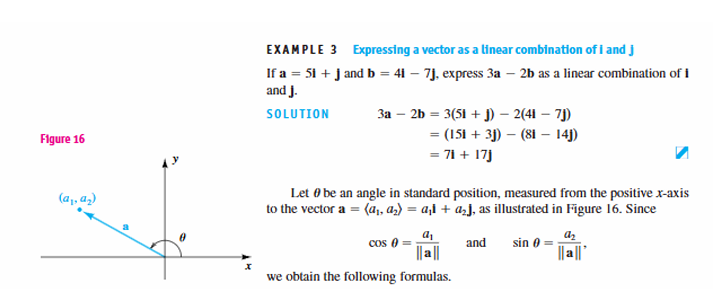
      Definition of i and j

      • i = <1, 0> - A unit vector representing the horizontal direction in the Cartesian coordinate system.

      • j = <0, 1> - A unit vector that represents the vertical direction in the Cartesian coordinate system.

      i, j Form for Vectors

      a=<a1,a2>=a1i+a2j</p><p>Examples:</p><p></p><p>Examples:</p><p><5,2>=5i+2j</p><p></p><p><-3,4>=-3i+4j ,-6>=0i+\left(-6\right)j=-6j

      Formulas for Horizontal and Vertical Components of a = <a1,a2>

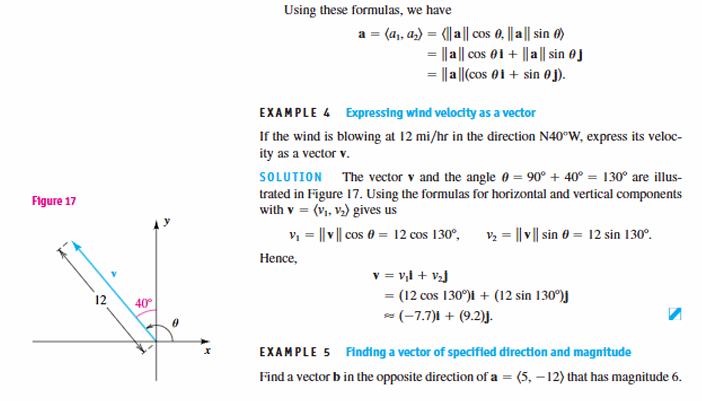
      a1a1 = acosθ\left\Vert a\right\Vert\cos\theta and a2 = asinθ\left\Vert a\right\Vert\sin\theta

      Definition of the Absolute Value of a Complex Number

      If z=a+biz=a+bi is a complex number, then its absolute value, denoted by a+bi\left\vert a+bi\right\vert is

      a2+b2\sqrt{a^2+b^2}

      De Moivre’s Theorem
      Polar Form of a Complex Number
      • z=a+biz = a + bi can be written in polar form as z=r(cosθ+isinθ)z = r(\cos \theta + i \sin \theta), where:

        • r=a2+b2r = \sqrt{a^2 + b^2} (the magnitude or modulus of z)

        • θ=arctan(ba)\theta = \arctan(\frac{b}{a}) (the argument of z)

      De Moivre's Theorem Formula
      • For any complex number z=r(cosθ+isinθ)z = r(\cos \theta + i \sin \theta) and any integer n:

        • zn=[r(cosθ+isinθ)]n=rn(cos(nθ)+isin(nθ))z^n = [r(\cos \theta + i \sin \theta)]^n = r^n(\cos(n\theta) + i \sin(n\theta))

      Applying De Moivre's Theorem
      1. Convert to Polar Form: Transform the complex number into its polar form z=r(cosθ+isinθ)z = r(\cos \theta + i \sin \theta).

      2. Apply the Theorem: Raise the modulus to the power of n and multiply the argument by n: zn=rn(cos(nθ)+isin(nθ))z^n = r^n(\cos(n\theta) + i \sin(n\theta)).

      3. Convert Back (if needed): If required, convert the result back to rectangular form.

      Proving De Moivre's Theorem
      • Base Case (n = 1): The theorem trivially holds for n = 1.

      • Inductive Step: Assume the theorem holds for n = k, i.e., [r(cosθ+isinθ)]k=rk(cos(kθ)+isin(kθ))\left[r(\cos \theta + i \sin \theta)\right]^k = r^k(\cos(k\theta) + i \sin(k\theta)).

      • Proof for n = k + 1:

        [r(cosθ+isinθ)]k+1=[r(cosθ+isinθ)]kr(cosθ+isinθ)\left[r(\cos \theta + i \sin \theta)\right]^{k+1} = \left[r(\cos \theta + i \sin \theta)\right]^k \cdot r(\cos \theta + i \sin \theta)

        =rk(cos(kθ)+isin(kθ))r(cosθ+isinθ)= r^k(\cos(k\theta) + i \sin(k\theta)) \cdot r(\cos \theta + i \sin \theta)

        =rk+1[(cos(kθ)cos(θ)sin(kθ)sin(θ))+i(sin(kθ)cos(θ)+cos(kθ)sin(θ))]= r^{k+1}[(\cos(k\theta)\cos(\theta) - \sin(k\theta)\sin(\theta)) + i(\sin(k\theta)\cos(\theta) + \cos(k\theta)\sin(\theta))]

        Using trigonometric identities:

        cos(A+B)=cosAcosBsinAsinB\cos(A + B) = \cos A \cos B - \sin A \sin B

        sin(A+B)=sinAcosB+cosAsinB\sin(A + B) = \sin A \cos B + \cos A \sin B

        We get:

        =rk+1[cos((k+1)θ)+isin((k+1)θ)]= r^{k+1}[\cos((k+1)\theta) + i \sin((k+1)\theta)]

      • Thus, by induction, the theorem holds for all integers n.

      Example 1: Finding Powers of Complex Numbers
      • Problem: Find (1+i)8(1 + i)^8 using De Moivre's Theorem.

      • Solution:

        1. Convert 1+i1 + i to polar form:

          • r=12+12=2r = \sqrt{1^2 + 1^2} = \sqrt{2}

          • θ=arctan(11)=π4\theta = \arctan(\frac{1}{1}) = \frac{\pi}{4}

          • So, 1+i=2(cos(π4)+isin(π4))1 + i = \sqrt{2} \left(\cos(\frac{\pi}{4}) + i \sin(\frac{\pi}{4})\right)

        2. Apply De Moivre's Theorem:

          (1+i)8=[2(cos(π4)+isin(π4))]8(1 + i)^8 = \left[\sqrt{2} \left(\cos(\frac{\pi}{4}) + i \sin(\frac{\pi}{4})\right)\right]^8

          =(2)8(cos(8π4)+isin(8π4))= (\sqrt{2})^8 \left(\cos(8 \cdot \frac{\pi}{4}) + i \sin(8 \cdot \frac{\pi}{4})\right)

          =16(cos(2π)+isin(2π))= 16 \left(\cos(2\pi) + i \sin(2\pi)\right)

          =16(1+0i)=16= 16 (1 + 0i) = 16

      Example 2: Finding Roots of Complex Numbers
      • Problem: Find the cube roots of 8i-8i using De Moivre's Theorem.

      • Solution:

        1. Convert 8i-8i to polar form:

          • r=02+(8)2=8r = \sqrt{0^2 + (-8)^2} = 8

          • θ=arctan(80)=3π2\theta = \arctan(\frac{-8}{0}) = \frac{3\pi}{2}

          • So, 8i=8(cos(3π2)+isin(3π2))-8i = 8 \left(\cos(\frac{3\pi}{2}) + i \sin(\frac{3\pi}{2})\right)

        2. Apply De Moivre's Theorem for finding roots:

          For cube roots (n = 3), we have:

          zk=r1n[cos(θ+2πkn)+isin(θ+2πkn)]z_k = r^{\frac{1}{n}} \left[\cos\left(\frac{\theta + 2\pi k}{n}\right) + i \sin\left(\frac{\theta + 2\pi k}{n}\right)\right]

          Where k=0,1,2k = 0, 1, 2

          For k=0k = 0:

          z0=813[cos(3π2+2π(0)3)+isin(3π2+2π(0)3)]z_0 = 8^{\frac{1}{3}} \left[\cos\left(\frac{\frac{3\pi}{2} + 2\pi (0)}{3}\right) + i \sin\left(\frac{\frac{3\pi}{2} + 2\pi (0)}{3}\right)\right]

          =2[cos(π2)+isin(π2)]=2(0+i)=2i= 2 \left[\cos(\frac{\pi}{2}) + i \sin(\frac{\pi}{2})\right] = 2(0 + i) = 2i

          For k=1k = 1:

          z1=813[cos(3π2+2π(1)3)+isin(3π2+2π(1)3)]z_1 = 8^{\frac{1}{3}} \left[\cos\left(\frac{\frac{3\pi}{2} + 2\pi (1)}{3}\right) + i \sin\left(\frac{\frac{3\pi}{2} + 2\pi (1)}{3}\right)\right]

          =2[cos(7π6)+isin(7π6)]=2(3212i)=3i= 2 \left[\cos(\frac{7\pi}{6}) + i \sin(\frac{7\pi}{6})\right] = 2\left(-\frac{\sqrt{3}}{2} - \frac{1}{2}i\right) = -\sqrt{3} - i

          For k=2k = 2:

          z2=813[cos(3π2+2π(2)3)+isin(3π2+2π(2)3)]z_2 = 8^{\frac{1}{3}} \left[\cos\left(\frac{\frac{3\pi}{2} + 2\pi (2)}{3}\right) + i \sin\left(\frac{\frac{3\pi}{2} + 2\pi (2)}{3}\right)\right]

          =2[cos(11π6)+isin(11π6)]=2(3212i)=3i= 2 \left[\cos(\frac{11\pi}{6}) + i \sin(\frac{11\pi}{6})\right] = 2\left(\frac{\sqrt{3}}{2} - \frac{1}{2}i\right) = \sqrt{3} - i

        3. The cube roots of 8i-8i are 2i2i, 3i-\sqrt{3} - i, and 3i\sqrt{3} - i.

      Applications of De Moivre's Theorem
      • Complex Number Powers: Simplifies raising complex numbers to integer powers.

      • Finding Roots: Used to find the nth roots of complex numbers.

      • Trigonometry: Can derive trigonometric identities and solve trigonometric equations.

      • Engineering and Physics: Applications in electrical engineering (AC circuit analysis) and quantum mechanics.

      De Moivre’s Theorem
      Polar Form of a Complex Number
      • z=a+biz = a + bi can be written in polar form as z=r(cosθ+isinθ)z = r(\cos \theta + i \sin \theta), where:

        • r=a2+b2r = \sqrt{a^2 + b^2} (the magnitude or modulus of z)

        • θ=arctan(ba)\theta = \arctan(\frac{b}{a}) (the argument of z)

      De Moivre's Theorem Formula
      • For any complex number z=r(cosθ+isinθ)z = r(\cos \theta + i \sin \theta) and any integer n:

        • zn=[r(cosθ+isinθ)]n=rn(cos(nθ)+isin(nθ))z^n = [r(\cos \theta + i \sin \theta)]^n = r^n(\cos(n\theta) + i \sin(n\theta))

      Applying De Moivre's Theorem
      1. Convert to Polar Form: Transform the complex number into its polar form z=r(cosθ+isinθ)z = r(\cos \theta + i \sin \theta).

      2. Apply the Theorem: Raise the modulus to the power of n and multiply the argument by n: zn=rn(cos(nθ)+isin(nθ))z^n = r^n(\cos(n\theta) + i \sin(n\theta)).

      3. Convert Back (if needed): If required, convert the result back to rectangular form.

      Proving De Moivre's Theorem
      • Base Case (n = 1): The theorem trivially holds for n = 1.

      • Inductive Step: Assume the theorem holds for n = k, i.e., [r(cosθ+isinθ)]k=rk(cos(kθ)+isin(kθ))[r(\cos \theta + i \sin \theta)]^k = r^k(\cos(k\theta) + i \sin(k\theta)).

      • Proof for n = k + 1:

        • [r(cosθ+isinθ)]k+1=[r(cosθ+isinθ)]kr(cosθ+isinθ)[r(\cos \theta + i \sin \theta)]^{k+1} = [r(\cos \theta + i \sin \theta)]^k \cdot r(\cos \theta + i \sin \theta)

        • =rk(cos(kθ)+isin(kθ))r(cosθ+isinθ)= r^k(\cos(k\theta) + i \sin(k\theta)) \cdot r(\cos \theta + i \sin \theta)

        • =rk+1[(cos(kθ)cos(θ)sin(kθ)sin(θ))+i(sin(kθ)cos(θ)+cos(kθ)sin(θ))]= r^{k+1}[(\cos(k\theta)\cos(\theta) - \sin(k\theta)\sin(\theta)) + i(\sin(k\theta)\cos(\theta) + \cos(k\theta)\sin(\theta))]

        • Using trigonometric identities:

        • cos(A+B)=cosAcosBsinAsinB\cos(A + B) = \cos A \cos B - \sin A \sin B

        • sin(A+B)=sinAcosB+cosAsinB\sin(A + B) = \sin A \cos B + \cos A \sin B

        • We get:

        • =rk+1[cos((k+1)θ)+isin((k+1)θ)]= r^{k+1}[\cos((k+1)\theta) + i \sin((k+1)\theta)]

      • Thus, by induction, the theorem holds for all integers n.

      Example 1: Finding Powers of Complex Numbers
      • Problem: Find (1+i)8(1 + i)^8 using De Moivre's Theorem.

      • Solution:

        1. Convert 1+i1 + i to polar form:

        • r=12+12=2r = \sqrt{1^2 + 1^2} = \sqrt{2}

        • θ=arctan(11)=π4\theta = \arctan(\frac{1}{1}) = \frac{\pi}{4}

        • So, 1+i=2(cos(π4)+isin(π4))1 + i = \sqrt{2} (\cos(\frac{\pi}{4}) + i \sin(\frac{\pi}{4}))

        1. Apply De Moivre's Theorem:

        • (1+i)8=[2(cos(π4)+isin(π4))]8(1 + i)^8 = [\sqrt{2} (\cos(\frac{\pi}{4}) + i \sin(\frac{\pi}{4}))]^8

        • =(2)8(cos(8π4)+isin(8π4))= (\sqrt{2})^8 (\cos(8 \cdot \frac{\pi}{4}) + i \sin(8 \cdot \frac{\pi}{4}))

        • =16(cos(2π)+isin(2π))= 16 (\cos(2\pi) + i \sin(2\pi))

        • =16(1+0i)=16= 16 (1 + 0i) = 16

      Example 2: Finding Roots of Complex Numbers
      • Problem: Find the cube roots of 8i-8i using De Moivre's Theorem.

      • Solution:

        1. Convert 8i-8i to polar form:

        • r=02+(8)2=8r = \sqrt{0^2 + (-8)^2} = 8

        • θ=arctan(80)=3π2\theta = \arctan(\frac{-8}{0}) = \frac{3\pi}{2}

        • So, 8i=8(cos(3π2)+isin(3π2))-8i = 8 (\cos(\frac{3\pi}{2}) + i \sin(\frac{3\pi}{2}))

        1. Apply De Moivre's Theorem for finding roots:

        • For cube roots (n = 3), we have:

          • zk=r1n[cos(θ+2πkn)+isin(θ+2πkn)]z_k = r^{\frac{1}{n}} [\cos(\frac{\theta + 2\pi k}{n}) + i \sin(\frac{\theta + 2\pi k}{n})]

          • Where k=0,1,2k = 0, 1, 2

        • For k=0k = 0:

          • z0=813[cos(3π2+2π(0)3)+isin(3π2+2π(0)3)]z_0 = 8^{\frac{1}{3}} [\cos(\frac{\frac{3\pi}{2} + 2\pi (0)}{3}) + i \sin(\frac{\frac{3\pi}{2} + 2\pi (0)}{3})]

          • =2[cos(π2)+isin(π2)]=2(0+i)=2i= 2 [\cos(\frac{\pi}{2}) + i \sin(\frac{\pi}{2})] = 2(0 + i) = 2i

        • For k=1k = 1:

          • z1=813[cos(3π2+2π(1)3)+isin(3π2+2π(1)3)]z_1 = 8^{\frac{1}{3}} [\cos(\frac{\frac{3\pi}{2} + 2\pi (1)}{3}) + i \sin(\frac{\frac{3\pi}{2} + 2\pi (1)}{3})]

          • =2[cos(7π6)+isin(7π6)]=2(3212i)=3i= 2 [\cos(\frac{7\pi}{6}) + i \sin(\frac{7\pi}{6})] = 2(-\frac{\sqrt{3}}{2} - \frac{1}{2}i) = -\sqrt{3} - i

        • For k=2k = 2:

          • z2=813[cos(3π2+2π(2)3)+isin(3π2+2π(2)3)]z_2 = 8^{\frac{1}{3}} [\cos(\frac{\frac{3\pi}{2} + 2\pi (2)}{3}) + i \sin(\frac{\frac{3\pi}{2} + 2\pi (2)}{3})]

          • =2[cos(11π6)+isin(11π6)]=2(3212i)=3i= 2 [\cos(\frac{11\pi}{6}) + i \sin(\frac{11\pi}{6})] = 2(\frac{\sqrt{3}}{2} - \frac{1}{2}i) = \sqrt{3} - i

        1. The cube roots of 8i-8i are 2i2i, 3i-\sqrt{3} - i, and 3i\sqrt{3} - i.

      Products and Quotients of Complex Numbers
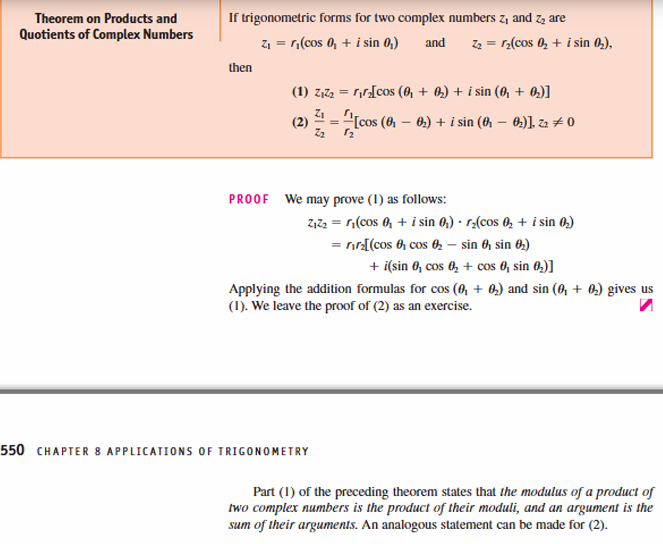
      • Given two complex numbers, z<em>1=r</em>1(cosθ<em>1+isinθ</em>1)z<em>1 = r</em>1(\cos \theta<em>1 + i \sin \theta</em>1) and z<em>2=r</em>2(cosθ<em>2+isinθ</em>2)z<em>2 = r</em>2(\cos \theta<em>2 + i \sin \theta</em>2):

        • Product: z<em>1z</em>2=r<em>1r</em>2[cos(θ<em>1+θ</em>2)+isin(θ<em>1+θ</em>2)]z<em>1 z</em>2 = r<em>1 r</em>2 [\cos(\theta<em>1 + \theta</em>2) + i \sin(\theta<em>1 + \theta</em>2)]

        • Multiply the magnitudes and add the arguments.

        • Quotient: \frac{z1}{z2} = \frac{r1}{r

      De Moivre’s Theorem

      Polar Form of a Complex Number

      z = a + bicanbewritteninpolarformascan be written in polar form asz = r(\cos \theta + i \sin \theta),where:</p><p>, where:</p><p>r = \sqrt{a^2 + b^2}(themagnitudeormodulusofz)</p><p>(the magnitude or modulus of z)</p><p>\theta = \arctan(\frac{b}{a})(theargumentofz)</p><p>nthRootsFormula</p><p>Forfindingthenthrootsofacomplexnumber(the argument of z)</p><p>nth Roots Formula</p><p>For finding the nth roots of a complex numberz = r(\cos \theta + i \sin \theta),wehave:</p><p>, we have:</p><p>z_k = r^{\frac{1}{n}} \left[\cos\left(\frac{\theta + 2\pi k}{n}\right) + i \sin\left(\frac{\theta + 2\pi k}{n}\right)\right]</p><p>Where</p><p>Wherek = 0, 1, 2, …, n-1</p><p>ApplyingtheFormula</p><p>ConverttoPolarForm:Transformthecomplexnumberintoitspolarform</p><p>Applying the Formula</p><p>Convert to Polar Form: Transform the complex number into its polar formz = r(\cos \theta + i \sin \theta).</p><p>ApplytheFormula:Usetheformulatofindthenthroots,iteratingthrough.</p><p>Apply the Formula: Use the formula to find the nth roots, iterating throughk = 0, 1, 2, …, n-1.</p><p>Simplify:Simplifyeachroottoitssimplestform.</p><p>Example:FindingCubeRootsof8i</p><p>Problem:Findthecuberootsof.</p><p>Simplify: Simplify each root to its simplest form.</p><p>Example: Finding Cube Roots of -8i</p><p>Problem: Find the cube roots of-8iusingDeMoivresTheorem.</p><p>Solution:</p><p>Convertusing De Moivre's Theorem.</p><p>Solution:</p><p>Convert-8itopolarform:</p><p>to polar form:</p><p>r = \sqrt{0^2 + (-8)^2} = 8</p><p></p><p>\theta = \arctan(\frac{-8}{0}) = \frac{3\pi}{2}</p><p>So,</p><p>So,-8i = 8 (\cos(\frac{3\pi}{2}) + i \sin(\frac{3\pi}{2}))</p><p>ApplyDeMoivresTheoremforfindingroots:</p><p>Forcuberoots(n=3),wehave:</p><p></p><p>Apply De Moivre's Theorem for finding roots:</p><p>For cube roots (n = 3), we have:</p><p>z_k = 8^{\frac{1}{3}} \left[\cos\left(\frac{\frac{3\pi}{2} + 2\pi k}{3}\right) + i \sin\left(\frac{\frac{3\pi}{2} + 2\pi k}{3}\right)\right]</p><p>Where</p><p>Wherek = 0, 1, 2</p><p>For</p><p>Fork = 0:</p><p>:</p><p>z_0 = 8^{\frac{1}{3}} \left[\cos\left(\frac{\frac{3\pi}{2} + 2\pi (0)}{3}\right) + i \sin\left(\frac{\frac{3\pi}{2} + 2\pi (0)}{3}\right)\right]</p><p></p><p>= 2 [\cos(\frac{\pi}{2}) + i \sin(\frac{\pi}{2})] = 2(0 + i) = 2i</p><p>For</p><p>Fork = 1:</p><p>:</p><p>z_1 = 8^{\frac{1}{3}} \left[\cos\left(\frac{\frac{3\pi}{2} + 2\pi (1)}{3}\right) + i \sin\left(\frac{\frac{3\pi}{2} + 2\pi (1)}{3}\right)\right]</p><p></p><p>= 2 [\cos(\frac{7\pi}{6}) + i \sin(\frac{7\pi}{6})] = 2(-\frac{\sqrt{3}}{2} - \frac{1}{2}i) = -\sqrt{3} - i</p><p>For</p><p>Fork = 2:</p><p>:</p><p>z_2 = 8^{\frac{1}{3}} \left[\cos\left(\frac{\frac{3\pi}{2} + 2\pi (2)}{3}\right) + i \sin\left(\frac{\frac{3\pi}{2} + 2\pi (2)}{3}\right)\right]</p><p></p><p>= 2 [\cos(\frac{11\pi}{6}) + i \sin(\frac{11\pi}{6})] = 2(\frac{\sqrt{3}}{2} - \frac{1}{2}i) = \sqrt{3} - i</p><p>Thecuberootsof</p><p>The cube roots of-8iareare2i,,-\sqrt{3} - i,and, and\sqrt{3} - i$$.

      Key Points

      The nth roots are evenly spaced around the complex plane.

      Each complex number has exactly n distinct nth roots.

      Applications

      Solving polynomial equations

      Electrical engineering

      Quantum mechanics

      Limitations