Cell Biology - lecture 15 - Development of Multicellular Organisms
Learning Aims/Outcomes
Understand how germ cells form during development.
Describe how meiosis ensures gametes have the correct amount of genetic material.
Understand fertilisation processes in mammals.
Describe asexual reproduction in Hydra.
Understand parthenogenesis.
Germ Cell Formation
Overview
Germ cells are the precursors to sperm and eggs, distinct from somatic cells that comprise the body.
Germline cells are uniquely segregated during early embryonic development.
Functional gametes develop during adulthood.
Mouse Germ-Cell Formation
Primordial Germ Cells (PGCs):
First identified in proximal epiblast (pre-gastrulation).
Migrate to posterior end during gastrulation.
Eventually migrate to gonads.
Human Development:
Similar migration occurs during the 4th week.
Gene Expression:
PGCs express genes essential for pluripotency (nanog) and cell adhesion/migration.
Migration Pathways
PGCs enter hindgut endoderm and travel via dorsal mesentery to genital ridges.
Differentiation:
Migrate and differentiate into eggs or sperm.
Rational for migration includes exclusion from body plan formation and selecting for health (localized survival).
Environmental chemical signals regulate migration; transplanted PGCs cannot orient correctly.
Meiosis in Germ Cells
Overview
Meiosis produces haploid gametes (egg and sperm), ensuring the correct chromosomal count in the zygote.
Phases of Meiosis:
Prophase: Chromosomes recombine and pair up.
Meiosis consists of two divisions; chromosome replication occurs before the first but not before the second, halving the count.
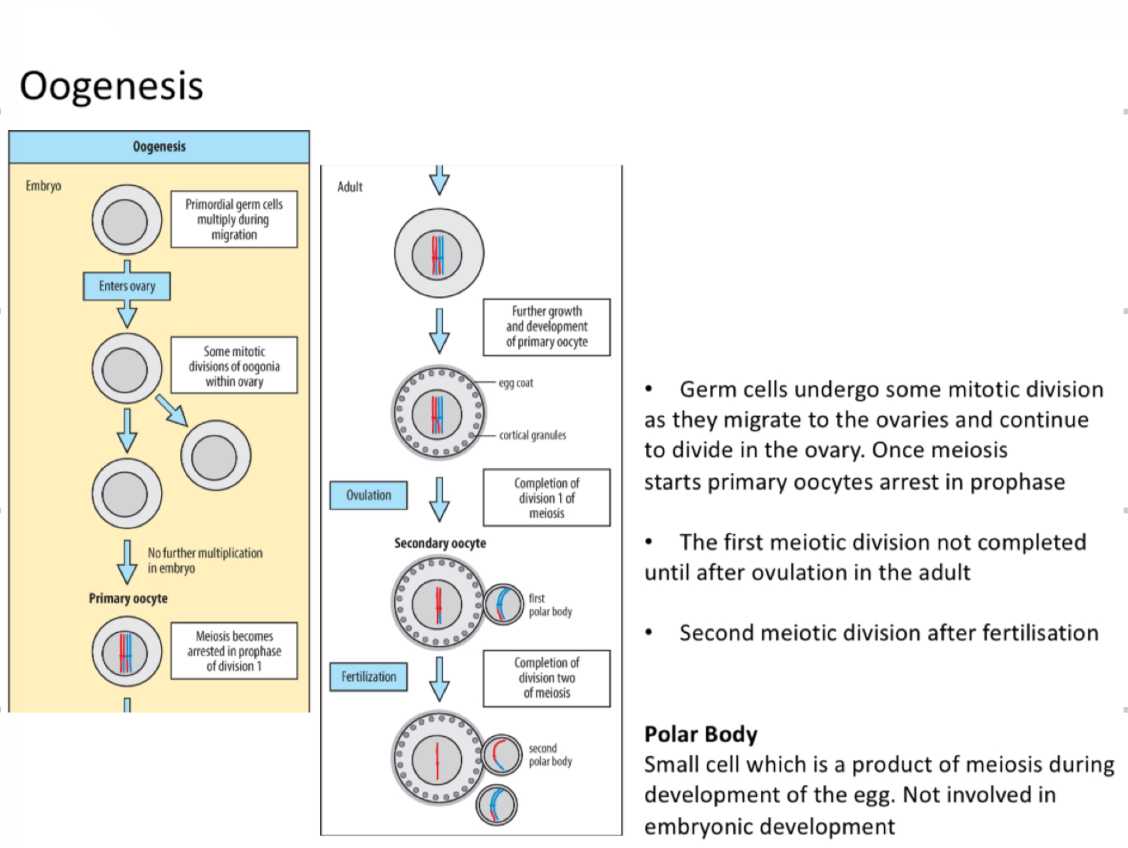
Oogenesis
Polar Body:
Small product of meiosis, nonembryonic.
Mitosis occurs during migration to ovaries; primary oocytes halt at prophase until ovulation.
Second meiotic division only occurs post-fertilisation.
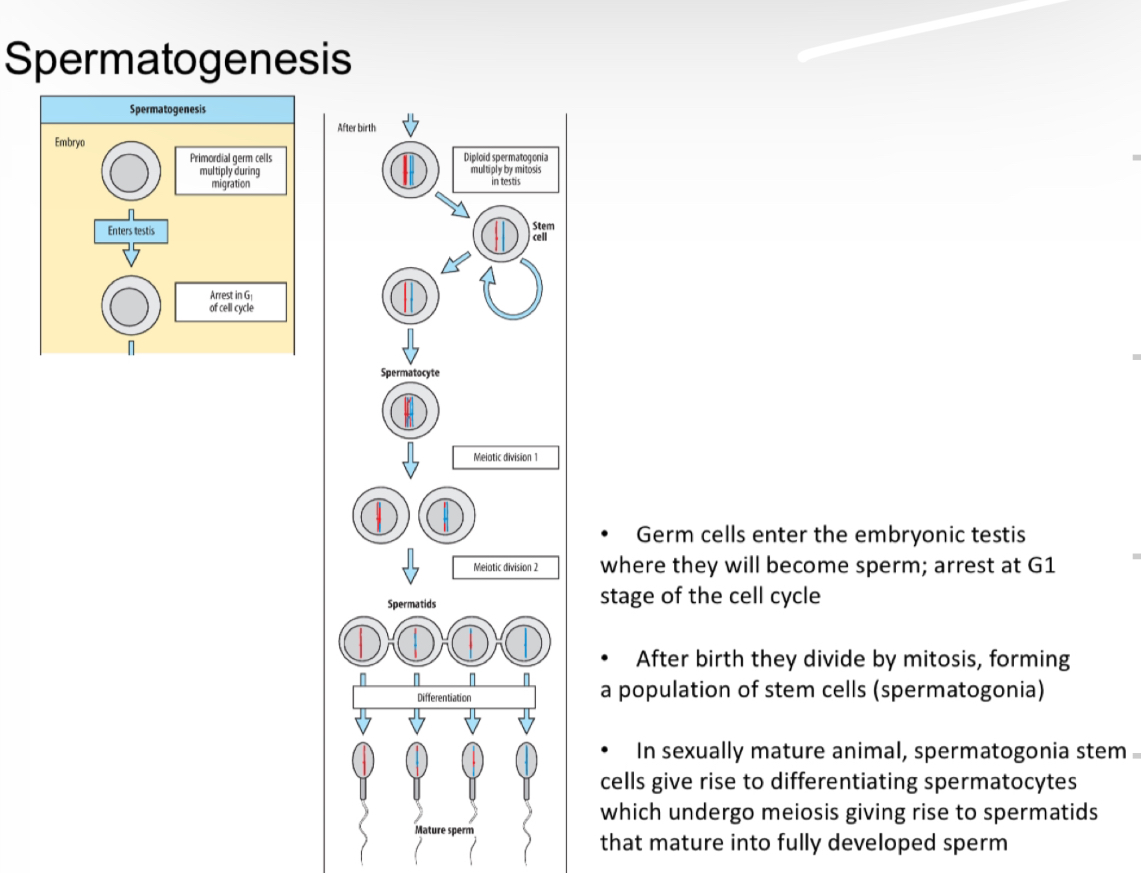
Spermatogenesis
Germ cells enter embryonic testis, pausing in G1 stage of the cell cycle.
Post-birth, they proliferate via mitosis into spermatogonia.
Mature sperm develop from differentiating spermatocytes through meiosis.
Impact of Age on Oocyte Numbers
Human oocyte numbers decline with age.
Initial count: ~7 million germ cells at fetal stage; drops to approximately 1 million at birth; ~300,000 at puberty; only about 400 released during lifetime.
Hypotheses of Germline Death in Mammals
Apoptosis Mechanisms:
Growth factors suppress apoptosis via germ-cell surface receptors.
Meiotic recombination failures can lead to cell death.
They can sacrifice themselves to protect other germ cells.
Nurse Germ Cells:
In cysts, these transport necessary materials to oocytes.
Fertilisation Overview
Fertilisation marks the beginning of development, occurring in the fallopian tube.
Fusion of the sperm and egg that initiates development.
Critical Aspect: Only one sperm should fertilise the egg to prevent chromosomal abnormalities.
Process of Fertilisation
Gametes Fusion:
Sperm penetrates sticky layer of hyaluronic acid and somatic follicle cells - cumulus cells
Sperm binds to zona pellucida
Penetrates the zona pellucida - layer of fibrous glycoproteins via acrosomal reaction
Plasma membrane of sperm fuses with egg plasma membrane
Sperm nucleus enter the egg cytoplasm
Initiates developmental processes.
Mitotic Stages:
Series of cell divisions from zygote to morula to blastocyst.
Egg Structure:
Zona pellucida and corona radiata protect the oocyte.
Acrosome Reaction
Enzymes from the acrosome digest the protective egg coat facilitating sperm entry.
Calcium Wave and Polyspermy Prevention
Calcium Wave:
Triggered by sperm entry, essential for cortical granule exocytosis and hardening of the vitelline envelope - fertilisation envelope.
Prevents more sperm from reaching the egg
Asexual Reproduction in Hydra
Budding Process:
Buds develop from repeated mitotic divisions of epidermal cells, eventually detaching.
Grows connected to parent
Then constricts at base and separates
Parthenogenesis
Embryos can develop from unfertilised egg cells, observed in specific species, including Komodo dragons and certain bees.
Reproduction in Honey Bees
Types of Bees
Worker Bees:
Females, non-functional reproductive system through eating phenolic acid.
Drone Bees:
Males with functional reproductive systems.
Queen Bee:
Fully developed reproductive capabilities.
Sexual Determination in Bees
Haploid-diploid system:
Males from unfertilized eggs; females from fertilized diploid eggs.