A level Biology Mistakes
Hydrogen molecules are important in cellulose molecules, why?
As many hydrogen bonds account in number to increase the strength
This allows to strengthen cell wall
Hydrogen bonds occur between the chains, which is called microfibrils
My mock 1 Yr 13 mistake: What is a non-competitive inhibitor?
I said ‘Something that binds to another side of the enzyme‘ WRONG
A competitive inhibitor binds to a part of the enzyme that is not active site***
Explain the importance of hydrolysis of ATP:
The energy released can be coupled for reactions to take place
It is a short term energy
Explain why Viruses are acellular?
They do not have any metabolic pathways
Explain the three features that all Viruses have:
Attachment proteins (to recognise host cells, causes the viruses to fuse with host cells to transfer the genetic information, so they can be replicated via the host cells)
Capsid (to hold the genetic information)
Genetic information (either in the form of DNA or RNA), to pass on their genetic information to host cells, to form the production of viral proteins. These viral proteins can assemble into viruses.
CH3:
What organelles do Eukaryotic cells have?
Nucleus, Mitochondria, ER, Lysosomes
Key term: wavelength of light TOO LONG, so lower resolution
Bacterium: They contain a cell-surface membrane
What does the fluid in the fluid mosaic model represent?
The phospholipids that can move around relative to one another.
DO NOT SAY: Phospholipids move around each other, thats saying they move around everywhere. But they move around in one position
Key note: CH6
Diaphragm contracts and flattens
In the mock (Nov Yr13): (roughly) There was a hole made in the tree, the student put tape over it why is it important? It was one mark, but Sahasra remember every key point is important!!
I said: To prevent water leaking out. WRONG Remember because the xylem is under tension, the opposite happens it draws in air
If a xylem vessel is broken or air enters then the tree can no longer draw in water. This is because the continuous column of water is broken, so the water molecules can no longer stick together.
So, tape was put over to prevent air entering, and prevent breaking the column of water.
Transpiration is a passive process, but energy is still required (The sun provides heat energy, causing the evaporation of water molecules)
WWW: In the mock, I was able to remember definitions (continue this)!!
Key point: all members of the same species have same genes, but they have different combination of alleles
Gene: A section of DNA that codes for polypeptide chains and functional RNA
Locus: The specific location of gene on DNA
Allele: An alternative form of gene
Genome: The complete set of genes in an organism
Protenome: The full range of proteins produced by the genome (complete set of genes of organism)
Homologous chromosomes: One homologous chromosome (paternal) and one homologous chromosome (maternal), that have the same gene loci
Genetic Diversity: The total number of different alleles within a population
Population: Group of individuals of same species that can interbreed to form successful offspring
Gene pool: containing wide variety of alleles
(natural selection: increased allele frequency)
Classification: Organising living organisms into groups
Species: Is a group of organisms that are capable of breeding to form fertile offsprings
Taxonomy: the theory and practice of biological classification (the study of phylogenetic groups and their positions in hierarchical order)
Phylogenetic classification: Evolutionary relationships between organisms (groups arranged in a hierarchy with no overlap)
Species diversity: The number of different species and the number of individuals of each species within a community VERSUS Species richness: The number of different species in a particular area at given time
Ecosystem diversity: Range of different habitats within habitat
Higher the index of diversity, the greater the species diversity
How to identify if cells are undergoing interphase?
no visible chromosomes
Visible (one) nucleus present
Give precautions the student should have taken when settings up potometer to obtain reliable results:
Seal joints to ensure air tight
Cut the shoot underwater
Shut the tap
Measure where the air bubble was at the start, and where the air bubble was at the end
Explain why potometer does not truly measure the rate of transpiration?
Some water used for photosynthesis
Some water used for respiration
Some water used for structural integrity
Some water used for hydrolysis
How does pH effect the shape of a protein:
pH causes addition of many protons
This effects the ionic bonding between R groups
How does temperature effect the shape of a protein:
Temperature causes change in the hydrogen bonding between R-groups
Effecting the tertiary structure of protein
Respiration:
The Krebs cycle does not require oxygen directly. However this cycle stops in the absence of oxygen.
Use you understanding of the aerobic respiration to explain why Krebs cycle stops in the absence of oxygen?
Oxygen needs to be final electron acceptor during oxidative phosphorylation
Without oxygen all FAD and NAD will remain reduced (they will not accept hydrogen ions)
And without FAD and NAD taking up hydrogen ions the krebs cycle cannot operate.
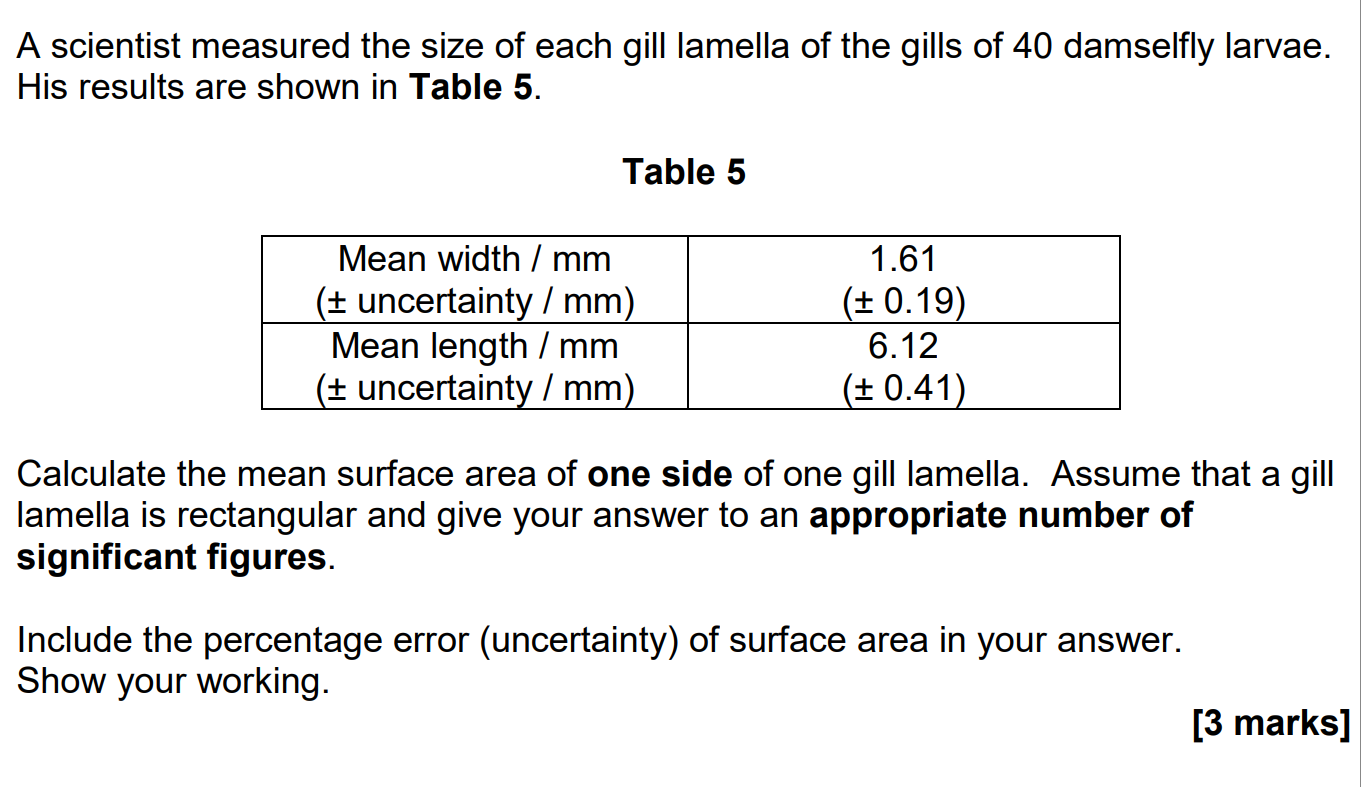
To find the percentage uncertainty for SA, calculate individual percentage uncertainty and then add them up together.
So, (0.19/1.61 × 100) + (0.41/6.12 × 100) roughly equal to 19 percent
Question of meosis (common ones):
Describe how the change in chromosome number in Edward’s syndrome may be produced:
By meosis
Homologous chromosomes do not separate OR non-disjunction OR sister chromatids do not separate
Explain why this chromosomes mutation is found in all body cells of individuals with Edward’s disease:
All cells are dervived from a single cell by mitosis
Mitosis produces genetically identical cells
What are homologous chromosomes:
One from mother and one from father
Pairs of chromosomes
With genes for same features (genes at same loci (genes at the same position))
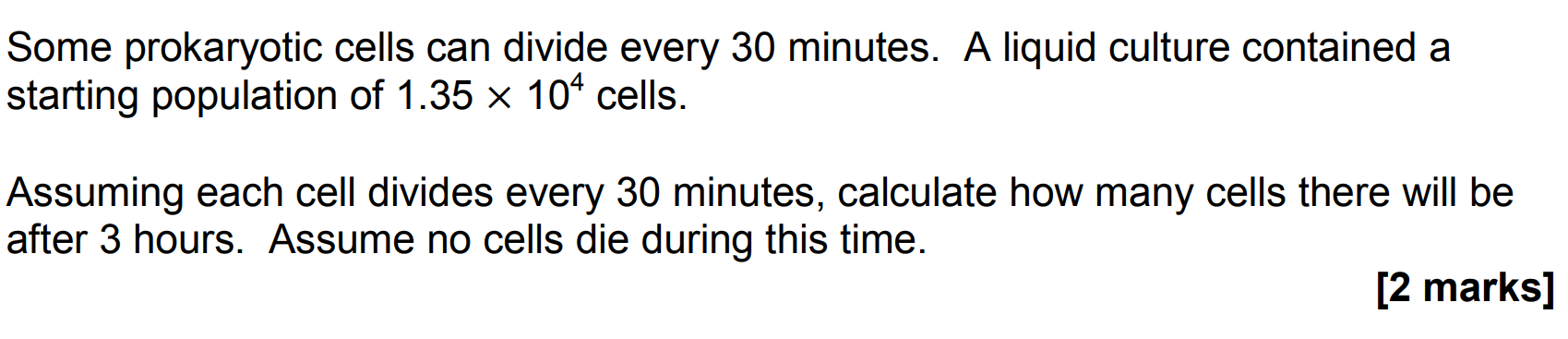
For this question:
2^6 x (1.35 × 10^4)
the reason is there are 6 divisions, but the growth factor is by 2
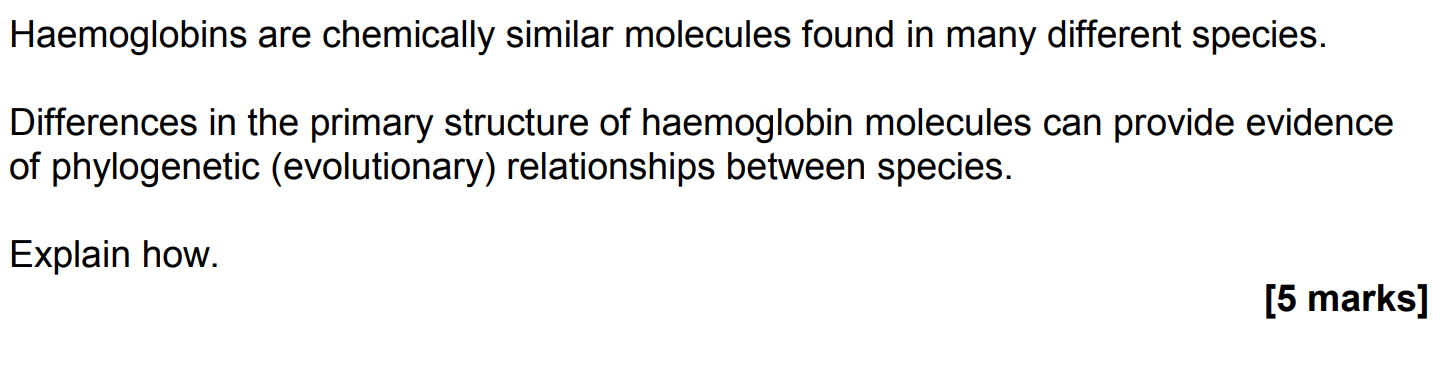
There are random mutations, which alter the DNA base sequence
This results in different transcription and transulation of amino acid sequence.
So, organisms with many mutations and altered amino acid sequence so they are not related to each other as closely, so they are distant species.
However, organisms with similar amino acid sequence are more closely related so they are of recent evolutionary species.
The differences between triglyceride and phospholopid:
Both contain glycerol
Both contain ester bonds
Phospholipids contain 2 fatty acids and phosphate ion, but triglycerides contain 3 fatty acids
Phospholipids contain a hydrophoibic area and a hydrophillic area but triglycerides only contain hydrophillic area.
Both contain a C, H and O but phospholipids contain a P.
Homologous chromosomes: contain the same genes
Genetic deiversity: includes the number of individuals in each species and the total number of species.
Explain why with the electron transport chain stopped, there is still increased temperature to the surroundings?
Energy is released to the surroundings from the excited electrons.
Why is pyruvate used as a respiratory substrate instead of glucose?
Glucose is converted (broken down) to pyruvate in the cytoplasm, where glycolysis takes place
Glucose cannot pass through the mitrocondrial membranes
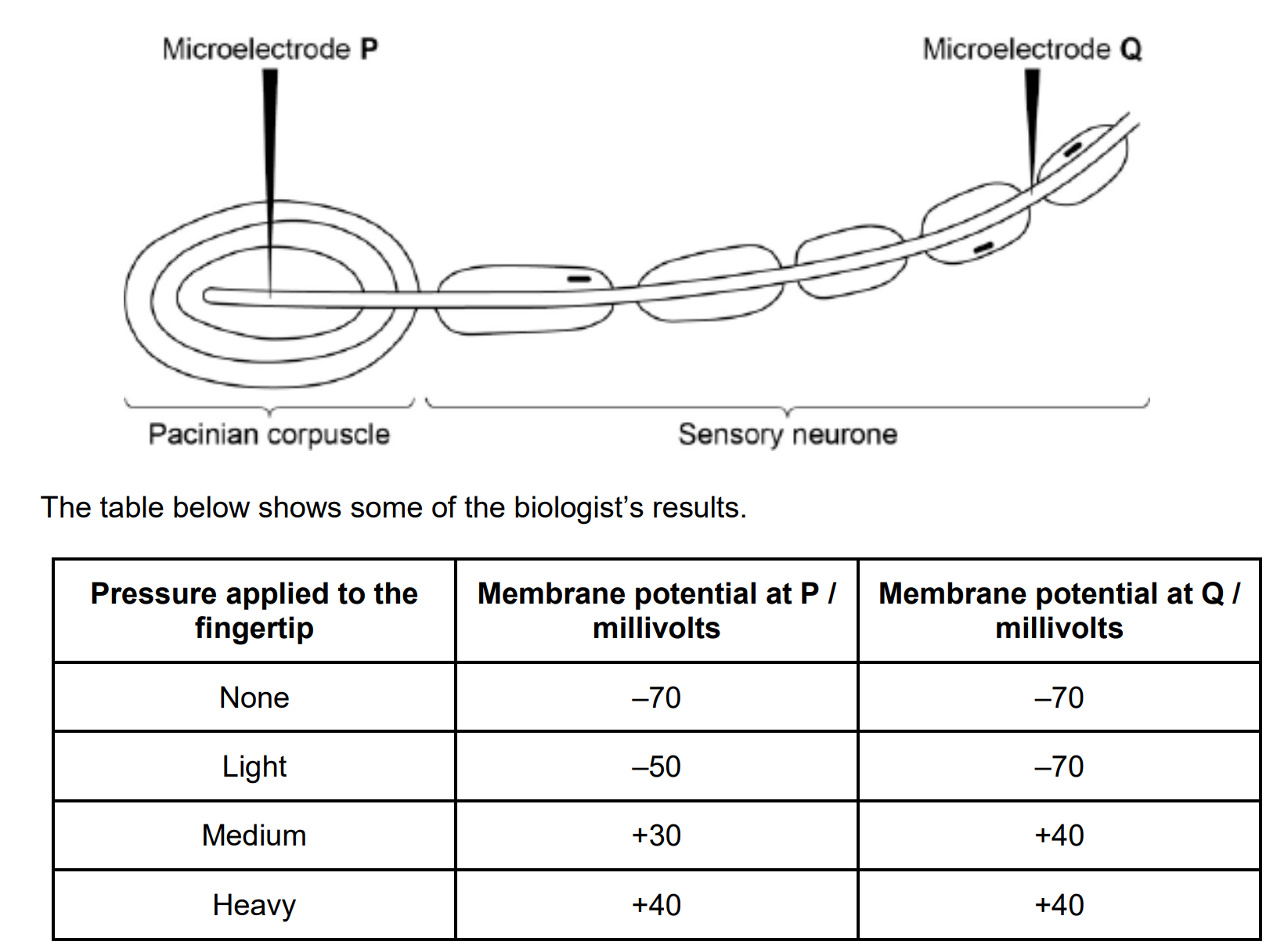
Question) The membrane at Q was the same whether medium or heavy pressure at fingertip, Why?
This is because of the all or nothing principle, the threshold has been reached.
Question) Explain why the pressure applied to the fingertips caused a change in membrane potential? MARK SCHEME WAS VERY STINGY!!
This is because activated stretch mediated sodium ion channels to open
This caused Sodium ions to enter via facilitated diffusion
The greater the pressure, the more sodium ion channels open, so more sodium ions enter, causing even more depolarisation.
Osmoreceptors are found where in the mammal: they are found in the hypothalamus.
The mistakes from flashcards:
The process of how calcium ions find their way into the myofibril?
Action potential refractory period purpose: ensures that impulses are discrete and they are propagated in one direction
Acetylcholine → ethanoic acid + choline
Wording better: Hyperpolarisation => the outward movement of K+, causes a sudden overshoot in negative charge inside the neuron
Skeletal muscles are made from a bundle of muscle fibres, and muscle fiber contains many myofibrils.
The process of how calcium ions find their way into the myofibril

Action potential arrives at the end of neurone
Triggers opening of calcium ion channels and calcium ions enters the neurone
The acetylcholine vesicles release their contents into the synaptic cleft
Acetylecholine diffuses across the synaptic cleft
Acetylcholine binds to the receptors on sarcolemma leading to opening of sodium ion channels
This results in depolarisation of sarcolemma.
The depolarisation extends through the T tubles, which interact with sacroplasmic reticulum and release calcium ions into the sacroplasm

The base sequence of bases is longer than the sequence of amino acids, this is because 3 bases code for an amino acid.
Also, different triplets code for the same amino acid.
The scientist can create a DNA ladder, with known DNA fragment length and see how far that will move along the Gel plate, so can compare. (Run fragments of known length)
OR using genetic markers.

The volume stays constant, since the volume of carbon dioxide released is equal to the volume of oxygen absorbed. => equation for respiration, since question is respiration.
