Unit 4
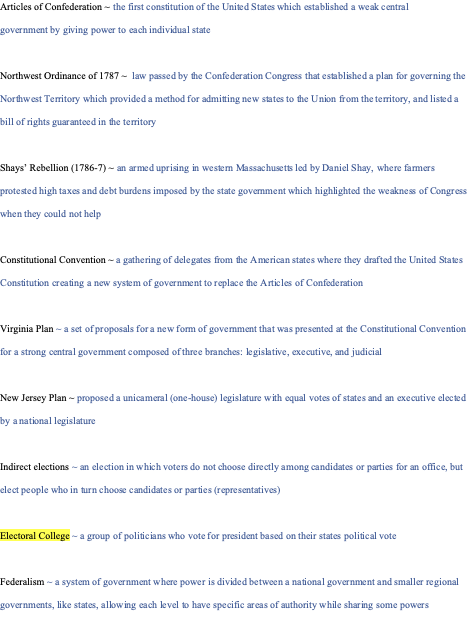
Articles of Confederation ~ the first constitution of the United States which established a weak central government by giving power to each individual state
Northwest Ordinance of 1787 ~ law passed by the Confederation Congress that established a plan for governing the Northwest Territory which provided a method for admitting new states to the Union from the territory, and listed a bill of rights guaranteed in the territory
Shays’ Rebellion (1786-7) ~ an armed uprising in western Massachusetts led by Daniel Shay, where farmers protested high taxes and debt burdens imposed by the state government which highlighted the weakness of Congress when they could not help
Constitutional Convention ~ a gathering of delegates from the American states where they drafted the United States Constitution creating a new system of government to replace the Articles of Confederation
Virginia Plan ~ a set of proposals for a new form of government that was presented at the Constitutional Convention for a strong central government composed of three branches: legislative, executive, and judicial
New Jersey Plan ~ proposed a unicameral (one-house) legislature with equal votes of states and an executive elected by a national legislature
Indirect elections ~ an election in which voters do not choose directly among candidates or parties for an office, but elect people who in turn choose candidates or parties (representatives)
Electoral College ~ a group of politicians who vote for president based on their states political vote
Federalism ~ a system of government where power is divided between a national government and smaller regional governments, like states, allowing each level to have specific areas of authority while sharing some powers
Necessary and proper clause ~ gave Congress power to make “all Laws which shall be necessary and proper for carrying into Execution” other federal powers
Checks and balances (separation of powers) ~ a system that prevents any one branch of the U.S. government from becoming too powerful:
- Legislative branch: Makes the law
- Executive branch: Enforces the law
- Judicial branch: Interprets the law
Three-fifths clause ~ stated that enslaved people would be counted as three-fifths of a person when determining a state's population for representation
Federalists ~ political party that advocated a strong central government and favored Britian
Federalist Papers ~ 85 essays written by Alexander Hamilton, James Madison, and John Jay that advocated for the ratification of the Constitution
Anti-Federalists ~ a group of Founding Fathers who opposed the Constitution of 1787 and feared that it gave too much power to the national government
Bill of Rights ~ first ten amendments to the United States Constitution which guarantee fundamental individual liberties
Bank of the United States ~ the first central bank established in the United States primarily designed to manage the nation's debt from the Revolutionary War
Impressment ~ the practice of forcibly seizing men from civilian merchant ships and forcing them into naval service (acted by the British on American sailors)
Jay’s Treaty ~ an agreement between the United States and Great Britain that aimed to resolve outstanding issues from the American Revolution
Republicans (Democratic-Republicans) ~ a political party for the “common man” who supported an alliance with France
Whiskey Rebellion of 1794 ~ a protest by farmers in Western Pennsylvania against a federal excise tax on whiskey, which was seen as a crucial part of their livelihood
Washington’s Farewell Address ~ Washington’s warning to Americans about political parties and how their creation will cause division and competition in the nation, but also to stay away from foreign affairs
XYZ Affair ~ a diplomatic incident between the United States and France where French agents, identified as X, Y, and Z, demanded a bribe from American diplomats seeking to negotiate a treaty, essentially refusing to discuss peace unless the US paid them off
“Quasi-War” ~ naval conflict between the United States and France which marked the first time the American Navy actively defended its ship against foreign countries
Alien and Sedition Acts ~ a series of four laws passed by Congress that were designed to restrict the rights of Democratic-Republicans and limit their criticism of the government
Virginia and Kentucky Resolutions ~ a series of documents that protested against the limitations on civil liberties contained in the Alien and Sedition Acts
Louisiana Territory ~ land acquired by the United States from France through the Louisiana Purchase, effectively doubling the size of the country
Marbury v. Madison ~ Supreme Court case that established the principle of "judicial review," meaning that the courts have the power to declare laws unconstitutional
Judicial review ~ ability of the Court to declare a Legislative or Executive act in violation of the Constitution
Embargo Act ~ a law that closed U.S. ports to all exports and restricted imports from Britain
War Hawks ~ a group of young, mostly Southern and Western politicians in the United States who strongly advocated for war with Great Britain
War of 1812 ~ a conflict between the United States and Great Britain, primarily fought over British practices like impressment of American sailors and restrictions on American trade, which ultimately led to the young American nation declaring war on the powerful British Empire
Fort McHenry ~ a port that successfully defended Baltimore Harbor from an attack by the British navy from Chesapeake Bay
Hartford Convention ~ a secret meeting of New England Federalists in December 1814 that proposed constitutional amendments to limit the power of slaveholding states and the Democratic-Republican Party
Battle of New Orleans ~ final American victory which ended the war
Treaty of Ghent ~ a peace agreement that officially ended the War of 1812 between the United States and Great Britain, restoring pre-war territorial boundaries and essentially marking a return to the status quo before the conflict (US gained Northwest Territories)
Daniel Shays ~ a Revolutionary War veteran who is primarily known for leading "Shays' Rebellion
Thomas Jefferson ~ Founding Father of the United States, most notably known as the primary author of the Declaration of Independence, and later served as the third President of the United States
James Madison
Alexander Hamilton ~ a founding father of the United States, who fought in the American Revolutionary War, helped draft the Constitution, and served as the first secretary of the treasury
George Washington ~ led the Continental Army to victory in the Revolutionary War, helped create the U.S. Constitution, and served as the first president of the United States
Citizen Genet ~ a French diplomat sent to the United States during the early years of the French Revolution
John Adams ~ a Founding Father of the United States, serving as the second President, and is considered important for his leading role in advocating for American independence from Great Britain
John Marshall ~ fourth Chief Justice of the United States Supreme Court who helped increase the power and prestige of the Federal court system
Henry Clay ~ recognized as the "Great Compromiser" for his crucial role in negotiating political compromises between the North and South, particularly regarding slavery
John C. Calhoun ~ politician from South Carolina, most notably known for his strong advocacy of states' rights and his staunch defense of slavery, and he served as Vice President under both John Quincy Adams and Andrew Jackson
Andrew Jackson