Digestion 2 saliva secretion
Mechanism of saliva secretion
primary stage 2. modificarion stage
cAMP leads to protein (enzyme/mucus) secretion, while Ca2+ is the primary trigger for the water and electrolyte flow(the Cl– channels).
3. Driving Secondary Active Transport
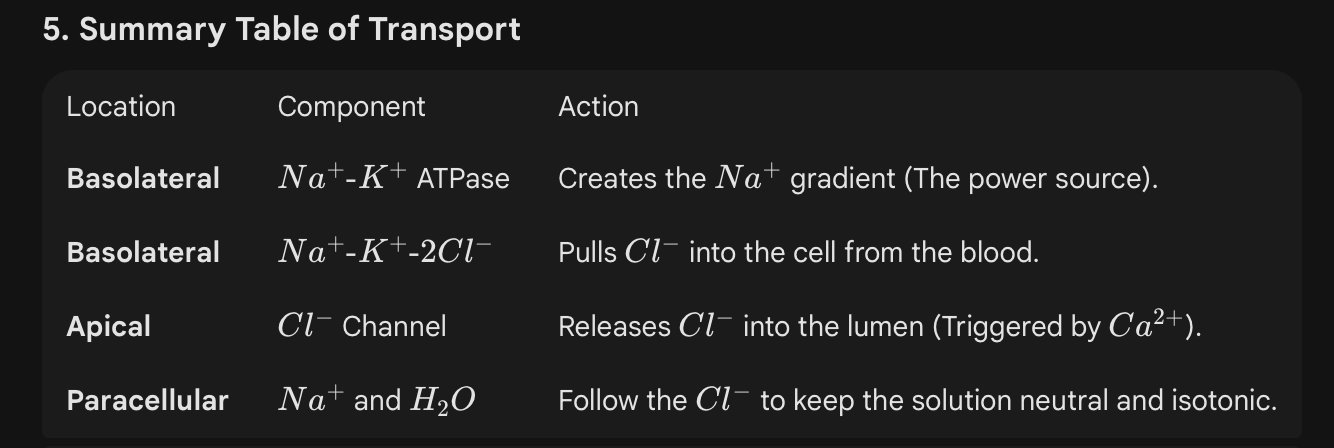
This Na+ gradient is not just a byproduct; it is the energy source for other transporters. In the salivary glands, the most critical of these is the Na+/K+/2Cl− cotransporter (NKCC1).
Hitching a Ride: The NKCC1 transporter uses the energy of Na+ moving down its gradient to pull Cl− and K+into the cell against their own gradients.
Chloride Accumulation: This causes Cl− to accumulate inside the secretory cell far above its equilibrium point.
Secretion: Eventually, Cl− exits the apical membrane (facing the duct) through channels. Na+ and water then follow the Cl− into the duct to maintain electrical and osmotic neutrality, forming the initial saliva.
PRIMARY STAGE
. Parasympathetic Stimulation (The "Watery" Flow)
This is the dominant pathway for volume. It relies on the IP3/DAG pathway rather than cAMP to raise calcium.
Neurotransmitter: Acetylcholine (ACh).
Receptor: M3 Muscarinic receptor.
Result: High Ca2+ opens apical Cl− channels
2. Sympathetic Stimulation (The "Protein" Flow)
This branch primarily uses the cAMP pathway, though it can cause modest increases in Ca2+.
Neurotransmitter: Norepinephrine (NE).
Receptor: β-Adrenergic receptor.
Mechanism:
NE binds to the β receptor, activating Adenylyl Cyclase.
Adenylyl Cyclase converts ATP into cAMP.
cAMP activates Protein Kinase A (PKA).
it releases the proteins
Water follows this salt immediately via aquaporin-5 (AQP5) channels
300 mOsm/L
MODIFICATION STAGE
K= and HCO3- secretion is lesser thna reabsorption of Na+
the duct walls also not permeaable to water
tactile and taste stimuli from the oral tissues regulate and control salivation