Neuromuscular junctions
Neuromuscular junctions
a motor neurone meets a skeletal muscle fibre
when an action potential reaches a neuromuscular junction, this triggers a sequence of events that leads to muscle contraction
distributed along the muscle’s length
ensures that all the muscle fibres contract simultaneously for maximum power
Motor neurones and contraction force
a motor unit consists of all muscle fibres supplied by a single motor neurone
each motor unit acts as a single functional unit, providing control over muscle force
the number of motor units stimulated determines the force of muscle contraction
to exert a strong force, a large number of motor units are stimulated
a small force requires the stimulation of only a few motor units
Triggering muscle contraction
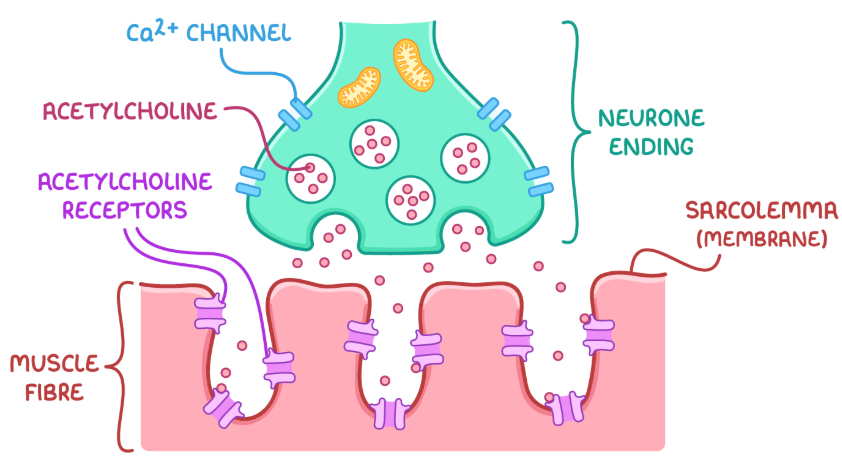
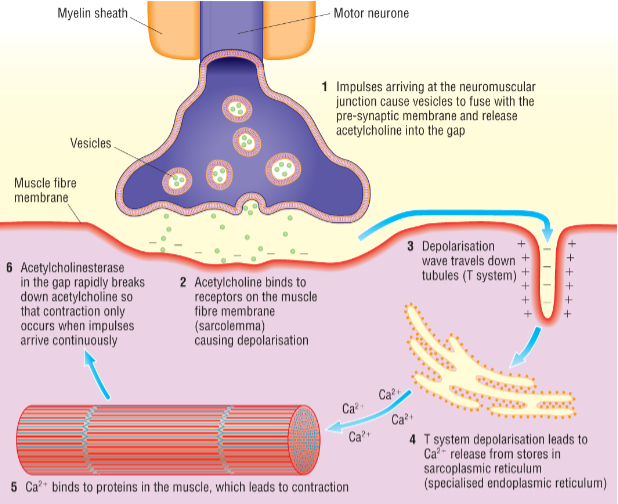
action potential arrives at end of neurone
Triggers opening of calcium ion channels and calcium ions enter the neurone
causes acetylcholine vesicles to release their contents into the synaptic cleft
acetylcholine binds to receptors on the sarcolemma, leading to the opening of sodium ion channels
results in the depolarisation of the sarcolemma
Breaking down and recycling of acetylcholine
acetylcholinesterase enzyme breaks down acetylcholine into choline and ethanoic acid
crucial to prevent excessive stimulation of the muscle fibre
choline and ethanoic acid then return to the synaptic knob where they are reassembled into acetylcholine for future use
the mitochondria found in the neurone provide the energy for the reformation of acetylcholine
Sarcoplasmic reticulum
depolarisation extends deep into the muscle fibre through T tubules
tubules interact with with the sarcoplasmic reticulum - storage site for calcium ions
when stimulated by the arrival of an action potential, calcium ion channels open in the SR membrane
releases a flood of calcium ions into the sarcoplasm
this surge is the trigger for muscle contraction