Comprehensive Guide to Digital SAT Math
Digital SAT Math: The Complete Syllabus Review
Welcome to your ultimate study guide for the Digital SAT Math section. This guide covers the four main domains tested by the College Board: Algebra, Advanced Math, Problem Solving and Data Analysis, and Geometry and Trigonometry. Since the transition to the Digital SAT, the Desmos calculator is integrated into the testing platform, emphasizing conceptual understanding over manual calculation.
Domain 1: Algebra (Heart of Algebra)
This domain focuses on the mastery of linear equations, systems of linear equations, and linear functions. These are the fundamental building blocks of the SAT math section.
Linear Equations in Two Variables
Linear equations describe a straight line relationship between two variables. The most essential form you must memorize is the Slope-Intercept Form.
- $m$ (Slope): The rate of change. On a graph, this is . In word problems, look for keywords like "per," "every," or "rate."
- $b$ (y-intercept): The starting value or initial condition when $x = 0$. In word problems, look for "flat fee," "starting amount," or "initial deposit."
Different Forms of Linear Equations
| Form Name | Formula | When to use |
|---|---|---|
| Slope-Intercept | $y = mx + b$ | Graphing; identifying rate and start value |
| Point-Slope | $y - y1 = m(x - x1)$ | When given a slope and a single point $(x1, y1)$ |
| Standard Form | $Ax + By = C$ | Finding intercepts quickly (set $x=0$, then $y=0$) |
Systems of Linear Equations
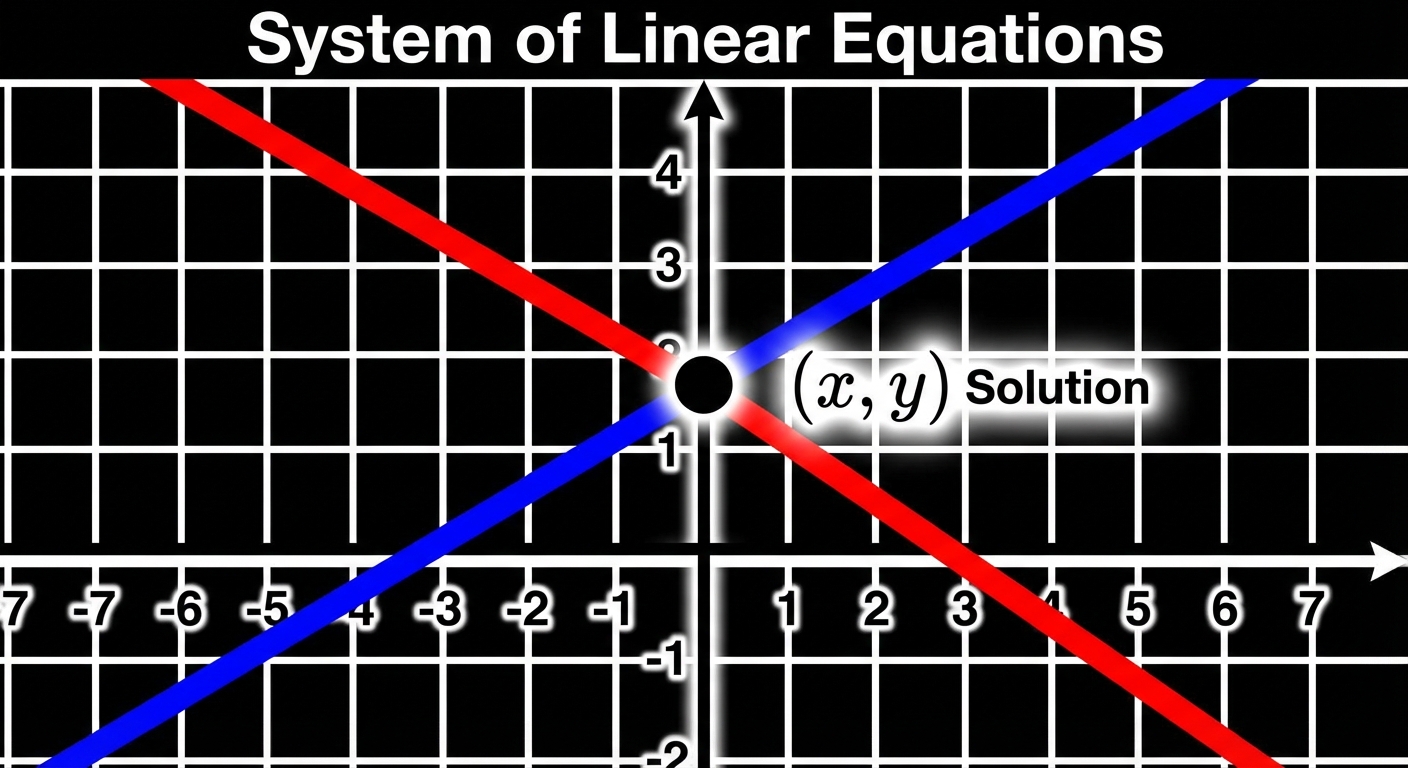
A system consists of two or more linear equations using the same variables. The solution is the point $(x, y)$ where the lines intersect.
Types of Solutions
- One Solution: The lines have different slopes. They intersect at exactly one point.
- No Solution: The lines have the same slope but different y-intercepts. These are parallel lines.
- Infinitely Many Solutions: The lines have the same slope and the same y-intercept. They are identical lines.
Linear Inequalities
Solving inequalities follows the same rules as equations, with one crucial exception: If you multiply or divide by a negative number, flip the inequality sign.
- $
- or : Solid line on graph.
Domain 2: Advanced Math (Passport to Advanced Math)
This section moves beyond lines to nonlinear relationships, primarily focusing on quadratic functions, polynomials, and exponents.
Quadratic Functions
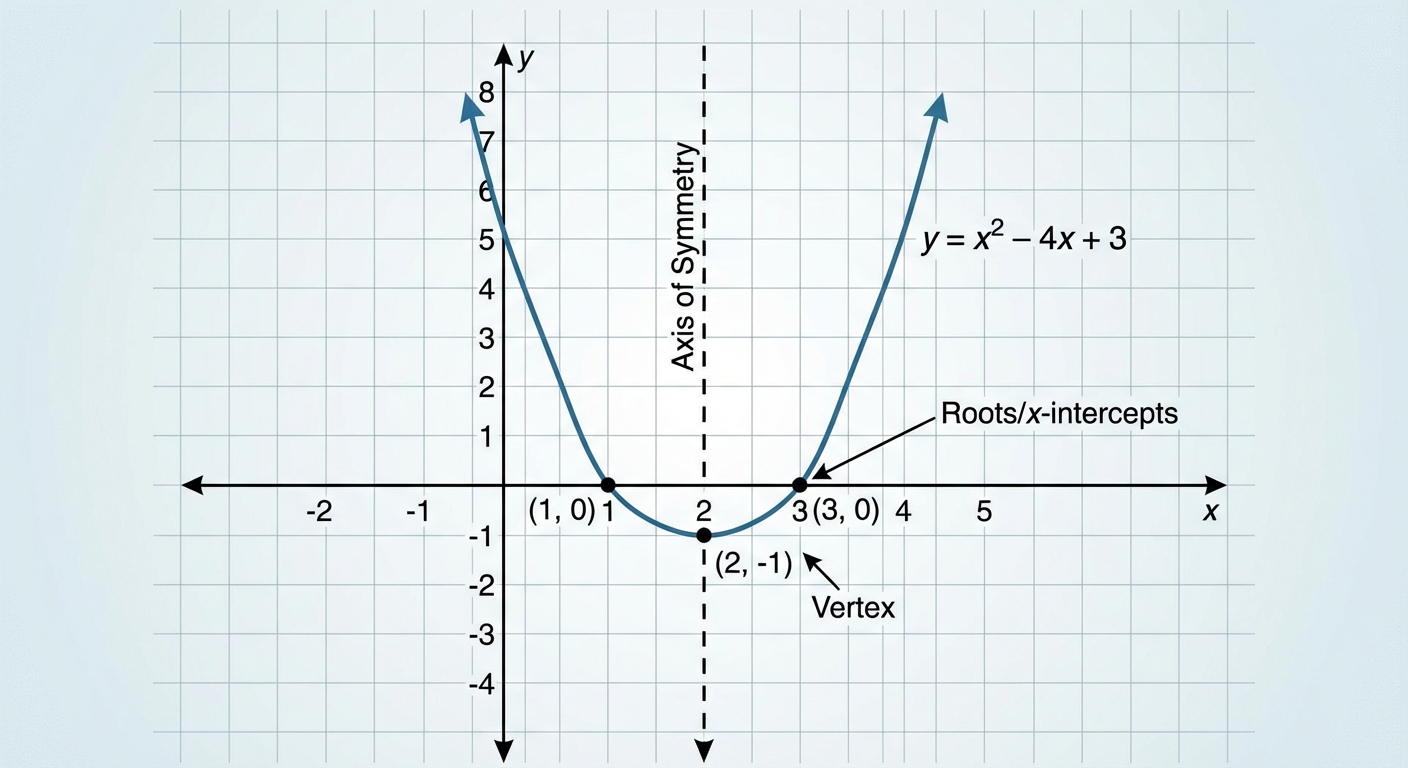
A quadratic function creates a U-shaped curve called a parabola. The standard form is:
- If $a > 0$, the parabola opens up (minimum).
- If $a < 0$, the parabola opens down (maximum).
Key Forms of Quadratics
- Standard Form: $y = ax^2 + bx + c$
- Vertex Form: $y = a(x - h)^2 + k$, where $(h, k)$ is the vertex.
- Factored (Intercept) Form: $y = a(x - r1)(x - r2)$, where $r1$ and $r2$ are the x-intercepts (roots).
Solving Quadratics
To find the solutions (roots/zeros) when $y=0$:
- Factoring: Looking for two numbers that multiply to $ac$ and add to $b$.
- The Quadratic Formula: Use this when factoring is impossible.
The Discriminant
The expression inside the square root, $b^2 - 4ac$, is called the Discriminant. It tells you the number of real solutions:
- $b^2 - 4ac > 0$: 2 Real Solutions (intersects x-axis twice).
- $b^2 - 4ac = 0$: 1 Real Solution (vertex touches x-axis).
- $b^2 - 4ac < 0$: No Real Solutions (graph does not touch x-axis; complex roots).
Exponential Functions
Exponential growth or decay occurs when a quantity is multiplied by a constant factor over equal time intervals.
- $a$: Initial amount.
- $r$: Rate of growth/decay (as a decimal).
- $t$: Time.
- Use $(1+r)$ for growth and $(1-r)$ for decay.
Example: A population of 1000 grows by 5% per year.
- Equation: $y = 1000(1.05)^t$
Domain 3: Problem Solving and Data Analysis
This domain tests your ability to apply math to real-world context, including statistics, ratios, and probability.
Ratios, Rates, and Proportions
- Ratio: Comparison of two quantities (e.g., $3:4$ or ).
- Proportion: An equation stating two ratios are equal (e.g., ).
Strategy: Use cross-multiplication ($ad = bc$) to solve for unknown variables.
Percentages
- Percent Change Formula:
- The Multiplier Method:
- Increase by 20% Multiply by $1.20$.
- Decrease by 20% Multiply by $0.80$.
Statistics and Data
- Mean (Average): .
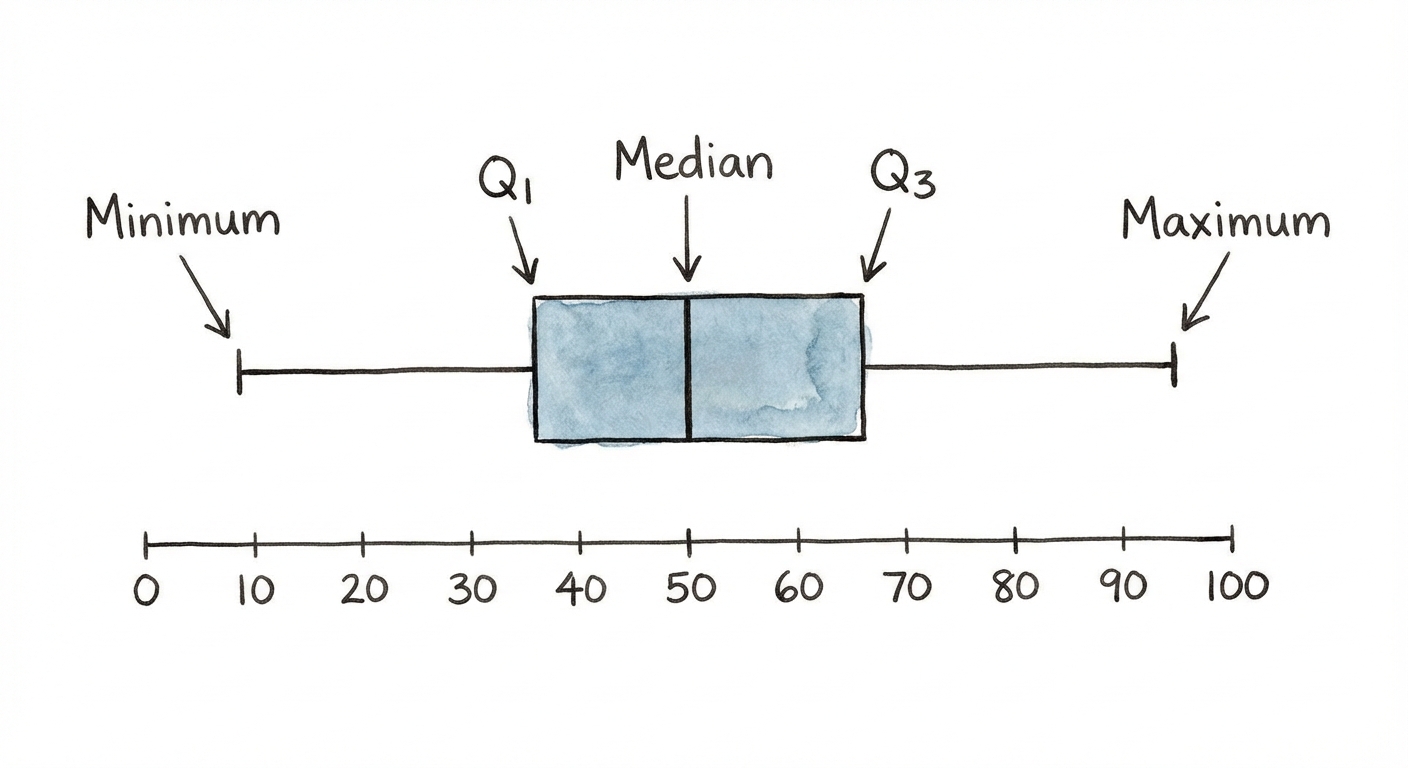
- Median: The middle number when data is ordered from least to greatest. If the list has an even number of items, average the two middle numbers.
- Mode: The value that appears most frequently.
- Range: .
- Standard Deviation: Measures how spread out the data is. A larger standard deviation means the data points are further from the mean.
Scatterplots
Scatterplots show the relationship between two variables.
- Line of Best Fit: A straight line that best represents the data trend.
- prediction: You will often substitute an $x$-value into the line of best fit to predict a $y$-value. Note that the actual data point might differ from the predicted value (the difference is the residual).
Domain 4: Geometry and Trigonometry
This section covers volume, area, triangles, circles, and trigonometry.
Triangles
Pythagorean Theorem
For right triangles only:
(where $c$ is the hypotenuse).
Special Right Triangles
These appear frequently. Memorize the side ratios:
- 30-60-90 Triangle: Short leg $x$, Hypot $2x$, Long leg .
- 45-45-90 Triangle: Legs $x$, Hypot .
Trigonometry (SOH CAH TOA)
For right triangle trigonometry:
Complementary Rule: .
Circles
Equation of a Circle
- Center: $(h, k)$ — Note the sign switch!
- Radius: $r$
Arcs and Sectors
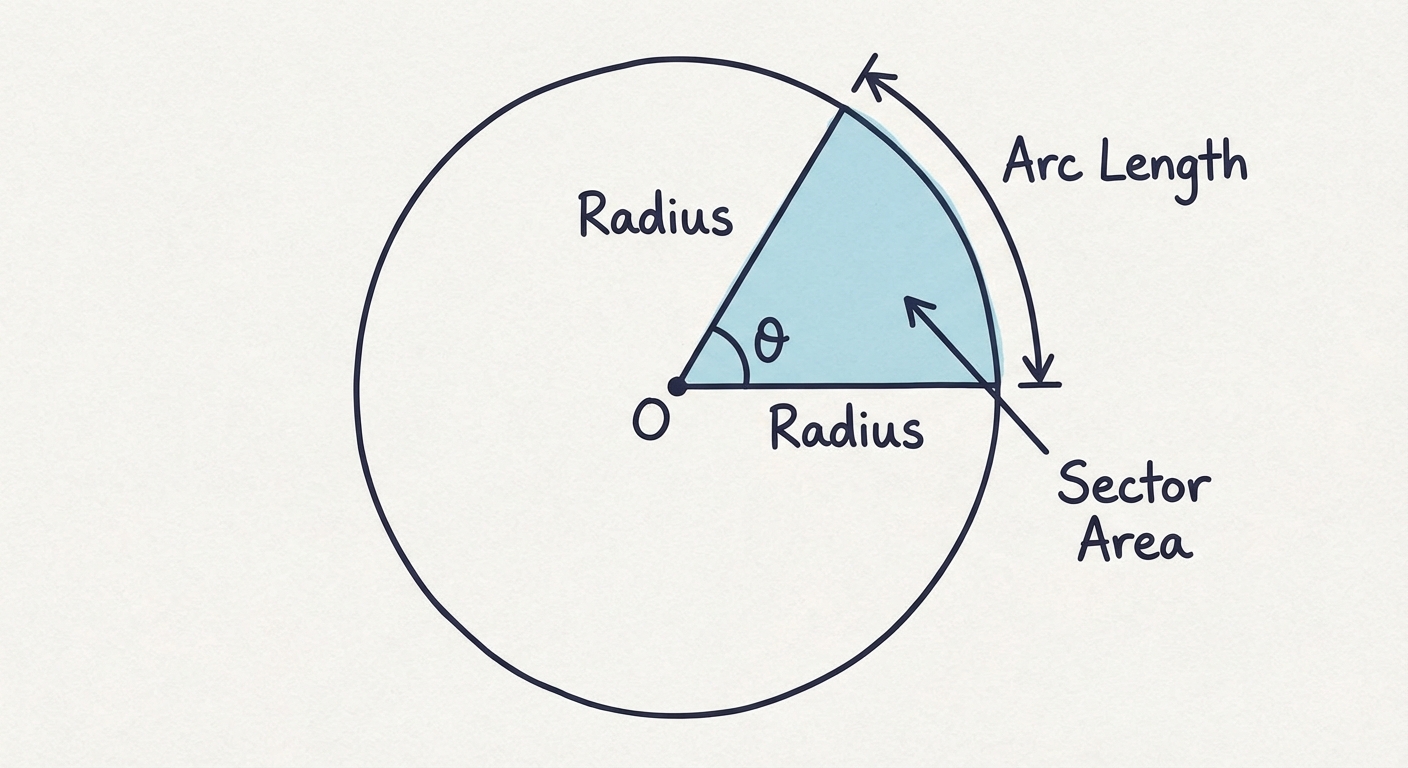
When dealing with a slice of a pie (sector) or the crust (arc):
- Arc Length: Fraction of the Circumference.
(if degrees) or (if radians). - Sector Area: Fraction of the Area.
Volume
The SAT provides a reference sheet for volume formulas (prism, cylinder, sphere, cone, pyramid), but remember:
- Prisms/Cylinders: .
- Cones/Pyramids: .
Common Mistakes & Pitfalls
- Unit Conversion Errors: Always check if the question gives dimensions in feet but asks for the answer in inches. Or, if it asks for the answer in square feet when dimensions were linear.
- Radius vs. Diameter: The circle equation uses radius squared ($r^2$). If the problem gives you the Diameter, divide by 2 immediately.
- Sign Errors in Quadratics: In the vertex form $y=a(x-h)^2+k$, the vertex x-coordinate is $h$, not $-h$. If the equation is $y=(x+3)^2$, the vertex $x$ is $-3$.
- Misinterpreting Probability: Probability is . Students often put (which is odds, not probability).
- Forgetting to Flip: When solving an inequality, if you divide by a negative number, the inequality sign MUST flip direction.
- Calculator Mode: Ensure your calculator is in Degree mode for geometry questions involving degrees, and Radian mode only if the question specifies radians.