semester 2 bio cornell note
6.3 + p158
struggle for existence = all populations have the potential to produce more offspring than can survive members of the population will compete for ifinite supply of environmental resources
Predatory w better phenotype - catch prey more
Prey w better phenotype - avoid being caught
Adaptation = Any heritable characteristic that increase an organism's ability to survive & reproduce in environment
phenotype
Physiological
Photosynthesis
Way an animal hibernates
Behaviors
Difference in adaptation affect an individual's fitness
Fitness = how well an organism can survive & reproduce in its environment
Survival of the fittest =
Individuals with adaptations better suited can survive & reproduce & are said to have high fitness
Individuals with characteristics not well suited either die without reproducing or leave relatively few offspring & are said to have low fitness
Result -> Differential reproductive success or survival of the fittest
Survival - survive and reproduce and passing good adaptations to next gen
Natural selection = process by which organisms in nature with variations most suited to their local environment survive & leave more offspring
Both artificial & natural selection, only certain individuals produce offspring
Natural selections the environment influences fitness
Artificial selection farmer or animal breeder influences fitness
Natural selection occurs in any situation in which
more individuals are born than can survive
natural heritable variation affect the ability to survive & reproduce or inheritable adaptations vary among individuals
fitness varies among individuals
Basically natural selection occurs in situations of struggle for existence, variation & adaptation, & differential reproductive success
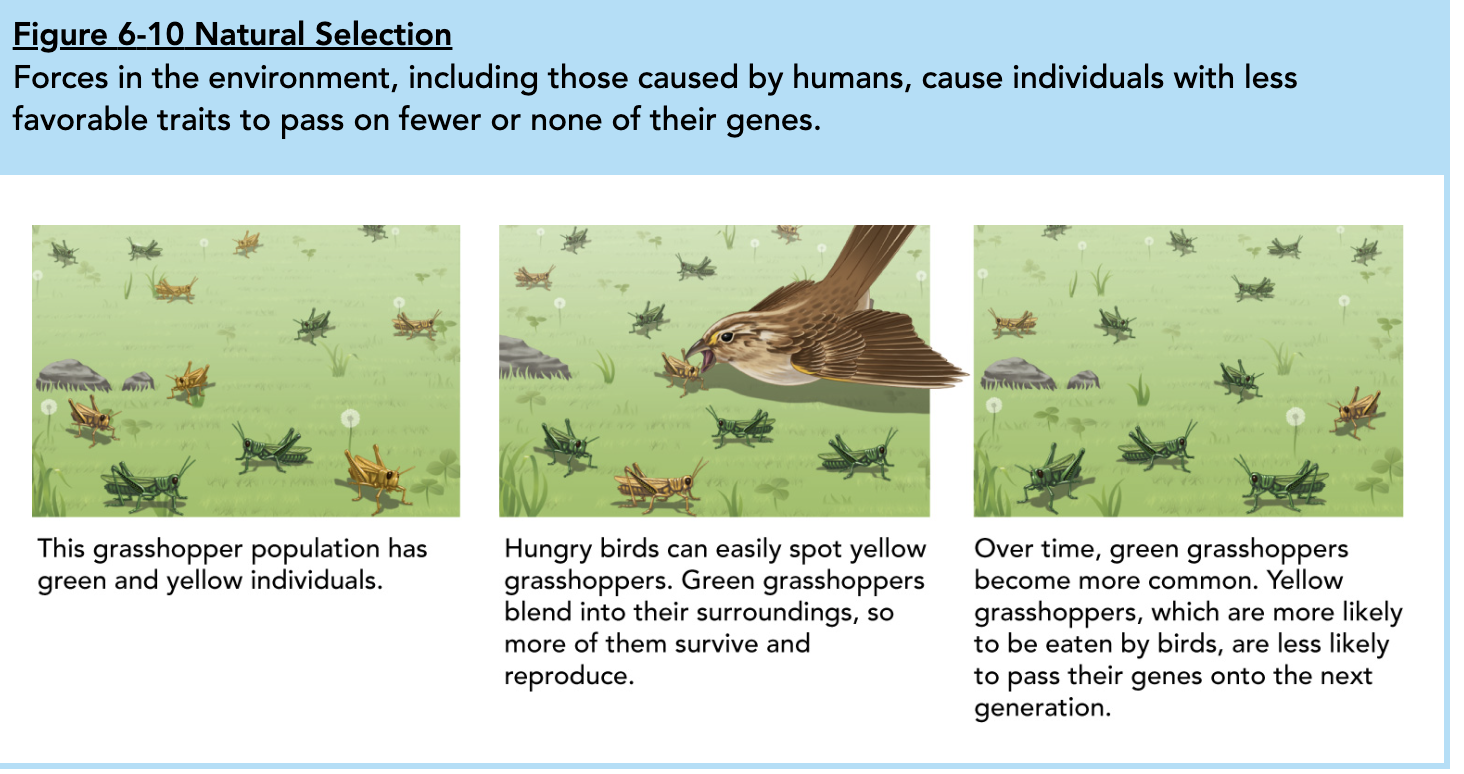
natural selection doesnt move in a fixed direction
Local environmental conditions change some traits that use to be adaptive may no longer be useful & diff traits may be come adaptive
This can lead to great diversity of adaptations in species living in diff environments
Environmental conditions change faster than species can adapt to those changes the species may become extinct
Natural selection depend on individuals ability to reproduce & leave offspring
Descent with modification = living species are descended with change over time form common ancestors
Principle of common descent: all & living and extinct are united by descent from ancient common ancestors & exhibit diversity due to natural selection & adaptation
Artificial selection = selective breeding of plants & animals to promote the occurrence of desirable traits in offspring
Nature provides the inherited variations & humans select variants that r useful
selective breeding = artificial selection
Inherited variation could provide raw material for natural mechanism that could drive evolution
6.4
Biogeography = the study of past & present distribution of organisms
Patterns in the distribution of fossils & living species combined with info from geology tell us how modern organism evolved from their ancestors
Why involving biogeography important
Closely related species can evolve diverse adaptations in diff environments
Very distantly related species can evolve similar adaptations if they live in similar environments or face similar challenges in the struggle for existence
Discovery of radioactivity & the technique of radioactive dating enables geologists to establish the age of certain rocks & fossils
earth is about 4.5 billion years old
Homologous structure = structures that are similar in diff species of common ancestry
Key to identifying homology is common structure & origin during development not common function
Homologous structures have similar structures & development but diff functions
Evolutionary theory explains the existence of homologous structures adapted to diff purposes bc of descent with modifications from common ancestor
Similarities & diff among homologous structures help determine how recently species shared common ancestors
Vestigial structure = structure that is inherited from ancestors but has lost much or all of its og function
Analogous structures = body parts that share a common function but not structure
grow & develop from diff embryonic tissues
The same groups of embryonic cells develop in the same ogre & similar pattern to produce any homologous tissues & organs
Molecular homology - genes that control the development of both visible & microscopic homologous structures
At molecular lvl overwhelming similarities in the genetic code of all organisms along with homologous genes
Mutations & gene shuffling during sexual reproduction produce heritable variation on which natural selection operates
Molecular evidence for evolution is so basic all living cells use info coded in DNA & RNA to carry info from 1 gen to the next & direct protein synthesis
Ex of homologous gene is set of genes called hox genes that determine the destinies of body parts
Hox gene help determine which part of an embryo become the head & which part becomes tail
Small changes in the hox genes can produce dramatic changes in the size & shape of the structures they control
Relatively minor mutations in an organism genome can produce major changes in an organism structure & the structure of its descendants
Variation within species increases a population ability to adapt to & survive environmental change
Evolutionary theory is vital to all biological & biomedical sciences often called the grand unifying theory of the life science
13.1
Heritable traits are controlled by genes carried on chromosomes
Changes in gene & chromosome generate variation
Molecular genetic techniques test hypothesis abt variation & selection
Genes, population, & species
Species = is a population ( or group of population) of physically similar interbreeding organism that dont interbreed with other groups
Population = group of individuals of the same species that mate & produce offspring
Bc interbreed they share common group of gene
Gene pool = all the genes including diff alleles for each gene that are present in a population at any one time
Allele frequency = the number of times that an allele occurs in a gene pool compared with # of alleles in that pool for the same gene
Basically the # of times an allele occurs in a genepool as a percentage of total occurrence of alleles for that gene in that gene pool
Evolution involves any change in the frequency of alleles in a population over time
Natural selection can act by increasing or decreasing the relative fitness of individual organism
Individuals dont evolve during their life time
Result of natural selection show as changes in allele frequency in population over time
natural selection “selects” an entire organism either to survive & reproduce or die without reproducing
Genotype = the combo of alleles an individual
Phenotype = all physical physiological & behavioral characteristics of an organism
Natural selection acts directly on organism's phenotype not genotype
Phenotype made by Individuals genotype tgt w environmental conditions during its lifetime
Some individuals have phenotypes that are better suited to their environment
Higher fitness = produce more offspring & pass more copies of their genes to the next gen
Inherited variation can lead to natural selection bc result in diff reproductive success
Evolutionary adaptation is any genetically controlled traits that increases an individual's fitness
Sources of genetic variation
Genetic variation is produced in 3 main ways
Mutation
Genetic recombination during sexual reproduction
Lateral gene transfer
Mutations
Genes are duplicated & passed from 1 gen to next without change
Sometimes mutations is a heritable change in genetic info
Mistakes in DNA replication are actually essential to species long term survival
Population where DNA replicates flawlessly producing new gen without genetic change would lack much variation on which natural selection operates
Environments changes , population that cant evolve dont survive long
Neutral mutations = dont affect phenotype & dont affect fitness
Mutations that do produce changes in phenotype may or may not affect fitness
Some mutations may lower fitness by decreasing an individual's abilities to survive & reproduce
Other mutations may result in adaptation that improve individuals abilities to survive & reproduce
Mutations matter in evolution only if they can be passed from gen to gen
For mutation to happen in plants & animals mutations must occur in gametes
Most heritable diff within families caused by genetic recombo
During meiosis, 1 member of each chromosome pair is shuffled randomly into each egg or sperm w 1 member of every other chromosome pair
Human have 23 pairs of chromosome
Can produce 8.4 million gene combinations
Crossing over another mechanism that can produce genetic recombo
Crossing over - meiosis paired chromosomes often swap length of DNA at random
Increase # of new genotype created in each gen
Genes are passed oneself from parent to offspring during reproduction
Sometimes gene pass from 1 individual to another individuals that is not its offspring
Lateral gene transfer = passing of gene produces a kind of gene flow
Occur between individuals of the same species or individuals of diff species
Gene flow can increase genetic variation -> increase diversity in any species that picks up new genes
Lateral gene transfer among single celled organism common & important in generating diversity among species during history of life
Sometimes single gene produces a simple trait
Number of phenotypes produced for traits depend on how many genes control the trait
Traits control by single gene may have only 2 or 3 distinct phenotypes depending on # of alleles
Single gene trait = trait controlled by 1 gene that has 2 alleles
In population phenotypic ratio are determined by frequency of alleles in the populations as well a whether the alleles are dominant or recessive
Polygenic trait = trait controlled by 2 or more genes
Each gene of a polygenic traits often has 2 or more alleles
Single polygenic trait often has many possible genotype & even greater variety of phenotype
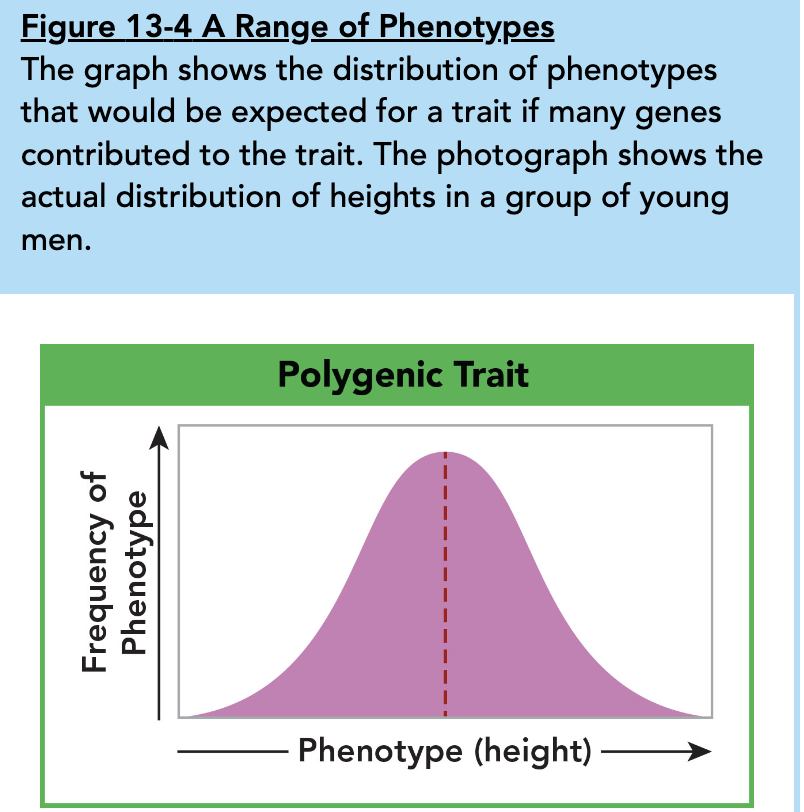
Height in humans is polygenic trait bc it varies from small to tall
Symmetrical bell- like shape of curve is typical of polygenic traits
Bell Shaped curve = normal distribution
This graph show distribution of phenotype that would be expected for a trait if any genes contributed to trait
13.2
How natural selection works
Insecticide or antibodies introduce:
Compounds become part of environment
Reduce fitness of any individual susceptible to their effect
Some individuals in pest population carry 1 or more genetic variation that enable them to resist
Few america carry genetic variation that lets them resist antibodies
Both kind of resistance are adaptation that enable individuals to survive & reproduce
Presence of pesticide or antibiotic increase the relative fitness of the few individuals that carry the resistance adaptation
Resistant individuals survive & thrive bc dramatically reduce d population (less competition for resources)
Over time the frequency of resistance alleles increase in the population
Natural selection - Diff survival & reproduction of individuals with beneficial characteristics
Natural selection on single gene traits can produce changes in allele frequencies that may be reflected by simple changes in phenotype frequencies
Can lead changes in allele frequencies so thus to evolution
A trait is controlled by more than 1 gene both the traits & the effects of natural selection on the trait are more complex
Polygenic traits often display range of bell curve
Fitness of individual may vary from 1 end of such survival to the other & natural selection can act 1 of 3 ways
Natural selection on polygenic traits can affect the relative fitness of phenotype in 3 types of selections
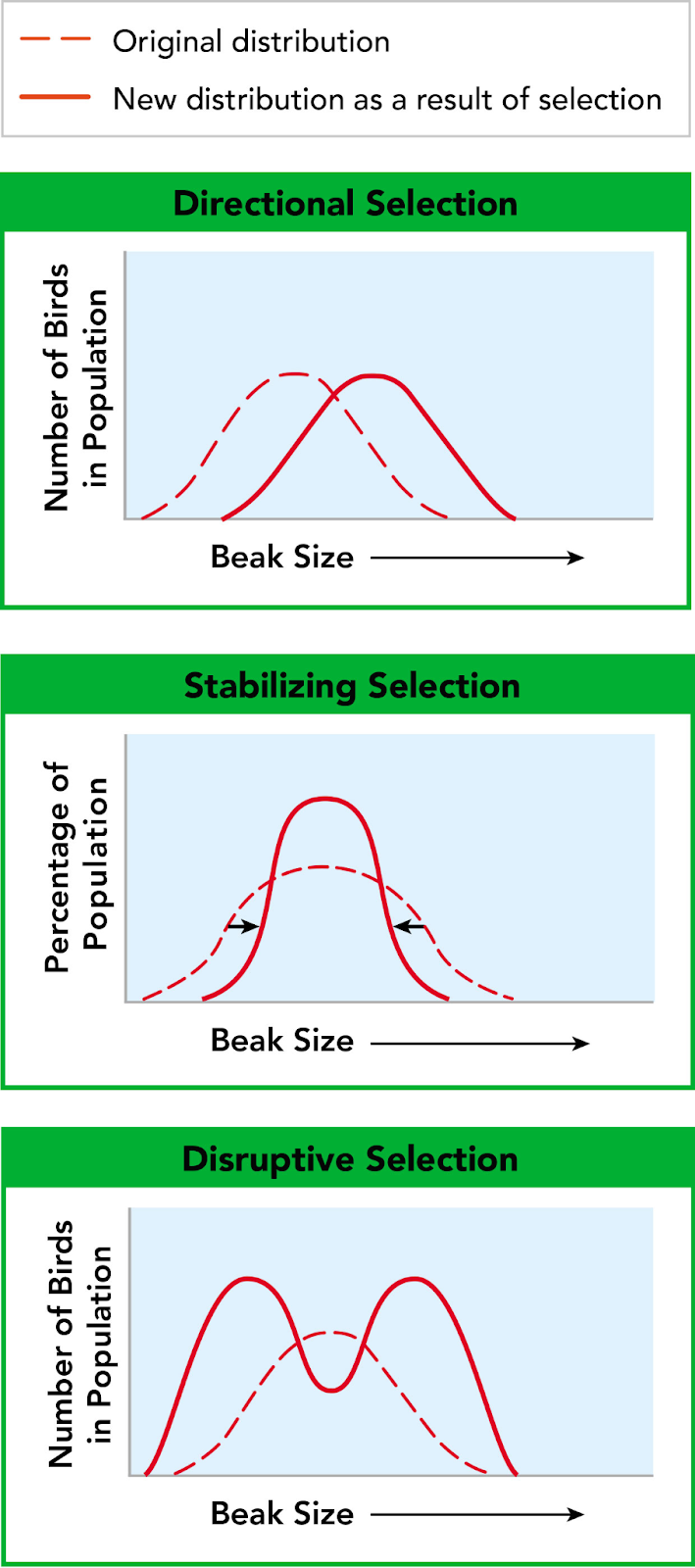
Directional selection
When individuals at 1 end of the curve have higher fitness than individuals elsewhere in the curve
Range of phenotype shift bc individuals with adaptations that result in higher fitness experience higher reproductive success
Stabilizing selection
Individuals near the center of the curve have higher fitness than individuals at either end
Center of curve remains current position but curve overall become narrow
Disruptive selection
Phenotypes at both the upper & lower end of curve have higher fitness than individuals near middle
Lowers fitness of intermediate phenotypes
If pressure of natural selection strong & longs enough curve can split
Making 2 distinct phenotypes created increasing diversity
In small populations individuals that carry a particular allele may leave more descendant than other individuals just by chance
Over time series of chance occurrences can cause an allele to become more or less common in population
genetic drift= random change in allele frequency caused by series of chance that cause allele to become more or less common
Genetic drift can occur by bottleneck effect & founder effect
Bottleneck effect= a change in allele frequency following a dramatic reduction in the size of a population
Founder effect= change in allele frequency as result of the migration of a small subgroup of a population
Genetic equilibrium = situation in which allele frequencies in populations remain the same
Meiosis & fertilization by themselves do not change allele frequencies
Population of sexually reproducing organisms could remain in genetic equilibrium
Hardy weinberg principle= that allele frequencies in a population remain constant unless 1 or more factors cause those frequencies to change
Hardy weinberg principle predicts 5 conditions can disturb genetic equilibrium & cause evolution
Nonrandom mating
sexual selection= individuals select mates based on heritable traits
When occur genes for traits selected for or against are not in equilibrium
Small population size
Genetic drift does not usually affect large populations
Gene flow from immigration & emigration
Gene flow = the movement of genes into or out of a population
Individuals that join through immigration may introduce new alleles
Individuals that leave through emigration may remove alleles
If allele frequency in population changes gene flow has caused evolution to occur
Mutations
Can introduce new alleles into gene pool changing allele frequencies
Natural selection
If genotype have diff fitness natural selection will disrupt genetic equilibrium
13.3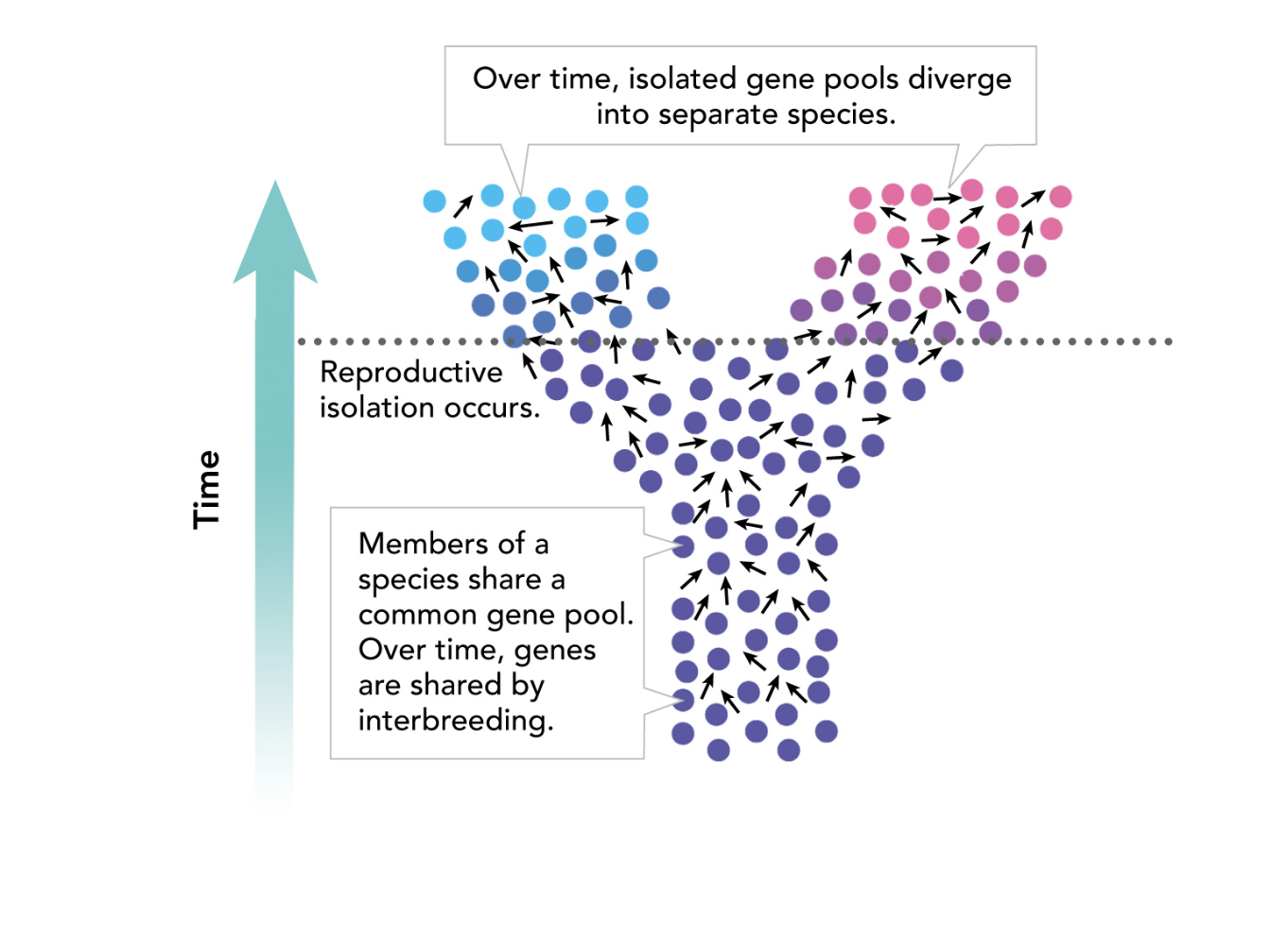
speciation= formation of new species
Interbreeding enables any genetic change that occurs in a population to spread throughout that population
If 2 populations stopped interbreeding change in 1 gene pool could not spread to other
reproductive isolation= separation of a species or population so that they no longer interbreed & evolve into 2 separate species
Can develop in several ways
Behavioral isolation = form of reproductive isolation in which 2 populations develop diff behaviors that prevent them from breeding
If 2 populations that were once able tgt interbreed evolve diff then this would occur
Geographic isolation= 2 populations are separated by geographic barrier leading to the formation of 2 separate subspecies
When 2 populations are separated by geographic barrier
Geographic barriers dont always guarantee isolation
Temporal isolation= 2 or more species reproduces at diff times
Biological island - any habitat that is isolated in some way from other similar habitats
Speciation in darwin's finches
Speciation in galapagos finches occurred by:
Founding of new population
Allele frequencies of founding finch population could have differed form allele frequencies from og populati9on
Geographic isolation
Some combo of founder effect geographic isolation & natural selection resulted in diff reproductive success adaptations & evolutions
Bc of diff island the finch populations were geographically isolated & no longer shared a common gene pool
Changes in the new population gene pool
Finch went to diff island but that island food was smaller so those finches adapted to having smaller becks
Over times natural selection would have caused the population to evolve smaller beaks forming new population w new phenotype
Behavioral isolation
Finches preferred to mate w bird that have same size beak so they did not want to mate with other population
The gene pool of the 2 birds population live in same place but population now become 2 distinct species
Ecological competition ( competition & continued evolution
As 2 new species live tgt they compete for seeds
During diff seasons birds that are most diff from each other have higher fitness bc more specialized bird experience less competition for certain kind of seed
8.1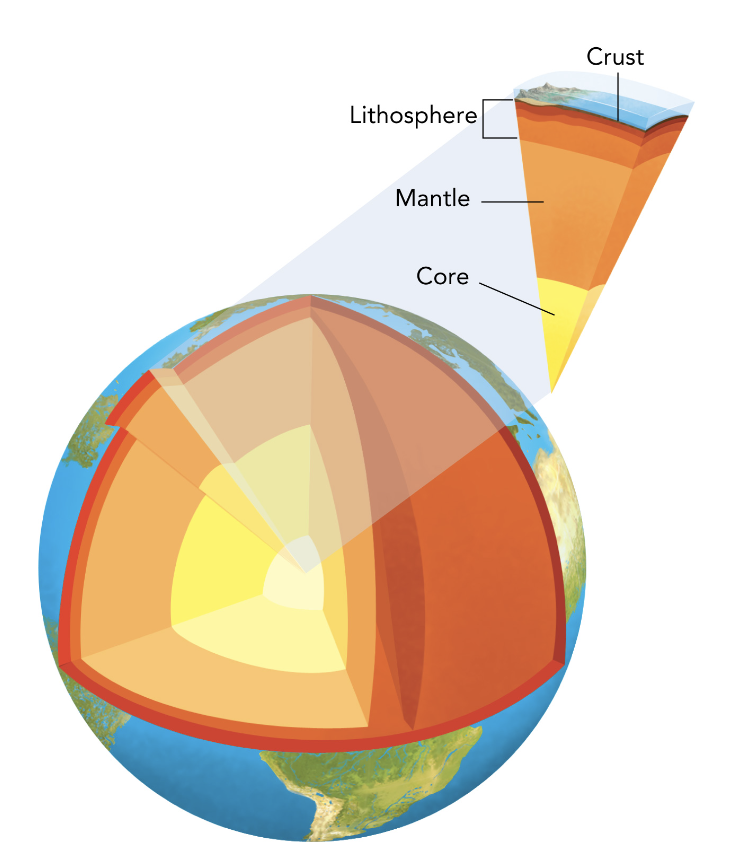
Nebula -> heat up & rotate -> cooled -> repeat & collide w other things = planets
Crust = thin layer of rock that forms earth's outer surface on land & in ocean
Lithosphere = sphere made up of hard rock on & just below earth's surface (the outermost layer of both earth & geosphere
Mantle = layer of very hot but mostly solid rock beneath earth crust
Core = layer of earth below mantle (rllllllllly hot)
Earths early atmosphere contained little or no oxygen
Main composed of CO2, water vapor, nitrogen, smaller amount of carbon monoxide, hydrogen sulfide, hydrogen cyanide
Earth cool make water vapor rain -> earth cooler
Lithosphere divided into huge plates that each include vary amount of continental & oceanic crust
Plate tectonics= geologic process resulting in plate movement
Theory of plate tectonic explain how & why earth lithospheric plate move relative to each other
Result convection currents in earth mantle
Upwelling current in mantle bring hot rock to surface
Hot rock metals to form magma creating new crust at mid ocean ridges
Youngest crust in center where plates diverge
Heat of magma at mid ocean ridges creates hydrothermal vents
Older crust sink to mantle subduction zone heated releases water & partially melt
Melting crust rises to surface leading to volcanic eruption
Hotspot = volcano created by plume of magma rises to
2 plates carrying continents collide -> part of lithosphere contain oceanic crust sinks into mantle
Part of colliding lithospheric containing continental crust cant sink so collide & get forced into each other
Many interactions between the geosphere atmosphere & hydrosphere break down or chemically change rock at or near earth's surface
Weathering = physical & chemical process that break down rock & mineral into smaller particles
Water enter rock & freezes it expand -> expansion can break rock into smaller & smaller
2 types of weathering
Chemical weathering = Occurs when water or chemically active molecule in rain transform compounds in rock or other material
Physical weathering breaks up rocks & wears them down in diff ways
Erosion - after rock have broken down small particles carried by wind water or ice
+ some compounds formed or released by weathering can dissolve in water & carried either into ground or through river & streams to lakes & oceans
Small particles of sand silt clay or lime carried by streams or rivers reach larger body of water
Pressure & chemical process compress & transform sediment into sedimentary rocks
Examining and comparing rock layers exposed at diff places across landscape geologist can determine the order in which those rock layer formed & which layers are older than others
Relative dating = method of determining the age of fossil by comparing its placement with that of fossil in other rock layers
Sedimentary rock formed as layers
Lower layers of rock & fossil contain generally older than upper layers
Index fossil= distinctive fossil aht used to compare the relative age of fossil
Must be easy to recognize
Only existed for brief span
Widely distributed
Radiometric dating= method to determine age of sample from amount of radioactive isotopes to the nonradioactive isotope of the same element
Half life = length of time required for half of the radioactive atoms in a sample to decay
Radiometric dating uses the proportion of radioactive isotopes & stable isotopes to calculate age of sample
Age determined by amount of carbon 14 remaining in tissues
Carbon 14 half life if to old cant be seen anymore
Older fossil that cant be dated using isotopes
Use potassium 40, etc
Geologic time scale = timeline used to represent earth's history
Geologic time scale based on both relative & absolute dating
Major divisions are
Eons
Eras
Periods
8.3 & p224
Distribution of continents & oceans determined by plate tectonics formation of islands global climate change & meteorite impacts have altered earth's habitat with major effects
Environmental changes altered ecological interaction among organism & between organism & their environments
Change the pressures of natural selections favoring adaptations to new conditions
Emergence of new habitat & changes in existing habitats create new niches
New niches - offer opportunities for natural selection to increase diversity
Regional & global environments are influenced by interactions between wind & ocean currents
Slow movement of continents due to forces of plate tectonics produced even more dramatic changes in global landscape
Over deep time actions of living organism have changed conditions in the atmosphere ocean & land
Macroevolutionary pattern= changes in anatomy, phylogeny, behavior that take place in clades larger than single species
Emergence growth & extinction of larger clades are macroevolutionary
Fossil species are classified using same cladistic techniques used to classify living species
Cladograms illustrate hypothesis about how closely related organism are by proposing relationships among living, extinct pieces, & common ancestors they share
Hypothesizing that extinct species is related to a living species not same thing as claiming that extinct organism is ancestors of living species
Environmental condition change natural selection & other evolutionary mechanisms enable some species to evolve adaptations to new conditions
Extinct = refer to a species that has died out & has no living members
Background extinction = extinction caused by slow & steady process of natural selection
High species diversity in clade serve as raw material for macroevolutionary change in that clade
More varied adaptations of species in clade are the more likely the clade is to survive
Rate of speciation in clade = or > rate of extinction = clade will continue to exist
Rate of extinction in clade > than rate of speciation= clade will eventually become extinct
Mass extinction = event during which many species become extinct during relatively short period of time
Large number of species become extinct relatively short time
Become extinct bc environment break down & ordinary process of natural selection cannot compensate quickly enough
Reduce biodiversity rapidly & dramatically
After mass extinction
Less competition
Climate may have changed
New ecological niches open up
Adaptations & speciation produce new species that fill those niches
Biodiversity recovers slowly
Fossil evidence supports hypothesis that evolution can occur at diff rates in diff clades at diff times
Fossil record incomplete bc every organism as fossil many more die without a trace
Fossil reveal info abt
Structure of ancient organism
Sequential nature of groups in fossil record
Evolution from common ancestors & the ecology of ancient environments
Gradualism = evolution of a species by gradual accumulation of small genetic change over long period of time
Sometimes physical structure preserved dont appear to change much over long period of time
State of equilibrium - their structure dont change much even though they continue to evolve
Slow steady change in line of descent
Fossil record show that equilibrium can be interrupted by brief period of geologically rapid change
punctuated equilibrium= pattern of evolution in which long stable period are interrupted by brief period of more rapid change
During punctuations existing species may change & new species may appear rapidly
Stable period interrupted by rapid change
Rate of change: genetic drift & mass extinction
Small population
Trait can become more or less common by chance
Rapid evolution may occur after small population become isolated from main population
Adaptive radiation= single specie or small group of species evolves into several diff forms that live in diff way
Descendants of ancestral species may diversify over time into related species adapted to diff niches
Adaptive radiation may occur when species migrates to new environment or when extinction eliminates competing species
Convergent evolution= unrelated organisms independently evolve simialties when adapting to similar environments
Unrelated organism in similar environment evolve adaptations to similar niches
Coevolution = 2 species evolve in response to changes in each other over time
Relationship between coevolving organism often become so specific that evolutionary change in 1 organism usually followed by a change in other organism
1.1
Biosphere = part of earth in which life exist including land water & air or atmosphere
Ecology = study of interactions among organism population & communities of organisms effects on their environment & their responses to changes in their environment
lvls of ecological organization
Individual (species)
Group of similar organism that can breed & produce fertile offspring
Population
Group of individuals that belong to same species & live in same area
Community
Assemblage of diff populations that live tgt in defined area
Ecosystem
abiotic & biotic factors
Biome
biosphere
Biotic factors = any living part of environment with which an organism might interact
Abiotic factors = physical or nonliving factor that shape an ecosystem
Earths 4 global spheres:
Atmosphere: all gases thin layer of gases that surround earth
Hydrosphere: all water. Liquid ice or vapor EVERYWHERE
Geosphere: all the rock EVERYWHERE
Biosphere: part of earth in which life exists including land, water, & air or atmosphere
Earth's systems interact w 1 another & cause & effect of global changes involve all of the systems
1.2
Weather = day to day condition of atmosphere (short term changes)
Climate = average year to year conditions of temperature & precipitation in area over long period of time
Both shape natural populations communities & ecosystems
Earth global climate system powered & shaped by total amount of solar energy retained in biosphere as heat & by unequal distribution of that heat between the equator & poles
Earth average temperature determined by balance between amount of heat that stays in atmosphere & amount of heat that is lost to space
Greenhouse gases
Carbon
Methan
Water vapor
These gases enter & leave atmosphere as part of cycle
Greenhouse effect = process in gases (carbon, methane & water vapor) trap sunlight energy in earth's atmosphere as heat
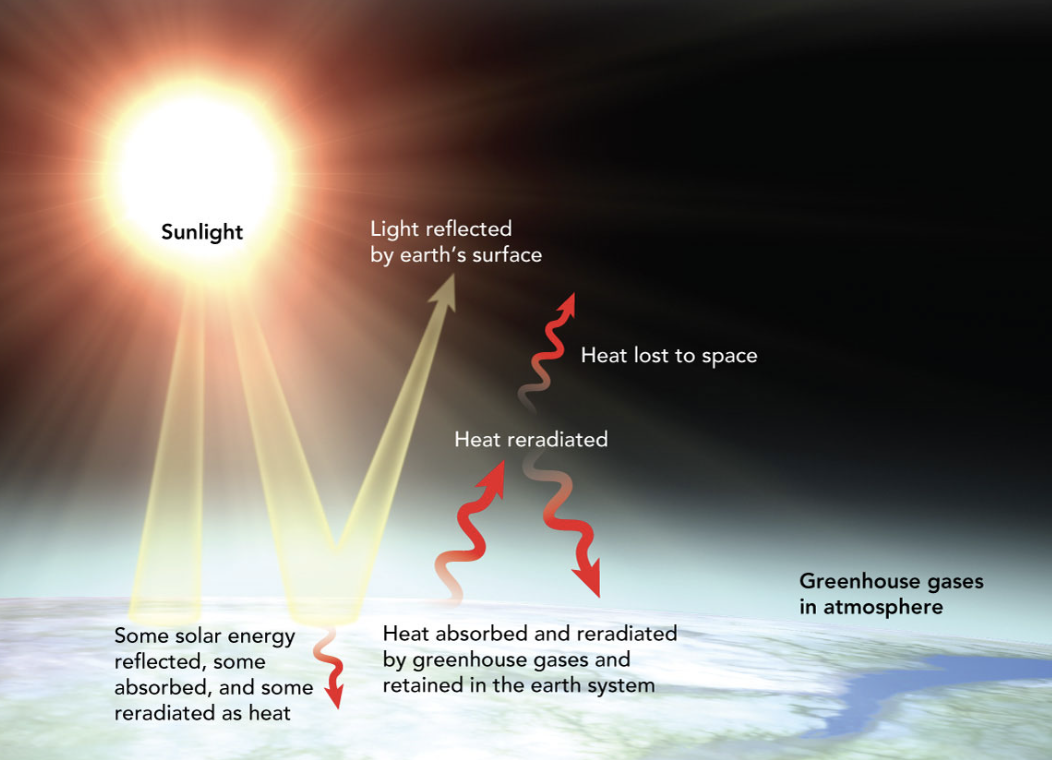
increase greenhouse gas = retains more heat & earth warms
decrease greenhouse gas = more heat escapes & earth cools
Amount of sunlight that is reflected or absorbed- amount of heat that is reradiated in earth system & intensity of greenhouse effect influence earth energy balance
3 main climate zone
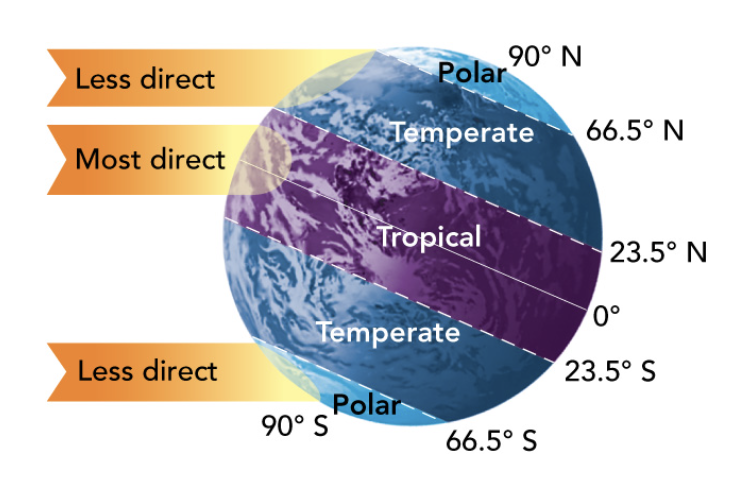
Tropical
Temperate
Polar
Unequal heating of earth's surface creates winds & ocean currents
Hot air = less dense & rises
Cold air = more dense & sinks
Air rises - loses heat along way
Rising & sinking air creates circulation of air that rises -> creates winds
Ocean currents are driven & shaped by patterns of warming & cooling by winds & location of continents
Prevailing winds blowing over ocean create surface currents affecting weather & climate
Upwelling - water sinks flow along sides & rises to surface
Move cold water to top & hot to bottom
Regional climate shaped by transport of heat & moisture by wind & ocean current & by geographic features
Upwind side of mountain ( near the ocean)
Air rises & cools releasing moisture as rain or snow
Downwind side of mountain
Air descends & warm & drier so less rain falls
3.1
Autotrophs = organism that able to capture energy from sunlight or chemicals & use it to produce its own food
Convert energy into forms living cells can use
Primary producer = first producers of energy rich compounds that are later used by other organisms
All life depend on 1 or another kind of primary producer
Photosynthesis = used by plants & autotrophs to capture light energy & use it to power chemical reactions that convert carbon & water into oxygen & energy rich carbohydrates (sugars & starches)
chemosynthesis= process in which chemical energy is used to produce carbohydrates
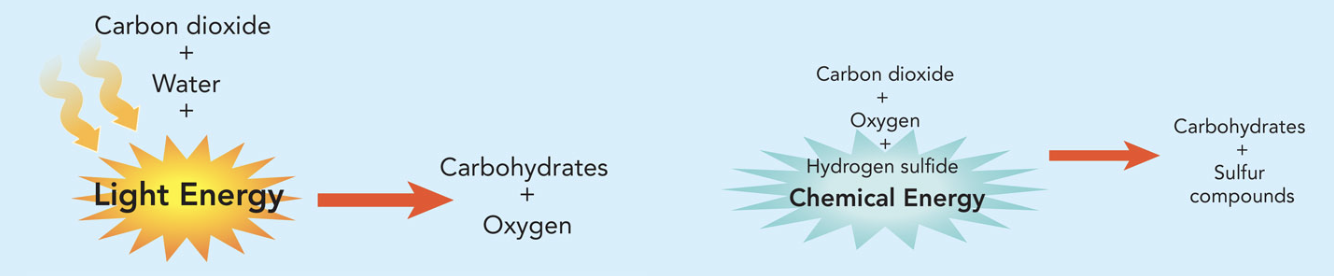
Chemosynthetic bacteria thrive
deep in earth crust
Total darkness
Exposed to hecka high temps
Heterotrophs = organism that obtain food by consuming other living things
Heterotrophs = consumers
Consumers = organism that relies on other organism for its energy & food supply
Consumers are organism that rely on other organism for energy & nutrients
Diff types of consumers:
Carnivores - meat
Herbivores - plants
Scavengers - carcasses
Omnivores - meat & plant
Detritivores - commonly digest decomposer that live on & in detritus particles
Detritus: material made up of decaying bit of plant & animal material
Decomposer: chemically breaks down the organic matter back into their elemental form
Convert dead material to detritus then eaten by detritivores
Release matter in form of nutrients for primary producers
2 main decomposers: Bacteria & Fungi
3.2
Energy flows through an ecosystem in 1 way direction
Food chain = series of steps in ecosystem in which organism transfer energy by eating & being eaten
Phytoplankton = photosynthetic algae found near surface of ocean
Eaten by zooplankton
Food web = network of complex interactions formed by feeding relationships among various organism in ecosystem
Bunch of food chains that connects
Trophic lvl = each step in food chain or food web
Producer 1st lvl of trophic lvl
Ecological pyramid = model of relative amounts of energy or matter contained within each trophic lvl in given food chain or food web
2 diff types of ecological pyramid
Energy pyramid
show relative amount of energy available at each trophic lvl of food chain or food web
Biomass pyramid
Relative amount of living organic matter in each trophic lvl of ecosystem
Number pyramid
Relative number of individual organism at each trophic lvl in ecosystem
Only small portion of energy stored in any trophic lvl available to organism in next lvl
Bc organism use the energy for life processes
10% of energy available in 1 trophic lvl to next
Biomass = total amount of living tissues within given trophic lvl
Measured organic matter per unit area
3.2
Elements are recycled within & among ecosystem through cycles that may involve:
Biosphere
Geosphere
Hydrosphere
Atmosphere
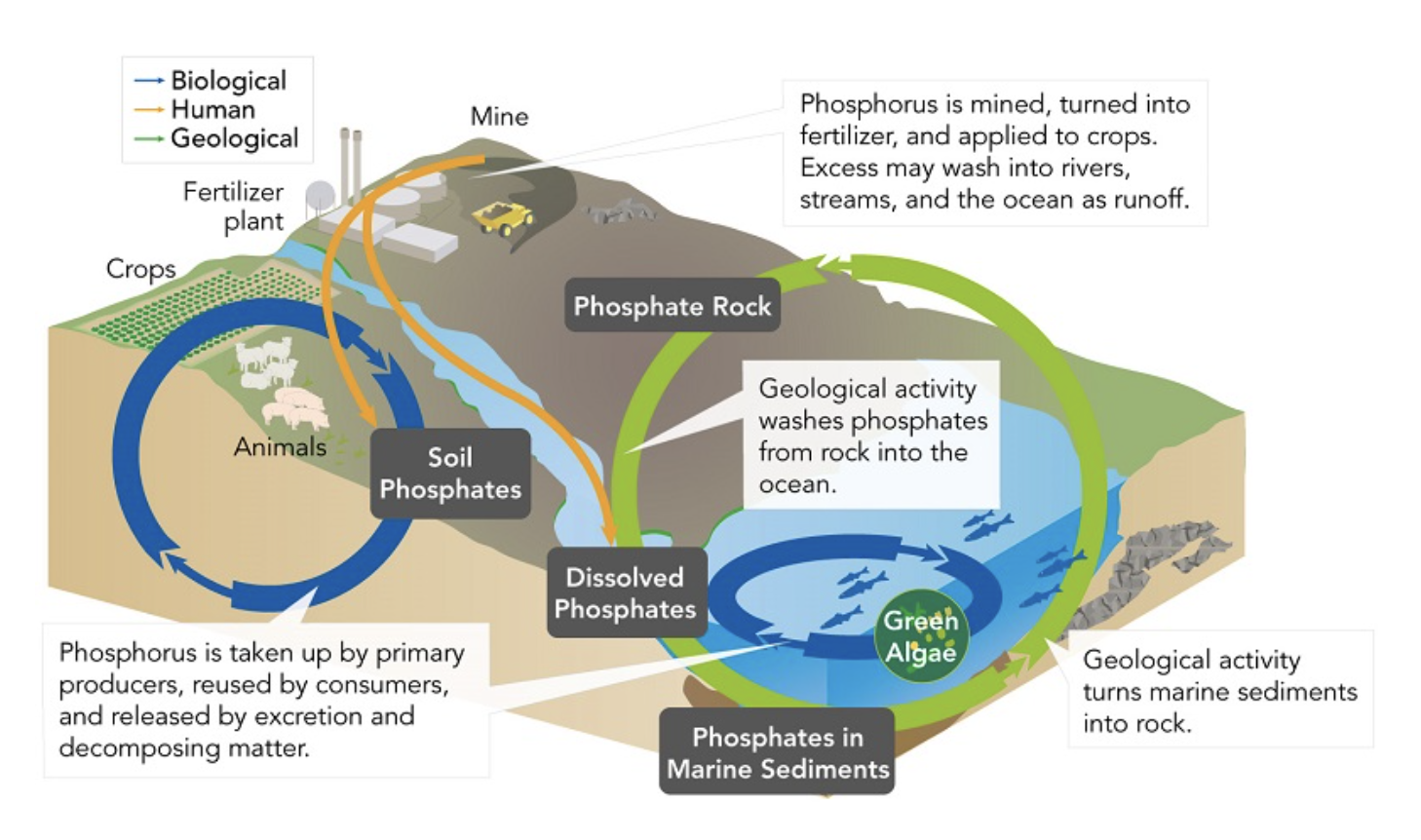
Biogeochemical cycle = element chemical compound & other forms of matter are passed from 1 organism to another & from 1 part of biosphere to another
Powered by flow of energy
Biogeochemical cycles:
Biological process- activities performed by living organisms
Mainly occur in biosphere but involve all 3 spheres
Geological process- rocky earth stuff (volcano, formation & breakdown of rock & movement of matter
Mainly in geosphere but also affect 3 other spheres
Physical & chemical process- cloud form, precipitation, flow water
Primarily hydrosphere atmosphere & biosphere but also affect biosphere
Human activities- big & small scale
Change system in 4 sphere
Water cycle among hydrosphere, atmosphere, & geosphere sometimes out & in biosphere
Carbon nitrogen & phosphorus cycle important part of several global systems & vital to function of ecosystem
Carbon reservoir = natural feature that stores carbon
Nitrogen fixation = converting nitrogen gas -> nitrogen compound that plant can use
Denitrification = bacteria convert nitrate -> nitrogen gas
If ample sunlight & water are available primary productivity of ecosystem may be limited by availability of nutrients
Limiting nutrients = single essential nutrient that limit productivity in ecosystem
22.1
Habitat = area where organisms live including biotic & abiotic factor that affect it
Habitat can be described as an area with particular combo of biotic & abiotic factors that affect which organism can live within it
Organisms ecological “address”
Microhabitat - many small organism live only in very small part of larger habitat
Microclimate = environmental conditions in microhabitat
Mircobiome or microhabitat perform more important functions
Tolerance = ability of organism to survive & reproduce under circumstance that differ from their optimal condition
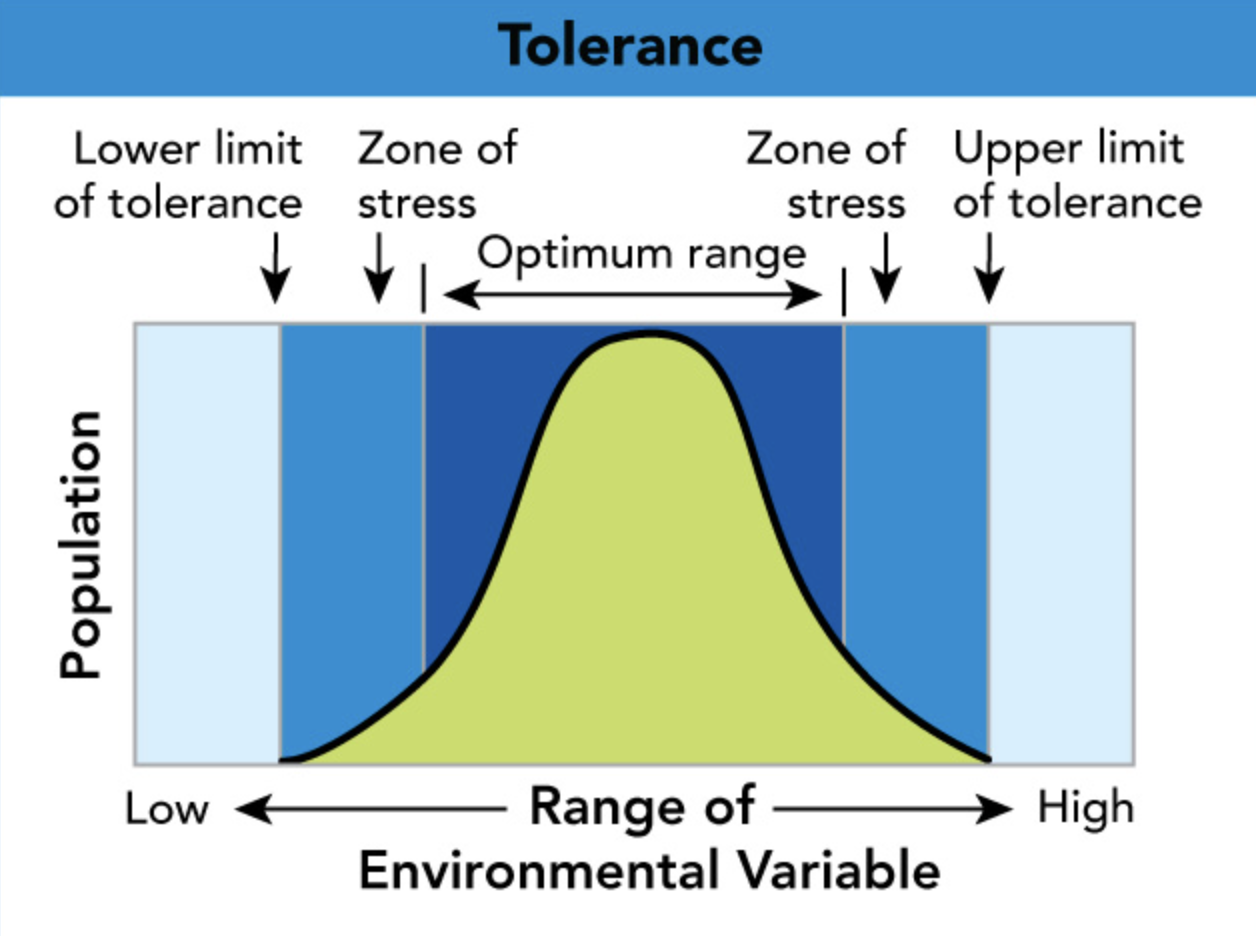
Optimum range is environmental conditions enable individual to
find enough energy
Nutrient to maintain homeostasis
Grow & reproduce
Stress - 1 or more environmental condition rise above or fall below optimum range
Stressed
Expend more energy to main homeostasis
Leave less energy for growth & reproduction
Slightly stressed
Produce fewer offspring
Fewer of those offspring will survive
HECKA stressed
May survive but not reproduce
Niche = full range of physical & biological condition in which an organism live & the way in which organism uses those condition
Where organism live & what it does ( ways it interact with biotic & abiotic factors
Physical aspects
Factors to which it is adapted
Biological aspects
Factors it require for survival
Species niche: range of physical & biological condition in which it can survive 7 reproduce & obtain resources it needs
Resources = any necessity of life
Competition - competing for resources
Intraspecific competition- among member of same species
Interspecific competition - between members of diff species
Direct competition -> 1 winner 1 lose & losing species die out
Species grown in separate culture under same condition = survived
Both species grown tgt in same culture 1 species outcompeted other
Less competitive species die
Competitive exclusion principle = states that no 2 species can occupy the same niche in same habitat at same time
Creates pressure for each species to specialize in way that it obtains & uses resources
If 2 species try 1 species will be better at competing for limited resources & eventually exclude other species
Division of resources - resources used by species are similar but not identical each species occupy a diff portion of area
By causing species to divide resources competition help determine number & kind of species in community & niche each species occupy
Herbivores affect size & distribution of plant population in community & determine place that certain plants can survive & grow
Keystone species = single species that not usually abundant in community yet exerts strong control on structure of community
Keystone species play vital & unique role in maintaining
Structure
Stability
Diversity in ecosystem
Removal of keystone species - may or may not be possible to restore OG community by putting it back
Symbiosis = relationship in which 2 species live close tgt
3 main type of symbiotic relationship
Commensalism = 1 organism benefit & other neither helped or harmed
Mutualism = both species benefit
Parasitism = 1 organism live on or in another organism & harms it
Obtain all or part of nutritional need form host
Generally weaken but not kill host
22.2
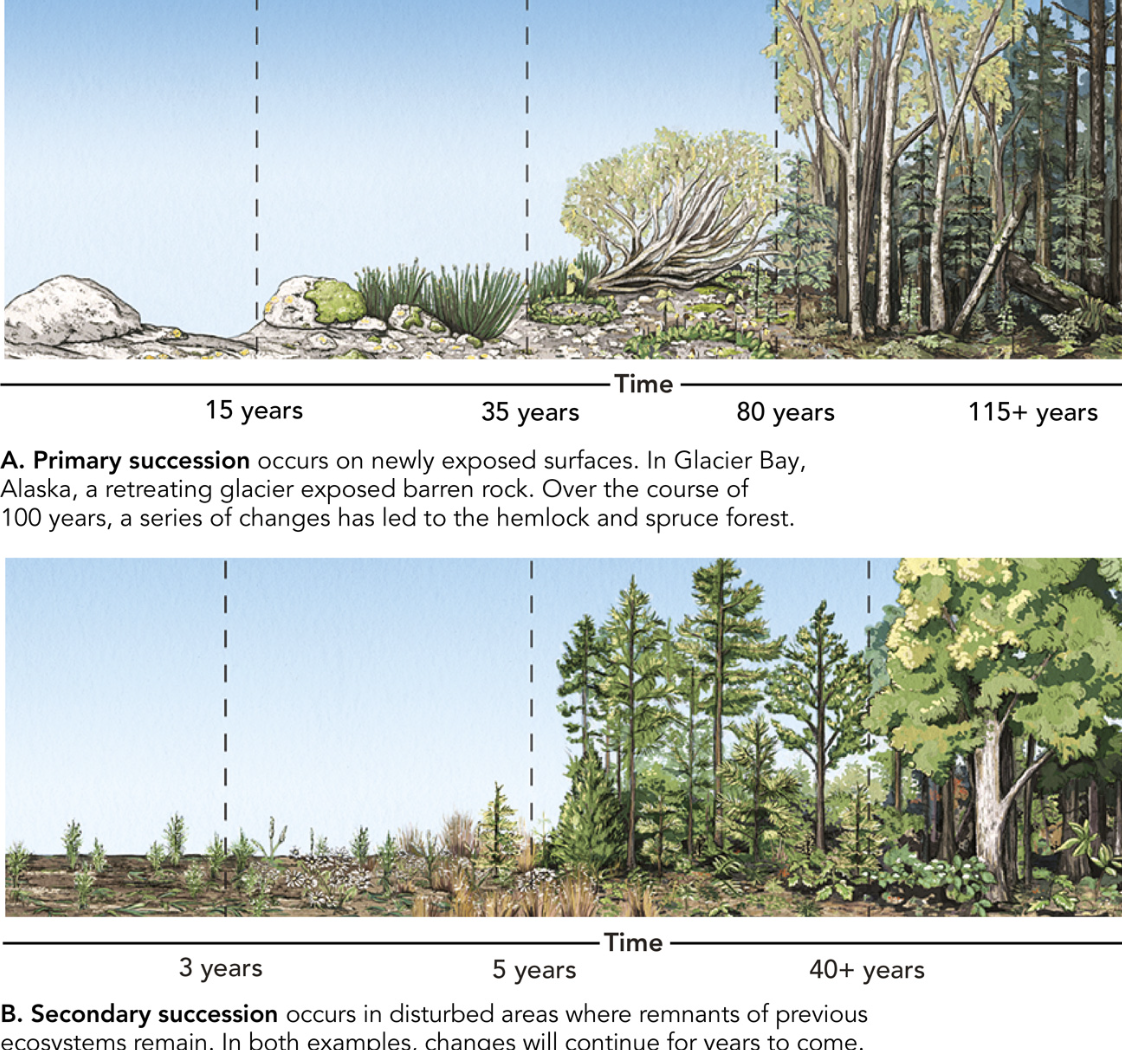
Ecological succession = series of gradual changes that occur in community following a disturbance
Ecosystems change over time especially after disturbances
New species move in
Population change
Some species die out
Primary succession = succession that occur in area in which no trace of previous community is present
Pioneer species = 1st species to populate an area during succession
Have broad range of tolerance
Usually lichens
Secondary succession = succession the occur in area that was partially destroyed by disturbances
Faster than primary bc old parts of community still survive & can regrow fast
Each species alters its environment in way to make it ez for other species out compete for resources & survive
Some processes increase the complexity of environment enabling more plants & animals species to find home & food
Natural disturbances happen in healthy ecosystems the event & processes that occur during secondary succession often( not always) reproduce OG climax community
Secondary succession can take diff paths & produce diff communities depending on
kind of disturbance
Season in which disturbance occur
other factors
Early stages of primary succession are slow & chance can play big role in determining which species colonize at diff times
1.3
Biomes = group of ecosystem that share similar climate & typical organism
Biomes described in term of abiotic factors & biotic factors
Anthromes = ecological region created by long term interaction between human & ecosystem
Aquatic ecosystem are described primarily by
Salinity
Depth
Temp
Flow rate
Concentration of dissolved nutrients
2 main group of aquatic ecosystem
Marine ecosystem
Freshwater ecosystem
Estuaries
Open ocean- literally ocean ocean
Has 2 main zone of light penetration
Photic & aphotic zone
Photic zone = region near surface in which photosynthesis occur yes sunlight
Aphotic zone = dark layer of ocean below photic zone where no sunlight
Organism exposed to high pressure frigid temps & total darkness
Supported by deep sea vents based on chemical energy
Intertidal zone - submerged in seawater at high tide & exposed air & sunlight in low tide
Typical rocky intertidal community in temperate region exposed rock line the shore
Experience regular & extreme changes in temp & often battered by wave & current
Coastal ocean - extends low tide mark to outer edge of continental border
Water brightly lit & often supplied with nutrient by freshwater runoff
Highly productive
3 main categories of freshwater ecosystems
Rivers & streams
Originate from underground sources in mountain or hills
Near source: high dissolved oxygen low plant life
Downstream: increased sediment & plant growth
Hecka downstream: water meander through flat area
1 way directions
Lakes & ponds
Depend on combo of plankton & attached algae & plants
Water flow in & out via rivers or streams
Upwelling of heat oxygen & nutrients
1 way direction
Freshwater wetlands
Nutrient rich & highly productive
Breeding ground for many organism
Purify water by filtering pollutant
Prevent flooding by absorbing & slowly releasing large amounts of water.
Wetland = ecosystem in which water either cover the soil or is present at or near surface for at least part of year
Estuary = kind of wetland formed where river meet ocean
Serve as spawn in & nursery ground for many ecologically & commercially important fish & shellfish
Salt marsh - temperate estuaries bc salt tolerant grasses above low tide line & seagrass below water
Mangrove swamp - tropical estuaries bc several species of salt tolerant tree (called mangroves lol)
2.1
Ecologists study populations by examining:
Geographic range
Growth rate
Density & distribution
Age structure
Geographic range or population range - places a population lives
Population density = number of individuals per unit area
How number are in area
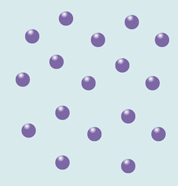
Diff species can have diff densities in same environment
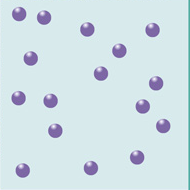
Population distribution = describes way individuals are space out across their range
How they are spread out in area
3 main distribution patterns
Random - location of individuals is independent of other individuals
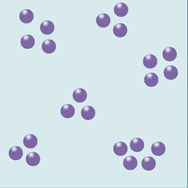
Uniform - individuals compete with 1 another for space or other resources
Clumped - clumping to help individuals
Age structure: number of males & females of each age in population
Important bc
most plant & animals cant reproduce until certain age
animals only female can produce offspring
number of offspring they produce vary with age
Birthrate deathrate & rate at which individuals enter or leave population all affect population growth
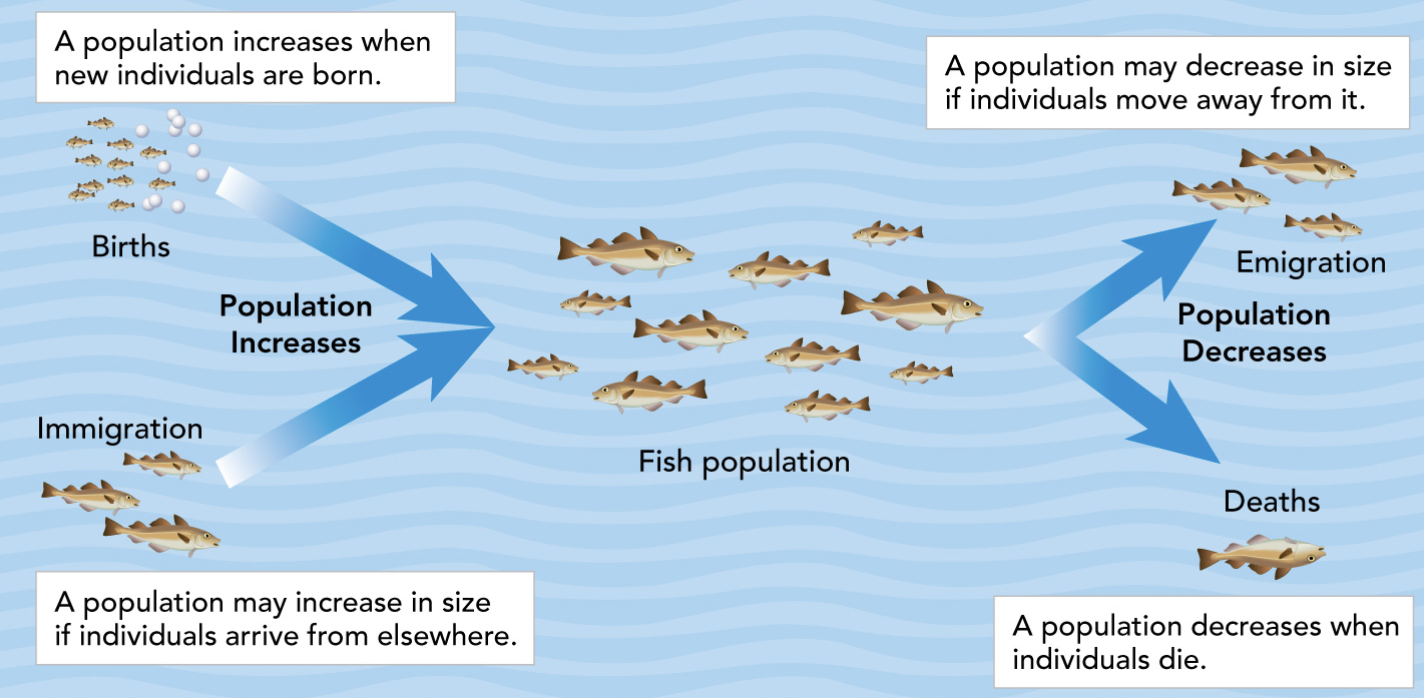
Population increase = birthrate > deathrate
Birth mean diff things in diff species & spiecies vary in amount of young produced
immigration
Population stay same = birthrate = deathrate
Population decrease = Deathrate > birthrate
emigration
Immigration = movement of individuals into
Emigration = movement of individual out
Exponential growth - Population increase more & more rapidly as more & more offspring made
J shaped curve
Presences of unlimited resources
Absence of predation & disease
Lots of offspring & gens - > why rate of population growth changes even though birth rate more or less constant
Under ideal condition w unlimited resources a population will increase exponentially
Means that larger population get faster grows
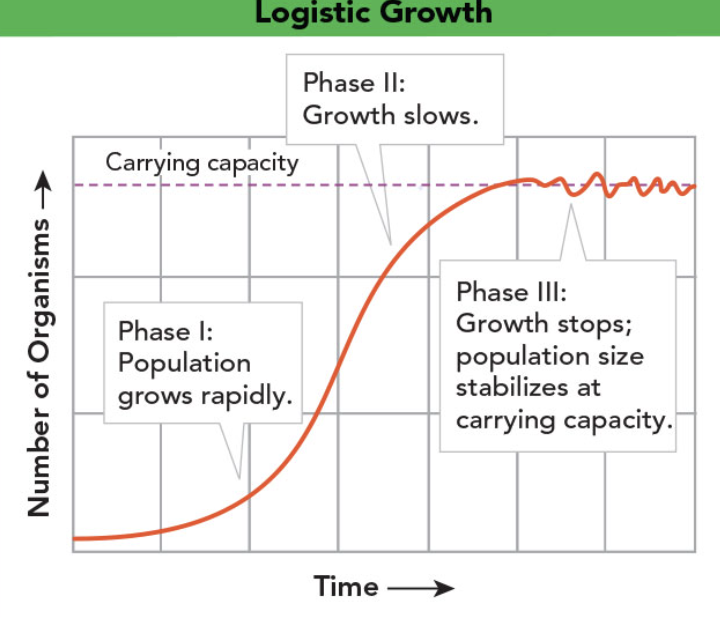
Logistic growth = growth pattern in which population growth slow & then stop following period of exponential growth
S shaped curve
Resource become limited
Population growth slow or stop
Leveling at carrying capacity
Logistic growth phases:
Phase 1 - population grow rapidly
Individual grow & reproduce lots
Phase 2 - growth slow down
Doesn't mean population size decreases
Phase 3 - growth stop
Population growth drop -> 0
Population size levels off
Stable growth = combo of birthrate + deathrate + immigration + emigration = 0
Carrying capacity = largest number of individuals of particular species that a particular environment can support
Population reach carrying capacity = stabilizes if environmental condition r kinda constant
2.2
Limiting factor = factor that causes population growth to decrease
Are interactions between members of population & either biotic or abiotic factors
Some interaction depend on population density
Other interaction act in more or less same way regardless of population density
Acting separately or tgt limiting factors determine the carrying capacity of an environment for species
Often limiting factor keep most population in natural habitat at a population size between extinction & overrunning ecosystem
Long term population growth & species survival often depend on limiting factors
2 types of limiting factors
Density dependent limiting factors = limiting factor that depend on population density
Density independent limiting factors = limiting factor that affect all populations in similar way regardless of population density
Density dependent limiting factor:
Competition - competing for resources & more individuals that there soon use up the resources
Can decrease birthrate
Increase deathrate
Or both
Occur among members of diff species that attempt to use similar or overlapping limited resources
Parasitism & Disease - weaken hosts & causes stress or even death & more dense host population more easily can spread to diff hosts
Stress from overcrowding - weakens body ability to resist disease & species fight amongst themselves
Can lower birthrate
Raise deathrate
Or both
Increase rate of emigration
Predation
Population of predator & prey may rise or fall
Prey increase = easy prey for predators
Predator increase = predator kill more than born
Prey decrease = deathrate > birthrate
Prey decrease = predator rises deathrate & lower birthrate = predator decrease
Herbivory - eating to many of 1 plant
Lwk like predator prey but prey is plant
Density independent limiting factors:
Environmental extremes
Natural disasters
Population may crash then population may build up again quick or stay low
Artificial density independent - control measures by human
If carrying capacity falls low enough species can be extinct