MIL 1st Quarter
LESSON 1
MIL - Media and Information Literacy
Media and Information Literacy
- The essential competencies that allow citizens to engage effectively with media and other information providers and develop critical thinking and lifelong learning skills for socializing and becoming active citizens.
- A compounded field of study. It also intersects other fields with overlapping concerns
UNESCO FIVE LAWS of Media Literacy
LAW 1 - Information, communication, libraries, media, technology, the internet as well as other forms of information providers are for use in critical civic engagement and sustainable development
LAW 2 - Every citizen is a creator of information/knowledge and has a message
LAW 3 - Information, knowledges and messages are not always value neutral or always independent of biases
LAW 4 - Every citizen wants to know and understand the new information, knowledge and messages
LAW 5 - Media and information literacy is not acquired at once
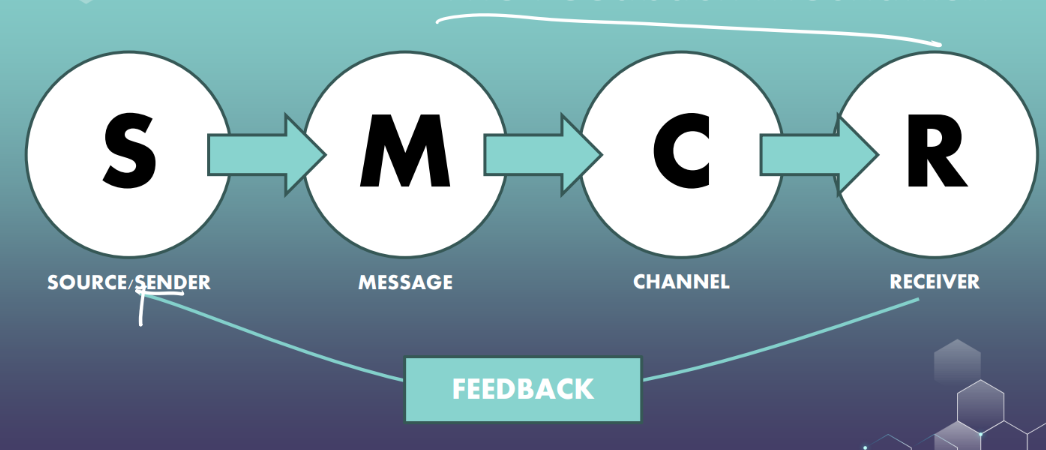
Communication Process
S->M->C->R
Source → Message → Channel → Receiver
(Shannon Weaver Model of Communication)
Feedback Mechanism
Mass Media - When a media outlet is used to disseminate a piece of information to a large audience
Mass Communication - Spreading one-way type of information toward a huge audience
Culture - The sum of those characteristics that identify and differentiate human societies- a complex interweave of many factors
TYPES OF MEDIA (Traditional Media/New Media)
Broadcast Media - electronic media that uses electricity and technology to deliver the information
Film or Cinema - this pertains to the movies that carry audiovisual messages and are usually projected onto a huge screen in the theaters or movie houses
Social Media - Internet-maintaned computer programs that can be installed in personal computers or portable devices
Mobile Communications Technology - Smartphones and tablet computers have revolutionized the way we create, process and distribute media today
EVOLUTION OF MEDIA
Pre Industrial Age (Before1700s) → Industrial Age (1700s-1930s) → Electronic Age (1930s-1980s) → Information Age (1900s - 200s)
Pre Industrial Age - ex. Cave Painting, Clay tablets, Papyrus in Egypt, Dibao in China
Industrial Age - ex. Printing Press, Camera, Newspaper, Telephone, Type Writer, Telegraph, Motion Picture Photography, Punch Card
(Samuel Morse invented the first Telegraph)
Electronic Age - using technology to inform. ex. Transistor Radio, Television, Large Electronic Computers (Edsac & UNIVAC 1), Mainframe computers, Personal Computers, Apple 1
Information Age - current age. ex. Web browsers (Internet Explorer), Blogs (Blogspot,WordPress), Friendster, Facebook, Microblogs ( Twitter,Tumblr), Video (Youtube), Video chat( Skype, Google Hangups), Search Engines (Yahoo, Google), Portable Computers (Laptops, Netbooks,Tablets), Smart Phones ( Iphone, Huawei), Wearable Technologies (Apple Watch)
Brief History of Philippine Media
The history of media growth in the Philippines mostly corresponded with the country’s colonial past, when it became a result of multiple political movements and upheavals in certain cases. Similar to the worldwide history of media, the rise of media in the country has both native and foreign-brought predecessors
ALIBATA/BAYBAYIN - The most notable discovery of ancient alphabet
UMALOHOKAN - refers to the town criers of precolonial barangays in the Philippines, They were responsible for going around and making people aware of new laws and policies enacted by the Datu or chieftain
The Print industry and Filipino freedom
Del Superior Govierno - established in 1811, the very first newspaper in the country, it was intended for the Spaniards only so it was written in Spanish.
La Solidaridad - was the most popular of these nationalistic newspapers published in 1889.
Jose Rizal - our national hero who wrote his two famous novels that criticized the Spanish rule: Noli Me Tangere and El Filibusterismo.
The Manila Times (1898) and Manila Bulletin (1900) - the long-running newspapers we have in the country were established during the 1 American period.
The European Film Import
Carlo Naquera - Spanish soldier
The Lumiere brothers' cinematography film camera and projector innovation found its way to Philippine shores two years after cinema was first launched.
With the cinematography, he brought several Spanish-language short films and showed them to select audiences during 1897.
When he ran out of short films to screen, he brought the cinematographe around and shot local scenes then showed them as brief documentaries.
In early 1900, short films from America were soon imported and shown in the early theaters in Manila, particularly those located around Escolta and lntramuros
Broadcast Industry
The introduction of the broadcast industry in the Philippines started with the introduction of the telegraph and telephone system in the country.
During the colonial Spanish period of the late 1800s, the British company Eastern Extension was granted permission to place submarine telegraph cables from Hong Kong to Manila via the province of Bolinao in Pangasinan.
in 1890, the first telephone system of the country began its operations, and the whole archipelago enjoyed this system of information and communication exchange.
Americans were primarily pivotal in bringing the broadcast industry to the Philippines
Henry Herman - an American businessman who first operated a small radio station in 1922 to serve as a product demonstration media for his business called the Electrical Supply Company. From these tests, he upgraded his small station and adopted the call letters KZKZ to name his station in 1924 and set up Radio Corporation of the Philippines to legally own it.
This station eventually closed but the oldest radio station that still exists today is DZRH which first broadcast in 1939 as KZRH. It was connected to the H.E. Heacock Company, a popular department store whose Manila branch was owned by Samuel Gaches.
Francisco "Koko" Trinidad - The Father of Philippine Radio Television came into the picture when an American engineer, James Lindenberg, established Bolinao Electronics Corporation
(BEC) in 1946.
The Philippines was named as Social Media Capital of the Worlds in 2011 as 93.3% of the population area are heavy Facebook users
LESSON 2
Understanding Media: Aesthetics of the Image, Text and Audio
FRAMING - means to construct, compose, or imagine something, meaning to construct with a solid plan to follow using a specific structure in mind.
News - it is defined as “the communication of information on current events via print, broadcast, internet or word of mouth to a third party or mass audience. Since it’s root word is “new”
Newspaper - paper that is printed and distributed usually daily or weekly and that contains news, articles of opinion, features, and advertising. Newspaper all have sections inside, mostly covering the general category of headlines, opinions entertainment, and lifestyle.
- In order to create news the structure of the 5W and 1 H is always followed to present facts
Who - the person that or any person that (used relatively to represent a specified or implied antecedent
What - to ask for information about things and actions
Where - a place; that place in which something is located or occurs
When - to refer to a future situation or condition that we are certain of
Why - used to talk about reasons and explanations
How - to ask about someone's general health or about the condition or state of something, or how people experience something
Journalism - the collecting, writing, editing, and presenting of news in newspapers, magazines, radio and television broadcasts, or the internet
Books - Literature covers books that usually involve fictional or true to life stories of the human conditions like novels. Trade books are the most expensive books usually printed on a glossier type of paper with hard bound covers
Comics - the comics format is usually designed into panels, where the visual drawings are similar to how you see scenes of movies or tv shows.
Magazines - the magazine is also a format popular among adults and teens alike. Somewhat an intersection of the newspaper, books and comics. A typical magazine contains printed stories or essays. Illustrations and photographs, and pages of advertising contents.
Publishing House - corporation that also produce different types of reading materials.
Photography - process of recording images through a chemical interaction causes by lightrays hitting a sensitized surface.
Photography THEN all celluloid based film strips need to undergo chemical processes to make an image appear.
Photography NOW only need to push the playback button of our digital camera devices to see the picture we took seconds ago. It also makes the reproduction of images easier and their storage more manageable l, as you only need the computer hard drive or smaller storage devices to store the digital image files.
FILM FORM
Film - originally “moving pictures”
It comes in 2 forms (Short films - less than an hour and Feature length film - up two or three hours
Modes of Film Production
Pre Production - the initial planning stage of a film
Production Stage - also known as the "principal photography phase, " involves the actual shooting of a film.
Post Production Stage - involves editing, music composition, and special effects for a mainstream commercial film.
Film Formats
Narrative Films - is primarily aimed at entertainment, feature fictional characters and situations that are relatable to viewers
Documentary Films - The opposite of the Narrative Films which presents nonfictional characters and situations, presenting facts and real lives as the story unfolds
Animation Films - The oldest film format, involves the rapid projection of moving images. It can be used to create non-moving objects or people
Experimental Films - Is often deviate from traditional narrative or documentary formats,incorporating animated styles but not their main aesthetics. They experiment with physicality, shooting styles, production processes, and concepts, often incorporating symbolic or philosophical meanings.
pan - camera swivels horizontally in place, from left to right or vice versa
tilt - camera swivels vertically in place, up to down or vice versa
TV BROADCAST
Television - Also known as TV for short, has similar aesthetics with film form and has a more stable and unending supply of content
Types of TV SHOWS
Informative Programming - Were created to deliver current events relevant to the viewing public. Types of Informative programming: News, Documentaries,
Entertainment Program - this type of program is for entertainment purposes. Types of Entertainment program
Fictional Entertainment ex. crime stories, supernatural
Non Fictional Entertainment Program ex. Singing contest, game shows
TV SHOWS ANATOMY AND ADVERTISING
Commercial Gap / Commercial Break - the interval during a commercial television programme, or between programmes, during which advertisements are shown.
Crafting Audiovisual Media and Messages
Audio aspect contains everything you hear
Visual aspect contains everything that you see in a given film or TV show
Audiovisual productions are composed of sounds, music, noise, or dialogue. It is very important to deliver the messages of the various kinds of TV shows on air.
ELEMENTS OF IMAGE PRODUCTION
Color Combination - it's one of the main things that holds our visual attention. Colors like red, which sometimes signify war or romance, or blue, which signifies sadness, are examples of how color combinations affect the mood of the image
Lighting - Lighting goes hand in hand with color combinations. Whether the colors on the screen are displayed or not, the mood of the overall image production depends on how much brightness a scene has indicate positiveness, or how little light a scene has which can indicate something negative
Balance - Balance between the elements or the characters in the scene is important when it comes to image production. In a scene, an element can be shown, and whether the camera focuses on it too much (showing a bigger picture) or it is a background element, both hold meaning for the production
Framing - determines what was included and excluded in a shot. When watching, you will see whether the frame or shot of a scene is near or not. What was included or excluded can hold a significant meaning to the story, as well as be one of the biggest keys to solving something
Expression - One of the most important elements we see in a shot is the expression of the character. The scene in general can be solely based on how the characters' expressions are. Whether it's a sad, happy, climax, or a war scene, perhaps the most important element that we can see immediately in the shot's meaning is the expression