Comprehensive Study Guide to Momentum, Systems, and Conservation Laws
Quantitative Foundations of Momentum
Momentum (symbolised as ) represents the measure of how difficult it is to stop or turn a moving mass.
Mathematical definition:
Momentum is how much motion an object has and how hard it is to stop, calculated by multiplying its mass by its velocity ( )
Standard SI units of momentum are kilogram-metres per second ( ) or Newton-seconds .
Mass is measured in kilograms
Velocity () is measured in meters per second ().

Mass versus velocity influence on total momentum:
An object can have high momentum if it has a large mass moving slowly or a small mass moving very fast.
Examples:
Freight train case study:
Mass:
Velocity: east
Total momentum calculation:
Fast baseball case study:
Mass:
Velocity: east
Total momentum calculation:
Comparative analysis (Sprinter vs. Crawling Compact Car):
Sprinter parameters: , north
Car parameters: , north
Despite crawling at low speed, the compact car possesses greater momentum than the sprinting athlete due to its substantially greater mass ().
Kinematic Acceleration and Net Force
Acceleration is the rate of change of velocity over an elapsed time interval:
Initial velocity is represented as .
Final velocity is represented as .
Time passed is represented as .
Newton's Second Law of Motion relates acceleration to Combined net force:
Worked automotive acceleration example:
A car accelerates forward from rest () to over an elapsed time of .
Acceleration determination:
Combined net force calculating:
System Boundaries, Internal Forces, and External Forces
Formal definitions of mechanical systems:
System: A group of objects you focus on when studying how things move or interact in physics.
System Boundary: An imaginary or real line that separates the objects being studied from everything around them.
Internal Forces: Forces that objects inside the system exert on each other.
Examples:
The force between two people pushing each other.
The force between two balls when they hit each other.
Newton’s Third Law: When one object pushes or pulls another object, the second object pushes or pulls back with an equal force in the opposite direction. These forces act on different objects.
External Forces: Unbalanced pushes or pulls from outside the system that act on objects inside it.
Fundamental boundary rule: Only forces crossing the defined system boundary qualify as external forces.

Isolated (Closed) System:
A collection of objects experiencing zero net external force () across its defined perimeter.
When the net external force is zero, the system’s total momentum stays the same.
External force mechanisms altering system momentum:
Friction: A force that slows down or stops an object when two surfaces rub against each other.
Gravity: Exerts a continuous external downward pull on bodies, continuously accelerating them downward and increasing downward momentum.
Air Drag: Collisions with atmospheric gas molecules apply an external retarding force that opposes velocity, dissipating momentum at rates proportional to velocity squared at high speeds.
Applied Thrust: Directed external forces (such as expelled rocket propellants or manual pushing) introduce net external force, driving acceleration and altering system momentum.
Environmental momentum retention (Earth vs. Interstellar Space):
Kicked soccer ball on grass: Decelerates and stops because external forces (surface friction and fluid air resistance) exert a net retarding force that opposes forward motion and dissipates momentum.
Asteroid in deep space: Experiences neither fluid resistance nor contact friction; in the absence of net external forces, its momentum is conserved, allowing it to coast for billions of miles across interstellar space indefinitely.
Approximating isolated systems on Earth:
Negligible Friction Environments: Systems operating on air hockey tracks or smooth ice experience minimal surface drag, allowing external forces to approach zero.
Brief Interaction Timeframes (): Over very brief impact events, external forces like friction have insufficient time to impart substantial impulse (), allowing total momentum to be treated as conserved throughout the impact.
The Law of Conservation of Momentum
Core physical law:
In any closed, isolated system, the total momentum before an event is equal to the total momentum after the event:
Core principles:
Momentum can transfer between interacting bodies within the system, but it cannot be created or destroyed.
If one body loses a specific quantity of momentum (), the interacting body gains that identical quantity ().
Momentum is a vector quantity; direction must be accounted for using opposite algebraic signs ().
Conservation of momentum applies universally to both collisions and explosions.
Mathematical Modeling of One-Dimensional Inelastic Collisions
Perfectly inelastic collision characteristics:
Interacting objects collide and adhere together, moving forward as a single combined mass with a shared final velocity ().
General governing equation:

Spacecraft Orbital Docking (Space Shuttle and International Space Station):
Orbital context:
Both the Space Shuttle and the International Space Station (ISS) orbit Earth at roughly ().
Final docking contact is conducted at a relative velocity of only () to prevent catastrophic impact forces from destroying the latching mechanisms.
Inelastic docking calculation:
Shuttle parameters: , initial relative approach velocity .
ISS parameters: , initial relative velocity .
Initial momentum calculation:
Combined mass after latching:
Final velocity determination:
Total final momentum:
Total momentum is conserved.
Rear-End Identical Vehicle Collision:
Initial conditions: Two cars, each of mass . Car A travels at ; Car B is stationary ().
Initial momentum:
Combined mass: .
Post-collision velocity calculation:
Final momentum:
Shopping Trolley Car Park Collision:
Initial conditions: A stationary trolley (, ) is struck by a moving runaway trolley (, ). Both trolleys lock and move together.
Individual initial momenta:
Speed comparison before calculation:
The post-collision speed must be lower than the initial speed of the moving trolley because total mass increases from to while total momentum remains conserved.
Post-collision speed calculation:
Two-Cart Classroom Verification:
A cart moving at strikes and locks onto a stationary cart.
Initial total momentum: .
Combined mass: .
Final velocity:
Multi-Vehicle and Head-On Collision Analysis
Head-on collision with opposing directional vectors:
Two vehicles of mass collide head-on.
Car 1 travels rightward at .
Car 2 travels leftward at .
Initial momentum calculations:
Coupled post-impact motion:
Traffic Crash Sequence (Kinematics and Inelastic Momentum Transfer):
Initial conditions: A van () travels in heavy traffic at . A car () travels behind it at with a maximum braking deceleration of .
Car emergency stopping distance:
Collision impact state:
The car fails to stop in time and impacts the rear of the van while traveling at .
Momentum values prior to impact:
Momentum transfer to the car:
After impact, the car continues forward at .
Post-collision car momentum:
Total change in car momentum:
Post-collision velocity of the van:
Explosions and Recoil Dynamics
Explosion mechanics:
In an explosion, an initially stationary system () separates into distinct components driven by internal forces.
By momentum conservation, the total momentum of all fragments must sum to zero:
Negative velocity values indicate that recoil occurs in the direction opposite to the expelled body.

Cannon and Cannonball Recoil:
Cannon mass: .
Cannonball mass: .
Cannonball muzzle velocity: .
Initial momentum: .
Momentum balance equation:
The cannon recoils backward at .
Skateboarder Dismount:
Skateboarder mass: .
Skateboard mass: .
Initial momentum: .
Skateboarder leaps forward with velocity: .
Skateboarder forward momentum:
Skateboard momentum balance:
The skateboard recoils backward with a velocity of .
Ballistic Firearm Recoil:
Bullet mass: .
Muzzle velocity: .
Gun mass: .
Bullet momentum calculation:
Gun recoil speed calculation:
Recoil speed magnitude is .
Impact Force and Newton's Second Law
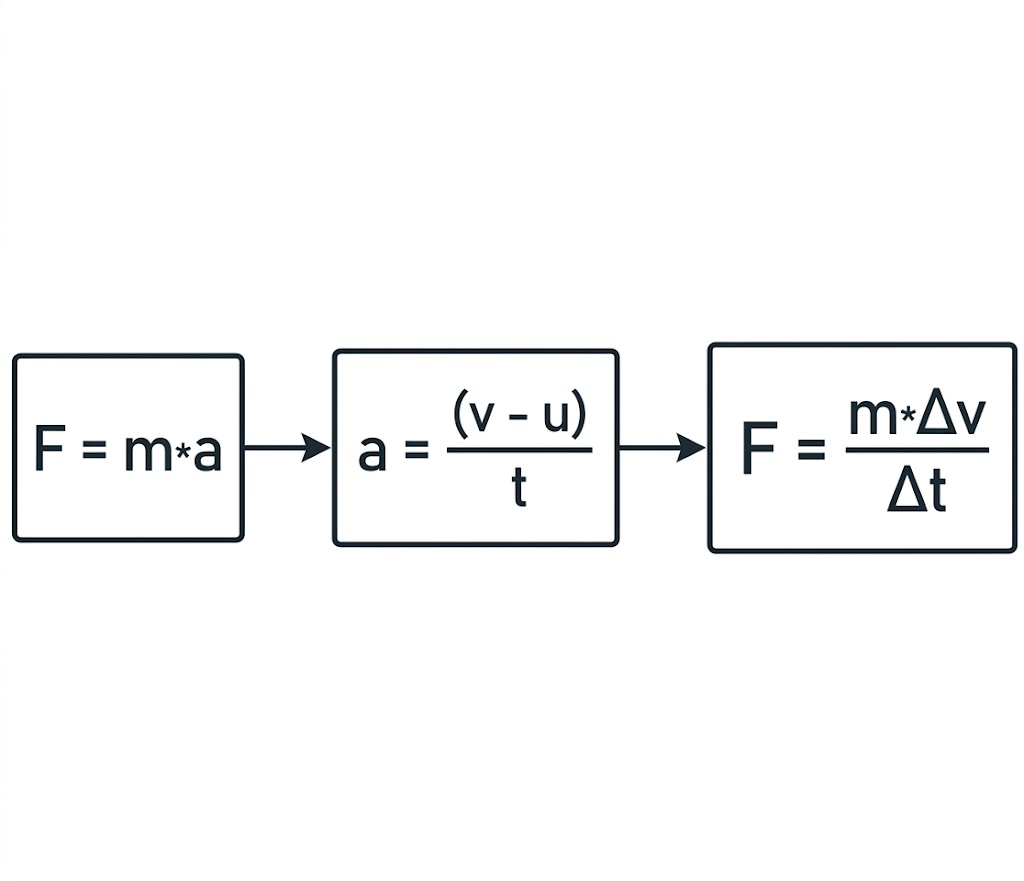
Derivation of the impact force equation:
Newton's Second Law defines force as the product of mass and acceleration:
Linear acceleration is the rate of change of velocity over time:
Substituting acceleration into Newton's Second Law:
Formal definition: Resultant impact force equals the time rate of change of momentum.
Inverse relationship between force and impact duration:
For a fixed total momentum change (), the experienced resultant force () is inversely proportional to the stopping duration ().
Extending contact time reduces the peak impact force proportionally.
Comparative Case Study (Rigid Wall vs. Cushioned Mat):
A person with mass runs at and comes to a full stop ().
Change in momentum:
Scenario A: Rigid Wall Stop ():
Result: High impact force produces severe skeletal shock.
Scenario B: Cushioned Inflatable Mat / Bouncy Castle Stop ():
Result: Extending duration by a factor of reduces peak force by a factor of ().
Emergency Braking Vehicle Calculation:
A vehicle traveling at stops in .
Average resultant braking force:
Engineering Safety Mechanisms for Momentum Attenuation
Automotive Airbags:
Rapidly inflate in milliseconds during frontal collisions.
Force the passenger's forward deceleration to occur across an extended time duration (), lowering the rate of momentum change and reducing peak chest and cranial loads.

Automotive Crumple Zones:
Structural zones built into vehicle chassis designed to deform and collapse progressively under impact.
Increases the total duration of the collision () and absorbs kinetic energy, preventing destructive deceleration forces from transferring into the passenger compartment.
Safety Helmets:
Contain dense expanded polystyrene liners engineered to crush permanently under impact.
Lengthens the stopping time of the skull and brain, reducing peak deceleration and impact forces.
Spacecraft Docking Attenuation Dampers:
Active hydraulic damping rings dissipate relative kinetic energy between spacecraft during contact.
Extends contact time during soft capture, preventing structural damage before hard-capture latches engage.
Controlled Crash Test Analysis (NHTSA Sled Dataset)
Experimental context:
National Highway Traffic Safety Administration (NHTSA) controlled collision tests analyze sled crashes to evaluate conservation laws during violent deformations.
System definition: Two sleds (Sled A and Sled B) confined within a system boundary on a low-friction test track.

Test 1 Evaluation:
Parameters:
Sled A: Mass , initial velocity , final velocity
Sled B: Mass , initial velocity , final velocity
Initial momentum calculations:
Post-collision combined state:
Sleds stick together to form a combined mass:
Shared final velocity:
Final total momentum:
Momentum transfer between objects:
Sled A loses momentum:
Sled B gains momentum:
The momentum lost by Sled A is transferred to Sled B via internal forces; total system momentum remains .
Test 2 Evaluation:
Parameters:
Sled A: Mass , initial velocity , final velocity
Sled B: Mass , initial velocity , final velocity
Initial momentum calculations:
Combined mass after collision:
Final total momentum calculation:
Conclusion: Initial system momentum () equals final system momentum (), confirming momentum is conserved in Test 2.
Dynamic rationale for conservation across sled crashes:
Forces exerted between Sled A and Sled B during the collision are internal to the defined two-sled system.
By Newton's Third Law, internal contact forces are equal in magnitude and opposite in direction, summing to zero.
Because net external forces acting along the track boundary are zero, total system momentum remains constant despite changes in speed.
Laboratory Instrumentation and Experimental Methods
Measuring momentum in the laboratory:
Momentum determination requires measuring both mass and velocity ().
Mass () is recorded using an electronic balance in kilograms.
Linear velocity () is calculated from the time taken () to traverse a known displacement ():

Improving measurement accuracy:
Manual stopwatches introduce measurement uncertainty due to human reaction time.
Light gates connected to digital dataloggers record interruption intervals accurately, providing precise velocity measurements at set positions along the track.
Newton's Cradle demonstration:
When the initial steel sphere strikes the stationary row, it stops upon impact.
Its momentum transfers through the intermediate spheres via elastic internal contact forces, causing the sphere on the opposite end to swing outward with an identical velocity.
Raising two spheres imparts double the momentum, causing two spheres to swing outward on the opposite side.
Real-world decay:
Oscillations eventually stop because the system is not isolated.
External air drag and internal inelastic friction convert mechanical kinetic energy into thermal energy and acoustic waves over time.
Conceptual Checks and Common Misconceptions
Formula inversion errors:
Misconception: Calculating momentum by dividing mass by velocity ().
Correction: Momentum is the product of mass and velocity ().
Example: A trolley with mass moving at :
Incorrect computation:
Correct computation:
Weight vs. Mass errors:
Misconception: Substituting weight in Newtons () directly for mass in kilograms ().
Correction: Convert weight to mass using before calculating momentum:
Example: A vehicle with weight travels at (assuming ):
Incorrect computation:
Correct mass conversion:
Correct momentum computation:
Vector velocity directional signs:
A negative velocity value denotes movement in the opposing spatial direction relative to the chosen reference axis.
A stationary body with zero velocity () always possesses a momentum of zero ().
Misconceptions regarding conservation of momentum:
False: Momentum is only conserved during collisions, not explosions (momentum is conserved in both, provided the system is closed).
False: A closed system permits net external forces to act (a closed system by definition experiences no net external forces).
False: The unit of momentum is (the correct unit is or ).