Chapter 20
Endocrine and Hematologic Emergencies
Endocrine system influences nearly every:
Cell
Organ
Function of the body
Patients with endocrine disorders have a multitude of signs and symptoms.
Hematologic emergencies
Difficult to assess and treat
Endocrine Emergencies: Anatomy and
Physiology
The endocrine system is a regulatory system that works with other systems to maintain homeostasis.
Endocrine glands secrete messenger chemicals called hormones.
Hormones travel through blood to organs, tissues, or cells they affect.
When they arrive, an action or cellular process takes place.
Endocrine disorders are caused by problems regulating the production, secretion, or reception of hormones.
Glucose is important to all cells in the body.
Cells metabolize glucose with oxygen to make ATP, a cell's energy source.
Insulin is necessary for glucose to enter cells.
The pancreas produces and stores two hormones that play a major role in glucose metabolism:
Glucagon
Insulin
In a person without diabetes, the pancreas stores and secretes insulin and glucagon in response to the level of glucose in the blood.


Pathophysiology
Diabetes includes disorders of insulin production and insulin sensitivity.
Impaired insulin production or insulin resistance by cells can prevent glucose from moving into cells and tissues.
The glucose level in blood remains high and continues to rise while cells are left without adequate glucose for ATP production.
Medications and injectable hormones that lower blood glucose levels help maintain consistent levels, and/or help cells become more sensitive to insulin.
If administered correctly or incorrectly, can create a medical emergency.
Low blood glucose level (hypoglycemia) can be life threatening.
Hyperglycemia: blood glucose level above normal
Hypoglycemia: blood glucose level below normal
Hyperglycemia and hypoglycemia can occur with all diabetes types.
Patients at both extremes can present with altered mental status.
Altered mental status related to diabetic emergencies can mimic alcohol intoxication, and intoxicated patients often have abnormal glucose levels.
Check glucose levels for all patients with altered mental status or diabetes.


Diabetes Mellitus Type 1
Autoimmune disorder in which immune system produces antibodies against pancreatic beta cells
Missing the pancreatic hormone insulin
Onset usually early childhood through fourth decade.
Patient must obtain insulin from an external source.
Patients who inject insulin often check blood glucose levels up to six times or more a day.
Some patients track their blood glucose in real time using wearable sensors that provide continuous glucose monitoring.
Sensor wirelessly transmits information to receiver, usually a smartphone or insulin pump.
Continuous glucose monitoring can help patients make more accurate decisions about glucose requirements and need to adjust medications.
Insulin pump: continuously measures glucose levels and provides insulin and correction doses of insulin based on carbohydrate intake at mealtimes
Pumps can malfunction and diabetic emergencies can develop.
Always inquire about presence of an insulin pump.
If you suspect hypoglycemia in an unconscious patient with an insulin pump, you should disconnect it if possible.
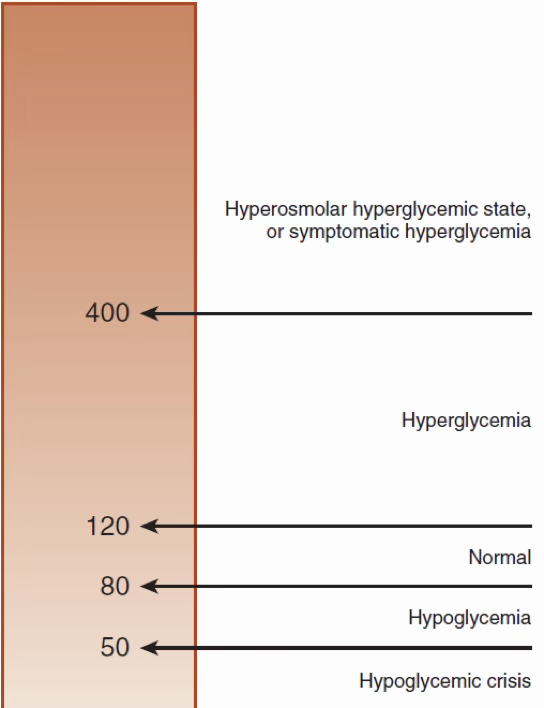
Normal blood glucose level is between 80 and 120 mg/dL.
Most common metabolic disease of childhood
New-onset type 1 diabetes symptoms:
Polyuria
Increased urination due to high glucose levels in the blood leading to increased glucose in the urine.
Polydipsia
Increased thirst resulting from dehydration caused by excessive urination.
Polyphagia
Increased hunger stemming from the body's inability to properly utilize glucose for energy, leading to a heightened appetite.
Weight loss
Fatigue
When blood glucose level is above normal, kidney's filtration system becomes overwhelmed and tries to offload glucose into urine.
This causes more water to be pulled into the urine (polyuria).
Increased urine production causes dehydration and thirst (polydipsia).
Patients may report severe hunger and increased food intake (polyphagia).
Diabetes Mellitus Type 2
Caused by resistance to the effects of insulin at cellular level
Obesity predisposes patients to type 2 diabetes.
Pancreas produces more insulin.
Insulin resistance can sometimes be improved by exercise and dietary modification.
normally the bigger people
Medications used to treat type 2 diabetes include oral medications, injectable medications, and various insulin preparations.
Some increase secretion of insulin and pose a high risk of hypoglycemic reaction.
Some stimulate receptors for insulin.
Others decrease effects of glucagon and release of glucose stored in the liver.

Often diagnosed at yearly medical examination from complaints related to high blood glucose levels:
Wounds that do not heal
Numbness in hands and feet (could lose a limb)
Blindness
Kidney failure
Gastric motility problems
Symptomatic Hyperglycemia
Occurs when blood glucose levels are very high
Early signs and symptoms include frequent urination, increased thirst, blurred vision, and fatigue.
If untreated, the patient may present with abdominal pain, nausea and vomiting, shortness of breath, dry mouth, weakness, or altered mental status.
Two types of hyperglycemic emergencies
Diabetic ketoacidosis
Hyperosmolar hyperglycemic
Diabetic Ketoacidosis
When glucose is unavailable to cells, the body burns fat.
When the body burns fat, it produces acid waste (ketones).
Diabetic ketoacidosis (DKA) is metabolic acidosis caused by insufficient insulin.
In response to metabolic acidosis, body begins to breathe faster and deeper.
Kussmaul respirations
DKA may present as generalized illness plus:
Abdominal pain
Body aches
Nausea
Vomiting
Altered mental status or unconsciousness (if severe)
Blood glucose levels over 350 mg/dL
Kussmaul respirations
Fruity odor on the breath (related to ketones)
If not rapidly recognized and treated, DKA can result in death.
Obtain a glucose level with a fingerstick using a lancet and a glucometer.
Generally higher than 350 mg/dL
DKA may also present in a patient with type 1 diabetes with an acute illness, an untreated infection, or other stressor.
Hyperosmolar Hyperglycemic State (HHS)
Diabetic complication that occurs more often in people with type 2 diabetes
High blood glucose levels lead to increased urination that results in dehydration.
Excess glucose in the blood pulls fluids from tissues into blood vessels, and subsequently, into urine.
Signs and symptoms of HHS
Hyperglycemia
Altered mental status, drowsiness, lethargy
Severe dehydration, thirst, dark urine
Visual or sensory deficits
Partial paralysis or muscle weakness
Seizures
Very high glucose levels, above 600 mg/dL
Patients respond by increasing fluid intake, which causes polyuria.
Patient cannot drink enough fluid to keep up with high glucose levels in blood.
Urine becomes dark and concentrated.
Patient may become unconscious or have seizure due to severe dehydration.
Symptomatic Hypoglycemia
An acute emergency in which a patient's blood glucose level drops and must be corrected swiftly.
Can occur in patients who inject insulin or use oral medications that stimulate pancreas to produce more insulin
When insulin levels remain high, glucose is rapidly taken out of the blood.
If glucose levels fall, there may be an insufficient amount to supply the brain.
Mental status of the patient declines.
Patient may become aggressive or display unusual behavior.
Unconsciousness and permanent brain damage can quickly follow.
Factors that can contribute to hypoglycemia
Change in routine (eg, exercised more, skipped meal)
Patient did not eat enough food.
Patient is experiencing an acute illness.
All hypoglycemic patients require prompt treatment.
EMTs can administer oral glucose if patient is able to protect their airway.
ALS clinicians can administer glucose or glucagon by injection.
Glucagon is also prescribed to patients as an emergency kit for self-administration.
Hypoglycemia develops much more quickly than hyperglycemia.
Signs and symptoms of hypoglycemia
Normal to shallow or rapid respirations
Pale, moist skin
Diaphoresis
Dizziness, headache
Rapid pulse
Normal to low blood pressure
Altered mental status
Anxious or combative behavior
Seizure, fainting, or coma
Weakness on one side of the body
Rapid changes in mental status
Scene Size-up
Scene safety
Patients with diabetes may use syringes.
Be alert for clues.
Take standard precautions.
Question bystanders on events leading to your arrival.
Keep open the possibility that trauma may have occurred.
Determine MOI/NOI.
Primary Assessment
Form a general impression.
Airway and breathing
Patients showing signs of inadequate breathing, a pulse oximetry level less than or equal to 94% on room air, or altered mental status should receive high-flow oxygen (12 to 15 L/min via nonrebreathing mask) to achieve an oxygen saturation of 94% to 98%.
Hyperglycemic patients may have Kussmaul respirations and sweet, fruity breath.
Hypoglycemic patients will have normal or shallow to rapid respirations.
Circulation
Dry, warm skin: hyperglycemia
Moist, pale skin: hypoglycemia
Rapid, weak pulse: symptomatic hypoglycemia
Make transport decision.
Patients with altered mental status and impaired ability to swallow should be transported promptly
History Taking
Investigate chief complaint
Obtain history of present illness from responsive patient, family, or bystanders.
If patient has eaten but not taken insulin, hyperglycemia is more likely.
If patient has taken insulin but not eaten, hypoglycemia is more likely.
SAMPLE history—ask the patient:
Do you take insulin or pills to lower blood sugar?
Do you wear an insulin pump? Is it working properly?
Have you taken your usual insulin dose (or pills) today?
Have you eaten normally today?
Have you had any illnesses, unusual amount of activity, or stress?
Look for an emergency medical identification device
Secondary Assessment
Physical examination
Assess unresponsive patients from head to toe.
When you suspect a diabetes-related problem, focus on mental status, ability to swallow, and ability to protect airway.
Vital signs
Include blood glucose level using a glucometer.
Normal nonfasting adult and child blood glucose level range: 80 to 120 mg/dL; neonates should be above 70 mg/dL
Reassessment
Reassess patient with diabetes frequently to assess changes.
Improved mental status?
ABCs intact?
How is patient reacting to interventions performed?
Base administration of glucose on serial glucometer readings or a deteriorating level of consciousness.
Determining blood glucose level in a patient with diagnosed diabetes can be difficult when signs and symptoms are confusing and you have no way to determine blood glucose value. In these situations:
Perform a thorough assessment.
Contact the hospital to help sort out signs and symptoms.
Coordinate communication and documentation.
Patients who refuse transport because their symptoms improve after taking oral glucose may require even more thorough documentation.
Emergency Medical Care for Diabetic
Emergencies
If in doubt whether that patient has symptomatic hyperglycemia or hypoglycemia, most protocols will err on the side of giving glucose.
Three types of oral glucose
Rapidly dissolving gel
Large chewable tablets
Liquid formulation
Only contraindications are inability to swallow and unconsciousness.
After you have confirmed that patient is conscious and able to swallow and have obtained an online or off-line order, administer it:
Open glucose pouch.
Squeeze glucose into patient's mouth, either under tongue or into buccal space.
Patient should then swallow.
Some patients may have prescribed glucagon emergency kits.
Local protocols may allow you to assist with administration.
Use household sources of glucose, such as juice or drinks that contain sugar.
For unconscious, hypoglycemic patients, or patients with risk of aspiration, intravenous (IV) glucose or intramuscular or intranasal glucagon is needed.
Provide transport to the next level of care.
Request an ALS intercept to start an IV line and administer IV glucose.
Reassess patient after administering glucose.
Monitor airway, remaining mindful of potential for vomiting and aspiration.
Provide a thorough reassessment to ensure that patient returns to normal mental status.
The Presentation of Hypoglycemia
Seizures
Consider hypoglycemia or an underlying condition.
Ensure airway is clear.
Place patient on side.
Put nothing in patient's mouth.
Have suctioning equipment ready.
Provide oxygen or artificial ventilations for inadequate breathing or cyanosis.
Transport promptly.
Altered mental status
May be caused by diabetes complications
Use the mnemonic AEIOU-TIPS.
Always suspect and check for low blood glucose in a patient with altered mental status.
Ensure airway is clear.
Be prepared to provide artificial ventilations and suctioning if patient vomits.
Provide prompt transport.
Misdiagnosis of neurologic dysfunction
Occasionally, patients with diabetic emergencies are thought to be intoxicated.
A diabetic patient confined by police is at risk.
An emergency medical ID may help to save the patient's life in such situations.
Blood glucose test performed at the scene will identify real problem.
Be alert to potential for diabetes and alcoholism to coexist in a patient.
Relationship to airway management
Patients with altered mental status can lose gag reflex.
Vomit or tongue may obstruct airway.
Carefully monitor airway.
Place patient in lateral recumbent position.
Make sure suction is available.
Hematologic Emergencies
Hematology is the study of blood-related diseases.
Five disorders that can create a prehospital emergency
Sickle cell disease
Hemophilia
Thrombophilia
Deep vein thrombosis
Anemia
Anatomy and Physiology
Blood is made up of four components.
Red blood cells contain hemoglobin, which carries oxygen to the tissues.
White blood cells collect dead cells and provide for their correct disposal.
Platelets are essential for clot formation.
Plasma serves as the transportation medium.
Sickle Cell Disease
Inherited disorder, affects red blood cells
More common among people of African; Central or South American; and Middle Eastern, Asian, Indian, or Mediterranean ancestry.
Sharp and misshapen sickled cells lead to dysfunction in oxygen binding and unintentional clot formation.
Sickled cells have a short life span, resulting in more cellular waste products in the bloodstream and contributing to sludging (clumping) of the blood.
Maintaining hydration is important, as insufficient hydration leads to increased clumping.
Complications associated with sickle cell disease
Anemia
Gallstones
Jaundice
Splenic dysfunction
Vascular occlusion with ischemia
Many of these complications are very painful and potentially life threatening.
Hemophilia
Hereditary condition in which patient lacks one or more of blood's normal clotting factors.
Rare: only about 33,000 people in the US have the disorder.
Hemophilia A affects mostly males.