1.5 - Determination of Young modulus of a metal in the form of a wire
Definition of Young Modulus, E:
Young modulus E = tensile stress / tensile strain
Unless otherwise indicated this is defined for the Hooke’s law region.
Unit: Pa or N m-2
Theory:
Theory: Young modulus 𝐸 = Stress / Strain or 𝐸 = 𝐹/𝐴 / 𝑥/𝑙 rearranging 𝐸 = 𝐹𝑙 / 𝑥𝐴
F = applied load
A = area of cross-section of the wire
x = extension
l = original length
If a graph of applied load, F (y-axis) is drawn against extension, x (x-axis) the gradient is 𝐹 𝑥 and so:
𝐸 = gradient x 𝑙 / 𝐴
The original length l can be measured and the area of the wire found using 𝐴 = 𝜋𝑟2 hence E can be determined.
Apparatus/Diagram:
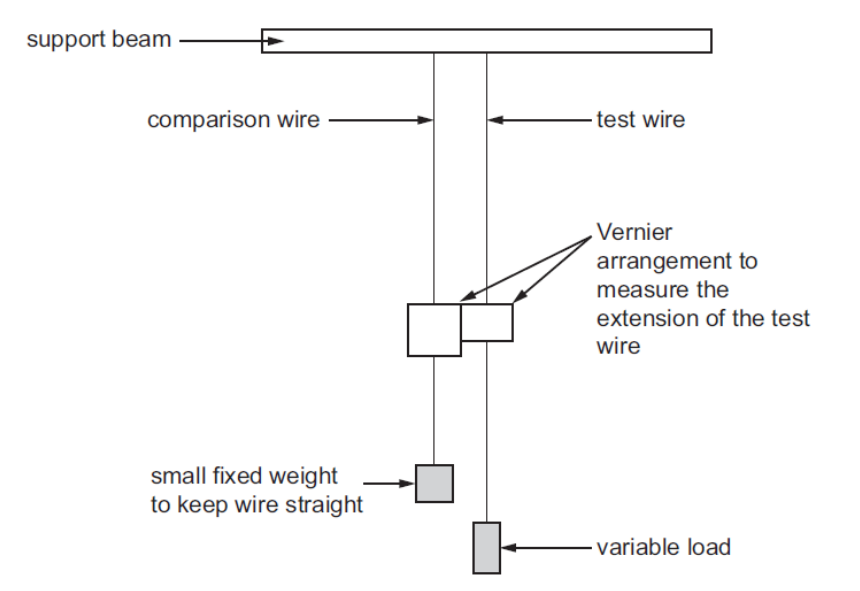
Experimental Method:
Hang two identical wires from a beam and attach a scale to the first wire and a small weight to keep it straight. Also, put a small weight on the second wire to straighten it and a Vernier scale linking with the scale on the comparison wire. Measure the original length, l, of the test wire and its diameter at various points along its length. Use this to calculate the mean cross-sectional area A.
Then place a load of 5 N on the test wire and find the extension, x. Repeat this in 5 N steps up to at least 50 N. Plot a graph of load (y-axis) against extension (x-axis) and calculate the gradient. Use this to find a value for the Young modulus.