Simple Harmonic Motion
definitions
frequency = the number of waves that pass a point per second
time period = how long it takes one wave to pass a point
amplitude = the maximum displacement of the oscillating object from equilibrium ( if the amplitude is constant and there are no friction forces the oscillations are described as free oscillations )
angluar frequency = 2pi / T or 2pi f
phase difference
imagine two childs on swings, the time period for each swing is the same and the swings are identical. if they reach maximum displacement at different times one (ct) later than the other, there are out of phase. the phase difference stays the same as they oscillate, always corresponding to a fraction of a cycle or ct / T.
for example if a childs time period at 2.4s and the other child reaches this 0.6s later then the second child will always be a quarter ( 0.6 / 2.4 ) behind the first child. the phase difference is therefor 0.5pi radians ( 2pi x 0.6 / 2.4 ).
phase difference = 2pi ct / T
principles of simple harmonic motion
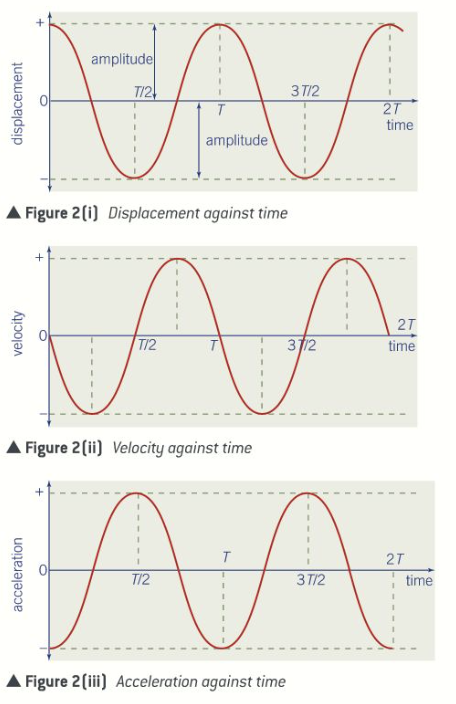
the variation of velocity against time is given by the gradient of displacement against time similarly the variation of acceleration is given by the gradient of velocity against time.
comparing figure 1 and figure 2 we can see that acceleration is always in the opposite direction of displacement
simple harmonic motion is definied as an oscillating motion where the acceleration is proportional to displacement in the opposite direction.
in other words, acceleration = - constant x displacement with the constant being equal to w² where w = angular frequency ( 2pi / T )
acceleration = - w² x displacement ( x )
using sin and cos graphs w can deduce that x = A cos ( wt ) where ( A ) is the amplitude and ( t ) is time and ( w ) is the angular frequency