L37 Plant_Development
Page 1: Overview of Plant Development
Unique characteristics of plant development
The development of plants is distinctive compared to animals.
Determinants of plant form focus on mechanisms rather than fixed structures.
Page 2: Indeterminate Growth
Plant growth and development are intermediate
not fixed in lifespan or size.
This contrasts with animal growth, which is usually determinate (fixed in scale and time).
Page 3: Plasticity and Modularity in Growth
Unique features of plant development:
Plasticity: Growth is adaptable, allowing plants to change development in response to environmental cues.
Modular Growth: Development features repetitive patterns.
Morphogenesis (plant form) arises within cell walls and depends entirely on cell division
Page 4: Totipotency and Developmental Plasticity
Indeterminate and Plastic Growth
Totipotency: The expression of developmental plasticity.
Enables clonal propagation allowing a single plant to reproduce via vegetative means.
Example: Coleus plant shows vascular differentiation after needle puncture.
Plasticity: able to adapt/alter development ‘on the fly‘ (no fixed blueprint for development)
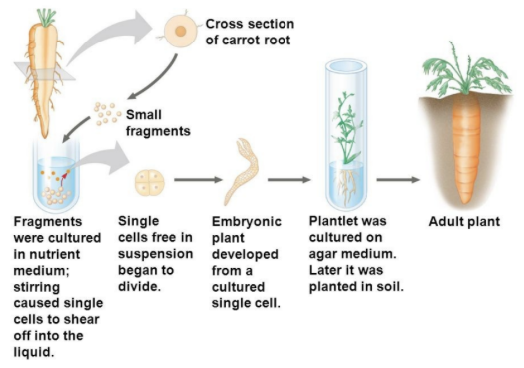
Page 5: Development Without a Blueprint
laws are guidelines that apply to developmental modules
Page 6: Insight into Developmental Guidelines
Detailed examination of Arabidopsis embryo development to illustrate guidelines.
Page 7: Zygotic vs. Somatic Development
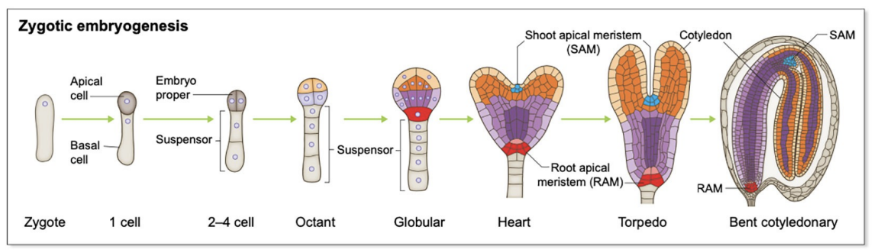
Zygotic Embryogenesis:
Somatic embryogenesis
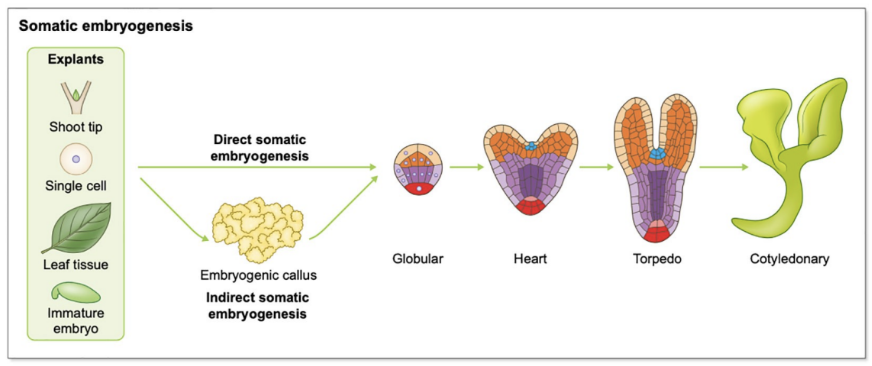
Somatic Development: Involves processes like direct and indirect somatic embryogenesis.
Page 8: Cell Division Patterns in Embryogenesis
Initial cell divisions provide structure and 'bulk':
Zygotic Stages:
1-cell to Octant stage embryo.
Importance of auxin patterns and crucial gene interactions (e.g., WOX, YDA).
Page 9: Cell Layering in Embryogenesis
5th division (16-cell stage) and beyond
results in cell layers, eg protoderm forming epidermis
Page 10: Stages of Embryogenesis
Heart Stage:
Exhibits multiple cell layers that aid in the differentiation of tissues.
Key genes involved include DRN, WUS, CUC influencing the axillary development of shoot and root apical meristems.
Two bulging cotyledons (forming the heart shape).
A clear apical-basal axis (top-to-bottom organization)
The shoot apical meristem (SAM) and root apical meristem (RAM) start to become organized
Page 11: The Torpedo Stage
becomes elongated by stretching along its apical-basal axis
Cotyledons (seed leaves) continue to grow and spread outward.
Shoot Apical Meristem (SAM) and Root Apical Meristem (RAM) are fully established and positioned:
SAM is between the cotyledons.
RAM is at the opposite pole (bottom of the torpedo)
Mature phase
looks like a tiny formed plant
Page 12: Implications of Pattern Disruption
Single genetic lesions (eg. transcriptional regulators) eliminate entire cell groupings, not just tissues (N.B. gene expression is normally cell-type specific)
Disruption in patterns indicates spatial guidelines during development.
Genetic lesions can affect not just tissue types but entire cell groupings, emphasising the importance of positional interactions.
implies positional (spatial interactions) are important.
Page 13: Arabidopsis Mutants and Positional Interactions
fass mutant (fassiculated): Loss of positional interactions leads to disorganised cell wall arrangements.
In arabidopsis, the fass mutant demonstrates how crucial positional interactions are for maintaining proper cell organisation, as the disorganisation results in compromised structural integrity and functionality of the plant.
Page 14: Cell Division Control
knolle mutant (club):
Disruption in cell division control leads to irregular and oversized cells.
Importance of structural proteins for proper cell division function.
in arabidopsis thaliana has shown that these mutations can significantly affect overall plant morphology and development.
knolle is a structural protein needed to form the cell division plate
Page 15: Complexity from Simple Rules
Fundamental rules of cell association can lead to complex developmental structures.
Interaction strategies dictate tissue formation through the positioning of colored cell types (red and white).
Page 16: Summary and Key Concepts
plant development is intermediate and plastic
plant morphogenesis arises entirely from cell division and cell lineage
Simple rules of association provide guidelines for development