Body fluids
Introduction to Physiology - Body Fluids
Presented by Dr. Natasha Barrett (n.e.barrett@reading.ac.uk)
Copyright University of Reading
PROUD TO BE AN ALLY
UNIVERSITY TEACHING FELLOW
Module Learning Outcomes
Describe the anatomy (structure) of the following systems:
Cardiovascular system
Respiratory system
Gastro-intestinal system
Musculoskeletal system
Renal system
Nervous system
Explain the functional physiology of the above systems.
Describe how the systems interact to produce the overall structure and function of a human.
Explain physiological principles such as homeostasis and feedback mechanisms.
Apply biological calculations, analyze, and present data in a physiological context.
Learning Objectives for the Session
By the end of this session, students should be able to:
Describe the concept of homeostasis as the control or stabilization of the internal environment.
Explain that illness is due to a disruption of homeostasis.
Describe several physiological feedback systems.
Describe several examples of homeostasis.
Describe the concepts of fluid balance.
Describe the constituents of body fluids.
Describe the functions of electrolytes (ions) in the body.
Recommended Readings
Available in the library:
For Biomolecular students: Ross and Wilson (2018). Anatomy and Physiology in Health and Illness, 12th Ed. Churchill Livingstone – online version via library.
For Zoology/Animal Sciences students: Aspinall and Cappello (2020). Introduction to Animal and Veterinary Anatomy and Physiology, 4th Ed. CABI. (The 2015 edition in the library is called Introduction to Veterinary Anatomy and Physiology – online version via library).
Grossman & Porth (2014). Porth's Pathophysiology, 9th Ed. Lippincott, Williams, and Wilkins. Available in the library, or to purchase; compare prices and consider second-hand.
Body Water Composition
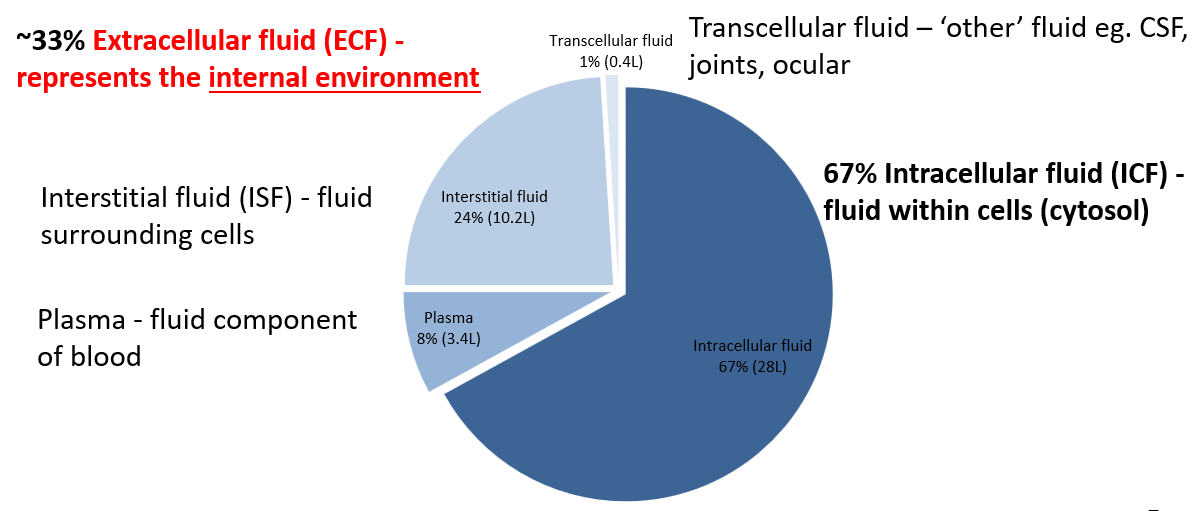
Body water accounts for about 60% of total body weight.
Calculation for a 70 kg man yields approximately:
Total water: ~42 litres
Intracellular fluid (ICF): 67% (28L)
Plasma: 8% (3.4L)
Interstitial fluid: 24% (10.2L)
Transcellular fluid: 1% (0.4L)
Definitions:
Intracellular fluid (ICF): Fluid within cells (cytosol).
Extracellular fluid (ECF): Represents the internal environment.
Transcellular fluid: ‘Other’ fluid (e.g., cerebrospinal fluid, joints, ocular fluid).
Plasma: Fluid component of blood.
Interstitial fluid (ISF): Fluid surrounding cells.
Homeostasis Definition
Homeostasis is defined as "the control or stabilization of the internal environment."
Water Content Variability in Body Tissues
Different body tissues contain different amounts of water:
Fat: ~20% water
Muscle: ~65% water
Therefore, the percentage of water in the body varies among individuals based on body composition.
Fluid Balance
The balanced state of fluid intake and output is crucial for maintaining homeostasis in the internal environment.
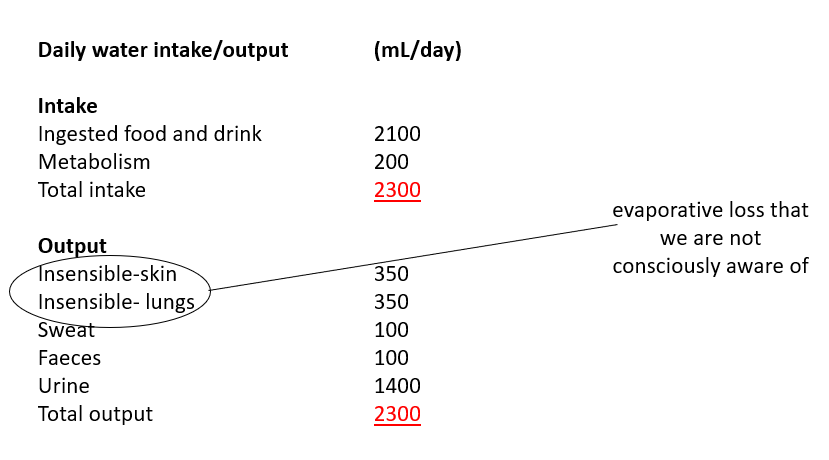
Daily water intake/output (mL/day):
Intake:
Ingested food and drink: 2100 mL
Metabolic water: 200 mL
Total intake: 2300 mL
Output:
Insensible losses (skin): 350 mL
Insensible losses (lungs): 350 mL
Sweat: 100 mL
Faeces: 100 mL
Urine: 1400 mL
Total output: 2300 mL
capillary membrane is permeable
The cell membrane is partially permeable
Intake and output need to be balanced
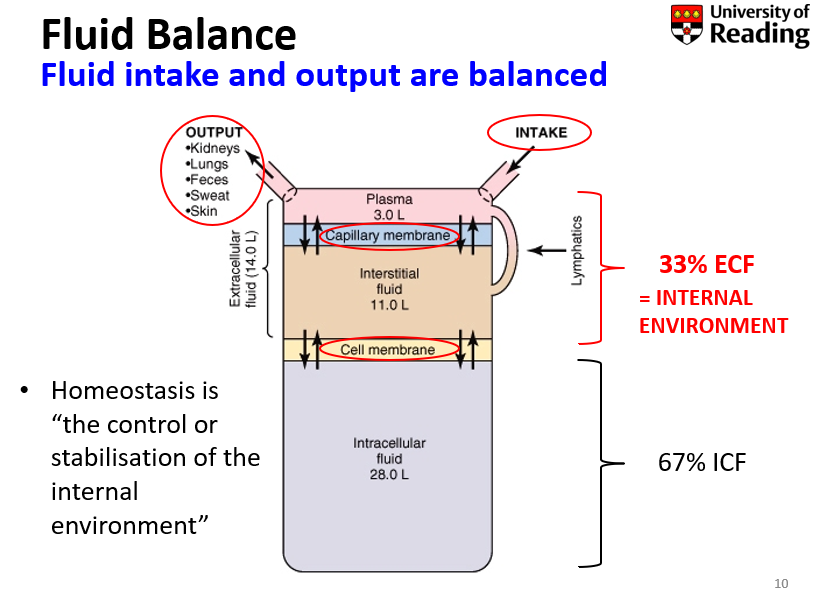
intake and output should be balanced
Inseparabe
insensible loss is the loss of water we are not consciously aware of.
e.g. in the lungs when talking or breathing & skin when sweating.
the water in our feases dependes on gut
Introduction to Biochemistry
To understand anatomy and physiology, an understanding of biochemistry (the chemistry of life) is necessary:
All matter is built of atoms.
Atoms combine to make molecules, such as H2O, O2, C6H12O6, NaCl.
Atoms interact through different types of bonds.
Atomic Structure
All matter consists of atoms.
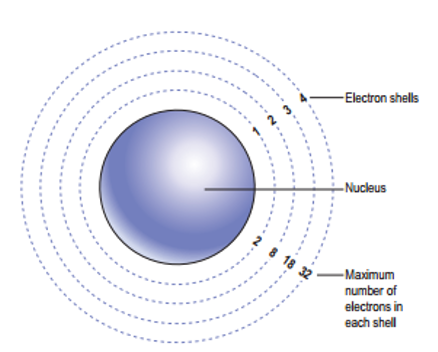
Atoms contain a central nucleus with protons and neutrons, surrounded by orbiting electrons (in layers or shells).
Atoms carry an equal number of protons and electrons, resulting in no net charge.
Electron shells represent energy levels, with each shell able to hold a different number of electrons.
Incomplete shells lead to interactions with other atoms, allowing them to donate, receive, or share electrons to achieve stability.
Definition of Elements
An element contains only one type of atom.
There are 92 naturally occurring elements.
The defining characteristic of an element is the number of protons it contains, referred to as its atomic number.
Atomic weight is calculated as the sum of protons and neutrons in the nucleus.
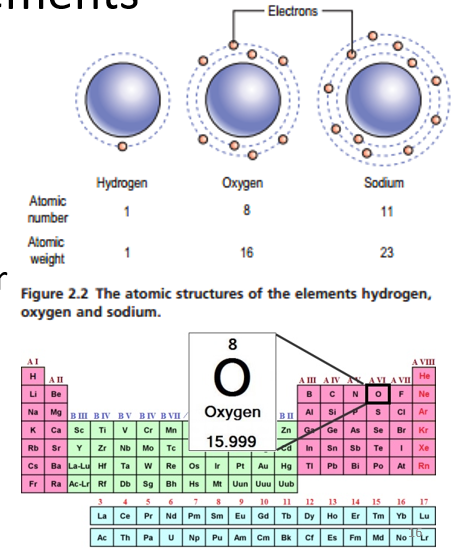
Molecules
A compound contains two or more types of atoms.
A molecule contains two or more atoms that are chemically combined (can be the same or different types of atoms).
Most compounds in living tissue are made up of carbon, hydrogen, oxygen, and nitrogen, with small amounts of sodium, potassium, calcium, and phosphorus.
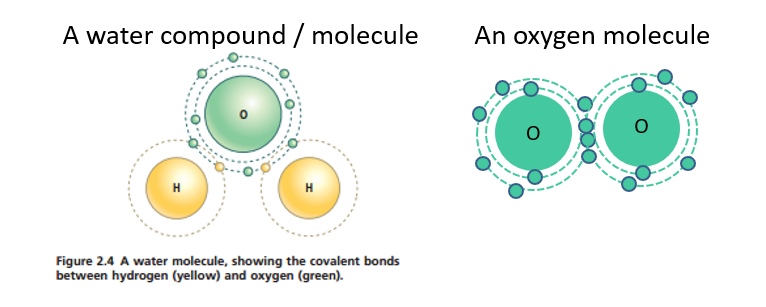
Types of Bonds
Covalent Bonds:
Bonds formed by sharing electrons.
Strong and stable bond.
Examples include H2O, O2, C6H12O6.
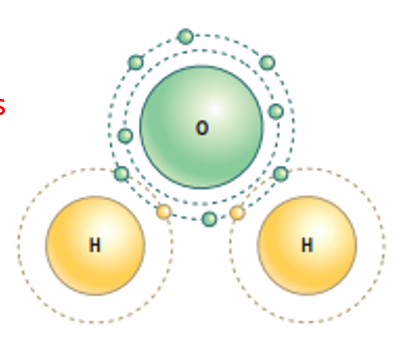
Hydrogen has 1 electron but needs 2, Oxygen has 6 in there outer shell but needs 2 more so they share
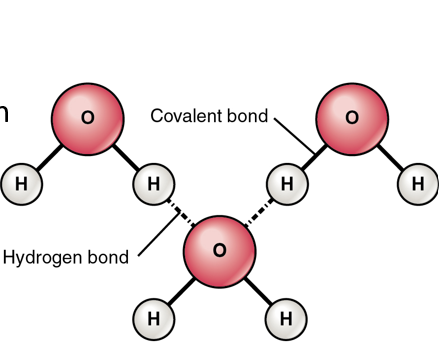
Hydrogen Bonds:
An attractive force between hydrogen attached to an electronegative atom of one molecule and an electronegative atom of another molecule.
Commonly forms between water molecules.
Ionic Bonds:
Formed by the donation or reception of electrons.
Weaker and more unstable bond.
Results in charged atoms known as ions, e.g., NaCl.
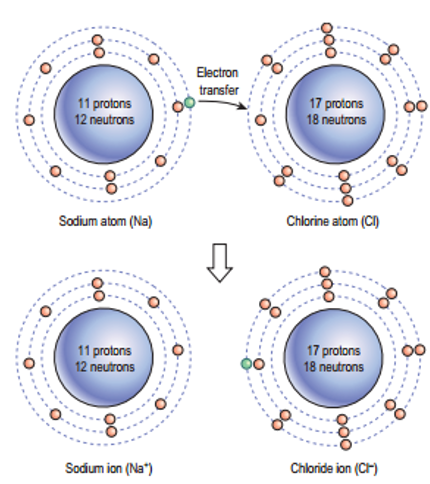
Electrolytes
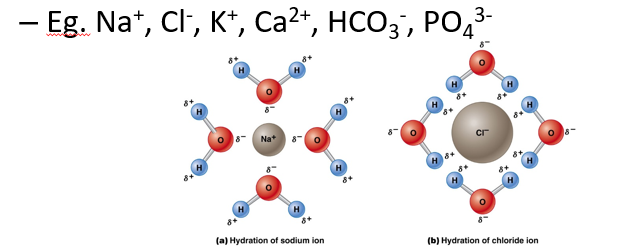
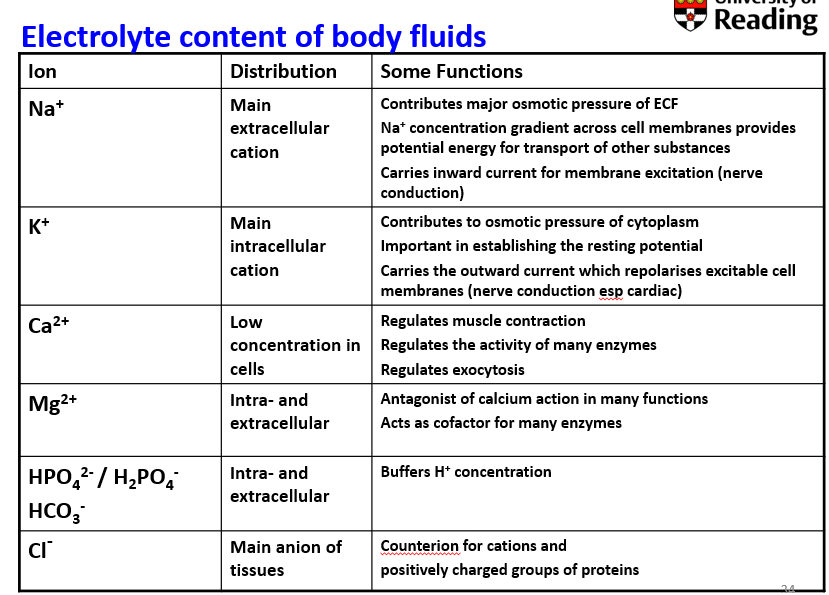
Electrolytes are ionic compounds dissolved in water, including ions such as Na+, Cl-, K+, Ca2+, HCO3-, and PO43-.
Importance of electrolytes:
Conduct electricity, essential for muscle and nerve function.
Help maintain osmotic pressure (keeping fluids in their respective compartments).
Act as buffers, resisting pH changes in body fluids.
Functions of Water
Water is crucial for living organisms as it serves several important functions, including:
Temperature Regulation: Evaporation from skin and lungs helps regulate body temperature.
Protective Cushion: Acts as a cushion in amniotic fluid and cerebrospinal fluid (CSF).
Lubrication: Provides lubrication through synovial fluid.
Reactant in Chemical Reactions: Participates in hydrolysis reactions (e.g., starch breakdown).
Solvent: Dissolves solutes such as salts (ions) and nutrients.
Transport Medium: Facilitates the delivery of nutrients and removal of waste via plasma.
Properties of Water
Water is a charged dipole;
The unequal sharing of electrons between hydrogen and oxygen results in a molecule with a positive and a negative end, allowing it to disrupt ionic bonds and form hydration shells around electrolytes.
The ability to form hydrogen bonds accounts for many of water's unique properties, such as:
High boiling point - buffers changes in heat
High specific heat capacity - stable internal environment
High latent heat of evaporation - buffers changed in heat, e.g. vaperisation.
High surface tension. - small animals and sticky.
High Heat Capacity:
Water can absorb and release significant quantities of heat without substantial temperature changes, leading to a slow temperature fluctuation in the body despite environmental changes.
Constituents of Body Fluids
Electrolytes: Charged ions in water (e.g., Na+, K+, Ca2+, Cl-, proteins = colloids negatively charged at neutral pH in solution).
Non-electrolytes: Uncharged substances (e.g., glucose).
Note: Blood cells do not dissolve in body fluids and are not considered part of body fluid constituents. They are carried
Electrolyte Content of Body Fluids
Plasma, Interstitial, and Intracellular Ion Concentrations (mOsmol/L)
In the plasma, there are similar concs of Na+ in plasma is similar to that in the interstital fluid. this is because the capiliary wallls are permerable (expect proteins)
so there is more protein in the plasma
Intercelleur fluid is different to intercellularrence to both of theses as there is a plasma membrane this is because it has select permerability due to channels (strict regulator)
The correction co-efficient to added to each substance when adding up the total.
the total volumes of all the fuilds there is a balance this is important as it effects the osmotic pressure.
e.g. interstital fuid and intracellular fluid both have the same osmolatrity is the same. this is ismo-osmotic. = balanced
Ion | Plasma | Interstitial Fluid | Intracellular Fluid |
|---|---|---|---|
Na+ | 142 | 139 | 14 |
K+ | 4.2 | 4.0 | 140 |
Ca2+ | 1.3 | 1.2 | 0 |
Cl- | 106 | 108 | 4 |
HCO3- | 24 | 28.3 | 10 |
Phosphate ions | 2 | 2 | 11 |
Creatinine | 0 | 0 | 45 |
Carnosine | 0 | 0 | 14 |
Amino Acids | 2 | 2 | 8 |
Creatine | 0.2 | 0.2 | 9 |
Lactate | 1.2 | 1.2 | 1.5 |
ATP | 0 | 0 | 5 |
Hexose monophosphate | 0 | 0 | 3.7 |
Glucose | 5.6 | 5.6 | 0 |
Protein | 1.2 | 0.2 | 4 |
Urea | 4 | 4 | 4 |
Others | 4.8 | 3.9 | 10 |
Total mOsm/L | 299.8 | 300.8 | 301.2 |
Osmotic pressure (mmHg) | 5441 | 5423 | 5423 |
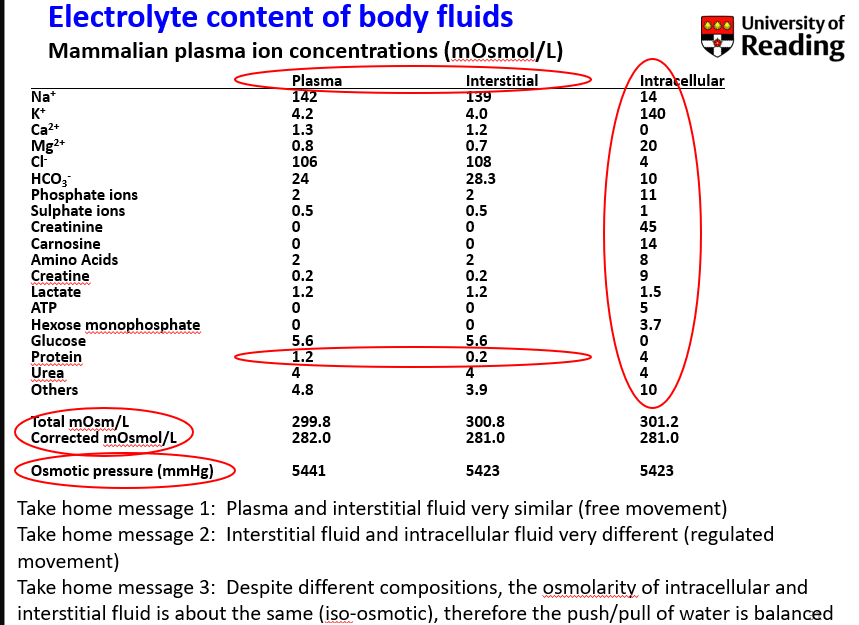
Take Home Messages:
Plasma and interstitial fluid are very similar (allowing free movement).
Interstitial fluid and intracellular fluid are very different (regulated movement).
Despite differences in composition, osmolarity of intracellular and interstitial fluid is about the same (iso-osmotic), balancing the movement of water.
Functions of Electrolytes
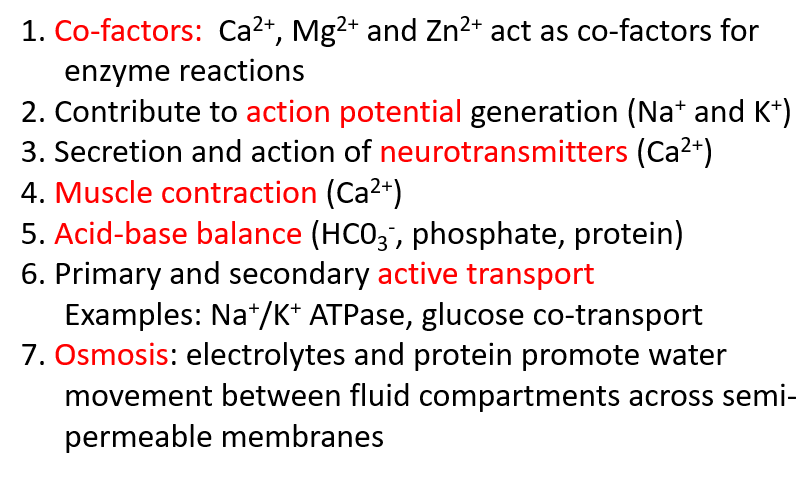
Co-factors: Ca2+, Mg2+, and Zn2+ act as co-factors for enzyme reactions.
Action Potential Generation: Contributes to the generation of action potentials (Na+ and K+).
Neurotransmitter Action: Secretion and action of neurotransmitters (Ca2+).
Muscle Contraction: Essential for muscle contraction (Ca2+).
Acid-base Balance: Important for maintaining acid-base balance (HCO3-, phosphate, protein).
Transport Mechanisms: Involved in primary and secondary active transport, e.g., Na+/K+ ATPase, glucose co-transport.
Osmosis: Electrolytes and proteins facilitate water movement between compartments across semi-permeable membranes.
Summary
Body fluids consist of water (solvent) and its dissolved substances (solutes).
There are three main compartments: plasma, interstitial fluid (extracellular fluid), and intracellular fluid.
Water has various properties that make it the primary substrate for living organisms.
Fluid intake and output must be balanced to maintain homeostasis.
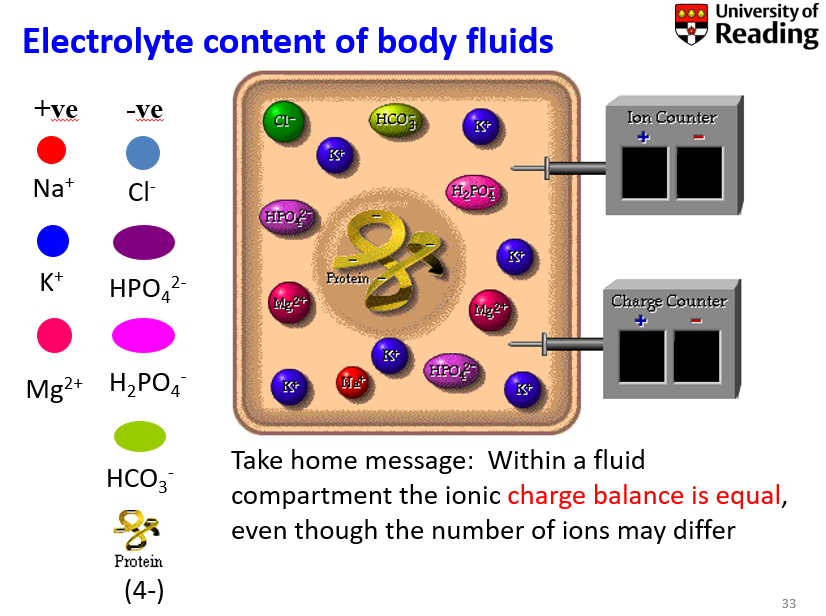
Within each body fluid, the positive and negative charges are balanced.
The concentration of electrolytes in the intracellular fluid is significantly different from that in the extracellular fluid.
Self-Study Recommendations
If the material was challenging:
Read the chapter on body fluids in any anatomy and physiology textbook.
Listen to the audio of the lecture again.
If the material was easy:
Engage in wider reading using PubMed: http://www.ncbi.nlm.nih.gov/pubmed.
Everyone should:
Prepare summary notes for exam revision.
Get ready for next week's lecture on the movement of substances across membranes.
Attendance Monitoring
Attendance monitoring for week 2.