***==TIME==***
**Aristotle On Time**
- concludes that there is no such thing as time.
- Either does not exist at all or barely in an obscured way.
- “One part of it has been and is not
- The other part is going to be and is not yet.
- What is made up of things which doesn’t exist have no share in reality
- All of its parts do not exist. It is not available.
Aristotle’s argument against the identification os time with motion
A. “the change or movement if each thing is only the thing which changes or where the thing itself moves or changes ma chance to be. But time is equally everywhere and with all things”
B. “Change is always faster or slower, where as time is not: for ‘fast’ and ‘slow’ are defined by time. ‘Fast’ is what moves much in a short time. “Slow” is what moves little in a long time: but time is not defined by time, by being either a certain amount or a certain kind of it. Clearly then it is not movement.”
OBJECTION: Psychologically, in love: time is fast. In tedium: time is slow.
Aristotle: could there be time without change? No. Because we would not notice time but for the fact that things change.
**TEMPORAL VACUUMS**
Temporal Vacuum: a time in which nothing happens.No change takes place.
LEIBNIZ’S Measurement argument AGAINST temporal vacua.
1. Periods of time are measured by changes
Therefor
2. Since by definition nothing happens in a temporal vacuum, there is no possible means of determining it’s length.
3. If there is no means of determining the length of a temporal interval, it has no specific length.
Therefor
4. There cannot be temporal vacuum.
LEIBNIZ’S sufficient reason argument against temporal vacua (a theological argument)
1. If there have been temporal vacua in the past, then there would have been time when change has resumed after a period of no change.
2. For every period of change that occurs at a given moment, there is always an explanation, in terms of an immediately preceding change of why it occured at precisely that moment and not at another.
Therefor
3. There is no explanation of why a change occurring immediately after a temporal vacuum occurred when it did. (Since no change immediately preceded it)
Therefore
4. There have been no temporal vacua in the past.
Essentially, if there is time when nothing happens, then “why did God create the universe at precisely that moment and no other?”
**RELATIONIST THEORY OF TIME**: time is an ordered series of events, each moment consisting of a collection of simultaneous event; roughly, time is a before, simultaneously with, an after.
**ABSOLUTIST THEORY OF TIME**: Time is independent of whether there is a change and thus the possibility of another vacuum.
==***POSSIBLE WORLDS***==
Do possibilities have any being?
*HOW DO YOU EXPLAIN NECESSITY?*
1. Un-give-up-able
2. Unable to be rationally rejected
3. Self-evident
4. Apriori
Identify the differences between something being possibly true, and necessarily true.
Possible worlds are useful for explaining the truth of modal statements.
Modal statement: “it is possible that…” “it is necessary that…”
Ways that things could have been and ways that things necessarily are.
**Armstrong on possible worlds**
*The combinatorial theory of possibility*
- think of all the worlds elements in the form of a grid
- Particulars on one axis, properties on another.
- Think of the grid spaces where certain property and a certain particular intersect as filled in with a check mark, indicating that that property was held by a particular. In this grid, knowledge is complete, and we can see all things that are. For any certain property, there are boxes checked and unchecked. An apple checks grids green, coloured, etc. It does not check “being human.”
OBJECTIONS TO ARMSTRONG'S ARGUMENT
- allows for too much to be possible.
- It’s not always able to deliver enough possibilities: because, the theory constructs possibilities out of recombinations of all the existing elements. But there may be more than there actually is.
SOLUTION: One could couple the grid theory with a fourth dimension which would give you all the particulars and all the properties there ever was an ever will be and leave them all for recombination. Even though the number of possibilities is huge, it is still finite and therefor valid and real.
==**ZENO PARADOXES***==
use of the *reductio ad absurdum*. (This the method of proving that a given statement is false, or very probably false, by showing that it logically implies something that is absurd, contradictory, unacceptable, too unlikely
The Achilles Paradox:
(Achilles and the tortoise have a race)
**The Dichotomy Paradox or the racecourse/stadium paradox:**
the problem is to explain how the runner can complete what appears to be an infinite series of tasks. The set-up of the paradox does not defeat the paradox.
Suppose [Atalanta](https://en.wikipedia.org/wiki/Atalanta "Atalanta") wishes to walk to the end of a path. Before she can get there, she must get halfway there. Before she can get halfway there, she must get a quarter of the way there. Before traveling a quarter, she must travel one-eighth; before an eighth, one-sixteenth; and so on.

The resulting sequence can be represented as:
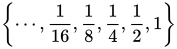
This description requires one to complete an infinite number of tasks, which Zeno maintains is an impossibility.[[14]](https://en.wikipedia.org/wiki/Zeno%27s_paradoxes#cite_note-14)
**The Dichotomy Paradox**: **The Regressive Version** of this
paradox. Never mind finishing the race. The runner cannot even get
started! Whereas the stress on the first version falls on the (seemingly)
impossibility of completing a super-task (an infinite series of tasks), the
stress on the inverted version is about the impossibility of mot
**Super-tasks and Thomson’s Lamp**:
Johns Notes:
A brief note on Aristotle’s “finitism”: his distinction between actual infinite (no such thing) and potential infinite (yes, you can notionally always divide something
further and further, or add something again and again): For the fact that the process of dividing never comes to an end ensures that this activity exists potentially, but not that the infinite exists separately.--Metaphysics, 9.6
For generally the infinite has this mode of existence: one thing is
always being taken after another, and each thing that is taken is
always finite, but always different.--Physics, 3.6
Presumably, an appeal to Aristotle’s distinction would disarm the Parts and
Wholes paradox—and maybe also the Achilles and the Racecourse
paradoxes.
What, however, if we asked Achilles to mark the various stages of his
journey, perhaps by sneezing when he reached the 100-years point,
again at 111 yards, and so on. Then the parts of his journey would
have more than a notional existence: they would, because marked out
in this … way, really exist. Would Aristotle not have to concede that in
this case Achilles could not overtake the tortoise, for he would have
had to sneeze an infinite number of times before he did so? –
Poidevin, Travels in Four Dimensions
… So what about Thomson’s lamp?
A confirmation of Aristotle’s finitism? The idea that such a contraption is
not a genuine possibility.
What else can we say about this thought-experiment?
**Supertask**: undertaking an infinite series of tasks in a finite amount of time,
Thomson’s Lamp thought-experiment purports to show that the very idea
of a supertask is logically incoherent and hence is not metaphysically
possible. Does this follow?
Assume L: The lamp can complete a supertask.
A. If L then [the lamp is both on and off at the end!]
B. But a lamp’s being off and on Hence, L is to be rejected. And more generally, so is the possibility of any and all supertasks.
We may question B. Even if we allow for B, maybe the final statre of the
lamp is outside the causal sequence, and thus whether it is off or on may
well be randomly determined. Notice, these objection does not show that
supertasks are possible, but only that Thomson’s argument for their
impossibility is found wanting.
Consider this example: A train is stationary. And then it begins to
move. At what point does it begin to move? Is there such a thing as the first
moment of motion? We might say, now that Zeno has forced this sort of paradox on us (minus the train, since there were no such things around for the pre-
Socratic): Maybe one way out of this paradox, which would have us
conclude that there’s no such thing as motion, is to say that motion cannot
be, after all, continuous, but is rather a series of granular, discrete,
“cinematic” positions of displacements. Ordinary beliefs about motion
notwithstanding, motion, “way down there”, is not smooth but “atomic” We
may extend this cinematic model of motion to change in general—change in
shape, color, temperature, pitch, brightness, volume, &c.
Consider also a case where no change takes place but where perfect
smoothness seems metaphysically ruled out: “Democritus’ c
***==TIMES ARROW==***
What might explain time’s intrinsic directedness?
We have three candidate explanations: thermodynamic, causal, and psychological.
CAUSAL:
process by which particles exchange energy is identical forward and backward in time
From Johns notes:
1) Causal relations are asymmetric: E1 causes E2, E2 does not cause E1
2) From this asymmetry arises—or just is—the temporal “before” (E1) and “after (E2); or indeed the temporal “past” (E1) and the temporal “future” (E2).
3) A is “before” B if and only if A is the cause (or among the causes) of B.
4) So, temporal precedence is defined in casual terms.
5) Why causal direction is more basic than the other explanatory candidates for time’s directedness—entropic directedness and psychological directedness. (First the perception, then the experience; first the experience, then the memory of that experience. That is, first the cause, and then the effect (experience, memory). Why no experiences of the future? Because (so we assume) there’s no such thing as “backward causation”. More on this in Part III.
6) But what about events that do not appear to be causally related at all? (A car accident in Sidney and a power failure in New Westminster, for instance.) Is the one event simultaneous with the other event? In which case, neither event pre-dates or post-dates the other. Or are the two events just completely unrelated, time-wise? (A strange position to take, no?)
a) One solution is to say that “E1 is before E2 if it is possible that E1 is among the
causes of E2.” But what is this “possible” business? It’s possible (unlikely, yes, but
possible) for the car crash to have been among the causes of a distant power
failure—and vice-versa. So, in this case, is E1 both before and after E2?
7) Some events are simultaneous with each other, obviously. So far, no problem. However, in some cases it seems that cause and effect are simultaneous—a box on a weight-scale, an engine’s turning and the train moving, a cat on a pillow and the indentation of the pillow. But are these cases really counter-examples of the causal relation of before/after? What about one billiard striking another billiard—the first with a momentum, the second with a zero-momentum? If cause and effect are simultaneous, then the momentum of the first billiard is both greater than zero and zero at the same time, which is a contradiction!
PSYCHOLOGICAL:
the representation of time to be generated by the oscillatory activity of cells in the upper cortex.
THERMODYNAMIC:
the definition of time has been introduced by introducing the irreversible thermodynamics into the analysis of the atomic irreversibility. In this way, time is defined by means of the entropy generation and the entropy rate.