Chapter 7: Alkyl Halides: Substitution and Elimination Reactions
Fundamentals of Substitution and Elimination Reactions
Alkyl halides possess a polarized bond where the electronegative halogen creates an electrophilic, partially positive () -carbon.
Reactions require a suitable leaving group, which is defined as the conjugate base of a strong acid; stability of the conjugate base correlates with leaving group ability ().


Two main reasons why alkyl halides undergo substitution and elimination reactions:
The halogen is electron-withdrawing, creating a partial positive charge on the adjacent carbon, making it susceptible to nucleophilic attack
The halogen acts as a leaving group, and for a substrate to undergo a substitution/elimination reaction, it must possess a good leaving group.
When the reagent can act as a nucleophile or a base, elimination and substitution will be competing reaction pathways.

Naming
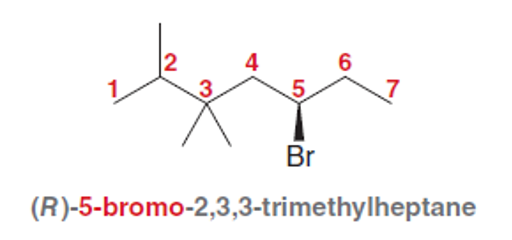
Alkyl halides are compounds where a carbon group (alkyl) is bonded to a halide (F, Cl, Br, or I).
Identify and name the parent chain.
Identify the name of the substituents.
Assign a number to each substituent.
Assemble the name alphabetically.
The halide group is the key substituent we will name and locate.

Greek letters are often used to label the carbons of the alkyl group attached to the halide

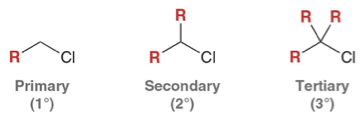
The amount of branching at the α carbon affects the reaction mechanism. There are three types of alkyl halides
Mechanism
An SN2 reaction is a concerted, single-step nucleophilic substitution.
A nucleophile attacks the electrophilic carbon from the backside (180° away from the leaving group)
leaving group departs and nucleophile takes its place
causes an inversion of stereochemistry
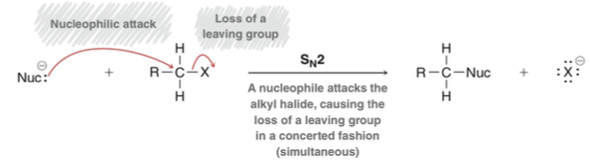
Mechanism and Kinetics: A concerted, bimolecular nucleophilic substitution proceeding through a single transition state; exhibits second-order kinetics:
Stereochemical Outcome: Proceed via backside attack, leading to an inversion of configuration at the -carbon (Walden inversion).
Front-side Attack Restriction: Repelled by high electron density and blocked by a destructive orbital node on the front lobe of the electrophile's LUMO.

Substrate Reactivity: Due to back side attack, steric hindrance at both and carbons lower reactivity:
Tertiary () substrates and neopentyl systems are unreactive via due to steric crowding.

Nucleophile and Solvent: Requires a strong nucleophile with negative charge and not a lot of steric hinderance (e.g., , , , , , , , ), is accelerated by polar solvents, and larger atoms are more polarizable and therefore better nucleophiles
The Mechanism
A strong base uses a lone pair to pluck a -hydrogen.
the electrons from the C-H bond move down to form a double bond between the carbon and carbon.
the leaving group leaves taking its bonding pair of electrons with it

Mechanism and Kinetics: A concerted, bimolecular -elimination occurring when a strong base abstracts a proton from a -carbon and it causes the formation of a causing the leaving group to depart; exhibits second-order kinetics:
Because of steric strain, cis isomers are generally less stable than trans.
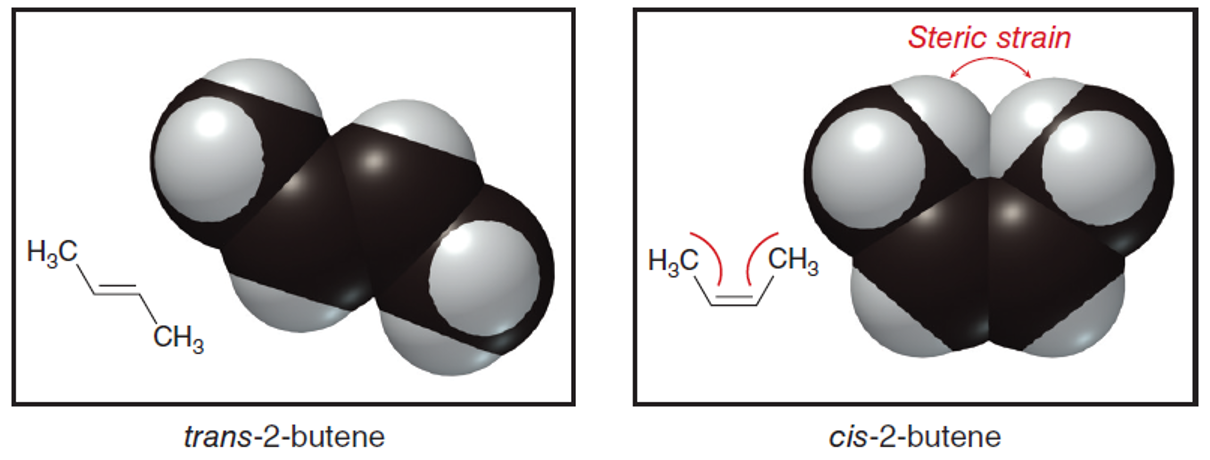
More substituted alkyl groups = more stable alkene
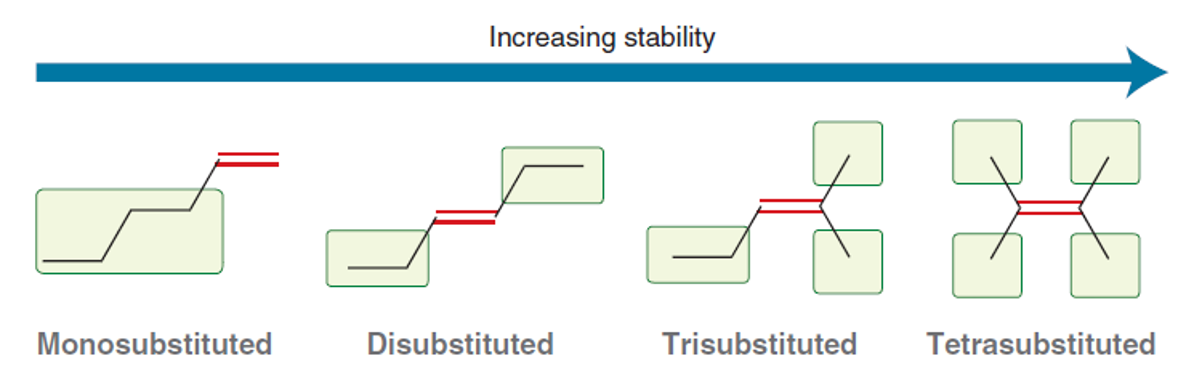
When constitutional isomers are formed as the products of a reaction, with one of them as the major product, the reaction is regioselective.

Zaitsev product: The double-bonded carbons have more groups attached to them.
Hofmann product: The double-bonded carbons have fewer groups attached to them.
Regiochemistry:
Smaller bases (e.g., , ) favor the Zaitsev product (the more substituted double bond, thermodynamically more stable alkene) because a small base can fit into tight spaces and remove a hydrogen from a more crowded secondary/tertiary β-carbon.
Sterically hindered, bulky bases (e.g., potassium tert-butoxide [ ], diisopropylamine, triethylamine) favor the Hofmann product (the less substituted double bond alkene) because it tends to grab a hydrogen that is easier to reach on a less crowded or primary β-carbon.
Small bases: major product = Zaitsev product, which is the more substituted and more stable alkene.
Small base can more easily remove a β-hydrogen from a crowded location forms more substituted double bond
Bulky bases: major product = Hofmann product, which is the less substituted and less stable alkene.
Bulky base tends to remove a more accessible β-hydrogen forms less substituted double bond
Stereospecificity and Periplanarity:
E2 requires an anti-periplanar geometry (dihedral angle , staggered arrangement) between the -hydrogen and the leaving group in the transition state.
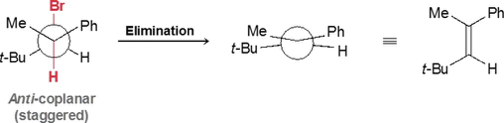
In cyclohexane rings, the leaving group and the -hydrogen must be trans-diaxial to undergo elimination. Leaving group must be axial position 180 degrees away from beta hydrogen

Because groups are naturally in the equatorial position (more stable), must be flipped to the axial position by ring flip.

In this case A would be more likely to undergo E2 reaction because Me is smaller and easier to flip than t-bu.
When the -carbon possesses two protons, the reaction is stereoselective, preferentially generating the more stable (generally trans or ) alkene isomer.
Unimolecular Reactions: and
Mechanism and Kinetics: Both processes begin with the ionization of the substrate to yield a carbocation intermediate; exhibit first-order kinetics:
Substrate Reactivity: Dependent on carbocation stability:
Primary () carbocations do not form; benzylic and allylic carbocations are resonance-stabilized exceptions that do form.
Carbocation intermediates can also undergo 1,2-hydride or 1,2-methide rearrangements to achieve greater stability.
SN1 Mechanism

Levaig
When the nucleophile is a neutral species, such as an alcohol, there will be a proton transfer after nucleophilic attack.
Stereochemistry: Generates a racemic mixture configuration at chiral carbons,
E1 Mechanism

Regiochemistry: Regioselective for the most stable, most substituted alkene (Zaitsev product); cannot be steered toward Hofmann products using bulky bases.
Conditions: Favored by weak nucleophiles/bases (e.g., , , ) and polar protic solvents that stabilize both carbocations and developing leaving-group anions via hydrogen bonding.
Predicting Reaction Pathways


Step 1 — Reagent Role:
Strong Base / Weak Nucleophile (DBU, DBN): across all substrates ().
Strong Base / Strong Nucleophile (, , ): major on ; major on and exclusive on .
Weak Base / Strong Nucleophile (, , , , , , ): on and ; on .
Weak Base / Weak Nucleophile (, ): No reaction on ; mixture of and on and . HEAT FAVORS E1 AS MAJOR PRODUCT
Step 2 — Substrate Analysis: Identify degree of substitution () and potential for steric hindrance.
Step 3 — Regiochemical & Stereochemical Dictates:
: Inversion of configuration.
: Anti-periplanar requirement; Zaitsev vs. Hofmann depending on base bulk.
: Racemic mixture: Inversion plus retention via planar carbocation (plus potential rearrangement).
: Most stable alkene isomer.
Sulfonates and Alcohols in Synthesis

Tosylates and triflates are excellent leaving groups. They are also quite large, and so we usually use abbreviations when drawing their structures (OTs and OTf).
Sulfonates are such good leaving groups because they are very stable (like halides, they are the conjugate bases of strong acids).

Sulfonates are made from the corresponding alcohol.

We are just strapping the “Ts” group to the oxygen of the alcohol… no change in the carbon atom bearing the OH group occurs.
Alcohols (not good leaving groups) good leaving groups

Backside Attack: The hydroxide ion OH- acts as a strong nucleophile. It approaches the terminal carbon from the exact opposite side (180°) of the leaving tosylate group.
Concerted Transition State: As the oxygen from the hydroxide begins forming a new C-OH bond, the bond between the carbon and the tosylate oxygen simultaneously weakens and breaks.
Expulsion of the Leaving Group: The tosylate anion leaves the molecule completely. It is an exceptional leaving group because its negative charge is stabilized by resonance across the sulfur-oxygen bonds.
Acid-Catalyzed Alcohol Reactions:
Primary () alcohols react with via an displacement on the protonated oxonium ion ().
Secondary () and tertiary () alcohols react with hydrogen halides () via an path involving carbocation intermediates.
Alcohols treated with concentrated sulfuric acid () and heat undergo dehydration to form alkenes via an pathway.
Retrosynthetic Strategy: Target bonds in ethers, esters, nitriles, and thiols are disconnected to identify appropriate nucleophile-electrophile pairs, ensuring the alkyl electrophile does not suffer from excessive steric hindrance during bond construction.
Protic vs Aprotic Solvents

Protic Solvents: OH or NH bonds
Aprotic Solvents: often have a carbonyl group or C=O, S=O, etc. They lack OH bonds

Protic Solvents
Hydrogen on the solvent will cover and stabilize the nucleophile, making it less reactive
Aprotic solvents
Nucleophiles are less stable, thus more reactive in aprotic solvent.
The activation energy will be lower and the reaction faster.
Overall:
For SN2/E2 rxns, a polar aprotic solvent is best.
Aprotic solvents raise the energy of the Nu-, which results in lower Ea and a faster SN2 reaction.
For SN1/E1 rxns, a polar protic solvent is best to stabilize carbocation intermediate
Protic solvents stabilize the carbocation intermediate, which results in lower Ea and a faster SN1 reaction.