Osmoregulation
Helps the animal not dry out or dying b/c of own excrement or swelling too much
All waste affects the osmotic gradient
Balancing Water Levels
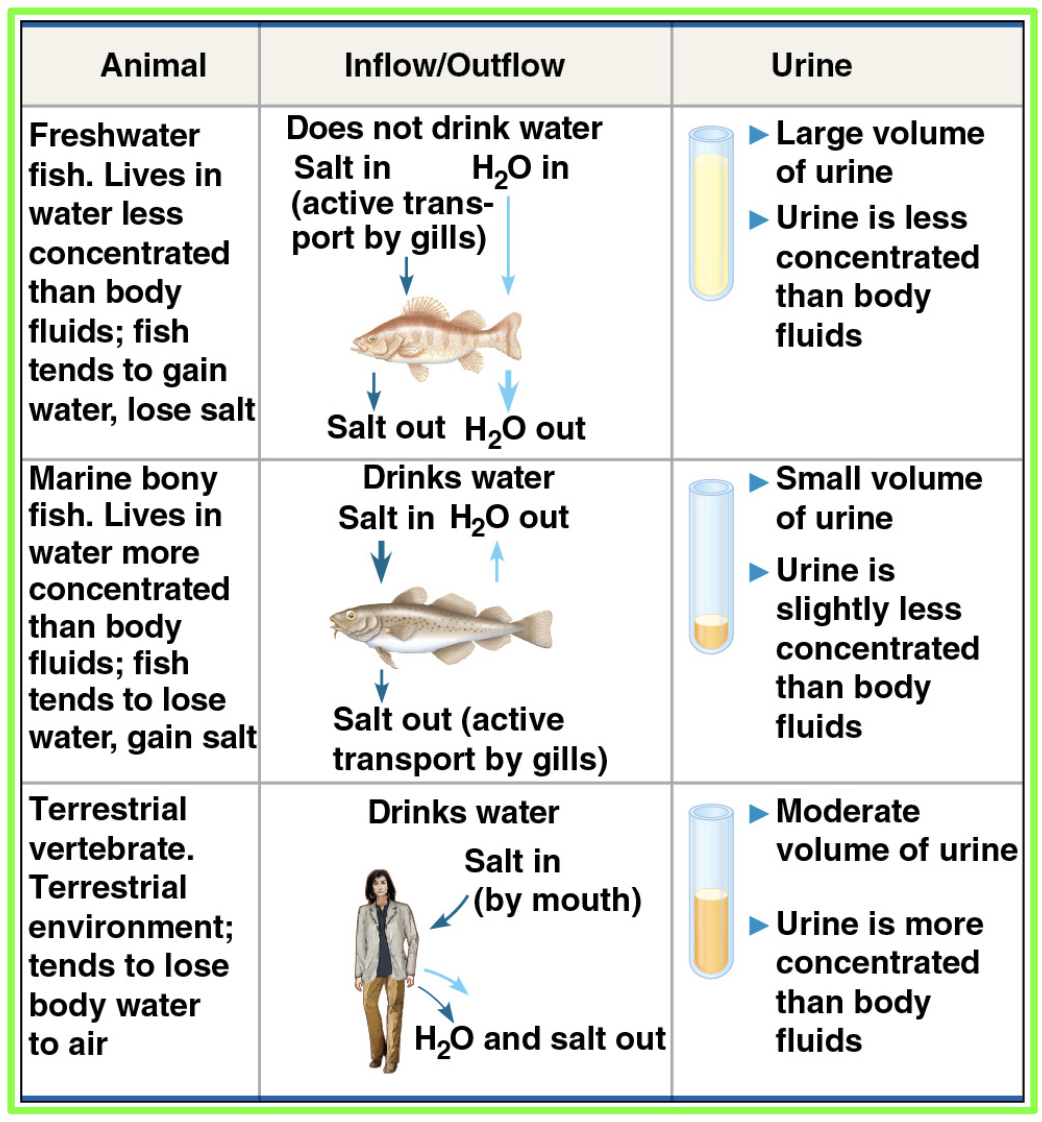
Osmoconformers = isoosmotic w/ the environment
don’t gain or lose water
match inside environment w/ outside
need stable environments→ restricted to 1 type of environment
mainly marine invertebrates
Osmoregulator = osmolarity of body differs from environment
in hyperosmotic→ lose water
in hypoosmotic→ gain water
higher energy cost but more environmental freedom
found in terrestrial, freshwater, and marine environments
Nitrogenous Waste
breakdown of proteins and nucleic acids produces nitrogenous waste
has to be dissolved in water to be excreted→ more waste = more water needed
Endotherms eat more food than ectotherms→ generate more nitrogenous waste
Carnivores » Omnivores and Herbivores b/c higher protein diets, others eat more carbs and fat
different species produce diff forms of Nitrogenous waste b/c of different evolutionary history and osmotic environment, forms differ based on toxicity and water required
3 Types:
Ammonia- requires high volume of freshwater to dilute b/c very toxic→ can’t stay in body
secreted by freshwater fish, juvenile amphibians, and some invertebrates
very water soluble
constantly excrete across body, NH3 in urine
Excrete via gills, exchange for sodium ions
Urea- less toxic than ammonia, less concentrated than uric acid
secreted by mammals, adult amphibians, sharks, some bony fishes, and turtles
amphibians switch strategies from ammonia to this (urea is kinda like a middle strategy)
can be stored in body b/c less toxic
higher concentration than ammonia→ less water needed
converted from ammonia in liver→ energetically costly
concentrated in kidneys to minimize water loss
flushed from body in urine (soluble)
Uric Acid- least toxic, but most energetically expensive to produce b/c most concentrated
secreted by reptiles (including birds), insects, land snails
not very water soluble→ excreted as semisolid→ very little water loss
common in animals that need to conserve more water
Anatomical Structures:
Large intestine
Kidneys + Bladder
Gills + Skin

Solid Waste Excretion in Humans
Large Intestine does most of the work
Colon reabsorbs liquids and prepares feces
Components:
Cecum - fermenting bacteria stored in herbivores
appendix- bank for
Liquid Waste:
reabsorb water + excrete nitrogenous waste
Components:
Nephron- basic unit of vertebrate excretory systems
human kidneys have a million of these→ process 180 L of filtrate per day→ less than 1 percent becomes urine, rest is reabsorbed
interact with blood vessels along the way
blood enters the Bowman’s capsule via blood pressure in the afferent artery
Filtration occurs in the glomerulus based on size of molecules (blood plasma minus other stuff)
Cells and large proteins stay in the blood vessels
Salt, ions, nitrogenous wastes, glucose, amino acids, water, and drugs leave
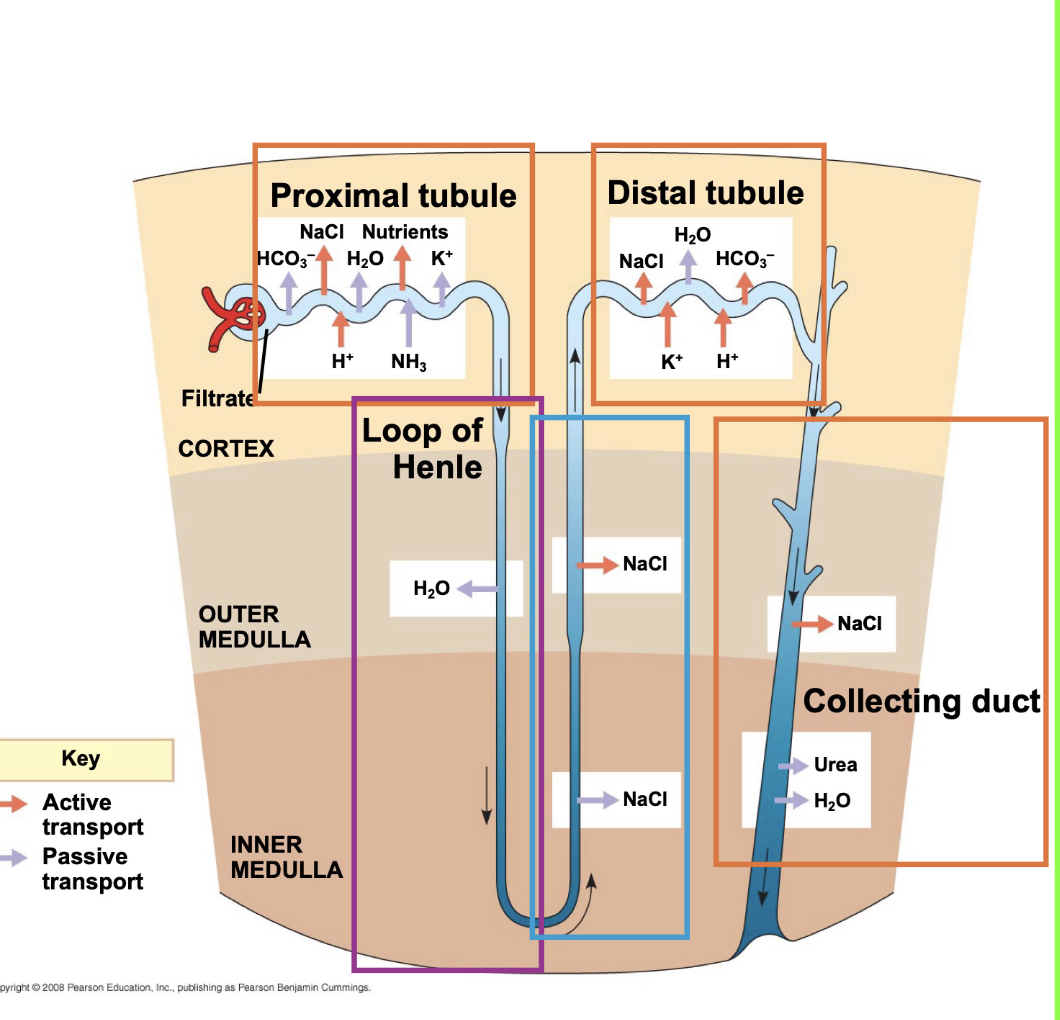
Loop of Henle sets up a concentration gradient to pull out urine in an energy efficient way
proximal tubule is where bulk reabsorption happens, ions transported out, reclaim most of water and nutrients
Descending Loop of Henle→medulla- region is permeable to water, not to salt→water leaves (reabsorbed)
Ascending the loop- permeable to salt, not water→ filters out salt, water left behind, makes filtrate more dilute, increases urine concentration and salt reabsorption
counter-current system
more reabsorption and secretion in the distal tubule
Collecting duct- last spot for reabsorption and secretion
controlled by hormones
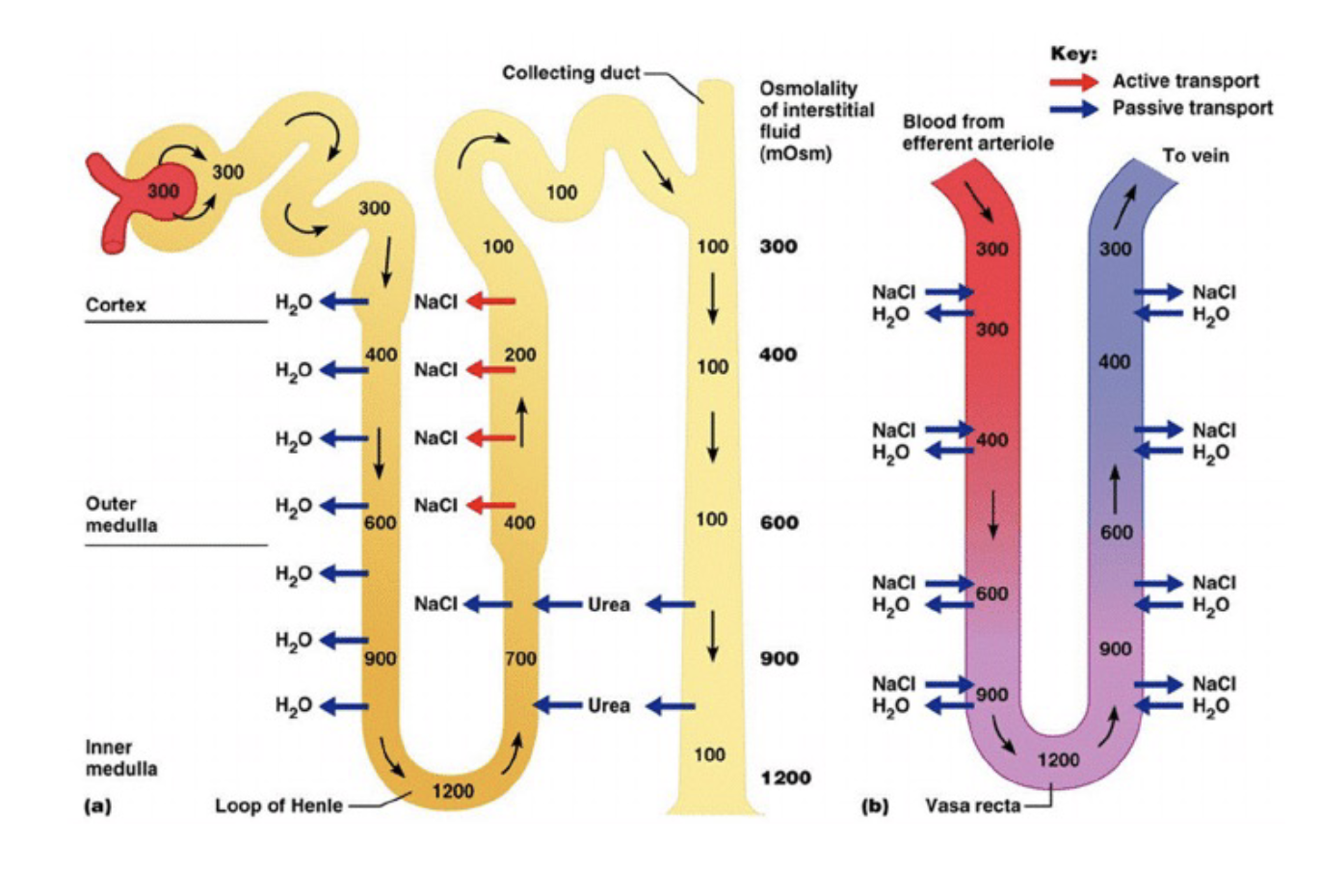
deeper into the medulla→ more ions pumped out→ requires more energy→ creates a gradient
Dehydration- losing water
blood becomes more concentrated, hypothalamus monitors this
increase in blood osmolarity→ hypothalamus signals pituitary gland→ Antidiuretic Hormone (ADH) released
increases number of aquaporins in walls of collecting duct→ more water reabsorbed→ less urine produced→ more concentrated
negative feedback loop
opposite happens when hydrated
Alcohol is an antagonist for ADH→ pee more→ dehydration
ADH acts in distal tubule and collecting duct
Low Blood Pressure
filtration rate decreases b/c less volume of filtrate pushed into nephron
Aldosterone secreted from adrenal gland→ increases Sodium ion absorption in collecting duct→ increased water reabsorption b/c water follows salt→ blood volume increases→ blood pressure increases
dehydration and low blood pressure have similar symptoms b/c of this
if both ADH and Aldosterone high→ blood pressure increases
Comparing Excretory Systems and Osmoregulation
Chondrichthyes- sharks, rays, chimeras
diff from other marine animals b/c raise internal osmolarity
retain urea in body fluids
water moves in by osmosis
rectal gland
instead of always drinking seawater, they absorb it?
match ocean using urea
Marine bony fishes (salt water)
drink sea water constantly→ replaces water lost by osmosis
get rid of excess salts using gills (main salt excretion organ)
Tissues hypoosmotic to environment→ lose water to hyperosmotic surroundings
Kidneys reabsorb ions and prevent excretion and water loss
Freshwater fishes- opposite problem
hyperosmotic tissues→ gain water from hypoosmotic environment
must excrete excess water to preserve salt levels
gills transport salt into body
kidneys lose some ions to enable water excretion
try not to drink water constantly b/c passively getting water all the time
Birds
independently evolved short loops of Henle
can’t concentrate urine as well as mammals
excrete concentrated uric acid instead of urea
Marine Reptiles (inc birds)
nasal gland removes excess salt, nostril excretes it
active transport of NaCl into tubule, out of blood
countercurrent exchange
Nonavian Reptiles
lack loops of Henle
can’t concentrate urine more than already have
produce mostly uric acid
still conserve water, reabsorb it later
Mammals
access to lots of freshwater→ short loops of Henle
Desert/marine mammals→ longer loops of Henle