PM154 Lecture 9 - Nervous System Part 1 & 2: Neuron & Electrochemical Signalling
Learning objectives
Define the role of the nervous system in human physiology.
Identify the functional divisions of the nervous system.
Describe the functions of the central, peripheral and autonomic systems.
Describe the functions of the main structures within the nervous system (brain, spinal cord, peripheral nerves)
Part 2: Neurons and electronic signalling
Neuron: the soma
Relatively large nucleus
Very high demand for protein synthesis
Many proteins packaged into vesicles and transported to axons
Some organelles are more abundant in the soma and others in distal portions of axons and dendrites
Neuron: dendrites
Number of dendrites present on a neuron varies
Neurons often display elaborate dendritic arbores (i.e. complex braching networks)
Can have spines - bumps that provide more surface area to relay electrical signals
Neuron: the axon
signal goes from axon → terminal - termed as retrograde
Neuron: axon terminals and synapses
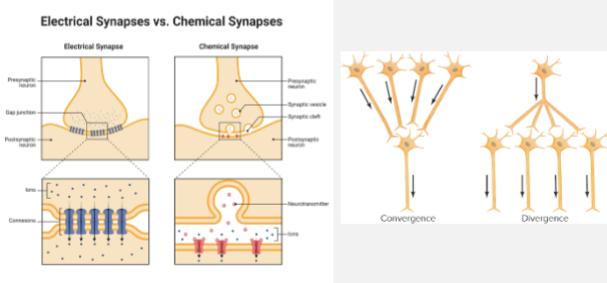
Neurons are not continuous; each cell is a separate unit and forms a very close contact association with other nerve cells.
The neuron sending the signal is referred to the presynaptic neuron
The neuron receiving the signal is referred to as the postsynaptic neuron
Lots of mitochondrion present for the energy needs of the nerve cells
Synaptic transmission
How do neurons conduct electricity?
Ion concentration gradients across the cell membrane
Voltage (electrical potential difference) across the membrane
Membrane permeability
The neuronal action potential
Transient reversal in the voltage across the axonal membrane
Instigated by rapid change in permeability to Na+ ions and the resulting influx of positive current
Terminated by K+ efflux and loss of positive current from the cell
Leak channel - always open
More potassium leaking out than sodium coming in