7a: Associative Learning
ASSOCIATIVE LEARNING
TYPES OF LEARNING
Classical Conditioning
Definition: Learning that stimulus X predicts outcome Y.
involuntary (reflexive)
e.g. flinching when you hear thunder
Operant Conditioning
Definition: Learning that doing X leads to outcome Y.
voluntary (intentional)
e.g. learning that workiing harder earns you a bonus
Erroneous Learning
Definition: Illusory correlations—‘learning’ that X and Y co-occur when they are actually random.
CLASSICAL CONDITIONING
Definition: Learning association between a stimulus and an outcome, leading to new behavior.
Notable Practitioner: Ivan Pavlov and his dogs.
Phases of Classical Conditioning
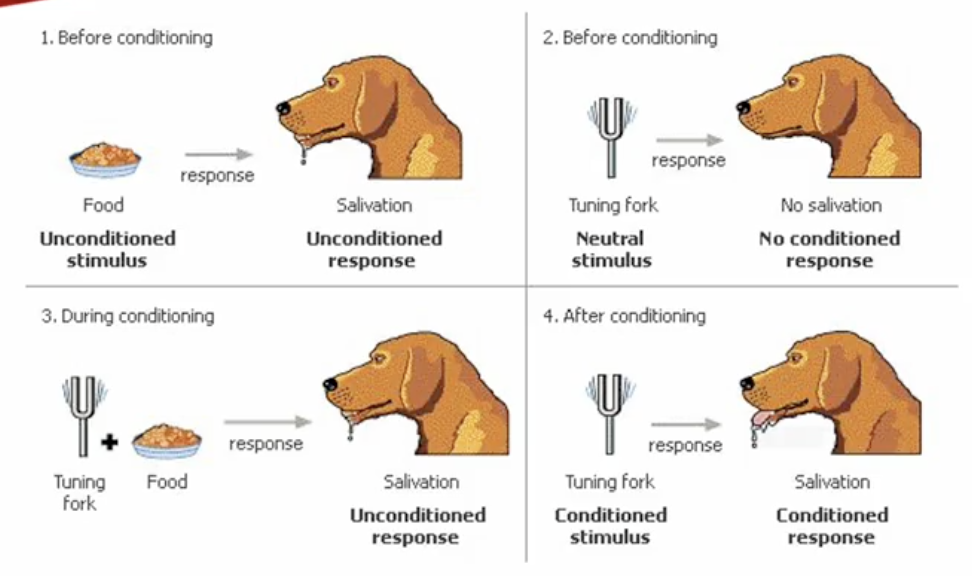
Before Conditioning
Food: Unconditioned Stimulus (US).
Salivation: Unconditioned Response (UR).
During Conditioning
Tuning Fork: Neutral Stimulus (NS).
Salivation: Response upon presentation of Food (US).
After Conditioning
Tuning Fork: Now a Conditioned Stimulus (CS).
Salivation: Conditioned Response (CR).
Key Terms in Classical Conditioning
Unconditioned Stimulus (US): A stimulus that naturally elicits a response prior to learning.
automatically encripted stimulus (the activation button)
Unconditioned Response (UR): The response elicited by the US.
automatically encripted response
Conditioned Stimulus (CS): A stimulus that did not initially elicit a response but does so after learning.
manually encripted stimulus (后加的 activation button)
Conditioned Response (CR): The response elicited by the CS after conditioning.
manually encripted response
Processes in Classical Conditioning
Acquisition: The process of learning the association between CS and US, resulting in the CR.
acquiring
the process
Latent Inhibition: Prior presentation of a CS alone can impair further conditioning.
a phenomenon in classical conditioning where an organism learns more slowly to associate a stimulus with a consequence after it has been repeatedly exposed to that stimulus on its own.
Extinction: The conditioned response is gradually eliminated by presenting the CS alone without the US.
Renewal: After extinction in one context, presenting the CS in a new context can reinstate the CR.
Stimulus Control in Classical Conditioning
Stimulus Generalisation: The CR is elicited by stimuli resembling the CS.
e.g. CS = bell, but also responds to chime and buzz
Stimulus Discrimination: The CR is not elicited by stimuli that do not resemble the CS.
e.g. CS = bell, and does not respond to chime and buzz
“Little Albert” Experiment (Watson & Rayner, 1920)
Overview: Focused on pairing a white rat (CS) with an aversive sound (US).
US: Aversive sound (e.g., loud noise).
UR: Fear response to the sound.
CS: White rat.
CR: Fear response to the white rat.
Results:
Albert learned to associate the white rat with fear, demonstrating a CR where none existed before.
Generalization: Albert began to fear other fluffy white objects, such as a Santa Claus mask.
Discrimination: He did not exhibit fear towards all objects with hair, only certain ones.
Thinking Exercise in Preparation for Lecture
How can phobias arise through classical conditioning?
How does modern behavioral therapy utilize extinction?
What strategies can effectively “undo” or extinguish Little Albert’s learned fear? What steps could prevent renewal?
OPERANT CONDITIONING
Definition: The association between behavior and its consequences, leading to increased or decreased behavior via rewards and punishments.
Key Figure: B.F. Skinner.
Key Concepts in Operant Conditioning
Reinforcement: Increases the frequency of a behavior.
Positive Reinforcement: Addition of a positive stimulus to increase behavior (e.g., praise for good behavior). (+)+(+)=+
Negative Reinforcement: Removal of a negative stimulus to increase behavior (e.g., taking a painkiller to alleviate headache). (+)-(-)=+
Punishment: Decreases the frequency of a behavior.
Positive Punishment: Addition of a negative stimulus to decrease behavior (e.g., parking fine for illegal parking). (-)+(-)=-
Negative Punishment: Removal of a positive stimulus to decrease behavior (e.g., removing a toy for bad behavior). (-)-(+)=-
Misunderstanding Reinforcement and Punishment
Clarification of negative reinforcement (NOT punishment).
Consequences aimed at decreasing behavior are a form of punishment.
Consequences aimed at increasing behavior are reinforcement.
Reinforcement Schedules
Continuous Reinforcement: Reinforcement occurs every time the behavior is performed—results in quicker learning but less robustness (strong and healthy).
behaviour is rewarded every single time it happens
learns quickly
behaviour is easily lost if reward stops
Partial Reinforcement: Reinforcement occurs only occasionally—results in slower learning but more robustness.
rewarded occasionally
slower learning
behaviour more stable and lasts longer
Types of Partial Reinforcement Schedules
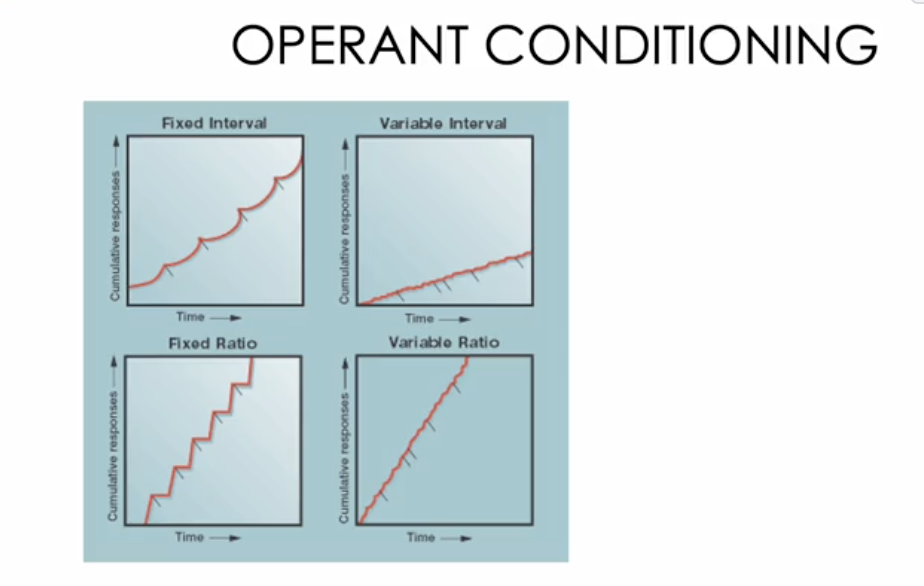
Fixed-Ratio Schedule: Reinforcement after a fixed number of responses (e.g., rewarding oneself after studying two lectures).
reward after 2 lectures watched
Fixed-Interval Schedule: Reinforcement after a specific amount of time (e.g., rewarding oneself with a break after one hour).
reward after 1hour lecture watched
Variable-Ratio Schedule: Reinforcement after an unpredictable number of responses (e.g., gambling).
reward after a varied amount of actions
Variable-Interval Schedule: Reinforcement after unpredictable time intervals.
reward after a varied amount of time
Graphs of Cumulative Responses
Illustrate different reinforcement schedules' effects (fixed vs. variable ratios and intervals).
Reinforcers: Strength and Origin
Factors that determine effective reinforcers depend on the organism.
Premack Principle: Higher probability behaviors can reinforce lower probability behaviors.
If behavior A is less likely and behavior B is more likely,
then access to B can reinforce A.
you can have ice cream after you finish your homework
Types of Reinforcers:
Primary Reinforcers: Essential for survival (e.g., food, water). the actual goods
Secondary Reinforcers: Conditioned to be associated with primary reinforcers (e.g., money).
reinforcers that become rewarding through experience by being associated with primary reinforcer
e.g. money, praise (linked to social approval or affection), grades (linked to future opportunities)
the currency
Thinking Exercise in Preparation for Lecture
What schedule of reinforcement would best increase studying behavior and why?
ERRONEOUS LEARNING
Definition: The propensity of the human brain to pick up on associations can lead to misconceptions about the relationship between events (illusory correlations).
Illusory Correlations: Misinterpretation of random variation as systematic.
Examples of Erroneous Learning
Coin flip example:
HHHHHH vs. TTTTTT vs. THTHTH: People might incorrectly assume a pattern or cause.
Superstitious behaviors and projective tests (e.g., Rorschach blots).
Explanation of Misperception
Normal fluctuations in random events can mislead people to conclude unvalidated causal relationships, especially when interpreting personal experiences (e.g., familial structures).
Cognitive mechanisms predispose (incline) individuals to see patterns even within randomness, leading to sustained erroneous beliefs.
Risks of Illusory Correlations
Cognitive biases and their implications include the perpetuation (the continuation or preservation of a situation/idea) of superstitions and mistaken reasoning.
Strategies to mitigate (make something less severe, serious) this include education on randomness and scientific reasoning.
Thinking Exercise in Preparation for Lecture
What are the risks of forming illusory correlations?
risk because reinforce false associations that distor judgment and fuel stereotypes
undermines evidence based reasoning
Which strategies can protect against or help overcome illusory correlations?
promote statistical literacy
encourage critical reflection