AP Microeconomics Units 3 & 4
3.1 The Production Function
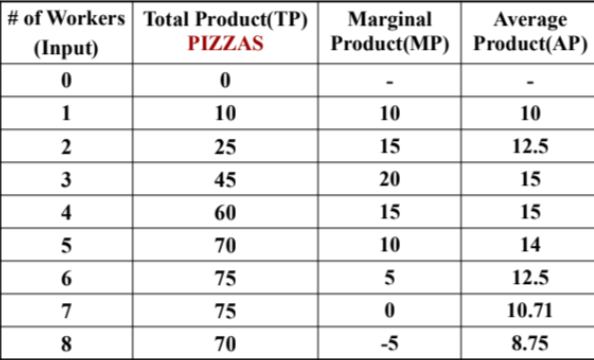
The Law of Diminishing Returns: As variable resources are added to fixed resources the additional output produced from each additional unit of the variable resource will eventually decrease.
3.2 Short-Run Production Costs
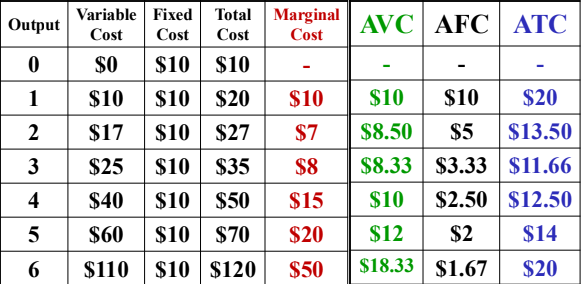
Fixed Costs (FC)- Cost for fixed resources that DON’T change with the amount produced
Variable Costs (VC)- Cost for variable resources that DO change as less or more is added
Total Cost (TC)- Sum of fixed variable costs
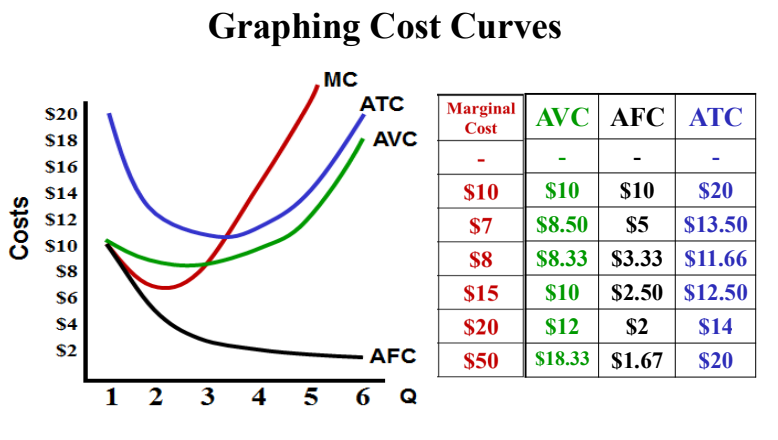
Marginal Costs (MC)- Additional costs of an additional output
3.3 Long-Run Production Costs
Economies of Scale- Long-run AC falls beccause mass production techniques are used
When do economies of scale? Firms that produce more can better use mass production techniques and specialization
3.4 Types of Profit
Accounting Profit- Accountants only look at explicit costs; payments paid by firms for using the resources of others
Economic Profit- Both explicit and implicit costs; opportunity costs that firms “pay” for for using their own resources
3.5 Profit Maximization
The goal of businesses is to maximize profit
To maximize profit frims must make the right output
Firms should continue to produce unti the additonal revenue from each new output equals the additional cost
MR=MC
3.7 Perfect Competiton
Characteristics:
Many firms
Identical products
No ads
Price Takers
Low barries to join
Allocative Efficiency- Markets use scarce resources to make products and provide the services that society demands
Productive Efficiency- A situation where firms or economies are producing goods and servicees at the lowest possible costs
Unit 4 Imperfect Competiton
Monolistic competition characteristics
Many firms
Differntiated products
Ads
Low barries
Price makers
Oligopolies
Few firms
Similar products
Ads
High barriers
Price makers
Monopolies
One firm dominates
Unique products
Price makers
Some ads
Price Makers
Why are monopolies inefficient?
Charge higher prices
Not allocative efficient
Not productively efficient