Long Term Memory
Definition (#f7aeae)
Important (#edcae9)
Extra (#fffe9d)
Long-term memory:
Responsible for storing information for long periods of time.
It is an “archive” of information about past events in our lives and knowledge we have learned.
It stretches from just a few moments ago to as far back as we can remember.
Main processes of memory: (3 common operations)
Stages in memory processing.
Encoding: Refers to how you transform a physical, sensory input into a representation that can be placed into memory.
Storage: Refers to how you store (keep) encoded information in memory.
Retrieval: Refers to how you gain access to information stored in memory.
Encoding into LTM storage:
Encoded semantically:
Participants learned a list of 60 words. The words were presented in random order. (categories were intermixed)
After participants heard the words, they were asked to use free recall to reproduce the list in any order they wished.
The investigator then analyzed the order of output of the recalled words.
Successive recalls from the same category did occur much more often than would be expected by chance occurrence.
Participants were remembering words by clustering them into categories.
Memory techniques:
Technique | Description |
Categorical clustering | Organize a list of items into categories |
Interactive images | Create interactive images that link the isolated words in a list |
Pegword system | Associate each new word with a word on a prev memorised list and form an interactive image between the 2 words |
Method of loci | Visualise walking around an area with distinctive landmarks that you know well and link the landmarks with specific items to be remembered |
Acronym | Devise a word or expression in which each of its letters stands for a certain other word |
Acrostic | Form a sentence rather than a word to help remember the new words |
Keyword system | Form an interactive image that links the sound and meaning of a foreign word with the sound and meaning of a familiar word |
Issue when transferring information from STM to LTM:
Interference:
Forgetting information due to competition with other memory information.
Proactive interference: Old information interfere with new information when we try to recall new information
Ex: Trying to remember your new address after moving out from your old address.
Retroactive interference: New information interfere with old information when we try to recall old information.
Ex: Forgetting the names of your old friends once you have new friends.
Decay: Forget information over time.
How can we retain information in LTM memory:
Rehearse: Through repetition.
Elaborative rehearsal: The individual elaborates on the items to be remembered.
Maintenance rehearsal: The individual simply repeats the items to be remembered.
The spacing effect: Ebbinghaus’s study.
Our memories tend to be good when we use distributed practice.
To maximize the effect on long-term recall, the spacing should ideally be distributed over months, rather than days or weeks.
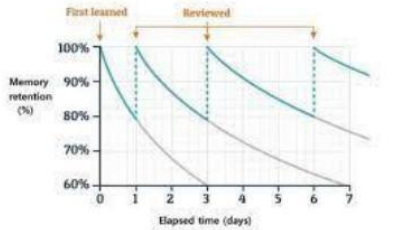
Sleep: REM sleep
Characterized by dreaming and increased brainwave activity.
Important for memory consolidation.
Disruptions in REM sleep patterns the night after learning reduced the amount of improvement on a visual discrimination task that occurred relative to normal sleep.
Insomnia: Negatively affects memory consolidation.

Patient HM:
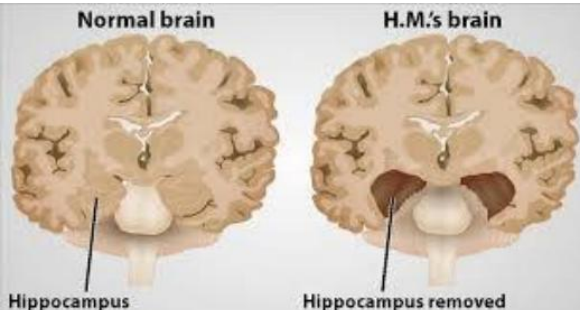
Injury: At age 7, Henry Molaison was knocked down by a bicycle, leading to minor seizures starting at age 10 and severe seizures by age 16.
Treatment: At age 27, in 1953, neurosurgeon William Scoville performed an experimental surgery to control his seizures, involving the bilateral removal of medial temporal lobe structures, including the hippocampus, amygdala, and parahippocampal gyrus.
Result: The surgery effectively controlled his epilepsy but caused severe anterograde amnesia.
Symptoms: H.M. could not form new long-term memories but retained his intellectual and perceptual functions.
He forgot events almost as soon as they occured, and despite being able to sustain attention and rehearse information short-term, he could not convert it into long-term memory.
Scientific impact:
Demonstrated that memory is a distinct cerebral function, separate from other cognitive abilities.
Identified the medial temporal lobe as critical for memory formation.
Established the existence of multiple memory systems, including declarative and procedural memory.
Highlighted the distinction between immediate (short-term) memory and long-term memory.
Role of the Hippocampus in LTM:
The hippocampus converts short-term memories into long-term memories.
The hippocampus is crucial for spatial memory, which helps in navigating and remembering locations.
The hippocampus is essential for forming declarative memories, which include facts and events.
Structures and functions:
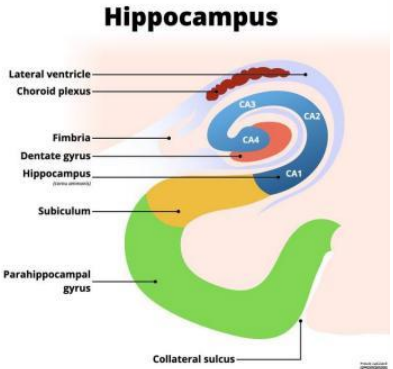
Overview:
Dentate Gyrus (DG):
Function: Plays a crucial role in the formation of new episodic memories and is involved in the process of neurogenesis (the formation of new neurons).
Role in Memory: Helps in pattern separation, allows the brain to distinguish between similar experiences or locations.
Cornu Ammonis (CA) Regions:
CA1 Function: Essential for the consolidation and retrieval of spatial and episodic memories.
CA2 Function: Less understood, but believed to be involved in social memory and recognition of social cues.
CA3 Function: Plays a vital role in the formation of long-term memories and spatial memory encoding.
Subiculum:
Function: Acts as the main output region of the hippocampus, transmitting processed information to various brain areas, including the neocortex.
Entorhinal Cortex:
Function: Serves as the main interface between the hippocampus and the neocortex.
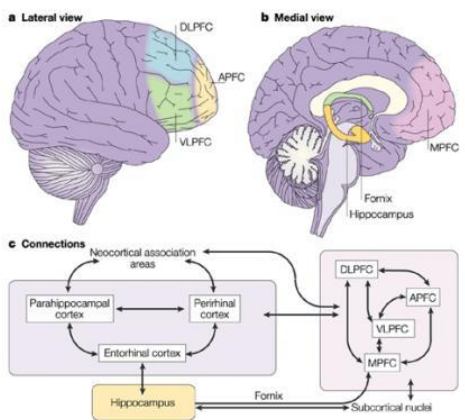
Prefrontal and medial temporal lobe interactions in LTM:
Interactions between the prefrontal cortex (PFC) and the medial temporal lobe (MTL) in the context of LTM.
MTL: Comprises the hippocampus and surrounding cortical areas.
PFC: Responsible for higher-order cognitive functions, such as planning, decision-making, and goal-directed behavior.
The PFC and MTL work together to support complex memory functions.
Examples:
Decision-Making: When making decisions based on past experiences, the PFC retrieves relevant memories from the MTL and integrates them with current goals and contexts.
Problem-Solving: During problem-solving, the PFC accesses stored knowledge from the MTL and uses it to generate solutions, demonstrating the interplay between stored information and current cognitive processes.
Latest research:
Memory networks: Collections of interconnected neurons responsible for storing and retrieving memories, are continuously reorganizing based on new experiences and environmental inputs.
This dynamic reorganization allows the brain to adapt to new information and maintain the accuracy and relevance of memories over time.
By reducing the number of neurons involved in a memory trace, the brain minimizes overlap between similar memories, which helps to prevent interference and confusion.
This selective refinement ensures that each memory remains distinct and accessible, improving overall memory clarity and retrieval.
Retrieval from LTM:
Sometimes can be difficult to retrieve information.
Due to availability and accessibility.
Availability: The presence of information stored in LTM.
Accessibility: The degree to which we can gain access to the available information.
Memory performance depends on the accessibility of the information to be remembered.
Memory researchers would like to assess the availability of information in memory. Unfortunately, they must settle for assessing the accessibility of such information.
Where is LTM stored:
The concept of long-term memory (LTM) has evolved over time.
In the 19th century, researchers began to recognize that there might be separate memory systems for short-term and long-term storage.
(Re)Constructive memory:
Autobiographical memory: The memory of an individual’s history.
Autobiographical memory is constructive.
One remembers one’s construction or reconstruction of what happened rather than exactly what happened.
People’s autobiographical memories are generally quite good.
1 way of studying autobiographical memory is through diary studies.
The eyewitness testimony paradigm:
Eyewitness testimonies are one of the least reliable and can lead to most wrongful convictions.
Strongest evidence comes from E. Loftus.
Loftus’s eyewitness testimony experiment and other experiments have shown people’s great susceptibility to distortion in eyewitness accounts.