Conservation of Mechanical Energy
Mechanical Energy
Energy acquired by objects upon which work is done
Ability to do work
Types of Mechanical Energy:
Potential Energy
Energy possessed by objects at rest
Types of Potential Energy:
Gravitational Potential Energy
Energy possessed by an object because of its location or position
Elastic Potential Energy
Energy stored in a stretched or compressed elastic material such as spring
Kinetic Energy
Energy possessed by an object by virtue of its motion
The sum of potential and kinetic energy is the total mechanical energy
Formulas:
Potential Energy
g = 9.8 m/s
Kinetic Energy
Mechanical Energy
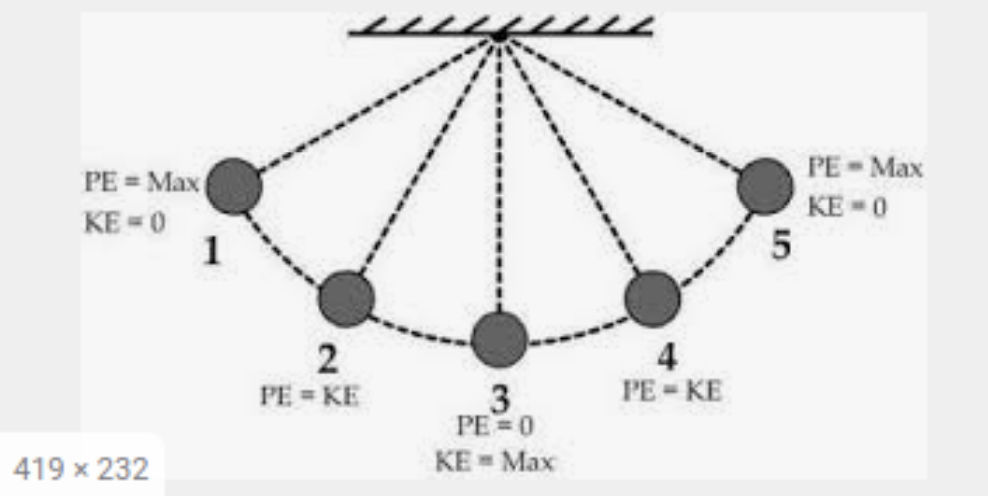
The Total PE is at its maximum due to its height or position. As the pendulum starts to move, the PE decreases while KE increases because of the change in position.
Half of the PE is lost and becomes KE. Then, PE is equal to KE.
The height of the pendulum is at its minimum, where PE is also at the minimum, while KE is at the maximum.
The reverse of #2 will happen.
The Total PE is at its maximum due to its height or position. As the pendulum starts to move, the PE decreases while KE increases because of the change in position.