Atoms, Compounds, and Chemical Bonding for the Principles of Bonding in Biosciences
Objectives of Lecture 2: Atoms, Compounds, and Chemical Bonding
Primary Questions to Answer:
Identify which interactions stabilise molecular structures in specific, three-dimensional shapes.
Determine how these interactions relate to physical and chemical properties.
Establish how to describe molecular structures correctly.
Learning Outcomes:
Describe atomic structure in terms of orbitals.
Compare electronic properties across different elements.
Sketch simple molecular orbital (MO) diagrams and assess resulting bonding interactions.
Compare and contrast different types of chemical bonds.
Explain how delocalisation stabilises molecular structures.
Terminology and Methodology:
The lectures center on core concepts applied to explain diverse chemical properties.
Students are expected to use chemistry-specific terminology to describe chemical ideas accurately.
Molecular Geometry Description:
Chemical Bonding: Determines how far apart two atoms are when bonded.
Bond Angles: Defines the relative position of atoms added to the system.
Dihedrals: Defines the configuration adopted by a fourth added atom.
Hierarchy: Chemical structure is based on chemical bonding, which is determined by constituent atoms.
Historical Perspective on Atomic and Molecular Theory
Robert Boyle (1661): Proposed matter as clusters of particles in "The Sceptical Chymist."
Amedeo Avogadro (1811): Stated that a certain number of atoms are united by attraction to form a single molecule.
Linus Pauling: Demonstrated that quantum mechanical descriptions of atoms allow for the deduction of the correct structure of molecules.
Fundamental Atomic Structure
Basic Building Blocks:
Nucleus: A small, positively charged core composed of protons and neutrons.
Electrons: Negatively charged particles surrounding the nucleus.
Stabilisation: Atoms are stabilised by interactions between positive (nucleus) and negative (electrons) particles.
Atomic Number: Fixed number of protons defining the element.
Mass Number / Isotopes: Variable number of neutrons within the same element.
Example (Helium): where 2 is the atomic number (protons) and 4 is the mass number (protons + neutrons).
Quantum Mechanical Picture of Electrons
Quantum Numbers: Each electron is described by four unique quantum numbers.
Pauli Exclusion Principle: No two electrons in an atom can have the same four quantum numbers; they must differ in at least one.
Principal Quantum Number ():
Describes the shell of the atom.
Roughly corresponds to the distance between the electron and the nucleus.
n starts from 1 and increases in integer steps ().
Azimuthal (Orbital Angular) Quantum Number ():
Defines the type of orbital an atom is in.
Ranges from to .
Electrons with the same reside in the same subshell.
Magnetic Quantum Number ():
Identifies the exact orbital within a subshell.
Ranges from to .
Number of orbitals per subshell is calculated as .
Spin Magnetic Quantum Number ():
Identifies the orientation of the spin angular momentum of each electron.
Can only be or (spin-up or spin-down).
Limits each orbital to a maximum of two electrons.
Atomic Orbitals
Definitions:
Orbitals are solutions to the Schrödinger equation, assuming independent electrons (a good approximation).
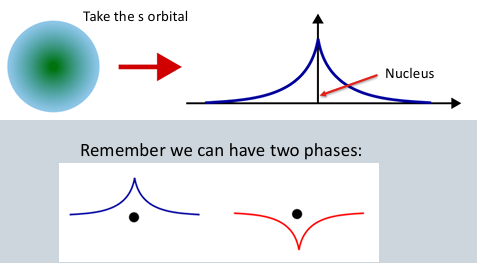
Wavefunction (psi): A function describing the behaviour of an electron as a quantum mechanical particle.
Probability Density: Calculated from the squared wavefunction; conventionally, plots show the surface containing of the probability density around the nucleus.
Orbital Types and Shapes:
s-orbitals (): "s" stands for sharp. These are spherical. There is only one s-orbital per subshell.
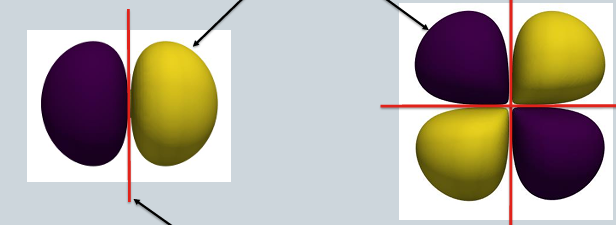
p-orbitals (): "p" stands for principal. These are shaped like dumbbells. There are three per subshell, oriented perpendicularly along the x, y, and z axes ().
d-orbitals (): "d" stands for diffuse. These have complex shapes and are perpendicular to each other. They play crucial roles in metal chemistry (e.g., ).
Key Features:
Orbital Lobes: Areas of high probability density for locating electrons.
Phases: Indicated by different colours indicate different phases of the wavefunction (negative or positive). Probability depends on the squared value, so signs do not affect location probability.
Nodal Planes: Areas with zero probability of locating an electron. These separate phases and are critical for molecular orbital formation.
Electron Configuration Principles
Energy Ordering of Subshells:
Aufbau Principle: Electrons fill orbitals starting from the lowest energy subshell.
n+l Rule:
Electrons first fill subshells with the lowest value.
If multiple subshells have the same value, the one with the lower is filled first.
Hund’s First Rule: Degenerate orbitals (orbitals with the same energy) are partially filled first with one electron each before pairing starts. This leads to spin-parallel conformations being the lowest in energy.
Configuration Examples:
Oxygen (O): 8 electrons = .
Magnesium (Mg): 12 electrons = , or shorthand .
Copper (Cu): 29 electrons = (Note the exception to standard filling rules).
Core and Valence Electrons
Core Electrons: Located in inner shells.
Valence Electrons: Located in the outermost shell. Atoms tend toward completely filled outer shells through bond formation.
Valency (IUPAC Definition): The maximum number of univalent atoms (originally hydrogen or chlorine atoms) that may combine with an atom of the element under consideration, or for which an atom of this element can be substituted.
Methane () Example: Carbon has four valence electrons and needs four more to fill its second shell. It forms four bonds with hydrogen to achieve this.
Periodic Table Trends
Covalent Radius: Defined as half the length of a symmetric, homonuclear element-element bond.
Atomic Radius Trend: Decreases across a period (left to right) and increases down a group (top to bottom).
Effective Nuclear Charge ():
The charge experienced by outermost electrons from the nucleus.
Inner core electrons shield effectively; electrons in the same shell shield each other poorly.
Trend: increases along periods.
Comparison of Carbon () and Oxygen ():
Carbon: 6 protons, configuration , radius , predicted .
Oxygen: 8 protons, configuration , radius , predicted .
Explanation: Oxygen has more protons pulling valence electrons in the same shell, and since electrons shield each other poorly, they are pulled closer to the nucleus.
Atomic Interactions Part I: Ionic Interactions
Electronegativity (x): The tendency of an atom to attract electrons shared with other atoms via chemical bonds. It is influenced by and the distance of valence electrons from the nucleus.
Classification based on difference in x:
> 1.7: Ionic bonding. One atom pulls shared electrons away entirely, forming ions (e.g., Sodium Chloride crystals).
< 0.7: Covalent bonding. Bond atoms attract the electrons at roughly even strength, electrons are shared evenly.
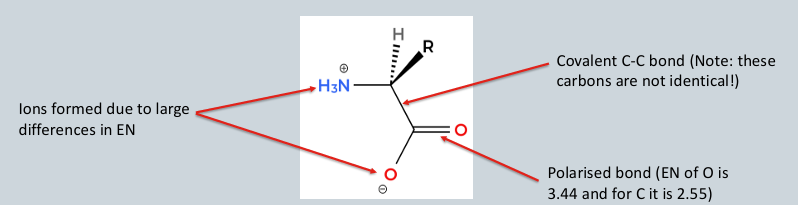
Intermediate differences (0.7 < \Delta\chi < 1.7): Polarised bonds. Electrons are shared, but there is a clear tendency toward one atom (e.g., bond, where and ).
Ionic Interactions in Biomolecules:
bonds formed due to large differences in EN, very stable bonds due to strength of charged interactions
Interactions between charged groups or ions in biomolecular systems.
Strong interactions, though not necessarily "pure" ionic bonds.
may occur alongside other interactions such as hydrogen bonding
similar interactions between charged and polarised groups
Described by Coulomb’s Law (strong distance dependence).
Example: Salt bridges.
Atomic Interactions Part II: Covalent Interactions and MO Theory
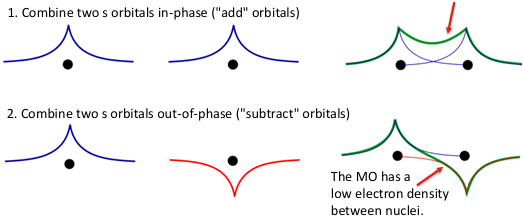
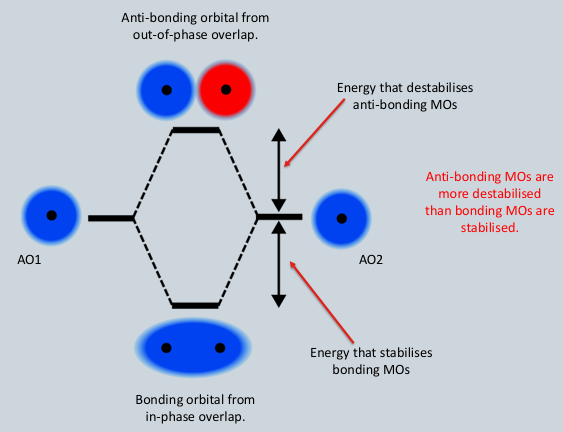
MOs (molecular orbitals): Can be seen as linear combinations of AOs, we can combine AOs either in phase or out of phase to form MOS. the number of MOs is always the same as the number of AOs combined (e.g. when combining 2 1s orbitals we obtain one bonding and one anti-bonding)
AOs (atomic orbitals): can form constructive overlap, if their symmetry allows for such overlap, the match in size and energy of AOs determines how strong the resulting bond is
LCAO (Linear Combination of Atomic Orbitals): Adding or subtracting atomic orbitals (AOs) to form molecular orbitals (MOs).
leads to in-phase and out-of-phase combinations, termed bonding and antibonding molecular orbitals
In-phase (Adding): Results in a bonding MO with higher electron density between nuclei and lower energy.
Out-of-phase (Subtracting): Results in an antibonding MO with low electron density between nuclei (nodal plane) and higher energy. Anti bonding more destabilised than bonding MOs.
Determinants for MO Formation:
Symmetry: Orbitals must have constructive overlap based on type and orientation.
AO Size Match: Atomic orbitals can overlap better (and hence produce lower energy MOs) if their size matches (e.g., overlap is better than )) Atomic orbitals that are smaller, overlap better, electron denstity is higher to the overlap is more efficient .
AO Energy Match: when interacting 2 atomic orbitals form one bonding and one antibonding MO. The bonding orbital is always lower in energy than the lower one of the two atomic orbitals.
the anti-bonding orbital is always higher than the higher of the two AOs.
the closer the 2 AOs are in energy, the stronger their interaction is

Orbital Symmetry types:
interactions between atoms are based on constructive in-phase overlap of atomic orbitals
these interactions effectively lower the energy of the electrons and bond the atoms together by shared electron density
only if orbitals can overlap constructively based on their symmetry, bonding occurs.
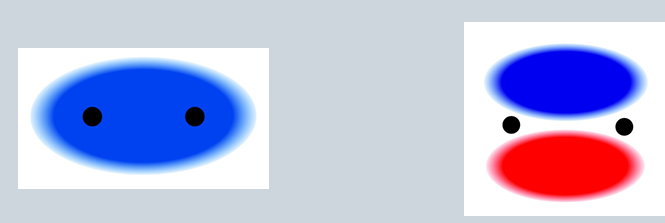
MOs: Head-on overlap between 2 AOs. Strongest bonds (single bonds). No nodal plane that coincides with the interatomic axis
MOs: Side-on overlap. Weaker than sigma bonds. Formed in double and triple bonds. They possess a nodal plane preserved from the AOs.
Constructing MO Diagrams
Process:
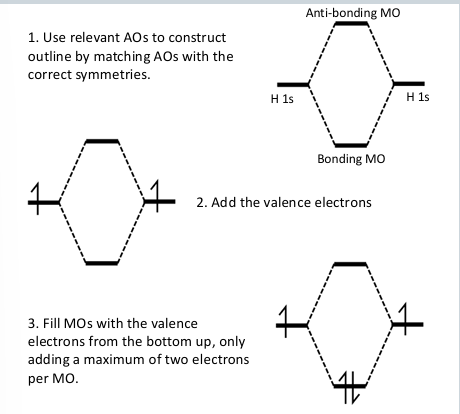
use relevant AOs and combine with correct symmetry to form bonding and anti-bonding MOs
add the valence electrons to the AOs
Fill MOs from low to high energy, for degenerate MOs, add one per orbital first
the bond order describes how significant bonding is = half the difference of the number of electrons in bonding and anti-bonding
Stability:
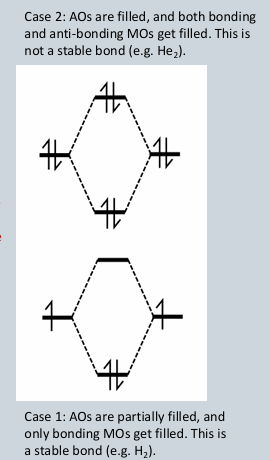
Stable if electrons fill bonding MOs (e.g., ).
Unstable if both bonding and antibonding (which are more destabilised than bonding are stabilised) are filled (e.g., ).
Bond Order: Calculated as half the difference between electrons in bonding MOs and antibonding MOs.
.
Polarised Bonds in MO Picture:
electrons in different atoms experience different effective charges (e.g. pulling forces), related to the reduced shielding between electrons in the same shell and subshell
different effective charges will change the energy of orbitals, the stronger the attraction between nucleus and electron, the lower is the energy of orbitals (e.g. orbitals in O will be lower than comparital orbitals in C)
Bonding MO is skewed toward the atom with lower energy AOs (higher ).
Resulting MO has larger electron density at that atom.
Example: In , Oxygen hybrids are lower in energy than Hydrogen , polarising the bond toward Oxygen.
MO explanation: energy of orbitals is based on effective charge, bonding MO resulting from 2 AOs with different energies will be more like the lower energy AO. The bonding Mo has a larger electron density at the corresponding atom → the bond is polarised towards this atom. Explains reactivity and geometry of bonds
EN: the difference in effective charge → electrons are pulled towards atoms at different strengths (EN). Difference in EN → shared electrons in bonds are pulled towards the bonded atoms at different strength = polarised bond. Allows fast identification of polarised bonds.
Lewis Structures and the Octet Rule
Octet Rule: chemical bonding for main group elements explained by atoms aiming to obtain the electron configuration of the nearest noble gas (e.g. filling their valence shell) achieved by sharing electrons with other atoms via bonding.
Duplet Rule: The exception for Hydrogen, which only needs 2 electrons.
Lewis Structure representation:
Bonds shown as lines.
lone electrons/pairs shown as dots.
Charges must be indicated.
Resonance Structures: Necessary when a single Lewis structure cannot uniquely define the molecule.
Delocalisation and Aromaticity
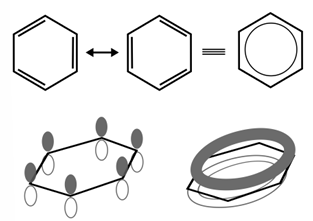
Delocalisation: Occurs when multiple orbitals can align and combine. Often occurs in -systems formed by aligned -orbitals.
Resonance structure: A set of structures showing the limits of a molecular structure that cant be shown as a single Lewis structure
COO- Group Example: Includes two bonds between and both atoms, all 3 have p-orbitals available for additional bonding, with 4 electrons remaining for the resulting MOs
3 AOs that can be combined, → 3MOs formed, a bonding, a non-bonding and an antibonding MO
non-bonding orbital describing the location of the charge, equally likely to be on either O. Bonding orbital where electrons are delocalised over all three atoms
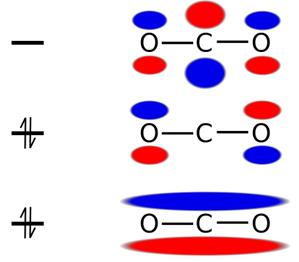
Conjugation: Alternating single and double bonds where double bonds interact to form large delocalised system of -electrons.
Aromaticity:
Requires one or more planar rings.
Must have a delocalised, conjugated -system.
Huckel Rule: Must contains -electrons.
Has enhanced chemical stability and form important scaffolds
Examples: Benzene, Paracetamol, Ibuprofen, Tyrosine (Tyr), Phenylalanine (Phe), Tryptophan (Trp), Nucleotides, Chlorophyll, Heme (Fe-prophyrin).
Benzene: 6-membered planar ring of C atoms where each atoms has a p-orbital perpendicular to the ring, forming a large pi-system
Spectroscopic Applications
Fluorescence Spectroscopy: Tryptophan’s indole group emits light upon de-excitation. Used to monitor protein folding and conformational changes and protein-ligand interactions (e.g., urea-induced unfolding).
UV-vis Spectroscopy: Conjugated aromatic systems absorb UV- light. Used to quantify protein concentration in a solution by measuring absorbance of aromatic amino acids via Beer’s Law:
Where is absorbance, is molar absorptivity, is concentration, and is path length.
Lecture Summary
Atomic orbitals are defined by four quantum numbers and hold up to two electrons.
differences lead to variations in electronegativity and size.
determines bond type: ionic, polar, or covalent.
MOs are linear combinations of AOs (bonding, non-bonding, or antibonding).
MO formation requires symmetry, size match, and energy match.
MO theory explains complex properties like bond conjugation and polarisation.