APES UNIT 4
Ecosystem ServicesIntrinsic Value: Ecosystems are valuable regardless of any benefit to humans 1. 1. Environmental regulations and protections should be driven by nature’s intrinsic worth.
Rooted in moral, philosophical, and/or ethical beliefs.
Instrumental Value: Ecosystems are valuable due to their worth as an instrument or tool that can be used to accomplish a goal.
1. These instrumental values are what we call ecosystem services.
4 categories of ecosystem services:
Provisioning: A benefit that can be extracted from nature.
Food
Clean drinking water
Timber
Medicinal plants
Raw materials for construction, etc
Cultural: A non-material benefit that contributes to the development and cultural advancement of people.
The role of ecosystems in local, national, and global cultures
Building and sharing of knowledge/ideas
Nature-based creativity
Recreation
Regulating: Ecosystem processes that regulate natural phenomena.
Bees pollinate wild and domesticated plants
Bacteria and fungi allow for decomposition
Aquatic plants provide water purification
Roots of plants prevent erosion
Trees store Carbon and aid in climate regulation
Supporting: Ecosystems themselves could not be sustained without the consistency of underlying natural processes.
Photosynthesis
Nutrient cycling (Carbon, Nitrogen, etc…)
The water cycle
Without supporting services, none of the other services would be able to exist!
Wetland Examples of ecosystem Services.
Retention, filtration and control of floodwater → Regulating
Long term storage of carbon [carbon sequestration] → Supporting
Production of natural wild rice beds → Provisioning
Provide opportunities for outdoor recreation → Cultural
The Value of Global ecosystems: Valued at over $30 trillion a year (1997)
Calulated by:
Replacement value (cost of man-made replacement of natural services/processes)
Property value impact of proximity to nature
Economic value of provisions (medicine, food, timber, etc)
Time or money people spent for services
Millenium ecosystem Assessment: Ecologists investigated 24 essential ecosystem services, including:
Food production
Pollination
Water purification
Nutrient cycling
Ecologists found that 15 of the 24 key services were declining rapidly, or being consumed unsustainably.
Preserving BiodiversityExtinction - the permanent elimination of a species.
E.O Wilson came up with HIPPOC, which summarized the modern drivers of extinction.
H: habitat destruction
I: invasive species
P: pollution
P: population growth (humans)
O: overharvesting
C: climate change
Extinction is a natural process! 99% of species before are extinct. The normal background rate of extinction is 1-5 species a year.
5 mass extinctions:
End Ordovician, 444 million years ago, 86% of all species
Late Devonian, 375 million years ago, 75% of all species
End Permian (“The Great Dying”), 251 million years ago, 96% of all species, at least
End Triassic, 200 million years ago, 80% of all species
End Cretaceous, 65 million years ago, 76% of all species (including the dinos)
Adaptive Radiation: The diversification of a group of organisms into forms filling different ecological niches.
We are possibly in the 6th mass extinctions. Drivers include:
Species extinction
Global Warming
Overpopulation
Pollution
Loss of Rainforests
Fossil Fuel Dependancy

Endangered Species Act (ESA): Seeks to identify all endangered species and populations have preserve as much biodiversity as possible. The focuses of the ESA include.
Protecting habitat to protect species
Keystone species
Indicator species
Umbrella species: require large, undisturbed areas - also benefits other species
Flagship species: “charismatic megafauna”
Major Conservation Trend 1: Since 1960, there has been a dramatic increase in the total area (km2) of protected land globally.

Major Conservation Trend 2: Biodiversity hotspots - A region with significant levels of biodiversity that is threatened by human habitation.
Increasingly, international protected areas are focusing on biodiversity hotspots.

Challenges to Modern Conservation
Conservation Challenge 1: Almost without exception, the more useful a biome is to humans the less likely it is to be protected.
Conservation Challenge 2: Habitat fragmentation is the process by which habitat loss divides large, continuous habitats into smaller, more isolated remnants.
This leads to loss of habitat connectivity and loss of gene flow (decreases genetic diversity)
Conservation Challenge 3: Edge Effect, Changes in population or community structure that occurs at the boundary of two habitats.
Small habitat fragments have A LOT of edge effects. The edge effects may extend throughout the entire habitat!
How do abiotic factors on the edge affect the biotic factors in the area?
The smaller the habitat patch, the more it is impacted by the edge effect!
Generally, try to connect patches the most, reducing the total perimeter of the area.
More Conservation Challenges:
ECONOMY!
Parks invite crowds, cars, and selfies.
Displacement of traditional cultures, people, economy, etc.
Demands of multiple users.
Approaches to Modern Conservation
Ecotourism: A sustainable way to bring income into an area that will keep the environment stable and bring in money to the local community. More sustainable and brings more income in then mining and logging.
Biosphere Reserves: Protected areas consisting of zones that very in the amount of human impact.
Core area
Buffer zone
Transition area (multiple-use area)
Wildlife Corridors: Links of wildlife habitat, generally native vegetation which joins two or more large area of similar wildlife habitat.
Corridors are critical for the maintenance of ecological processes including allowing for the movement of animals and the continuation of viable populations.
A good response to habitat fragmentation.


Problems with Agricultural Diversity
People don’t want to buy other products. People will buy off of looks, no one wants to eat a potato with curves or bumps.
Strong decrease in crop diversity.
More expensive to produce different crops, and inefficient.
Losing agricultural diversity means a greater risk for the global food system.

Metapopulation: A group of spatially distinct populations that are connected by occasional movements of individuals between them.
Without habitat corridors, metapopulation could experience inbreeding depression.
Inbreeding Depression: Occurs when individuals with similar genes (relatives) breed with each other and produce inbred offspring that have diminished survivorship.
Struggles with Islands:
3 unique impacts on Islands Biodiversity.
They are self-contained ecosystems.
They are disconnected from the mainland.
They often begin with many unclaimed niches.
The biodiversity of island habitats is governed by 3 primary “rules”:
Biodiversity decreases with distance from the mainland.
Biodiversity increases with the total size of the island.
Islands tend to have more specialists because of intense competition.
Islands are also extremely vulnerable to:
Invasive species (especially invasive generalists)
Habitat loss
Protecting Common Resources.
Tragedy of the Commons: A situation in which individuals with access to public resources ultimately deplete the resource.
Hardins Example: A farmer grazing 1 additional cow experienced a significant increase in personal wealth, but the environmental burden was shared by everyone in the community.

Textbook solutions to T.O.C:
Private Ownership - Private owners are much less likely to degrade resources that they have a long term personal interest maintaining.
Pros: Cons:
Government (Public) Ownership - Government ownership can control and/or limit the use of common resources like pasture, inland fish, forests, groundwater, etc.
Pros: Cons:
Government Regulation - Government regulation can set legal limits and require permits for the use of many common resources.
Pros: Cons:
Cooperative Ownership - Cooperatives are a hybrid of public and private ownership, where multiple owners or stakeholders jointly own a resource and share in the profits.
Pros: Cons:
Examples of T.O.C: Plastic pollution, air pollution, overgrazing, clearcut logging, urban sprawls, and overfishing.
Grazing
Ecology of Grazing:
Grazing large ungulates in grassland biomes can be environmentally beneficial or disastrous, depending on location, climate, scale, and technique.
Most grasslands and savannas evolved to support large herds of herbivores.
Overgrazing inn arid or semi-arid regions can lead to desertification.
Leads to extensive soil erosion.
Grassland biomes used to be able to support huge herds of grazing animals as they were some of the most productive biomes on Earth.
Grazing Cycle
Movement.
Beneficial impacts of grazers
Time for regeneration.
Grazing is an essential component of many major ecosystem types.
Large herds created rich, ecologically vibrant biomes.
Public grazing as a common resource.
In the US, grazing on public land is administered by the BLM.
Grazing is one of the most common forms of land use in the American West and one of the most controversial.
Many argue grazing lands are too ecologically fragile to support the intensive American System.
Grazing is highly regulated, users of public rangelands must pay a federal government fee.
Fees are often 25% on the private rate rather than public land (BLM)
31000 grazing permits collected raised $11 million last year, costing the government $47 million for the land.
Bare, deserted land causes the creation of bare ground.
Little/unplanned movement of animals leads to erosion and loss of topsoil
No time for plants to recover
Extremely high density of animals.
The buildup of manure leads to disease/illness, animals become resistant to this antibiotic.
Concentrated Animal Feeding Operations (CAFO) - Intensive animal feeding operation in which over 1,000 “animal units” are confined for over 45 days a year.
An “animal unit” = 1,000 pounds of "live" animal weight.
1,000 animal units = 700 dairy cows, 1,000 meat cows, 2,500 pigs, 10,000 piglets, 10,000 sheep, 55,000 turkeys, 125,000 meat chickens, or 82,000 egg-laying hens.
OverfishingOverfishing has dramatically declined the world’s fisheries.
Fewer fish in the sea than ever before.
4 Drivers of Overfishing
Unsustainable fishing.
Bycatch waste.
Harmful fishing gear.
Illegal, unreported, unregulated fishing.
Could aquaculture solve this?
Aquaculture: The breeding, rearing, fish harvesting, shellfish, algae, and other organism in all types of water environments.
Marine Aquaculture: Produces numerous species like oysters, clams, mussels, shrimp, etc…
DeforestationThe global use of wood is 4 billion m3/ year
Developed countries use 80% of forest resources, but produce only ½ of forest resources.
Deforestation: Loss of forest cover and forest ecosystems is caused by 2 major forces:
Systematic timber harvest: Logging by countries and/or corporations to provide timber to the international market.
Diffuse forest loss: Tree cutting or burning done by individuals to meet the needs of subsistence cultures.
Impacts of Clear Cutting:
Extensive loss of habitat and biodiversity.
Increase wind and erosion (especially on slopes)
Sedimentation of local watersheds reduces the water quality ad harms aquatic species.
Increased water temp due to loss of shade.
Clear-cut areas are usually replanted with trees that grow quickly for the next harvest, which leads to a monoculture and lack of diversity.
Selective Cutting: Removes single, high-value trees or a relatively small number of trees from the larger forest.
Benefits of selective cutting.
It creates many small openings where young trees can reseed or new trees can be planted. Patchiness.
Allows for the regrowth of shade-tolerant and sun-tolerant trees, leading to more species diversity.
Creates mixed-aged stands that support more biodiversity, leading to more age diversity.
Reduces the likelihood of a catastrophic forest fire.
Prevents erosion of topsoil and sedimentation.
Selective cutting relies on Maximum Sustained Yield (MSY=K/2): The largest yield that can be taken from a species stock over an indefinite period.
Diffuse forest loss: Tree cutting and/or burning done by individuals/communities to meet their subsistence needs.
Slash and burn agriculture: A farming method that involves the cutting and burning of plants in a forest to create a field called a swidden.
Due to leaching, the soil in the tropical regions is nutrient-poor.
Slash and burn is one of the only types of small-scale agriculture that can be practiced in areas with these factors.
Slash and Burn Process.
All trees/woody plants are chopped down.
Downed vegetation is left to dry right before the rainy season.
Dry biomass is burned, creating a nutrient-rich layer of ash that fertilizes topsoil while eliminating weeds and pests.
After 3-5 years, the soil is depleted, and farmers leave and move to somewhere new as the weeds come back.
Benefits:
Provides millions with food and income
Practiced on a small scale for thousands of years
Typically plant a variety of crops, increasing biodiversity.
Not harming the ecosystem at a small scale as there’s a rapid recovery period.
Downsides:
Not suitable for cash crops.
Huge amount of land or low population density is required.
When overpriced, the forest is destroyed by population density increase.
Other global drivers of deforestation.
Agriculture: 5 million hectares of forest lost a year. 95% occurs in the tropics.
At least 75% of this forest loss is driven by agriculture - clearing forests to grow crops, raise livestock, and produce paper.
Agriculture expansion comes from cash crops and diffuse forest loss
Climate change poses a significant threat to global forests.
Forest fires tend to affect countries unstable or with little infrastructure the most.
Invasive insects and diseases.
Urbanization effects on DeforestationSuburbs- Neighborhoods close to cities.
Exurbs- Neighborhoods far from cities.
Urban sprawl - The spread of urban and suburban development into rural areas and undeveloped habitats.
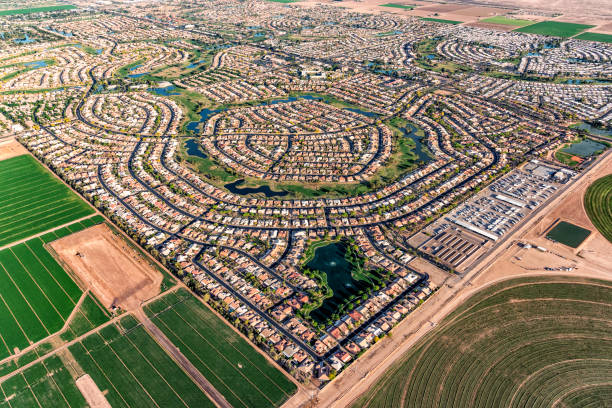
Major consequences of urbanization:
Major contributions to climate change:
Conversion of vegetation and cropland to urban land → significant reduction in carbon sequestration (drawdown).
Increased demand for fossil fuels and consumption of resources (suburbanites drive 50% more) → increased carbon emissions.
Together, these forces dramatically increase the CO2 concentration in the atmosphere.
Impervious Surfaces: Impervious surfaces are structures (pavement, roads, sidewalks, driveways ,and parking lots) that are covered by impenetrable materials (asphalt, concrete, brick, stone, and rooftops, etc).
Ecological impacts of impervious surfaces:
Significantly reduced absorption of rainfall - more flooding and less replenishment of groundwater (aquifers).
Less replenishment and more consumption of groundwater increases the likelihood of saltwater intrusion in coastal aquifers.
Increases runoff of pollutants into surrounding surface waters.
Impervious surfaces also create more Urban Heat Islands (UHI).
UHI - An urban area that is significantly warmer than than the surrounding rural areas due to the absorption and reflection of heat.
Urban Heat Islands affect communities by increasing summertime peak energy demand, air conditioning costs, air pollution and greenhouse gas emissions, heat-related illness and mortality, and water quality.
UHI Solutions:
Increase urban vegetation
Install green roofs
Create more “cool” roofs
Create more “cool” pavement
Follow Smart Growth principles
Smart Growth - A set of principles for community planning that focuses on strategies to encourage the development of sustainable, healthy communities.
Create mixed development, pedestrian-friendly, mix business, residents, etc.
Creating a range of housing, not zoning or creating subdivisions.
Create walkable neighborhoods. More social space, less traffic, improved quality of life.
Encourage local..community and stakeholder collaboration in development decisions. Making local voices heard.
Emphasize compact building design- Building up rather than out.
Foster distinct communities with . strong sense of place. Creating unique cities that residents take pride in
PReserve open space, farmland, natural beauty, and critical environmental areas. Growth shouldn’t impact the ecosystem.
Porvide a variety of transportation options. Utilizaing public transportation.
Strengthen
Infill: Building in vacant lots and open spaces
Urban growth boundaries: Example: Portland, OR
Make a development decisions predictable, fair, cost effective. Developing better permitting process would help support creation of unique, individualized communities.
National ParksNational Parks - The US Park Service has a “dual mandate” to both preserve nature and promote the use of our national parks. The US has 58 national parks and many, many other park properties including: national lakeshores/seashores, national monuments, national historic sites, etc...
U.S. National Parks are governed by the multiple use principle:
According to the “Leopold Report” of 1963, National Parks must try to maintain the biotic community as it was prior to European settlement.
National Parks must also provide recreational opportunities for visitors that are interested in everything from backcountry hiking to driving ATVs.
Can National Parks be loved to death???
National Wildlife Refuges - The only federal land preserved solely for the purpose of preserving wildlife.
Administered by the Fish and Wildlife Service
85 million acres of public land
National Wilderness Areas are set aside for the sole purpose of preserving large tracts of entirely undeveloped land.
Wilderness areas are usually created from other public land, like National Forests or Rangelands.
Logging, mining, road building, and mechanical transportation of any kind are not allowed in Wilderness Areas.