Positive externalities
POSITIVE EXTERNALITY OF CONSUMPTION
Definition - external benefits to third parties caused by the consumption of a product.
Examples;
Healthy food
Education
Vaccines
Gym membership
Healthcare
Charity products
Diagram:
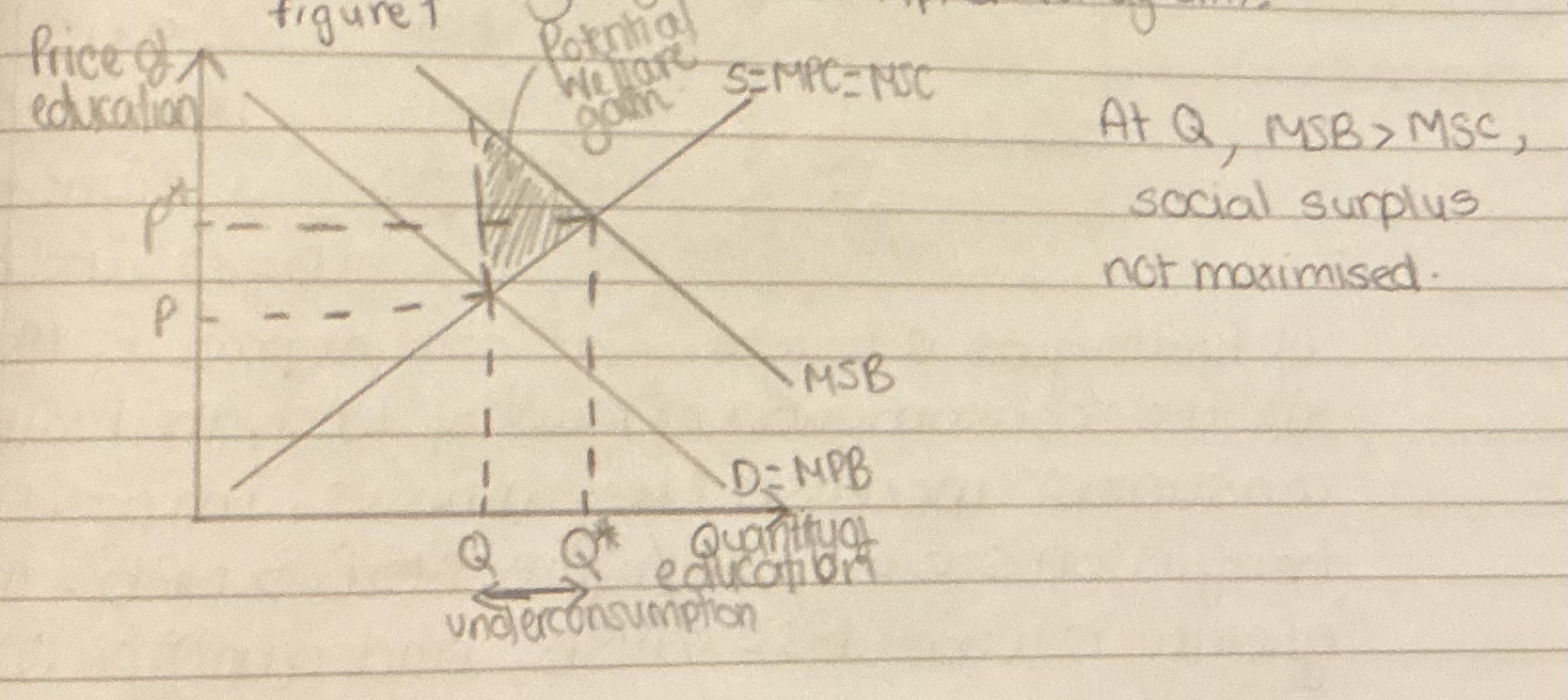
Figure 1 shows the positive externality of consumption in the healthy foods market with price on the y-axis and quantity on the x -axis. The free market equilibrium is where MPB=MPC (D=S) and quantity Q of healthy foods is bought and sold at price P. The consumption of healthy foods, the health of consumers increases/less illnesses, imposing external benefits on society therefore MSB>MPB. Allocative efficiency is where MSC=MSB, and quantity Q* is bought and sold at price P*. As Q<Q*, there is an underconsumption of healthy foods in the free market. Social surplus not maximised therefore potential welfare gain. Therefore there is market failure.
POSITIVE EXTERNALITY OF PRODUCTION
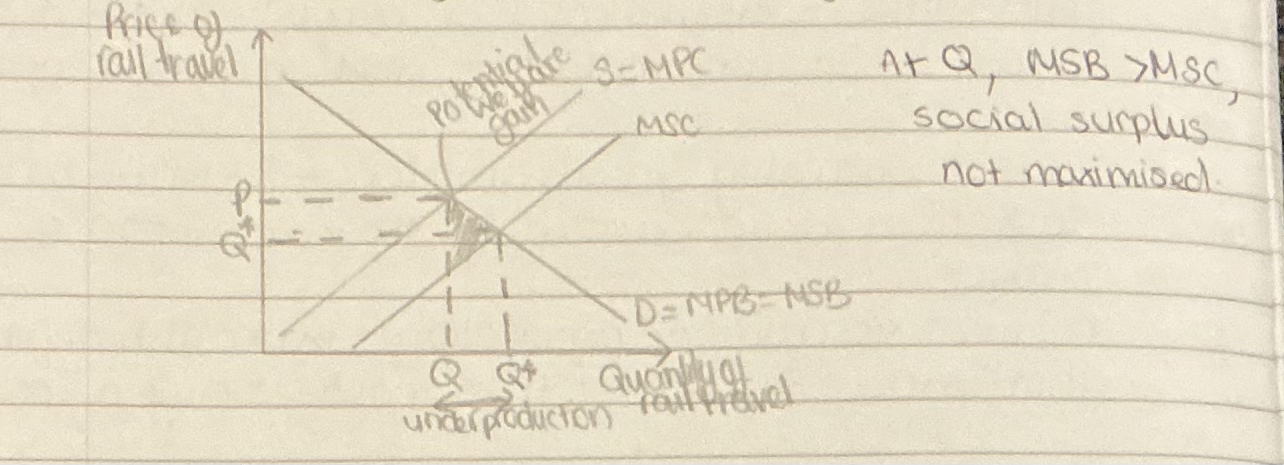
Diagram - external benefits to third parties caused by the production of a product.
Example;
Technology
Recycled production
Infrastructure/transport
Diagram:
SOLUTION 1: SUBSIDIES
The subsidy reduces costs for firms, shifting S down to S+Sub. The new market reaches a new equilibrium where S+Sub=D (or MPC + Sub =MPB) and Q* education is bought and sold at price P1. The socially efficient quantity has been reached, so the market failure is solved (the externality is internalised).
Consumers: lower price means they gain real income (especially low-income consumers) and are more educated is consumption increases.
Producers: gain revenue (‘PXQ’ to ‘P*XQ*’)
Government: must pay for the subsidy, either by raising taxes, borrowing money or taking funding away from other sectors (opportunity cost). Can they afford it?
Society: closer to Q* more social surplus.
But depends how much quantity will increase?
Whether producers decide to pass the subsidy onto consumers as lower prices. What if they just take the money and keep the price the same?
This is why, in the UK market for school education, the government has nationalised the industry rather than subsidising it, meaning it can ensure that price falls all the way to £0.
This is why , in the UK market for university education, the subsidy is combined with a maximum price, capping fees at £9500 per year.
Whether consumers respond to lower prices by increasing consumption (PED)
Families may rather their children work (instead of going to school), or may not have a school near enough with adequate transport.
This is why in the UK market for school education, the government has used command and control (legislation) to make it compulsory.
This is why, in the UK market for school education, transport infrastructure is accessible for all.
SOLUTION 2: COMMAND AND CONTROL
For goods that cause very big externalities (school education, seatbelts, face coverings during pandemic, car insurance) the government may force people to increase consumption by making it compulsory.
Diagram: no diagram
Evaluation:
Opportunity cost of policing this legislation? It is possible to punish offenders?
Is it four? Does it account for the circumstances of all households?
To make something compulsory, unless it is free (the govt must pay for it), it will be hugely politically unpopular - look at the backlash from the face mask rules. The government may also need to educate people on why the rule is important.
Generally only used for markets that cause significant positive externalities
SOLUTION 3: NUDGES
Advertising and education (ensure that consumers are constantly reminded of necessary info about the benefits of consuming education, healthy foods, exercise etc).
Make healthy school meals the default option (children are automatically enrolled in vaccination programmes and parents have to opt out.
Social norms with catchy phrases (‘hands, face, space’)
Diagram: shifts D right (MPB closer towards MSB)
Evaluation:
Should be transparent and justified to consumers.
Good that consumers have freedom of choice - it doesn’t punish people who have different circumstances as they can still choose not to consume the product.
Will these cause a big enough impact on its own?