Chapter 2: Models, Measurements and Vectors
2.1 Introduction
- Physics is a process by which we arrive at general principles that describe the behavior of the universe.
These principles are referred to as physical theories or physical laws (when they are well established)
- A physical theory is an explanation of natural phenomena based on observation and accepted fundamental principles.
2.2 Idealized Models
- A model is a simplified version of a physical system that focuses on its most important features.
- In creating a model, minor details of a problem are overlooked leaving the essential features.
For example, wind and air resistance are ignored when analyzing the motion of a projectile such as a thrown baseball.
2.3 Standards and Units
- A physical quantity is a number used to describe an observation of a physical phenomenon quantitatively.
- Certain quantities are referred to as fundamental. They are defined by describing a procedure for their measurement.
- An operational definition is a procedure for measuring a fundamental quantity that serves as its definition.
- Quantities are measured by comparing them with a reference standard known as a unit.
- A unit is a reference standard with which physical quantities are compared.
A system of units known as SI or International System is used by scientists and engineers all over the world.
Time
- Time is measured in seconds (s).
- A second is the time taken for Cesium-133 atom to complete 9,192,631,770 oscillations.
Mass
- The unit of mass is the kilogram (kg).
A kilogram is the mass of a particular cylinder of platinum-iridium alloy kept at the International Bureau of Weights and measures.
Prefixes
- Larger units and smaller units of predefined physical quantities are introduced using prefixes.
- The standard SI prefixes represent multiples and submultiples of 10 of the units they precede.
- Example: The prefix kilo represents the multiple 10^3. Other prefixes are shown in the table below:
Table of prefixes is shown below:
| Powers of ten | Prefix | Abbreviation |
|---|---|---|
| 10⁻¹⁸ | atto- | a |
| 10⁻¹⁵ | femto- | f |
| 10⁻¹² | pico- | p |
| 10⁻⁹ | nano- | n |
| 10⁻⁶ | micro- | μ |
| 10⁻³ | milli- | m |
| 10⁻² | centi- | c |
| 10³ | kilo- | k |
| 10⁶ | mega- | M |
| 10⁹ | giga- | G |
| 10¹² | tera- | T |
| 10¹⁵ | peta- | P |
| 10¹⁸ | exa- | E |
2.4 Unit Consistency and Conversions
- Physical quantities are related using equations.
- The physical quantities in these equations are represented by algebraic symbols.
- An equation must always be dimensionally consistent.
- A dimensionally consistent equation is one where the terms on both sides of the equation have the same units.
Example:
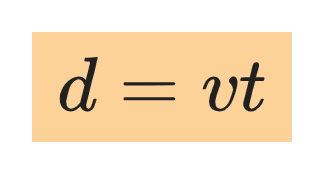
If d (distance) is in meters (m) the term vt must also be in meters (m)
Unit Conversions
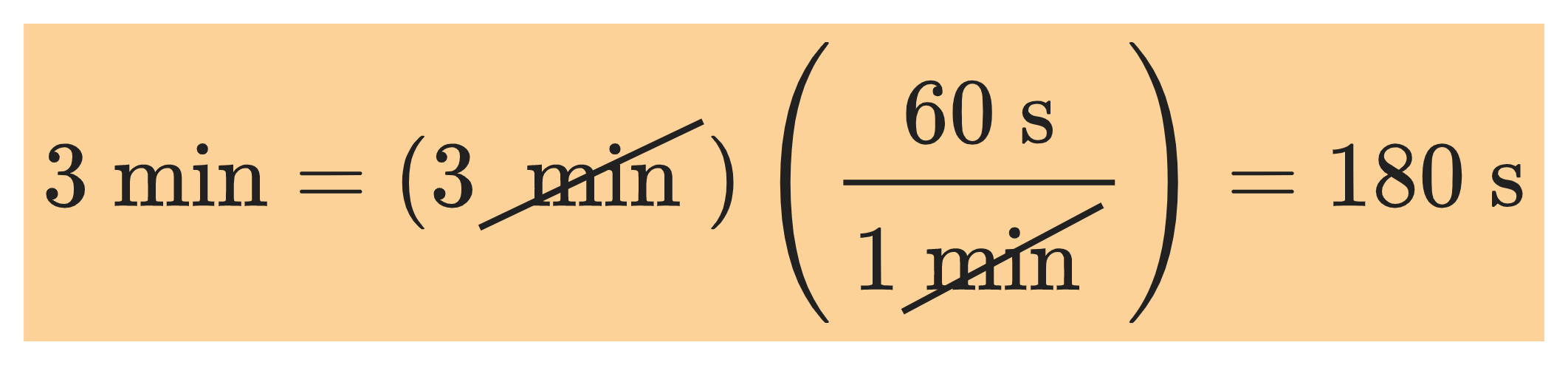
- Units are converted by treating them as algebraic quantities that “cancel” each other out.
- We can make a fraction with the conversion that will cancel the units we don’t want to leave the ones we do when this fraction is multiplied by the quantity in question.
- When units are taken into account the numerator is equal to the denominator, so we are essentially multiplying by 1.
Example: Convert 3 minutes to seconds
2.5 Precision and Significant Figures
- Accuracy is the degree of closeness of a measured value to the true value.
- Accuracy of a number is indicated by writing the number, the symbol and a second number indicating the uncertainty of the measurement.
- Uncertainty or error of a measured value is an indication of the maximum difference there is likely to be between a measured value and the true value.
The diameter of a steel rod is given to be 56.47±0.02 this means the true value is likely to be within the range 56.45 to 56.49.
Significant Figures
- In many cases the uncertainty of a number is not stated explicitly but it is rather indicated by the number of significant figures in the measured value.
- Significant figures are the meaningful digits in a measured value that tell us which digits are reliably known and which digit is uncertain.
- If a number has four significant figures it means the first three digits are known to be correct while the fourth digit is unknown.
- When we use numbers with uncertainties in calculations our results are also uncertain.
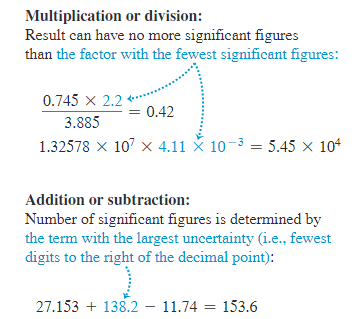
Therefore, there are rules that tell us which computed numbers are meaningful or significant and which are meaningless.
- Unitless constants in equations have no uncertainty.
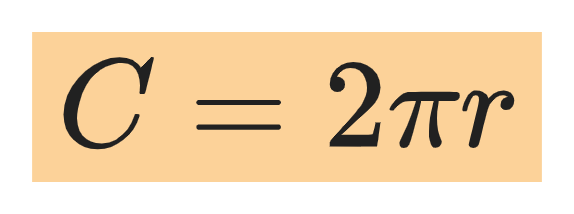
The 2 in the equation above has no uncertainty.
Ambiguity of zeroes and scientific notation
- Zeroes at the beginning or end of a number could be significant or they may simply show the place value or where the decimal point is in a number.
- To avoid ambiguity, scientific notation is used.
Example 2500 is written as 2.5×10³ if the zeroes are mere place holders and 2.500×10³ if the zeroes are significant.
2.6 Estimates and Orders of Magnitude
- An order of magnitude calculation is a rough, crude estimate which is designed to be accurate within a factor (usually) of 10.
They are used where calculations might be too difficult to carry out exactly.
2.7 Vectors and Vector Addition
A vector is a quantity that has both magnitude and a direction in space.
Representation of vectors
- Vectors are represented by a letter with an arrowhead above them in handwriting and bold in typed text.

- The magnitude of a vector quantity is represented using the same vector symbol with vertical bars on both sides.
Equal vectors
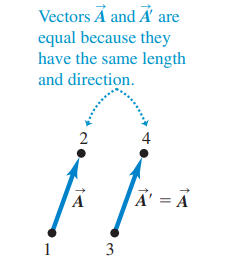
- Two vectors are equal if they have the same magnitude and direction.
- It does not matter where they are located in space. Two vectors can have different start and end points and still be equal.
 Negative of a vector
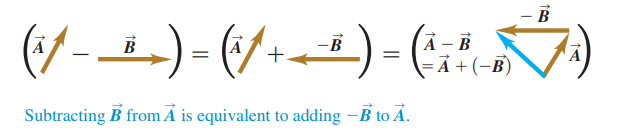
- The negative of a vector is a vector having the same magnitude as the original vector but the opposite direction.
- This forms the basis for vector subtraction.
- Thus, to subtract B from A we negate B (change its direction) and then add to A.
## Drawing a vector
- A vector is always drawn as a line with an arrowhead at its tip. The length of the line shows the vector’s magnitude, and the direction of the arrowhead shows the vector’s direction.
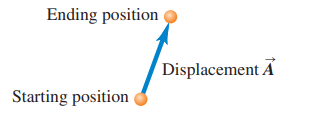
- When drawing diagrams with vectors, a scale is used, especially where the vector quantities have different units such as newton (N). 10N could be represented by 2cm in a vector diagram.
Scalar multiplication of a vector
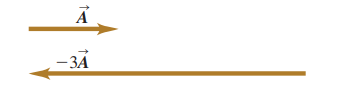
- Multiplying a vector by a positive scalar (ordinary) number changes its magnitude but not its direction.
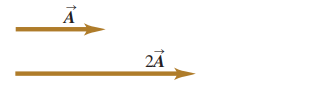
- Multiplying by a negative scalar changes its magnitude and reverses its direction.
##  Vector addition
- Vectors are added using two methods:
- Tip to tail method.
- Method of components. The method of components is more precise.
Tip to tail method.
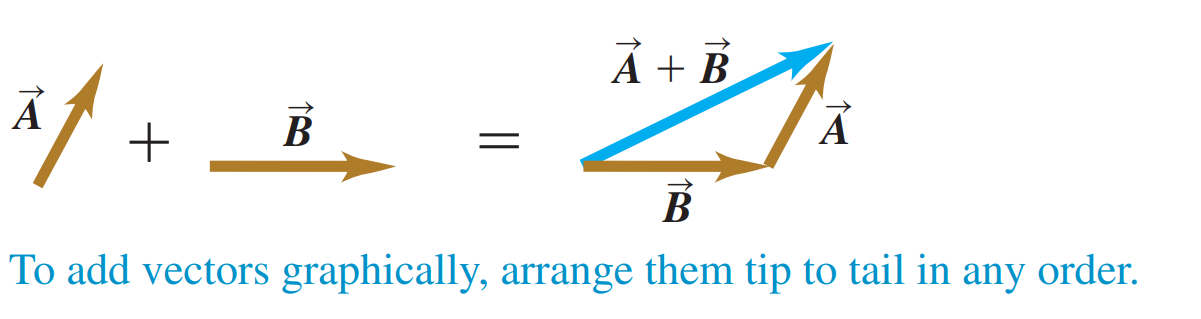
- The vectors to be added are drawn in succession with the tip of each vector at the tail of the one succeeding it.
- Vector addition is commutative so the order in which this is done is irrelevant.
- The sum or the resultant vector R points from tail of the first vector to the tip of the final one.
2.8 Components of Vectors
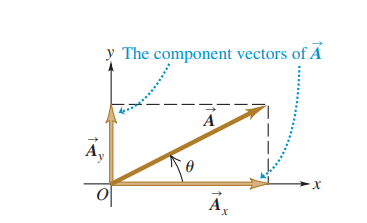
- Any vector lying in the x-y plane can be represented as the sum of a vector parallel to the x-axis and a vector parallel to the y-axis.
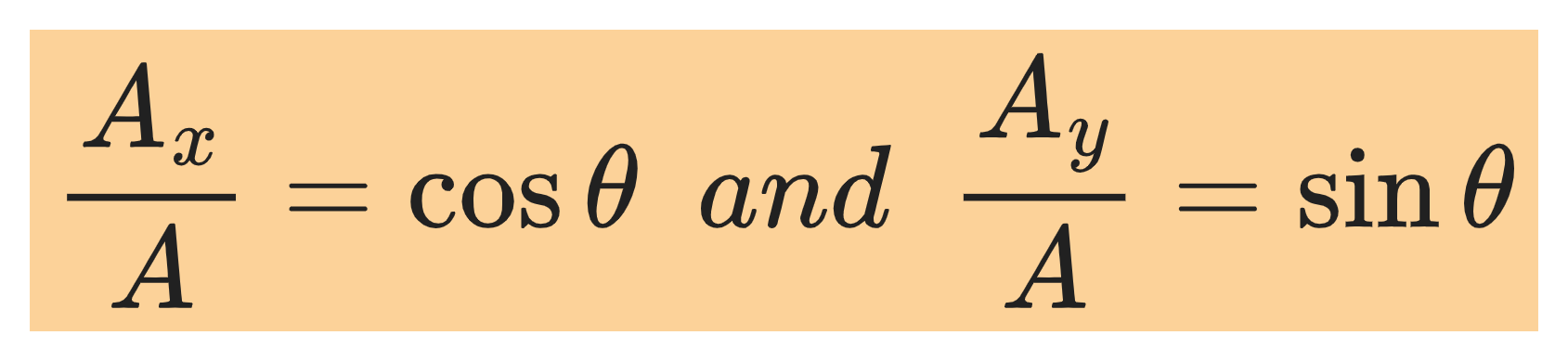
- Using the trigonometric ratios, we have:
- These vectors Aₓ and Aᵧ are called component vectors of vector A
- Aₓ and Aᵧ are numbers, and they can be positive or negative as shown:
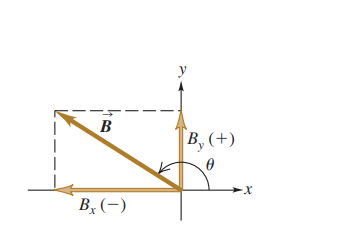
- The vector and its components form a right-angled triangle. The value of our components is each given by:

NB: θ is measured from the x-axis.
- Using the trigonometric ratios:
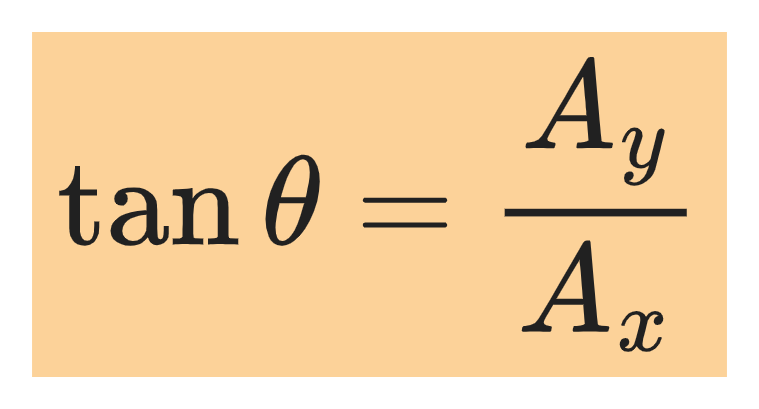
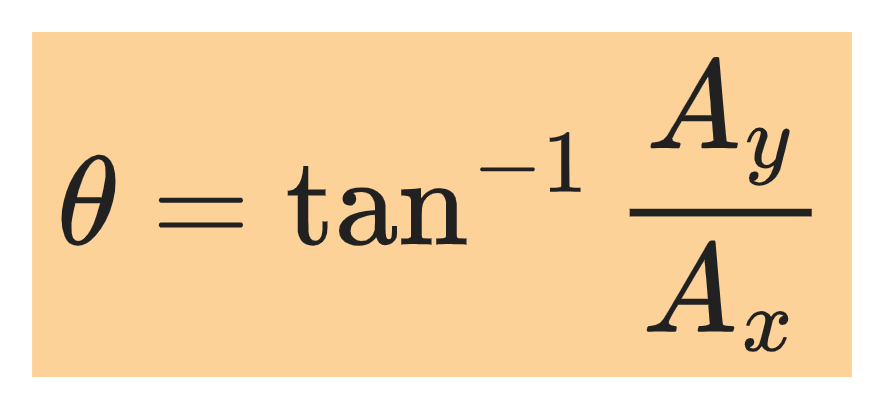
Hence, the direction of θ in terms of the components is given by:
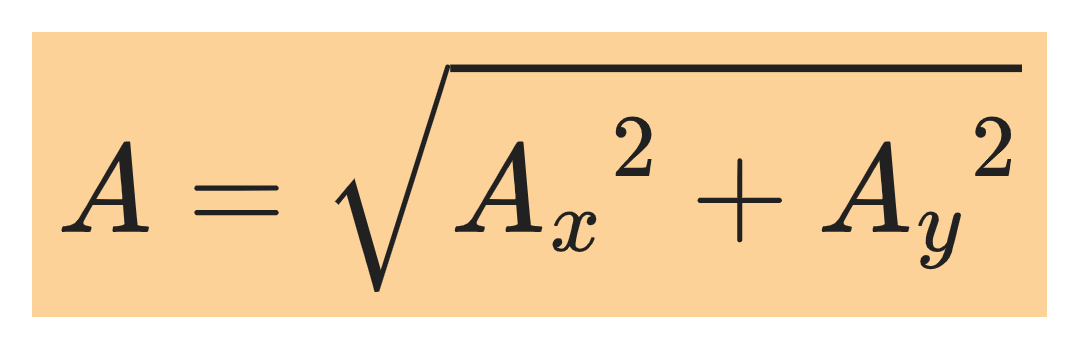
- Since we are dealing with a right-angled triangle, we can calculate the length (magnitude) of our vector when we know the components using Pythagoras’ theorem.
Vector Addition
- Adding vectors using method of components:
- Find the x- and y-components of each individual vector using:

- Add the individual x-components to find Rₓ, the x-component of the vector sum. Do the same for the y-components to find Rᵧ

- Calculate the magnitude R and direction θ by using:
