Sleep-Wake Disorders
Classification of Sleep-Wake Disorders
Altered Timing of Sleep:
Insomnia Disorder
Hypersomnolence Disorder
Narcolepsy
Circadian Rhythm Sleep Disorder
Altered Sleep Behaviors:
Non-REM sleep arousal disorder (includes sleepwalking and sleep terrors)
Nightmare disorder
REM sleep behavior disorder
Restless leg syndrome
Substance or Medication-Induced Sleep Disorder
Physiology of Normal Sleep
Regulatory Mechanisms:
Homeostasis: Regulates the "Sleep Debt" or pressure to sleep. This pressure increases as wake time lengthens and dissipates during a sleep episode.
Circadian Cycle: Known as the "body clock," it regulates the timing of sleep and awakening.
Ultradian Cycle: Reflects the internal balance and cycling between REM and NREM sleep stages.
The Circadian Rhythm:
Controlled by the suprachiasmatic nucleus (SCN) located in the hypothalamus.
Primarily influenced by environmental light and dark exposure.
The SCN controls the production of melatonin based on the light intensity received by the eyes.
Melatonin is released from the pineal gland specifically to promote sleep.
Elements of Quality Sleep:
Duration: Recommended for adults.
Continuity and Efficiency: The ability to fall asleep and stay asleep (calculated as the ratio of time asleep to time spent in bed).
Timing: Sleep should be aligned with the circadian night.
Regularity: Consistency of the sleep-wake schedule across different days.
Satisfaction: The individual's subjective perception of sleep quality.
Daytime Functioning: Maintaining alertness throughout the day.
Normal Sleep Latency: It should take approximately to fall asleep.
Sleep Stages:
NREM (Non-REM): Divided into three stages (N1, N2, N3) of progressively increasing depth.
REM (Rapid-eye Movement): The stage where the brain is most physically active or "wakeful" (dreaming). During this stage, the body lacks muscle tone.
Sleep Cycle: The brain cycles through N1, N2, N3, and REM. A typical night includes approximately five cycles.
Clinical Assessment and Screening for Sleep Disorders
Step 1: Brief Clinical Inquiry:
Should be part of every psychiatric intake.
Three screening questions:
Do you have difficulty falling asleep?
Do you have difficulty staying asleep?
Is your daytime functioning impaired because of poor sleep?
Positive responses require more formal assessment.
Step 2: Validated Self-Report Questionnaires:
Pittsburgh Sleep Quality Index (PSQI)
Insomnia Severity Index (ISI): Has the strongest evidence for use in psychiatric populations.
Epworth Sleepiness Scale (ESS) - Most Common
Step 3: Sleep Diary:
The patient should complete a diary as a baseline.
Essential for Cognitive Behavioral Therapy for Insomnia (CBT-I).
Records include: Bedtime, "lights out" time, estimated sleep onset latency, number/duration of awakenings, and naps (timing/duration).
Step 4: Objective Testing (Referral):
Polysomnography (PSG): Not indicated for routine insomnia evaluation as insomnia is a clinical diagnosis.
Indications for PSG or home sleep apnea testing include: Suspected Obstructive Sleep Apnea (OSA), Narcolepsy, REM sleep behavior disorder, or failure of standard insomnia treatment.
Refer to pulmonary and sleep specialist for further evaluation and management of suspected sleep disorders, ensuring a comprehensive approach to diagnosis and treatment.
Consequences of Untreated Sleep Disorders:
Hypertension (HTN)
Cardiovascular (CV) disease
Depression
Stroke
Weight gain
Poor quality of life
Epidemiology of Sleep-Wake Disorders
Insomnia Disorder: 30-50% short-term cases; 6-10% chronic cases. 90% are secondary to other psychiatric or medical disorders.
Hypersomnolence Disorder: 5-10% of patients in sleep clinics; equal male/female distribution; onset between 10-30 years old.
Narcolepsy: Requires one of the following for diagnosis: cataplexy, hypocretin deficiency in the CSF, or reduced REM sleep latency.
Insomnia Disorder
DSM-5 Diagnostic Criteria:
Predominant complaint of dissatisfaction with sleep quantity or quality.
Associated with:
Difficulty initiating sleep
Staying asleep
Early morning awakening with inability to return to sleep.
Causes clinically significant distress or impairment.
Frequency/Duration: Occurs at least for at least . (Shorter than is classified as short-term insomnia).
Occurs despite adequate opportunity for sleep.
Not better explained by another sleep-wake disorder, substance effects, or medical conditions.
Epidemiology:
Short-term insomnia: of cases.
Chronic insomnia: of cases.
of insomnia is secondary to other psychiatric (anxiety, depression, mania, psychosis) or medical (chronic pain, OSA, diabetes, heart failure) disorders.
Long-term effects: Functional impairment, work/school absence, motor vehicle collisions (MVCs), and cardiovascular conditions.
Treatment of Insomnia
Treat underlying cause if it is secondary (EX: secondary to anxiety or depression)
Cognitive Behavioral Therapy for Insomnia (CBT-I):
First-line treatment, typically lasting .
Components: Stimulus control (Pavlovian conditioning), sleep restriction, cognitive restructuring, relaxation training, and sleep hygiene.
Pharmacotherapy Categories:
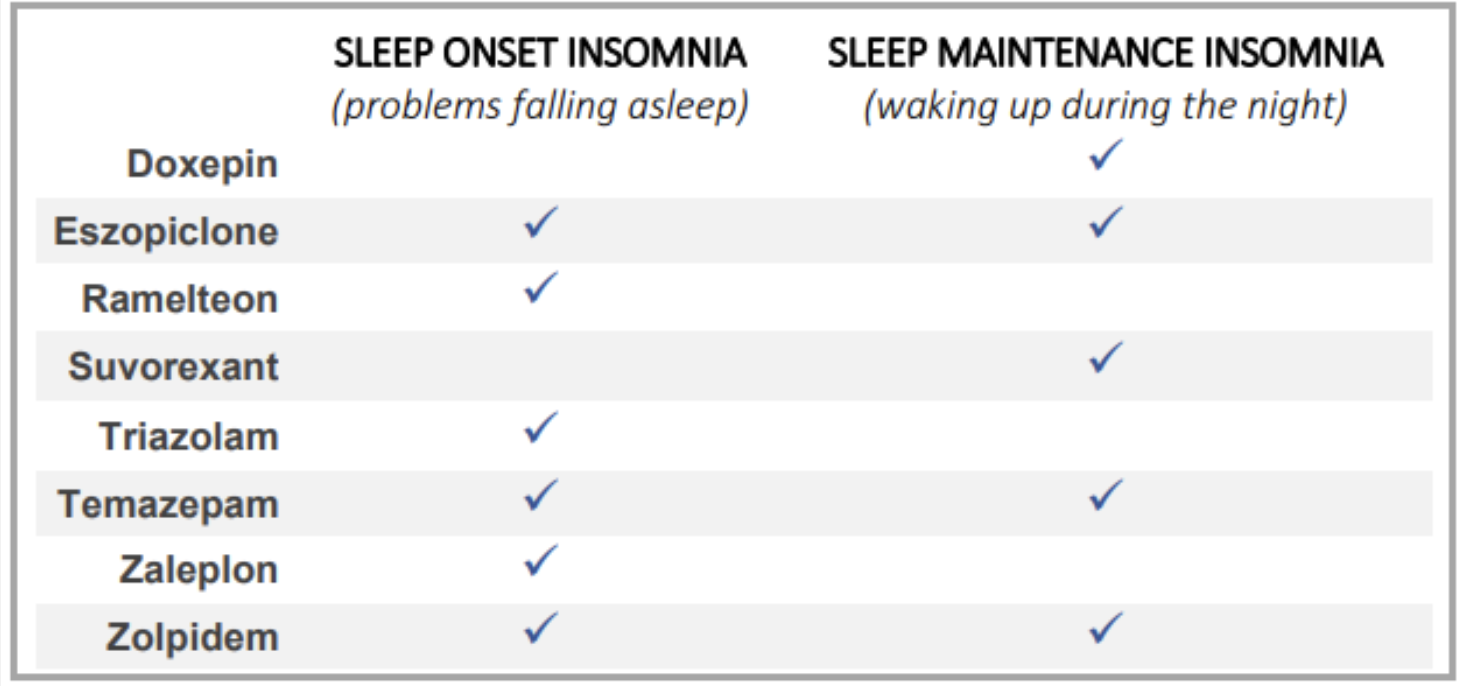
Sleep Onset Insomnia (Difficulty falling asleep): Ramelteon, Triazolam, Zaleplon, Zolpidem.
Sleep Maintenance Insomnia (Waking up during the night): Doxepin, Eszopiclone, Suvorexant, Temazepam.
Benzodiazepines:
FDA Approved: Temazepam, Estazolam, Flurazepam, Quazepam, Triazolam.
Off-label: Lorazepam and others.
Guidelines: Limit use to short-term ( or less).
Adverse Effects: Tolerance, addiction, rebound insomnia, high fall risk in elderly (Beer's List), respiratory depression (worsens OSA), and CNS depression.
Non-Benzodiazepine Hypnotics ("Z-drugs"):
Mechanism: GABA-A alpha-1 subunit agonists (inhibitory).
Examples: Zolpidem (Ambien), Eszopiclone (Lunesta), Zaleplon (Sonata).
Warnings: FDA boxed warning for complex sleep behaviors (e.g., sleepwalking, driving) which can cause death or serious injury.
Classification: Schedule IV drugs.
Dual Orexin Receptor Antagonists (DORAs):
Examples: Suvorexant (Belsomra), Daridorexant (Quviviq).
Characteristics: Lowest rates of abuse/dependence; no evidence of physiological tolerance, withdrawal, or rebound insomnia.
Classification: Schedule IV drugs.
Melatonin Agonists:
Ramelteon (Rozerem): Melatonin-1 and 2 receptor agonist. FDA indicated for sleep onset.
Off-label for jet lag and shift work disorder. No abuse potential.
Rare side effects: Decreased testosterone and increased prolactin at high doses.
Other Agents:
Antihistamines: Diphenhydramine ( at bedtime), Doxylamine, Hydroxyzine (off-label; short-term onset only).
Antidepressants (Off-label): Trazodone (most prescribed sedating antidepressant for insomnia), Amitriptyline, Mirtazapine.
Antipsychotics: Quetiapine (off-label Seroquel).
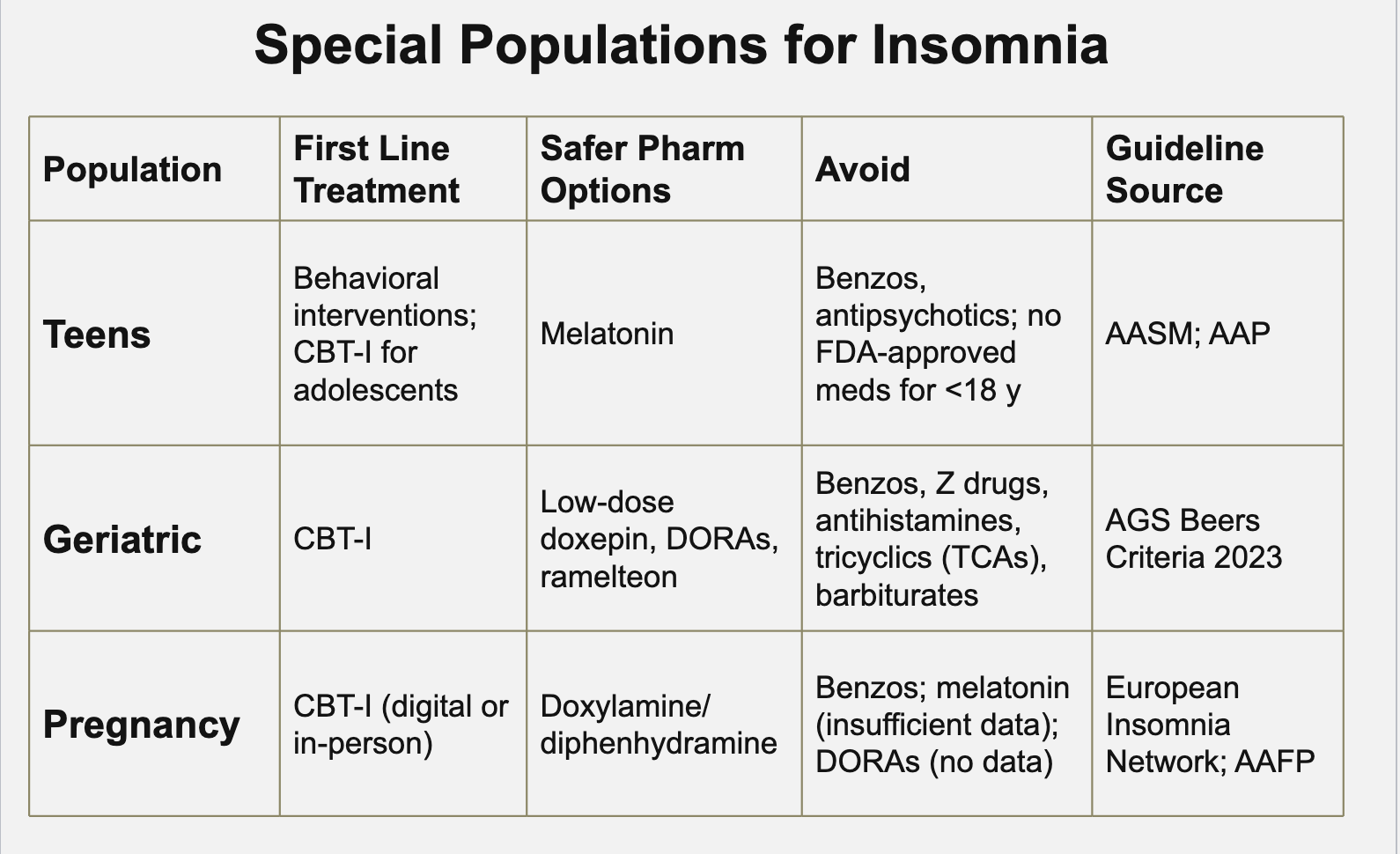
Special Populations:
Pregnancy:
Non-pharmacologic options are best.
Doxylamine or diphenhydramine are preferred over placebo for reducing insomnia-associated depression in pregnancy.
Adolescents (Less than 18 y/o):
Use melatonin
Alternative options are hydroxyzine and diphenhydramine (Benadryl)
Geriatric:
Beers Criteria
Safer alternatives: Doxepin (TCA), Ramelteon, Suvorexant (DORAs)
Hypersomnolence Disorder (Idiopathic Hypersomnia)
DSM-5 Diagnostic Criteria:
Self-reported excessive sleepiness despite sleep lasting at least .
Requires one of the following: Recurrent sleep lapses in a single day, a prolonged main sleep episode () that is nonrestorative, or difficulty being fully awake after abrupt awakening.
Frequency/Duration: for at least .
Symptom: "Sleep drunkenness" (sleep inertia).
Epidemiology and Etiology:
of patients in sleep clinics. Equal male/female distribution.
Onset: .
Causes: Viral infections, head trauma, or genetics.
Treatment:
Stimulant therapy: Modafinil or Methylphenidate (usually long-term).
Sodium oxybate (Xywav).
Insomnia Disorder:
Predominant complaint of dissatisfaction with sleep quantity or quality.
Associated with difficulty initiating sleep, staying asleep, or waking up too early.
Symptoms occur at least 3 nights per week for at least 3 months.
Causes clinically significant distress or impairment in daytime functioning.
Considered to be more about insufficient sleep or disrupted sleep.
Hypersomnolence Disorder:
Characterized by excessive sleepiness despite adequate sleep duration (≥7 hours).
Individuals experience recurrent sleep lapses, prolonged main sleep episodes (>9 hours) that are nonrestorative, or difficulty being fully awake after abrupt awakening.
Symptoms must occur at least 3 times per week for 3 months.
Often associated with a feeling of "sleep drunkenness" or sleep inertia.
Narcolepsy
DSM-5 Diagnostic Criteria:
Daytime sleepiness and falling asleep at inappropriate times (irrepressible need for sleep).
Recurrent periods of an irrepressible need for sleep, lapsing into sleep, or napping occurring with the same day
Requires at least one of the following:
Cataplexy: Drop attacks involving muscle weakness triggered by emotions (e.g., laughter).
Hypocretin deficiency in the CSF.
Reduced REM sleep latency on PSG.
Clinical Features:
Hallucinations during sleep onset (hypnagogic) or awakening (hypnopompic).
Sleep paralysis.
Disturbed nighttime sleep.
Treatment:
Short scheduled daytime naps
Psychological support
Stimulants for Daytime Sleepiness:
1st Line: Modafinil or Armodafinil
2nd Line: Methylphenidates or Amphetamines
For Cataplexy:
Histamine receptor antagonists, oxybates, antidepressants
Circadian Rhythm Sleep Disorders
Epidemiology:
Circadian Rhythm Sleep Disorders (CRSD) are prevalent and can affect individuals of all ages, but they are particularly prominent in shift workers, adolescents, and the elderly.
Studies suggest that up to 10-30% of shift workers may experience some form of CRSD due to misalignment between their circadian rhythms and social obligations.
Adolescents may also face challenges with CRSD due to biological changes and societal pressures, leading to delayed sleep phase syndrome.
Signs and Symptoms:
Symptoms vary widely depending on the specific type of CRSD but generally include:
Insomnia or excessive sleepiness during the day.
Difficulty falling asleep or waking up at desired times.
Mood disturbances, including irritability and anxiety.
Poor concentration and decreased performance in daily tasks.
Diagnostic Criteria:
Circadian Rhythm Sleep Disorder is diagnosed based on the following criteria:
Persistent or recurrent sleep disruption, leading to excessive sleepiness or insomnia.
The sleep disturbance is associated with changes in the timing of the sleep-wake cycle (shift work, jet lag, etc.).
The disturbance causes clinically significant distress or impairment in social, occupational, or other important areas of functioning.
The disturbance is not better explained by another sleep disorder or medical condition.
Parasomnias and Altered Sleep Behaviors
Sleepwalking (Somnambulism) and Sleep Terrors:
Occur during Non-REM sleep, usually in the first third of the night (deep sleep).
Sleepwalking: Behaviors range from sitting up to walking or eating. Eyes are open with a blank stare. Difficult to awake.
Epidemiology: of children; of adults.
Occurs more commonly with sedatives, antidepressants, hypnotics, stimulates, and antihistamines that may disrupt the normal sleep architecture or induce deeper stages of sleep, leading to an increased likelihood of these episodes.
Treatment: Focuses on safety measures, management of underlying conditions, and possibly medication such as benzodiazepines in severe cases. Reassurance, safety (gates, locks), and ensuring a safe environment. Clonazepam used only for severe adult cases.
Sleep Terrors (Night Terrors): Abrupt arousal from sleep with a panicky scream and intense fear. Autonomic symptoms (tachycardia, tachypnea, sweating). Little to no dream recall.
Often occur during non-REM sleep, primarily in children, and tend to diminish with age. Difficult to wake.
High comorbidity with sleep walking
Management typically includes ensuring safety during episodes and addressing any underlying stress or anxiety contributing to occurrences.
Nightmare Disorder:
Dysphoric, well-remembered dreams involving threats to survival or security.
Occur during REM sleep (second half of the night).
On awakening, the individual is rapidly alert and oriented.
Treatment:
If comorbid with PTSD: Prazosin or Doxazosin (Alpha Blocker)
Desensitization/Imagery Rehearsal Therapy
Feature | Night Terrors | Nightmares |
|---|---|---|
Occurrence | Usually occur during Non-REM sleep (first third of the night). | Occur during REM sleep (second half of the night). |
Awareness | Individual is often not fully awake; difficult to awake. | Individuals are fully awake and alert upon awakening. |
Recall | Little to no dream recall; often remember fragments. | Well-remembered dreams with vivid content. |
Symptoms | Abrupt arousal with a panicky scream and intense fear; autonomic symptoms (tachycardia, tachypnea, sweating). | May involve threats to safety; feelings of fear or anxiety. |
Age Prevalence | More common in children; often diminishes with age. | Occurs in both children and adults; can persist into adulthood. |
Management | Focus on safety; reassurance and managing underlying stress or anxiety. | Psychological support and techniques to reduce their occurrence. |
REM Sleep Behavior Disorder:
Vocalization (Sleep talking, crying, etc) and/or complex motor behaviors (limb jerking, punching, etc)
Hallmark Feature: Repeated episodes of dream enactment behaviors
Occurs during REM sleep ( after onset).
Awakens completely alert without confusion.
Strong association with neurodegenerative diseases (like Parkinson's with Lewy Bodies).
Male > Females (4:1)
Individuals > 50 Y/O
Psychiatric medications and narcolepsy increase risk
Treatment:
Injury prevention and safety measures
Melatonin or Clonazepam
Restless Leg Syndrome (RLS):
An urge to move the legs accompanied by or in response to uncomfortable and unpleasant sensations in the legs
Worsens at rest/night; relieved by movement.
Frequency: for .
Linked to iron deficiency. Worsened by antidepressants, antipsychotics, and antihistamines. 2x more likely in females. This condition is known as Restless Legs Syndrome (RLS), and patients often report difficulty falling asleep due to the urge to move, leading to significant sleep disturbances and daytime fatigue.
Treatment:
Iron Replacement
Regular exercise and reduce caffeine intake
1st Line Medications:
Pregabalin or Gabapentin
Dopamine Agonists (Ropinirole)
Referral to Sleep Specialists
Indicators for Referral:
Severe daytime sleepiness that puts the patient in harm's way.
Risk factors for sleep apnea (snoring, obesity).
Unusual or dangerous behaviors (REM sleep behavior disorder).
Insomnia refractive to standard behavioral/pharmacological approaches.
Atypical symptoms.
Signs and Symptoms of Sleep-Wake Disorders
Insomnia Disorder: Dissatisfaction with sleep quantity/quality; difficulty initiating/staying asleep; clinically significant distress; occurs at least 3 nights/week for 3 months.
Hypersomnolence Disorder: Excessive sleepiness despite sleep lasting 7 hours; recurrent sleep lapses, prolonged nonrestorative sleep, or "sleep drunkenness."
Parasomnias: Involve abnormal behaviors or experiences during sleep, including sleepwalking, sleep terrors, nightmares, and REM sleep behavior disorder.
Restless Leg Syndrome (RLS): Unpleasant leg sensations; urge to move legs, especially at night; symptoms occur 3 times/week for 3 months.
Obstructive vs. Central Sleep Apnea
Obstructive Sleep Apnea (OSA): Blockage of airway during sleep, often leads to loud snoring, gasping, or choking; severe daytime sleepiness.
Central Sleep Apnea: Brain fails to send appropriate signals to the muscles that control breathing; often occurs without airway blockage.