Market Failure
Wordfillers:
Market failure occurs when the free market fails to allocate ________ to the best interests of ________, causing ________ allocation of scarce resources.
Economic and social ________ is not ________ where there is market failure.
Questions:
What is an externality?
What is another way to describe an externality?
What are public goods?
Why are public goods underprovided in a free market?
What assumption is made about consumers and producers in economic decisions?
What happens when there is imperfect information?
Answers
Wordfillers:
resources; society; inefficient
welfare; maximised
Questions:
An externality is the cost or benefit a third party receives from an economic transaction outside of the market mechanism.
It is the spillover effect of the production or consumption of a good or service.
Public goods are non-excludable and non-rival.
Because of the free-rider problem.
It is assumed that consumers and producers have perfect information.
It leads to a misallocation of resources.
Questions / Wordfillers
Wordfillers:
An externality is the cost or benefit a ________ receives from an economic transaction ________ of the market mechanism.
Another way to describe an externality is the ________ effect of the ________ or ________ of a good or service.
Externalities can be ________ (external benefits) or ________ (external costs).
The extent to which the market fails involves a ________ judgement, making it hard to determine the ________ value of an externality.
Private costs are the costs to ________ involved directly in an economic ________.
Producers are concerned with ________ costs of production, such as ________, ________, ________, ________, and paying for ________.
Social costs are calculated by ________ plus ________.
Social costs represent the cost to ________ as a whole.
On a diagram, external costs are shown by the ________ distance between ________ curves.
External costs are the difference between ________ costs and ________ costs.
Marginal social costs (MSC) and marginal private costs (MPC) ________ from each other.
External costs increase ________ with increased output.
Questions:
What are externalities?
What are the two types of externalities?
Why is it hard to assign a monetary value to an externality?
Give an example of a private cost.
What determines how much a producer will supply?
How is social cost calculated?
How are external costs represented on a diagram?
What is the relationship between MSC and MPC?
How do external costs change with output?
Answers
Wordfillers:
third party; outside
spillover; production; consumption
positive; negative
value; monetary
economic agents; transaction
private; rent; cost of machinery and labour; insurance; transport; raw materials
private costs; external costs
society
vertical; two
private; social
diverge
disproportionately
Questions:
An externality is the cost or benefit a third party receives from an economic transaction outside of the market mechanism.
Positive (external benefits) and negative (external costs).
Because it involves a value judgement; different individuals value things differently depending on experiences (e.g., pollution in their hometown), making government policy decisions difficult.
Rent, cost of machinery and labour, insurance, transport, or paying for raw materials.
The private costs of production (and/or the market price consumers pay).
By adding private costs and external costs.
By the vertical distance between the private cost and social cost curves.
MSC and MPC diverge from each other.
External costs increase disproportionately with increased output.
Questions / Wordfillers
Wordfillers:
Consumers are concerned with the ________ benefit derived from the ________ of a good.
The price the consumer is prepared to pay determines the ________ benefit.
Private benefits could also be a firm’s ________ from selling a good.
Social benefits are ________ benefits plus ________ benefits.
On a diagram, external benefits are the difference between ________ and ________ benefits.
External benefits increase ________ as output increases.
The social optimum position is where ________ = ________ and represents the point of maximum ________.
The social costs of producing the last unit of output are equal to the social ________ derived from consuming that unit.
Questions:
What determines the private benefit for a consumer?
How are social benefits related to private and external benefits?
What does the social optimum position represent?
Answers
Wordfillers:
private; consumption
private
revenue
private; external
private; social
disproportionately
MSC; MSB; welfare
benefit
Questions:
The price the consumer is prepared to pay.
Social benefits are calculated as private benefits plus external benefits.
The social optimum position represents the point of maximum welfare where MSC = MSB.
Questions / Wordfillers
Wordfillers:
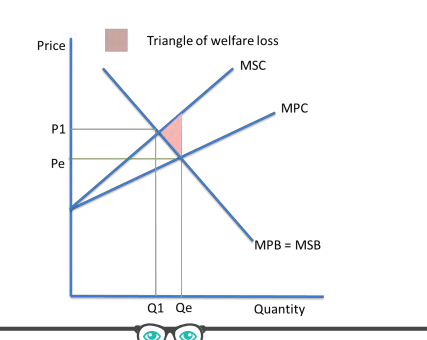
External costs occur when a good is being ________ or ________, such as ________.
External costs are shown by the ________ distance between ________ and ________.
The market equilibrium, where ________ = ________ at a certain price, ignores these ________ externalities.
Ignoring negative externalities leads to ________ and ________.
With negative externalities, ________ > ________ of supply.
At the free market equilibrium, there is an excess of ________ over ________ at the output between Q1 and Qe.
The output where ________ > ________ is known as the area of ________, shown by the ________ in the diagram.
The market fails to account for the negative externalities from the ________ of this good, which would reduce ________ in society if left to the free market.
Questions:
What is an example of an external cost?
What happens to welfare if the free market ignores negative externalities?
Answers
Wordfillers:
produced; consumed; pollution
vertical; MSC; MPC
supply; demand; negative
over-provision; under-pricing
MSC; MPC
social costs; benefits
social costs; private benefits; deadweight welfare loss; triangle
consumption; welfare
Questions:
Pollution (or any negative effect from production/consumption).
Welfare in society is reduced because the market does not account for the negative externalities.
Questions / Wordfillers
Wordfillers:
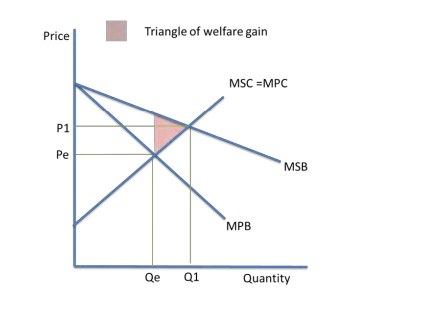
An example of an external benefit of consumption of a good or service could be the ________ of diseases and the ________ lives of consumers through ________ programmes.
Since consumers do not account for external benefits, they are ________ in the free market, where ________ > ________.
The triangle in the diagram shows the excess of ________ over ________. It is the area of ________.
Questions:
Why are goods with external benefits under-consumed in the free market?
What does the triangle in the diagram represent?
Answers
Wordfillers:
decline; healthier; vaccination
under consumed; MSB; MPB
social benefits; costs; welfare gain
Questions:
Because consumers do not account for the external benefits, leading to MSB > MPB.
The area of welfare gain, showing the excess of social benefits over costs.
Questions / Wordfillers
Wordfillers:
Indirect taxes are used to reduce the quantity of ________ goods consumed.
Indirect taxes ________ the price of the good.
If the tax equals the ________ of each unit, the supply curve becomes ________ rather than ________, and the free market equilibrium becomes the ________ equilibrium.
This process ________ the externality. In other words, the ________ pays for the damage.
Subsidies encourage the consumption of ________ goods and include the full ________ in the market price.
Regulation is used to enforce ________ consumption of a good.
Examples of regulation include the ________ and a compulsory ________ scheme.
Bans are only useful where ________ > ________.
Governments can provide public goods directly, such as ________, which are underprovided in the free market.
Providing information ensures there is no ________ failure, so consumers and firms can make ________ economic decisions.
Property rights encourage ________ because entrepreneurs can create new ideas, which are protected, and earn ________.
Personal carbon allowances could be ________, allowing firms and consumers to pollute up to a certain amount and ________ what they do not use.
Questions:
How do indirect taxes affect demerit goods and the market equilibrium?
Why might subsidies be given to merit goods?
What are some challenges with enforcing regulation like compulsory recycling schemes?
What is the purpose of property rights in the context of market incentives?
Answers
Wordfillers:
demerit
increases
external cost; MSC; MPC; socially optimum
internalises; polluter
merit; social benefit
less
minimum school leaving age; recycling
MSC; MPB
education
information; informed
innovation; profit
tradeable; trade
Questions:
Indirect taxes increase the price of demerit goods and, if set equal to the external cost, shift the supply curve to MSC, making the market equilibrium socially optimum.
Subsidies encourage the consumption of merit goods and ensure the full social benefit is reflected in the market price.
Compulsory schemes can be difficult to police and may involve high administrative costs; bans may push consumption to the black market.
Property rights encourage innovation by protecting new ideas and allowing entrepreneurs to earn profit.
Questions / Wordfillers
Wordfillers:
Public goods are missing from the free market but offer benefits to ________. Examples include ________ and ________.
Public goods are ________, so by consuming the good, someone else is not prevented from consuming it, and they are ________, so the benefit other people get does not ________ if more people consume the good.
The non-excludable nature of public goods gives rise to the ________ problem.
Public goods are underprovided by the private sector because consumers can receive the benefit without ________, so producers cannot make a ________.
Public goods are also underprovided because it is difficult to ________ the value consumers get, making it hard to ________ the good.
Consumers will ________ the benefit and pay ________, while producers will ________ and charge ________.
Governments provide public goods and must estimate the ________ of the good when deciding the output. They are funded using ________, but the quantity provided is ________ than the socially optimum quantity.
Private goods are ________ and ________. For example, a ________ can only be consumed by one consumer.
Private property rights can be used to ________ others from consuming the good.
Quasi (non-pure) public goods have characteristics of both ________ and ________ goods. They are partially provided by the ________ market.
Roads are an example of a quasi-public good: they are semi-, through tolls, and semi-, because consumers can benefit while others are using it (unless rush hour).
Questions:
Why do public goods suffer under-provision in the free market?
What is the free-rider problem?
How do governments attempt to provide public goods?
What differentiates private goods from public goods?
What are quasi (non-pure) public goods, and why are they partially provided by the free market?
Answers
Wordfillers:
society; street lights; flood control systems
non-excludable; non-rival; diminish
free-rider
paying; profit
measure; price
undervalue; less; overvalue; more
social benefit; tax revenue; less
rival; excludable; chocolate bar
prevent
public; private; free
excludable; non-rival
Questions:
Because they are non-excludable and non-rival, leading consumers to not pay for them, and because it is difficult to measure their value.
The free-rider problem occurs when people benefit from a good without paying for it, receiving the same benefits as those who do pay.
Governments estimate the social benefit, provide the goods funded by tax revenue, but the quantity is less than the socially optimum.
Private goods are rival and excludable; they can be consumed by one person only, and property rights prevent others from using them.
Quasi-public goods have both public and private characteristics, are partially provided by the free market, and may be semi-excludable and semi-non-rival (e.g., roads).
Questions / Wordfillers
Wordfillers:
Symmetric information means that consumers and producers have ________ market information to make their decisions, leading to an ________ allocation of resources.
Asymmetric information occurs when there is ________ knowledge between consumers and producers, leading to ________.
An example of asymmetric information is a ________ knowing about a fault in a car that the consumer is ________ of.
Consumers can sometimes have more information than producers, such as when purchasing ________.
Imperfect information occurs when information is ________, so an ________ decision cannot be made.
Misallocation of resources occurs when consumers pay ________ or ________, and firms produce the ________ amount.
The principal-agent problem occurs when an ________ makes decisions for the ________, but acts in their own ________ rather than the principal’s interests.
An example of the principal-agent problem is the conflict between ________ and ________, where managers might make decisions for ________ rather than shareholders.
Information can be made more widely available through ________ or ________ intervention.
An example is making the harmful effects of ________ public through adverts or messages on ________.
Moral hazard occurs when a party with superior knowledge ________ their behaviour to benefit themselves while disadvantaging the party with ________ knowledge.
Moral hazard can be seen in ________ markets.
Questions:
What is symmetric information, and what does it lead to?
How can asymmetric information lead to market failure?
What is an example where the consumer has less information than the producer?
What is an example where the consumer has more information than the producer?
How does asymmetric information cause misallocation of resources?
How is the principal-agent problem linked to asymmetric information?
How can information be improved to reduce market failure?
What is moral hazard, and in which market is it commonly seen?
Answers
Wordfillers:
perfect; efficient
unequal; market failure
car dealer; unaware
insurance policies
missing; informed
too much; too little; incorrect
agent; principal; interests
shareholders; managers; personal gain
advertising; government
smoking; cigarette boxes
alters; inferior
insurance
Questions:
Symmetric information is when consumers and producers have perfect information, leading to an efficient allocation of resources.
Asymmetric information leads to market failure due to unequal knowledge, causing misallocation of resources.
A car dealer knows about a fault in a car that the consumer does not.
Consumers might know more than the producer when purchasing insurance policies.
Consumers might pay too much or too little, and firms may produce the wrong amount, e.g., monopolies charging more than necessary.
The principal-agent problem occurs when an agent acts in their own interests rather than the principal’s, e.g., managers vs shareholders.
Through advertising or government intervention, e.g., publicising the harmful effects of smoking.
Moral hazard occurs when a party with superior knowledge changes behaviour to benefit themselves at the expense of the less informed party; commonly seen in insurance markets.