Multiplication Rule and Probability
Objectives
Compute probabilities using the Multiplication Rule for Independent Events.
Independence of Events
Two events are independent if the occurrence of one does not affect the other.
Events are dependent if the outcome of one impacts the other.
Examples:
Drawing a card and rolling a die (independent).
Drawing cards without replacement (dependent).
Multiplication Rule for Independent Events
For independent events A and B, the probability is given by:
Therefore, the Multiplication Rule states:
Example of Independent Events
Probability of all selected persons under 18 from different cities:
New York: 23.5%, Chicago: 25.8%, Los Angeles: 26.0%
Calculation:
This is considered an unusual event (cutoff point of 0.05).
Example: Survival Probability
Probability a randomly selected 60-year-old female survives the year is 99.186%.
For four females, the probability is:
Sampling Methods
Sampling with Replacement: Independent events since each draw is from the whole population.
Sampling without Replacement: Dependent events since the first draw affects the second.
Rule of Thumb: Treat as independent if sample is less than 5% of the population.
Knowledge Check: NCLB Act
Each student has a 0.99 probability of passing.
Questions: Probability everyone passes vs. probability 3 pass in a school of 500 students.
Probability Calculation
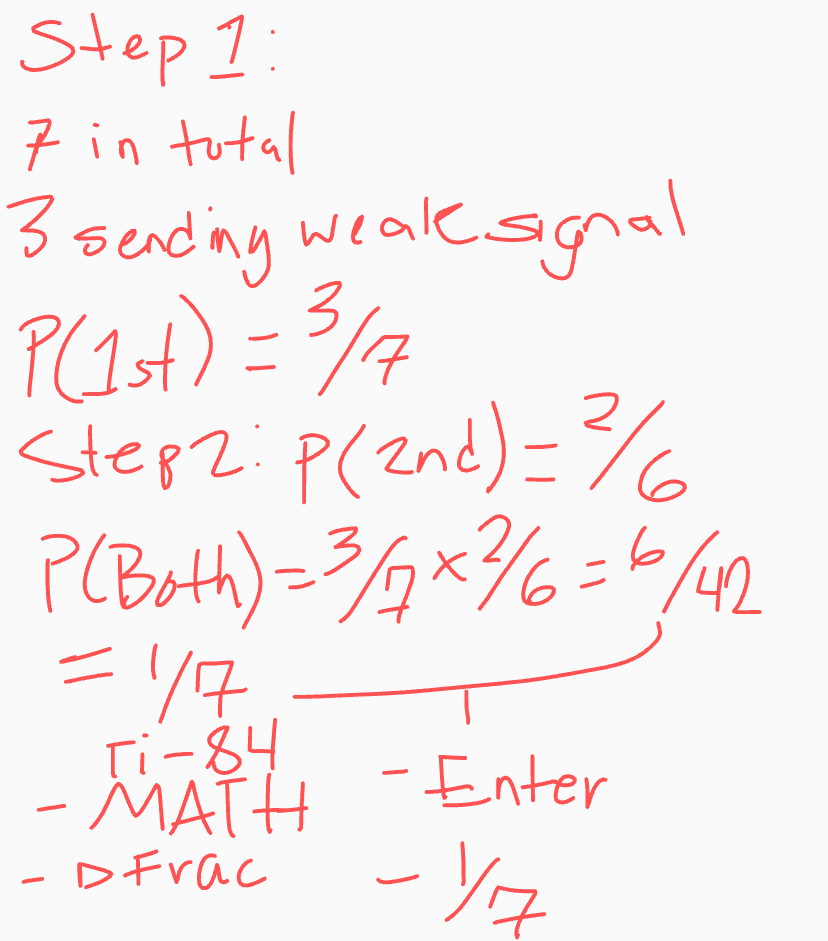
For a telecommunications company with 7 satellites (3 weak signals), the probability of picking 2 weak signals without replacement needs to be calculated.
Probability of all selected persons under 18 from different cities:
New York: 23.5%, Chicago: 25.8%, Los Angeles: 26.0%
Calculation:
This is considered an unusual event (cutoff point of 0.05).
New Example: Coin Flips and Dice Rolls
Let's calculate the probability of flipping a coin and getting a 'Heads' AND rolling a standard six-sided die and getting a '5'.
Step-by-step solution:
Identify the events:
Event A: Flipping a coin and getting 'Heads'.
Event B: Rolling a standard six-sided die and getting a '5'.
Determine independence:
Flipping a coin and rolling a die are completely separate actions. The outcome of the coin flip does not in any way influence the outcome of the die roll, and vice-versa. Therefore, these events are independent.
Calculate individual probabilities:
Probability of Event A () = Probability of getting 'Heads' =
Probability of Event B () = Probability of getting a '5' on a six-sided die =
Apply the Multiplication Rule for Independent Events:
Since the events are independent, we use the formula:
In decimal form:
Reasoning for this method:
We use the Multiplication Rule for Independent Events because the act of flipping a coin has absolutely no bearing on the act of rolling a die. If these events were dependent (e.g., drawing two cards without replacement from a deck, where the first draw changes the probabilities for the second draw), we would need to use a conditional probability formula, such as . However, in this case, the probability of rolling a 5 is the same regardless of whether the coin landed on heads or tails, demonstrating their independence and simplifying the calculation to a direct product of individual probabilities.
Knowledge check:
A telecommunications company has seven satellites, three of which are sending a weak signal. If two are picked at random without replacement, find the probability that both are sending a weak signal.
Express your answer as a fraction in lowest terms.