APGOV Required SCOTUS Cases
MCCULLOCH V MARYLAND
Congress chartered the Second Bank of the United States and attempted to establish branches in several states, including Maryland
Maryland passed a law that said any bank not established by Maryland would have to pay a $15K a year tax
The bank refused to pay it, so it went to the Supreme Court
Maryland argues that the establishment of the bank was unconstitutional, because the Constitution doesn’t say that Congress can establish a bank
McCulloch argues that they have the right to do so under the Necessary and Proper Clause
implied powers: powers aren’t implied, they are named
The decision was unanimous in favor of McCulloch, who said that it was constitutional because of the Necessary and Proper Clause
If a power is not prohibited by the Constitution, but the law upholds the spirit of the Constitution, it stands
Set a precedent for the supremacy of federal laws over state laws, and the balance of power between the two
Whenever the state law is in conflict with a federal law, the federal law wins
UNITED STATES V LOPEZ
In San Antonio, Texas, a high schooler named Lopez brought a gun with some bullets to school, and when the school found out, he was arrested and sent to jail, because under Texas law, it was forbidden to carry a gun onto school property
The next day, all the state charges were dropped, because it turns out he was also violating a federal law: the Gun-Free School Zones Act of 1990
He was found guilty of breaking this federal law and sentenced to 6 months in prison.
It is NOT a Second Amendment; gun legislation is a state issue, not a federal issue
The federal government isn’t allowed to pass laws concerning gun legislation, but it did so using the Commerce Clause
Commerce Clause: Congress can establish a free-trade zone among the states
US argued that guns in school are related to interstate commerce, because guns lead to gun violence, and if there is gun violence than people are less likely to travel through those states, which would negatively affect commerce in those places
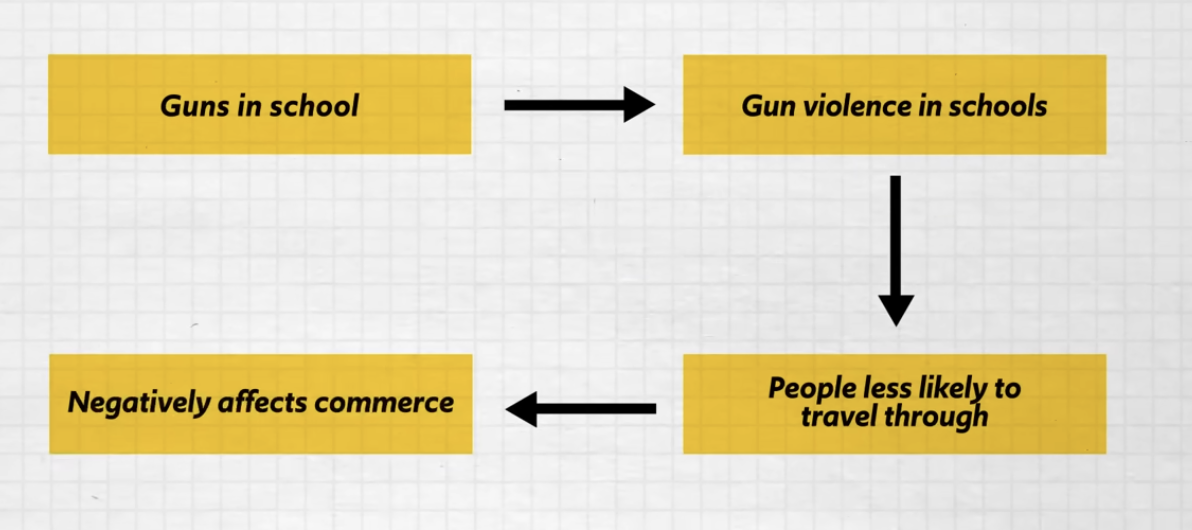
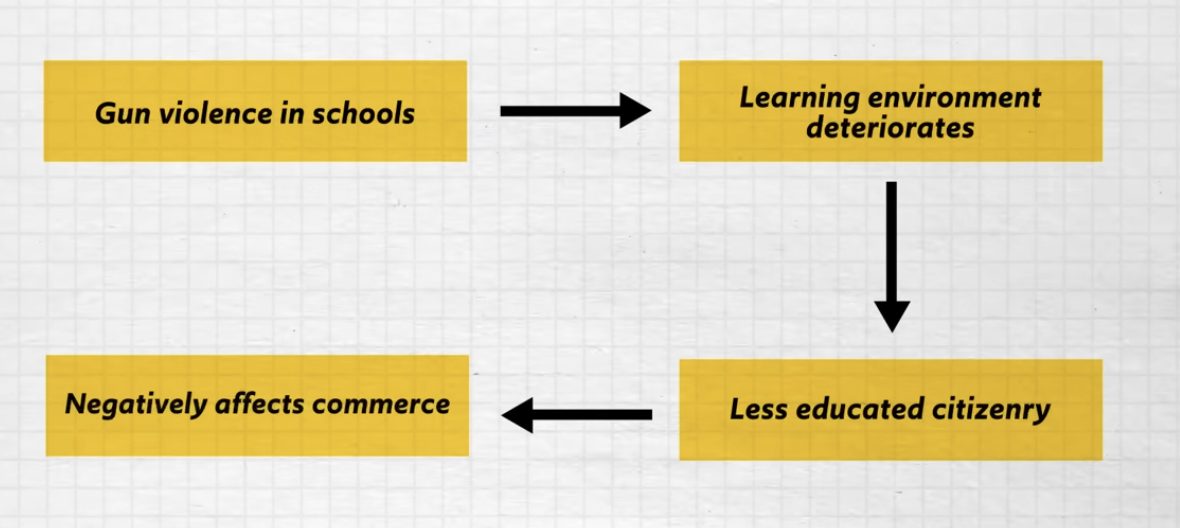
Lopez argues that gun regulation on school property is a power reserved for the states, and the connection between the commerce clause and gun violence is weak
The Supreme Court sided with Lopez, which was justified by saying that if there are no limits on what Congress could regulate under the commerce clause, then what can’t they regulate?
Additionally, it could turn Congress tyrannical
A case about federalism where the state triumphed
BAKER V CARR
Tennessee hadn’t redrawn its legislative districts in over 60 years, and its urban population had expanded a lot
Since the districts hadn’t been redrawn, the rural voters had way more voting power than urban voters
The Supreme Court had decided that redistricting was not justiciable (they weren’t allowed to rule on such things)
It was a political question, not a justice question
The 14th Amendment’s EPA was a constitutional principle
By refusing to redraw the districts and reapportion representatives, not all citizens were equally protected under the law
The Supreme Court ruled that issues of reapportionment were justiciable
Established the foundation of the one person, one vote doctrine (states had to apportion their representatives in a way that equally represented all the people so that no votes counted any more than any other vote)
Many states had to redraw their districts after this to follow this
It got the Supreme Court involved with a whole new set of cases involving political questions
SHAW V RENO
None of North Carolina’s representatives were black, so when it was time for reapportionment, they drew 2 districts that were majority black, but District 12 (one of those) was drawn really weirdly
Gerrymandering: Congressional districts are drawn to favor one group over another
Partisan gerrymandering: gerrymandering to favor one political party over another
Racial gerrymandering: to favor one racial group over another
The 14th Amendment’s EPC was the Constitutional principle at stake
Shaw argued that the EPC was violated bc the districts were drawn only with race in mind
Reno argued that it wasn’t violated because the districts were drawn with the intention of helping black residents who had a history of discrimination
The Constitution was colorblind
The Court ruled against Reno, saying that although they may have been drawn with noble intentions, districts drawn only based on race set a dangerous precedent
Set a precedent for future cases with racial gerrymandering
MARBURY V MADISON
The first two parties of the US were the Federalists and the Democratic-Republicans
Adams (Federalist) had lost his election to Thomas Jefferson (Democratic-Republican)
In his final days of his presidency, Adams packed the federal judiciary with federalist judges
Adams was signing commissions for these judges right until after he left office, and most of them were delivered, but some of them were not
When Jefferson took office, he left the undelivered commissions undelivered
William Marbury was one of those undelivered commissions, so he sued Madison and the Supreme Court to get his commission by a writ of mandamus
Writ of mandamus: a court order for an official to do what they’re legally required to do
He wanted the court to issue Jefferson a writ of mandamus
The Constitutional Principle is the jurisdiction clause in Article 3
The Supreme Court only has original jurisdiction when involving ambassadors or when one of the states is a party
3 questions that were asked
Does Marbury have the legal right to his commission? yes
If yes, is the court-ordered writ of mandamus the right way to get his commission? yes
If yes, does the Court have the authority to grant the writ of mandamus? no
The Judiciary Act of 1789 established all the lower federal courts, but it also said that the Supreme Court could issue a writ of mandamus during original jurisdiction
Chief Justice Marshall said that the Judiciary Act conflicted with Article III of the Constitution
Marbury is a judge, and Madison is a cabinet secretary who is not an ambassador or state official
Therefore, Article 13 of the Judiciary Act is unconstitutional and, therefore, null and void
Marbury did not get his commission
Marshall invested the judicial branch with the power of judicial review (which had been mentioned by Hamilton, but was not written in the Constitution)
ENGEL V VITALE
New York had created a 22-word prayer that was to be recited by school children, and kids could be written out this prayer with a permission slip
However, Engel and a bunch of other students challenged this practice
The 1st Amendment’s Establishment Clause (mostly) and the 14th Amendment were the constitutional principles
Establishment Clause: Congress can’t make a law that establishes a religion
14th Amendment: No state shall make or enforce any law that goes against the privileges of citizens
The Supreme Court decided that the prayer did violate the First Amendment Rights to freedom of religion
Demonstration of how the court rules in favor of individual liberty
social order v individual liberty
established a precedent for many other cases regarding schools and religious activities
WISCONSIN V YODER
3 Amish families removed their families from public schools after the 8th grade due to their religion
Wisconsin had a law that said children had to be educated until they were 16, and so the parents were fined $5
The constitutional principle at stake was the First Amendment’s Free Exercise Clause
Yoder argued that the law violated their right to freely exercise their religion
Wisconsin argued that states had a compelling interest in educating the children of the state, and that interest trumped their right to Free Exercise
social order v individual liberty
The Supreme Court unanimously ruled in favor of Yoder, saying that the compelling interest did NOT trump the Free Exercise Clause
It was enough of a threat to their way of life
It set the precedent for future precedent for cases following the free exercise of religion
TINKER V DES MOINES
Tinker and her family decided to support the Christmas truce on the Vietnam War by wearing black armbands to school
The school wrote an order saying that any student wearing a black armband would face suspension until they were willing to come back to school without it
The Tinker wore the armbands anyway, and they got suspended, and the parents sued
The Constitutional Principle at stake is the First Amendment’s protection of free speech
The Supreme Court ruled that it was a violation of the student’s right to free speech
The court created a “substantial disruption test”, which was a decision-making criterion for how school administrators could constitutionally limit student speech
if an administration is going to restrict speech, it must demonstrate that it would materially interfere with the operation of the school
The armbands caused no substantial disruption
SCHENCK V THE US
In 1917, Congress passed the Espionage Act (outlawing any hindrances to military recruitment), in the middle of WWI
Schenck didn’t like the military draft, so he wrote up a pamphlet explaining why people should resist the draft
He was arrested and sent to jail for violating the Espionage Act
The Constitutional Principle at stake was the First Amendment right to free speech, and so that section of the Espionage Act was unconstitutional
The court did not agree with Schenck and ruled unanimously that his rights were not violated because he wasn’t just protesting the draft; he was actively encouraging men to avoid the draft
If a man were to shout “fire” and cause panic, that is not an example of free speech
Clear and Present Danger test: protected and unprotected speech test; if you cause harm to someone with your words and cause danger to those around you, the speech is not protected
It created a clear standard for the silencing of speech
The government has more authority to silence speech during times of war
The Clear and Present Danger test is no longer used and was replaced by the Brandenburg test, which made the bar for unprotected speech very high
NEW YORK TIMES V US
The US was involved in the Vietnam conflict, which was an undeclared war, and Americans didn’t like their involvement in it
Nixon kept telling the Americans that they were winning the war, and they just needed a little more time
There was a finding saying that they were deceiving the public, and it got leaked to the NYT
Nixon wanted to cease publication because it would threaten national security (prior restraint)
First Amendment protection of freedom of the press case
The NYT argues that Nixon’s invocation of prior restraint violated their First Amendment rights
Nixon argued that prior restraint was justified because the publication of the papers would threaten national security
The court agreed with the NYT, saying that the bar to clear for prior restraint is extremely high
victory for free speech against censorship
MCDONALD V CHICAGO
In 2008, Heller v District of Columbia said that restricting gun ownership in washing dc was unconstitutional, but since DC is a federal district, this didn’t apply to the states
McDonald’s house had been broken in there, but he wasn’t able to buy a handgun to protect himself
Second Amendment case
McDonald argued that the restrictive gun laws infringed on his right to own guns, especially after the Heller case
Chicago argued that the laws were necessary to uphold public safety
The court ruled in favor of McDonald's
The case is also about selective incorporation (Fourteenth Amendment)
The Heller case applied to federal territory, and the McDonald one applied the same ruling to the states
GIDEON V WAINWRIGHT
Gideon was arrested for robbing and sent to trial, and in his earlier cases, he always had an appointed lawyer, but in Florida, lawyers were only to be provided during capital cases
Gideon acted as his own lawyer and lost the case
Sixth Amendment case
Does the equal protection clause let the Sixth Amendment be applied to the states?
The court ruled in Gideon’s favor
The Sixth Amendment was incorporated into the states from this case
BROWN V. BOARD OF EDUCATION
Plessy v Ferguson established the separate but equal doctrine, but a black family tried to get their daughter into a white school but was denied admission, and so the court went all the way up to the Supreme Court
The Fourteenth Amendment's equal protection clause was the principle at stake
Separation is not equal
They agreed with brown, overturning the precedent in Plessy v Ferguson
victory for the civil rights movement
Schools still took a while to integrate this new doctrine
CITIZENS UNITED V FEC
BCRA made it illegal to do ads 60 days before the election
During the 2008 election, Hillary the Movie came out, which had a bunch of weird stuff against Clinton, but by the time it was to be released, it was already 60 days before
Citizens United argued that BCRA prohibited them to make ads or anything was a violation of their First Amendment protection of freedom of speech
It was decided in favor of Citizens United
Since money = speech, is it fair for those with the most money to have the loudest voices