Food Microbiology
Day 1
Introduction to Spoilage
Sources of contamination
Growth kinetics and factors influencing growth
Nutrients and structure
pH and preservation by acid
Day 2
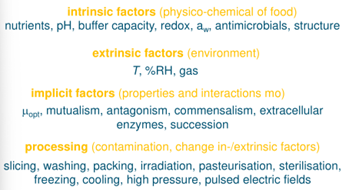
Redox potential and gaseous temperature
- Aerobic organisms produce energy via oxidative phosphorylation with O2 as terminal electron acceptor
- Enzymes (SOD and catalase) disable toxic products of oxygen
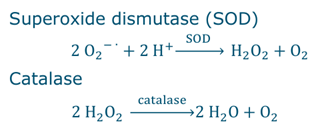
- Anaerobic organisms don’t have SOD or catalase, thus no growth at high redox potentials when O2 is present
- Terms to describe oxygen preference:
* ==Obligate aerobe==: Needs atmospheric O2 for growth.
* ==Microaerophile==: Requires O2, but below 20%.
* ==Facultative anaerobe==: Do not require O2, grows better with O2.
* ==Aerotolerant anaerobe==: Grows equally well in presence or absence of O.
* ==Obligate anaerobe==: Does not tolerate O2 and dies in its presence. - Classification of most important bacteria:
* Bacillus is an Obligate aerobe
* Campylobacter is an microaerophile
* E.coli is an facultative anaerobe
* LAB is an Aerotolerant anaerobe
* Clostridium is an obligate anaerobe - Anaerobic environment means that the Eh is negative
- Aerobic environment means that the Eh is positive
- Oxygen is the most influential redox couple in food systems. It has a high E0 and is a powerful oxidizing agent. Increasing the access of air to a food material by chopping, grinding, or mincing will increase its Eh. This is all solved by excluding air.
* Effects of other factors:
* Processing means that the product will be more exposed to oxygen => higher Eh
* Low pH => many H+ => higher Eh (Nernst equation) 58 increase for every level of pH.
* Microbial growth => less O2 => lower Eh - Dissolving CO2 to carbonic acid which then dissociates to bicarbonate, which acidifies the product.
* o This has the most effect on molds, oxidative gram (-) bacteria
o And the least effect on: Gram (+) bacteria (lactobacilli) and some yeasts (Brettanomyces spp).
o Larger effect if no oxygen present and at lower temperatures, because of higher CO2 solubility.
- MAP packaging flushes the package with gas mixture: less O2, more CO2
Water activity A2 and relative humidity RH
\
* \
* \Classification of bacteria: