Individual Differences
Individual differences refer to the unique characteristics and traits that make each person distinct, including factors such as personality, intelligence, and learning styles.
Nature vs. Nurture Debate
Nature Debate: Suggests children are born with inborn biases common to all. Influences developmental changes and behaviour.
Nurture Debate: Focuses on environmental influences on presentation and behaviour. Considers internal models of experience.
Studying Nature vs. Nurture
Experiments needed to control heredity/environments:
Control heredity while varying the environment.
Vary heredity while controlling the environment.
Ethical concerns limit experimental methods; natural situations can provide insights (e.g., Jim twins).
The Interaction of Nature and Nurture
Genes can be active (expressed) or inactive.
Environmental events can activate ‘switch on’ genes, indicating a complex interplay between genetics and environment.
Definition of Personality
Personality: Relatively stable and enduring aspects that distinguish individuals while allowing for comparisons.
Theories of Personality
Nomothetic Approaches (Consistency in behaviour due to traits, unlikely to change):
Type and trait theories (Eysenck, Cattell).
Idiographic Approaches (Variable behaviour influenced by situational factors, possibility for change):
Psychodynamic theories (Freud, Jung, Adler, Erikson).
Humanistic theories (Rogers, Maslow).
Interactionism (Bowers), Situationism (Mischel).
Humanistic Theories of Personality
Define personality by conscious experiences and drives.
Asserts that personality develops naturally unless hindered by external factors.
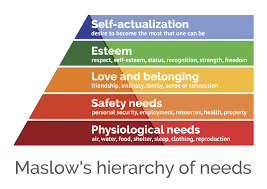
Maslow's hierarchy of needs with self-actualization at the top
Rogers' self-theory: focuses on self-image consistency. Perceptions and beliefs about themselves.
Trying to align our behaviours with our perception of ourselves. If we din’t, we doubt ourselves. How others see us.
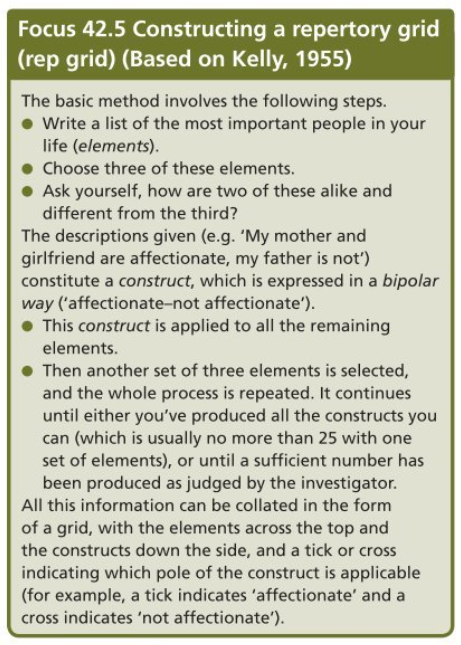
Kelly’s Personal Construct Theory
Emphasizes individual uniqueness through a phenomenological approach.
Uses repertory grid technique to help individuals identify personal constructs.
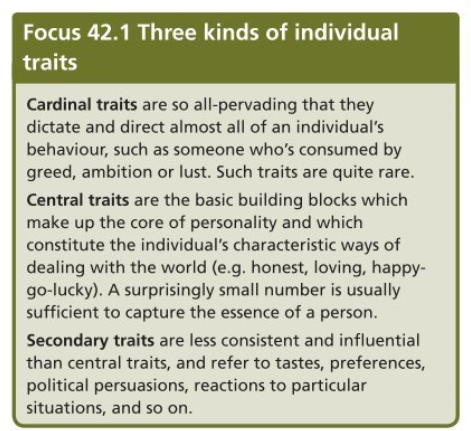
Allport’s Trait Theory (1961)
Common Traits: Basic adjustment modes for cultural or ethnic groups.
Individual Traits: Unique personal dispositions shaped by experiences.
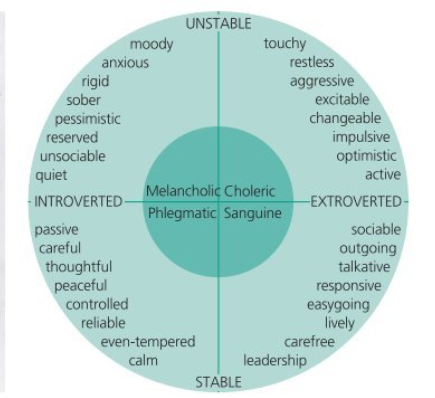
Eysenck’s Type Theory (1995)
Defines three personality dimensions:
Introversion-Extroversion (E)
Neuroticism (emotional stability) (N)
Psychoticism (P)
Eysenck's Hierarchical Model
Hierarchical levels of behaviour from specific responses to trait and type levels (e.g., introversion).
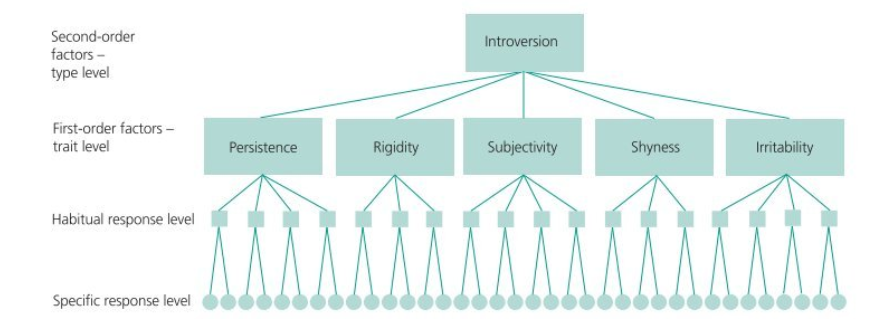
The Big Five Personality Factors (The 5 factor model)
Neuroticism: Emotional stability traits.
Extroversion: Sociable traits.
Openness to Experience: Creativity and intelligence.
Agreeableness: Trustworthiness and kindness.
Conscientiousness: Organization and reliability.
Undesirable traits contrasted with desirable qualities (Gross, 2020).
Definition of Intelligence
Intelligence involves learning from experience, problem-solving, and adapting to new situations.
Theories of Intelligence
One General Ability:
Charles Spearman: Concept of 'g' (general intelligence).
Central to our intelligence behaviour e.g. school work and problem solving.
L.L. Thurstone: Identified 7 clusters of primary mental abilities, suggesting a multifaceted view of intelligence.
Gardner’s Multiple Intelligences Theory
Intelligence is a collection of independent intelligence.
Each intelligence operates as a distinct system, interacting to achieve outcomes.
Gardner's Eight Intelligences
Linguistic: Reading and communication skills.
Logical-Mathematical: Numerical and scientific reasoning.
Spatial: Understanding and imagining spatial relationships.
Musical: Composing and appreciating music.
Bodily-Kinaesthetic: Physical manipulation skills.
Interpersonal: Understanding and interacting with others.
Intrapersonal: Self-reflection and understanding.
Naturalistic: Recognizing and categorizing natural phenomena.
Sternberg’s Triarchic Theory of Intelligence
Analytical Intelligence: Problem-solving skills, measurable by tests.
Creative Intelligence: Adaptability and novelty generation.
Practical Intelligence: Application in everyday tasks. Tested this for children by asking them to write captions for pictures and for adults to move furniture.
Emotional Intelligence
Defined as the ability to perceive, understand, manage, and use emotions.
Components include:
Perceiving: Recognizing emotions in others.
Understanding: Predicting emotion changes.
Managing: Expressing emotions appropriately.
Using: Facilitating adaptive thinking.
Assessing Intelligence
A metaphorical exam scenario highlighting the idea of uniform testing fairness.
Not everyone can showcase their intelligence in a test environment.
Understanding Abnormalities
Definition: Abnormality refers to behaviours that deviate from typical norms.
Need to differentiate between desirable and undesirable abnormal behaviours.
Types of Norms
Developmental norms- milestones. Medical form to track development/ progress. Help to identify development.
Societal norms- normal in society and cultures
Contextual norms- depending in the context that it is in.
How these apply to Speech and Language Therapy?
Consider socio-cultural factors in their language and behaviour- suitable to their upbringing.
Milestones are useful as a guide to know when to provide early intervention.
Different speech sound productions in different cultures and languages.
Neurodiversity and LD
Bilingualism.
Assessments- can use formal assessments in informal ways- appropriate for neuro-diversity and LD.
Classification of Abnormality
DSM-5 (Diagnostic and statistical manual of mental disorders): Criteria for clinically significant behavioural patterns linked to distress. Diagnostic criteria.
ICD-11 (International classification of diseases): Reflects significant disturbances in cognition or behaviour, impairing functioning. Guidelines are more descriptive. Widely used in medical practice.
Problems with Classification of abnormailty
Key Study: Rosenhan's 'On Being Sane in Insane Places'.
Eight pseudo-patients misdiagnosed with schizophrenia after feigning auditory hallucinations.
Showed challenges in distinguishing between normal and abnormal behaviours in clinical settings.
Influences on Psychological Disorders
Social-Cultural Influences: Roles, expectations, norms.
Psychological Influences: Stress, trauma, learned helplessness.
Biological Influences: Genetics, brain structure.
Psychopathology: Anxiety Disorders
Anxiety defined as adaptive but becomes abnormal when disproportionate.
Includes: Generalized Anxiety Disorder, Panic Disorder, and Phobias.
Psychopathology: Depressive Disorders
Monoamine Hypothesis: Links depression to neurotransmitter depletion (Medical)
Attributional Theory: Focuses on negative thought patterns contributing to depression. (Cognitive)
DSM-5 criteria for diagnosing depressive disorders.
Attributional Theory of Depression
DAS- Depressed attributional style
Locus- cause is internal or external
Stability- cause is stable or unstable
Global or specific- cause relates to the ‘whole’ person or some particular feature or characteristic.
Doesn’t necessarily reflect a resilient person.
Psychopathology: Bipolar Disorders
Characterized by mood extremes: depression and mania.
Potential for creativity during milder mania, but higher dysfunction overall.
Psychopathology: Schizophrenia (split- mind. Not split personality)
Psychotic disorder with symptoms of irrationality and distorted perceptions.
Symptoms categorized as positive (presence of abnormal behaviour) or negative (absence of normal behaviour).
Symptoms of Schizophrenia
Includes disturbed perceptions, disorganized speech, inappropriate emotions, etc.
Underlying factors include dopamine dysregulation and genetic components.
Symptoms are positive (behaving inappropriately)- Not seeing something that is normally there.
Symptoms are negative (appropriate behaviours are absent)- Taking something that isn’t normally there.